
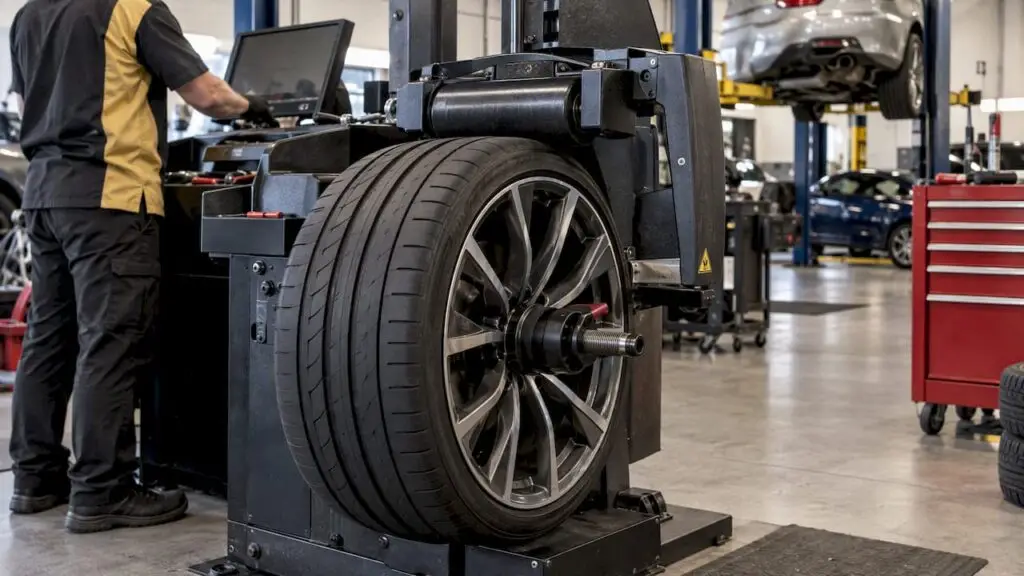
A car that shakes at highway speed almost always has something rotating slightly out of true: a tire and wheel assembly that is out of balance, out of round or stiff in one spot, or a worn part that lets that motion through. Tires and wheels are the first suspect. If balancing does not cure it, the next steps are road force balancing, then wheel bearings, axles, bushings and the driveline. At Alternative European & Domestic, we work through that order so you pay for the fix, not for guesses.
TL;DR
- Vibration that appears at a set speed range (often 60 to 75 mph) and fades above or below it usually points to a tire and wheel assembly.
- Steering wheel shake suggests the front axle. Vibration in the seat or floor suggests the rear axle or driveline.
- Standard spin balancing corrects weight distribution only. Road force balancing also checks how stiff and round the tire is under load, which matters on low-profile tires.
- A vibration that begins after new tires is a reason to go back for a recheck, not to live with it.
- Stop driving and arrange a tow if the shake is violent, comes with a grinding noise, a wobble, or a bulge in a tire.
Table of Contents
- Why vibration shows up at highway speed
- Where you feel it tells you where to look
- The most common cause: tire and wheel balance
- What road force balancing is and when it matters
- Vibration after new tires
- Other causes when tires are ruled out
- How a shop diagnoses it, step by step
- Can you keep driving?
- Why a European or performance car needs a careful approach
- What to do before you book
- How we can help
- Preventing the next vibration
- FAQ
- Sources
Why vibration shows up at highway speed
Every rotating part has a speed at which a small error becomes something you feel. A tire and wheel assembly turns about 13 times per second at 70 mph on a typical passenger tire. Any heavy spot, stiff spot or out-of-round area is pushed into the suspension 13 times per second, and when that rate matches the natural frequency of the suspension or steering system, the shake gets worse.
That is why many drivers report the same pattern: smooth at 50, rough from 62 to 72, smoother again at 80. The vibration did not go away. The frequency moved past the sensitive range.
The research literature describes this plainly. An SAE technical paper on steering wheel vibration studied shimmy and shake excited by tire and wheel imbalance and by tire non-uniformity, and looked at how inflation pressure changes the result. In other words, mass, stiffness and pressure all play a part.
Where you feel it tells you where to look
Before any part is replaced, a technician wants to know where the vibration is felt. This one observation narrows the list quickly.
| What you feel | Most likely area | Common causes |
|---|---|---|
| Steering wheel shakes | Front axle | Front tire imbalance, bent wheel, tire out of round, worn tie rod or control arm bushing |
| Seat or floor hums or shakes | Rear axle or driveline | Rear tire imbalance, driveshaft or center support bearing, worn rear bushings |
| Whole car shimmies at a narrow speed range | Any axle | Tire and wheel mismatch, separated belt in a tire |
| Vibration that changes when you steer or change lanes | Wheel bearing or CV axle | Worn bearing, damaged outer CV joint |
| Shake only when braking | Brakes | Warped or unevenly worn rotors (see our brake pulsation guide) |
A useful note for your service advisor: write down the speed range where it starts and stops, whether it is in the wheel or the seat, and whether it changes under acceleration, coasting or braking. Those three details save diagnostic time.
The most common cause: tire and wheel balance
When a tire is mounted, a small weight is added to the wheel to offset heavy spots. Those weights can fall off after a pothole, a curb strike or a tire rotation done carelessly. Tires also wear unevenly, and a tire with a flat spot or cupped tread will vibrate even with correct weights.
The fix for a simple imbalance is a spin balance, which is quick and routine. The catch is that spin balancing only corrects mass distribution. If the problem is not mass, the car leaves the shop still shaking.
What road force balancing is and when it matters
Road force balancing is a balancing procedure that presses a roller against the tire while it spins, simulating the load of the road. Instead of only measuring weight distribution, it measures how the tire’s stiffness changes as it rolls, known as radial force variation, along with runout of the tire and the wheel. Tire uniformity testing has its own industry standard: SAE publishes Recommended Practice J332 for machines that measure tire uniformity, noting that tires help excite vibration in a vehicle.
The difference in practice:
| Standard spin balance | Road force balance | |
|---|---|---|
| Measures | Weight distribution | Weight distribution plus stiffness variation and runout under load |
| Finds | Heavy spots | Heavy spots, stiff spots, out-of-round tires and wheels |
| Typical use | Routine tire installs and rotations | Persistent vibration, low-profile tires, performance and luxury cars |
| Can fix | Simple imbalance | Imbalance plus tire-to-wheel mismatch through repositioning the tire on the wheel |
The repositioning step is often called match mounting. The high point of the tire is lined up with the low point of the wheel so the two errors partly cancel instead of adding together. When those tolerances stack up instead, you get a vibration that standard balancing cannot remove. Tire retailers and engineers describe this the same way, and it is a common reason a freshly balanced set still shakes.
High-performance and luxury cars are more sensitive to this. Wide, low-profile tires on large wheels have little sidewall to absorb small variations, and the suspension is tuned to transmit road feel. A tire that would be fine on a base sedan can be noticeable on a sport sedan.
Vibration after new tires
This is one of the most frustrating versions, because you just spent money to fix a ride. Typical reasons it happens:
- Imbalance or a missed weight. A weight was placed wrong or the wheel was not cleaned before mounting.
- Stacked tolerances. The tire and wheel are each within spec, but their high spots line up.
- A tire with a uniformity defect. Rare, but it happens. Road force measurement exposes it, and the tire may need replacement under its manufacturer’s terms.
- A wheel that is not centered on the hub. Aftermarket wheels with the wrong center bore, or missing hub-centric rings, can mimic a severe imbalance even when the assembly is perfectly balanced. Lug nuts tightened unevenly cause the same thing.
- The real problem was never the tires. New tires can reveal a worn bearing, bushing or axle that the old, noisy tires were hiding.
If the vibration shows up within the first few hundred miles, go back to the shop that mounted them first. A reputable installer will recheck balance, and a road force check is a reasonable request.
Other causes when tires are ruled out
Bent or damaged wheels
Dallas drivers know the potholes and construction patches on stretches of I-35E, the Dallas North Tollway and Central Expressway. A strike that leaves no visible mark can still bend a rim lip or damage a tire’s internal belts. A wheel with excess runout cannot be balanced out. Some can be straightened, others need replacement.
Worn wheel bearings
A worn bearing usually adds a hum or growl that rises with speed and changes when you load the car through a lane change. Vibration comes later, as play develops. See our guide to diagnosing wheel bearing noise on European and performance cars.
CV axles and joints
A damaged inner CV joint can cause a shudder under acceleration, and a worn outer joint typically clicks in turns. If you hear clicking, read what CV axle noise means.
Suspension bushings and control arms
Worn bushings allow the wheel to move out of its intended position, which turns a small imbalance into a big shake. They also cause clunks and wandering. Our article on control arm bushing symptoms explains when it is safe to drive and when to tow, and the suspension clunk guide covers the shop tests we use for noises over bumps.
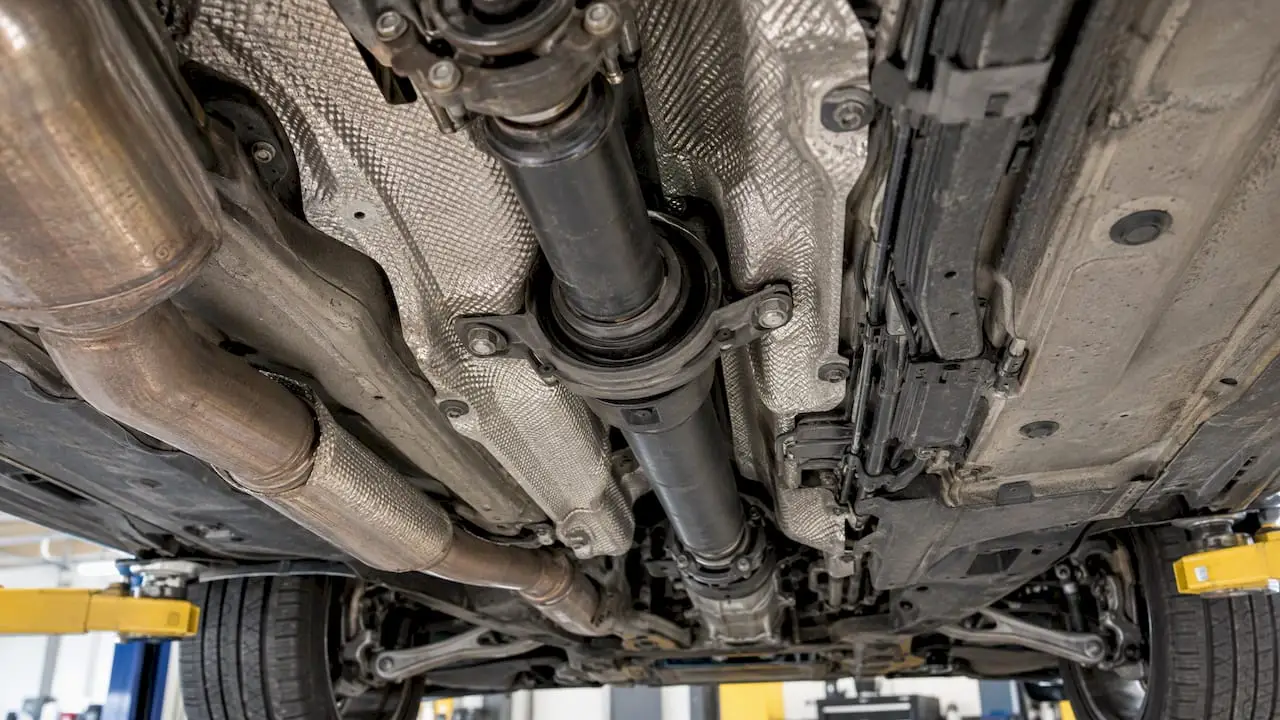
Driveshaft and center support bearing
Rear-wheel-drive and all-wheel-drive cars have a driveshaft. A worn flex disc, U-joint or center support bearing causes a vibration felt in the floor and seat that often varies with throttle. If a repair does not hold, the shaft may need to be reindexed during reassembly; we cover this in our center support bearing article. On all-wheel-drive cars, uneven tire wear between axles can also load the drivetrain, which is one reason we recommend regular rotation on European AWD cars.
Engine and transmission mounts
A failed mount lets normal engine vibration reach the cabin. It tends to show up at idle and under load more than at one steady speed, but it can add to a highway complaint. See our notes on engine mount failure.
A separated tire belt or bulge
This is a safety issue, not a comfort one. A tire with a bulge or a separated belt can fail without warning at speed.

How a shop diagnoses it, step by step
A methodical diagnosis follows the same logic whether the car is a German sedan, a domestic truck or a track-day coupe.
- Interview and road test. Note the speed range, where it is felt, and whether braking, throttle or steering changes it.
- Check tire pressures. Set them to the manufacturer’s specification, which is on the door jamb placard. Incorrect pressure alone can change how a car vibrates, and the SAE paper above treats inflation pressure as one of the variables.
- Inspect tires and wheels. Look for bulges, flat spots, cupping, missing weights, bent rim lips and debris or ice-melt residue inside the wheel.
- Check wheel fitment. Confirm correct lug torque and, on aftermarket wheels, correct hub-centric rings.
- Measure balance and runout. This is where a road force check separates tire stiffness variation from simple imbalance.
- Inspect suspension and driveline. Test for play in bearings, ball joints, tie rods, bushings, axles and mounts, with the car lifted and under load.
- Retest on the road. Confirm the vibration is gone at the speed where it appeared.
Skipping step 7 is how repeat visits happen. A vibration that was mild at 60 mph can hide a second, separate cause at 75.
Can you keep driving?
Some vibration can wait a few days for an appointment. Some cannot.
Book soon, but you can usually drive carefully:
- A mild shimmy in a narrow speed range that has been stable
- Steering wheel shake after a recent tire change or rotation
- A slight hum with no change in steering feel
Stop driving and consider towing:
- A violent shake or wobble that gets worse quickly
- A visible bulge or cord showing on a tire
- Grinding, loud rumbling or a burning smell from a wheel, which can mean a failing bearing
- A clunk with loose or vague steering, which can mean a failed suspension or steering component
- A vibration with a warning light, loss of power or a flashing check engine light
A failing wheel bearing or damaged tire can let go at speed. If you are not sure, a tow costs far less than a crash. Do not try to fix suspension, wheel or driveline parts at the roadside or in the driveway without proper lifting equipment and torque specifications. These are safety-critical parts, and a wrong torque or a re-used fastener can create a worse problem.
Why a European or performance car needs a careful approach
A few reasons the same symptom can take a different path on these vehicles:
- Run-flat and low-profile tires are stiffer and more sensitive to uniformity problems.
- Staggered wheel setups limit rotation, so uneven wear shows up sooner.
- Hub-centric wheel designs mean a wrong spacer or adapter produces vibration that balancing cannot fix.
- Complex driveline layouts (transfer cases, center support bearings, multiple CV axles) add places for vibration to originate. Our notes on BMW transfer case service and differential fluid intervals show how fluid and wear on those parts relate to drivetrain feel.
- Air suspension on some Mercedes and Audi models can create ride complaints that resemble tire problems; see our piece on AIRMATIC diagnosis order.
For a specific make and model, treat any claim about known issues with caution. Manufacturers sometimes publish technical service bulletins for vibration complaints, and a shop should check for them with your VIN before replacing parts.
What to do before you book
A few checks you can do safely:
- Check tire pressure when the tires are cold, and compare with the door jamb placard.
- Look at the tires for bulges, uneven wear or missing wheel weights.
- Note the speed range and feel of the vibration.
- Mention any recent tire work, pothole strike, curb contact or wheel change.
- Tell the advisor if the car has aftermarket wheels, spacers or lowered suspension.
Then let a technician confirm the cause. A shake has many possible origins, and replacing parts on a guess often leaves the vibration in place.
How we can help
Alternative European & Domestic is a Dallas-area shop that serves European, domestic and high-performance vehicles, including drivers in Oak Lawn, Uptown and nearby neighborhoods. Our ASE-certified technicians start with the symptom, check tires and wheels, then inspect the suspension, axles and driveline before recommending any repair. We explain what we find and why, so you can decide with the facts.
Our maintenance service covers regular inspections and rotations that help catch uneven wear early, and our full list of services includes shocks and struts, tires and electrical diagnostics. Qualifying repairs are covered by our 24-month/24,000-mile warranty, subject to applicable terms.
If your car shakes on the highway, schedule an appointment for a diagnostic evaluation.
Preventing the next vibration
- Rotate tires on the interval your manufacturer specifies, and balance them whenever you remount or repair a tire.
- Keep pressures correct, especially when temperatures swing, as they do in North Texas.
- Have alignment checked after hitting a curb or large pothole, or after suspension work.
- Replace worn bushings, bearings and mounts before they damage tires.
- Ask for a road force check when a car on low-profile tires keeps shaking after a normal balance.
FAQ
Why does my car shake at 70 mph but not at lower speeds?
Most often it is a tire and wheel assembly that is out of balance or out of round. At a certain speed its rotation rate matches a natural frequency of the suspension or steering, so the shake peaks there. It may fade at higher speeds, but the cause remains and can wear parts.
What is road force balancing?
It is a balancing method that loads the tire with a roller while it spins, to measure stiffness variation and runout as well as weight distribution. Technicians can then reposition the tire on the wheel to line up high and low points. It is most useful when a normal balance did not solve the vibration.
Is road force balancing worth it over regular balancing?
For most routine tire installs on ordinary tires, a standard balance is enough. Road force balancing is worth it on low-profile or performance tires, on cars sensitive to vibration, and whenever a vibration persists after a correct standard balance.
Why does my car vibrate after getting new tires?
Common reasons are a missed or misplaced balance weight, tire and wheel tolerances stacking up, an off-center wheel fit, or an older worn part that new tires exposed. Return to the installer promptly for a recheck, and ask for a road force measurement if the standard balance does not fix it.
Is it safe to drive with a vibrating steering wheel?
A mild, stable shimmy can usually be driven to a shop at moderate speed. Stop and call for a tow if the shake is severe, you see a tire bulge, you hear grinding, or steering feels loose.
Sources
- SAE 2005-01-2317: Tire mass imbalance, non-uniformity and inflation pressure effects on steering wheel vibration
- SAE J332: Testing machines for measuring the uniformity of passenger car and light truck tires