
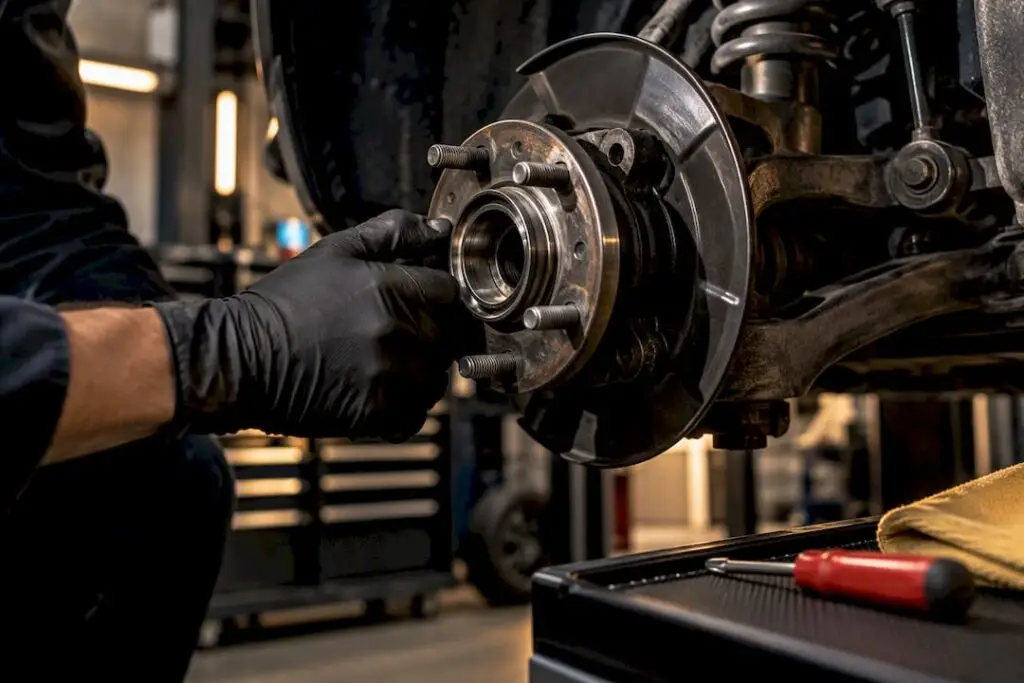
A humming or growling sound that gets louder as your speed climbs is one of the clearest signs of a failing wheel bearing, especially if it shifts pitch when you turn. If the noise is a steady hum, plan on scheduling service within the week. If you feel grinding, clunking, or looseness in the steering, treat it as urgent and get the car inspected within a day or two. If you notice a wheel wobbling, a sudden loud bang, or a burning smell, stop driving and call for a tow.
TL;DR:
- A humming or growling noise that increases with speed and changes pitch when turning indicates a developing wheel bearing issue, often requiring inspection within a few days.
- Temperature and weather conditions, such as cold mornings or wet winter roads, can accelerate bearing deterioration, making early symptoms worse faster.
- Identification at home involves sway tests, wheel wiggle, spin checks, and using a stethoscope, with front bearings easier to localize than rear ones.
- Short-term driving is possible with a mild hum, but any loud noise, play, or vibration requires immediate inspection and avoiding highway speeds until repaired.
- Typical replacement costs range from about $150 to over $500 per wheel, depending on vehicle type and bearing setup, with precise diagnosis before repair being crucial to avoid unnecessary expenses.
Table of Contents
- What Wheel Bearing Noise Actually Sounds Like
- What Causes Wheel Bearing Noise and How It Gets Worse
- How to Tell Which Wheel Bearing Is Bad
- Can You Drive With Wheel Bearing Noise?
- Repair Options and What They Typically Cost
- Sounds That Mimic a Bad Wheel Bearing
- How Weather Affects Wheel Bearing Noise
- Does Bearing Noise Sound Different on FWD, RWD, and AWD Vehicles?
- When a Specialist Shop Makes the Difference
- Book a Wheel Bearing Diagnostic in Dallas
- Sources
- FAQ
What Wheel Bearing Noise Actually Sounds Like
A bad bearing rarely stays quiet. Most drivers describe it as a hum, growl, or roar that rises and falls with vehicle speed rather than engine RPM, which is the biggest clue separating it from other noises. As the bearing wears further, that hum can turn into a rhythmic click or a coarse grinding, especially under load.
Turning often changes the pitch. Weight shifts onto the bearing on the outside of the turn, so a noise that gets louder in a left turn usually points to the right front or right rear bearing, and vice versa. This shift happens because wheel bearings under load tend to growl louder as speed and cornering force increase, which is the mechanical reason the sound seems to “move” with your steering.
Before assuming the worst, rule out a few easy suspects:
- Does the noise change on rough pavement but disappear on smooth asphalt? That points to tires, not a bearing.
- Does it fade when you let off the gas but the car keeps coasting? Bearings usually don’t care about throttle position.
- Have your tires been rotated recently? If a noise moved to a new spot after rotation, the tire itself is likely the source, not the bearing.
Pro Tip: Roll down your windows and drive on an empty, smooth stretch of road at varying speeds. Bearing noise tends to hold steady with speed regardless of road texture, while tire noise usually gets louder specifically over coarse or grooved pavement.
What Causes Wheel Bearing Noise and How It Gets Worse
Every wheel bearing is a sealed set of steel balls or rollers riding in a lubricated race, designed to let the wheel spin freely while carrying the car’s weight. Modern vehicles mostly use one of two setups: a serviceable bearing pressed into a housing, or a sealed hub assembly that combines the bearing, hub, and often the ABS sensor ring into one unit.
Bearings fail for a handful of predictable reasons:
- Grease breakdown or seal failure, which lets lubricant escape and allows metal-on-metal contact.
- Water or road salt contamination, which corrodes the races and pits the rolling surfaces.
- Impact damage from potholes, curb strikes, or aggressive off-road use.
- Ordinary wear, since every bearing has a finite service life that shortens under heavy cornering or towing.
Most bearings last well beyond 100,000 miles under normal conditions, but that range shrinks significantly with contamination or impact events. The failure sequence is fairly predictable: a faint hum comes first, then it deepens into a growl, then you start feeling vibration through the seat or steering wheel, and finally the wheel develops physical play you can feel by hand.
Ignoring that progression carries real consequences. A worn bearing can damage the CV axle, warp the rotor, or destroy the ABS sensor ring it shares a housing with, and in severe cases the wheel can seize or separate entirely while you’re driving.
How to Tell Which Wheel Bearing Is Bad
Pinpointing the failing corner before you ever reach a shop saves diagnostic time and money. Here’s a sequence you can run safely at home or on a quiet stretch of road.
- Highway sway test. On an empty road at a safe, steady speed, gently drift the car left, then right, within your lane. A worn bearing under load usually growls louder on the side opposite the direction you’re steering toward, since that’s the side carrying the extra weight.
- Jack-and-wiggle test. With the car safely supported on jack stands and the wheel off the ground, grab the tire at the 12 and 6 o’clock positions and rock it in and out. Noticeable play, clunking, or looseness signals a worn bearing or hub.
- Spin test. Spin the raised wheel by hand and listen or feel for grinding, roughness, or resistance that shouldn’t be there.
- Stethoscope check. A mechanic’s stethoscope (or even a long screwdriver held to your ear) placed near the hub can isolate a grinding or growling sound to one specific wheel far more precisely than driving alone.
This kind of hands-on check is exactly what shop technicians do on a hoist before confirming a diagnosis: road test first, then a stethoscope and manual wheel-play check to confirm the exact corner. Front bearings tend to respond well to the sway test, while rear bearings are often trickier since the sound can seem to come from the middle of the cabin rather than one side.
Pro Tip: Never attempt the jack-and-wiggle test with the car supported only by a jack. Always use rated jack stands, and never crawl under a vehicle held up by a jack alone.
Can You Drive With Wheel Bearing Noise?
It depends entirely on how far the wear has progressed, and treating every stage the same way is a mistake in either direction.
- Steady hum, no play or vibration: Safe to drive short distances, but schedule a diagnostic within the week.
- Growling that’s grown louder, or you feel mild vibration in the seat or steering wheel: Get it inspected within a day or two. This stage often overlaps with early ABS warning lights, since many hubs share a sensor ring with the bearing.
- Grinding, clunking, noticeable wheel play, or a wobble you can feel: Do not drive. Have the car towed or driven at very low speed directly to a shop.
While you’re waiting on service, avoid highway speeds, minimize sharp turns, and keep the load light. If the bearing fails outright while you’re driving, don’t panic. Ease off the throttle, steer straight, and coast to a safe stop on the shoulder. If the wheel locks up or you feel severe vibration, call for a tow rather than attempting to drive any farther.
Repair Options and What They Typically Cost
Most modern front-wheel-drive and crossover vehicles use a sealed hub assembly, where the bearing, hub, and ABS sensor ring come as one bolt-on unit. Older or rear-wheel-drive platforms sometimes use a separate, press-in bearing that requires a hydraulic press and more labor time to remove and install correctly.
Several factors drive the final bill:
- Hub assembly vs. press-in bearing. Bolt-on hub units cost more for parts but less in labor; press-in bearings are usually the reverse.
- Front vs. rear. Rear bearings on some vehicles require more disassembly, which adds labor hours.
- ABS and sensor integration. If the ABS ring is built into the hub, replacing it correctly matters for stopping performance, not just noise.
- Vehicle complexity. European and high-performance platforms often use tighter tolerances and specialized hardware, which can add time to the job.
As a general guideline, wheel bearing replacement in the U.S. commonly falls between roughly $150 and $500 or more per wheel, depending on whether the vehicle needs a bolt-on hub or a pressed bearing. For a broader look at how these cost breakdowns typically play out, it helps to compare parts and labor separately before agreeing to any repair.
A proper diagnostic before repair is worth the cost. Misdiagnosing a bearing noise as a tire or CV joint issue means paying twice, once for the wrong part and again for the right one.
Sounds That Mimic a Bad Wheel Bearing
Several common problems produce noises that sound remarkably similar to a bearing, and telling them apart saves you from an unnecessary repair.
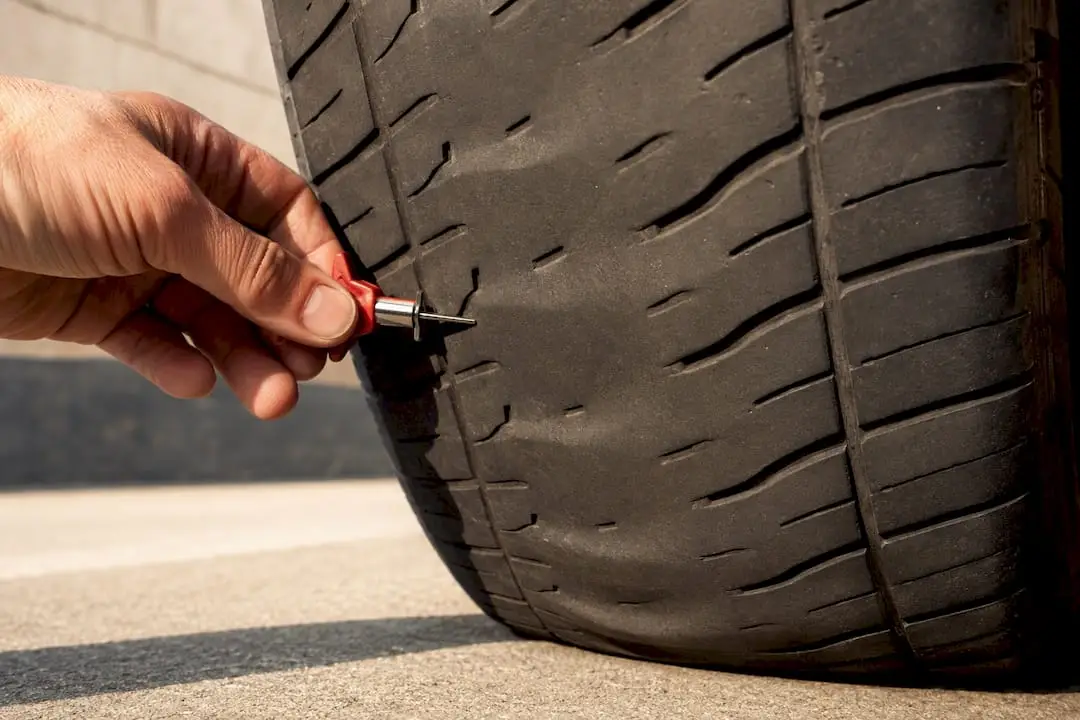
Uneven or cupped tire wear is the most frequent lookalike. Tire cupping, sometimes called tire scalloping, creates a rhythmic thumping or humming that changes with road surface rather than staying constant like a bearing. Rotating the tires is a quick test: if the noise follows the tire to its new position, the tire is the culprit, not the bearing.
Worn CV joints tend to click during turns rather than growl at speed, while a warped brake rotor or a loose dust shield often produces a rubbing or scraping sound tied to brake application rather than road speed. Loose suspension components can add a knocking noise over bumps that has nothing to do with the bearing at all.
Shops often check ABS sensors alongside a bearing replacement, and some replace bearings in pairs to avoid a follow-up comeback when the noise source was ambiguous to begin with.
How Weather Affects Wheel Bearing Noise
Temperature and moisture change how a failing bearing sounds and how fast it deteriorates. Cold mornings often make a worn bearing noticeably louder for the first few minutes of driving, since stiffened grease doesn’t cushion the rollers as well until it warms up. That’s why a noise that seems to fade after ten minutes on the road is still worth investigating, not ignoring.
Wet weather introduces a different risk. Water that gets past a cracked or damaged seal washes out lubricant and introduces corrosion, which accelerates wear far faster than dry-weather use. Roads treated with salt in winter compound this, since salt-laden water is more corrosive to bearing races and seals than plain rain.
Heavy rain and deep puddles matter too. Driving through standing water at speed can force moisture past a seal that’s already showing early wear, turning a minor issue into a faster failure. Owners in regions with hot summers and sudden downpours, which describes much of Texas, deal with both extremes: heat that thins out grease and breaks down seals over time, and intense rain that can force water in when a seal is already compromised. Dusty or gravel roads add another wear path, since fine grit works its way past seals in the same way water does.
None of this means weather alone destroys a bearing overnight. It does mean that a bearing already showing early symptoms tends to get worse faster in extreme heat, cold, or wet conditions, which is one more reason not to let a mild hum go unchecked through a full season of weather swings.
Does Bearing Noise Sound Different on FWD, RWD, and AWD Vehicles?
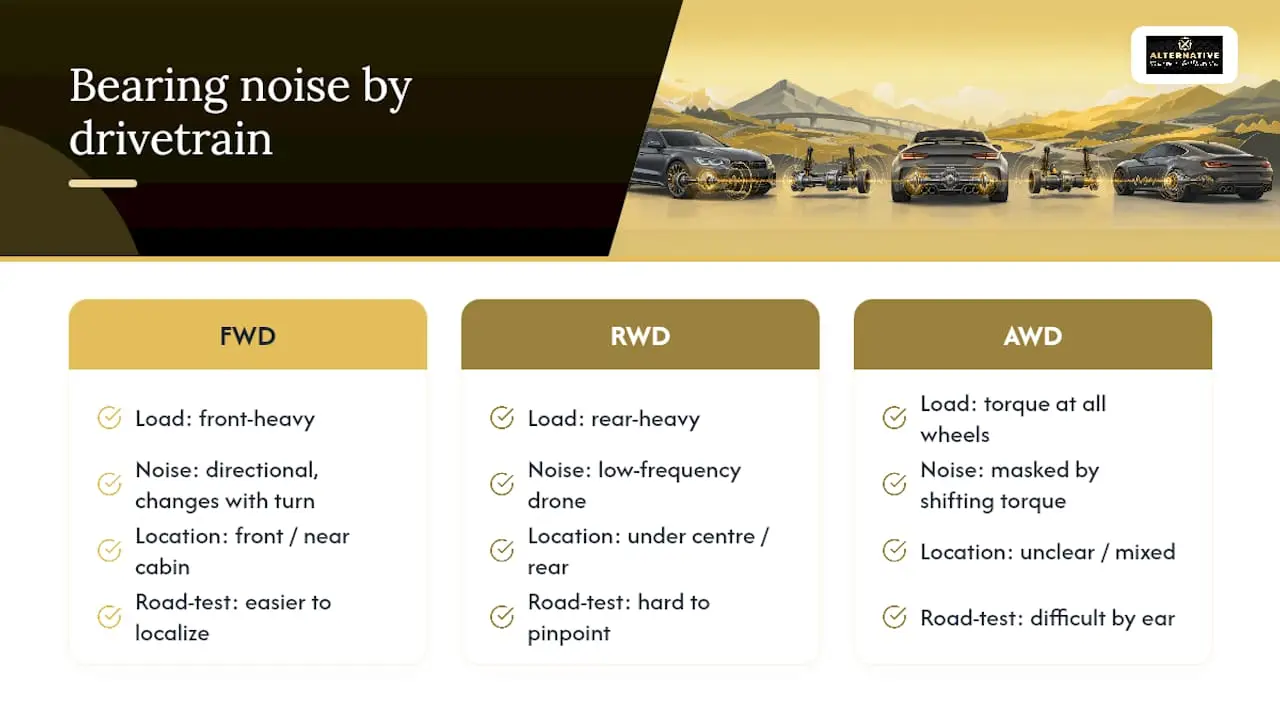
Drivetrain layout changes both where bearings sit and how their noise reaches your ears.
On front-wheel-drive cars, the front bearings work harder because they handle steering, driving force, and braking load all at once. Front bearing noise on these vehicles tends to be easier to localize with the sway test, since the sound is close to the cabin and changes clearly with turning direction.
Rear-wheel-drive vehicles put more of the driving load on the rear bearings, and rear bearing noise often sounds more like a low-frequency drone that seems to come from underneath the middle of the car rather than one clear side. This is part of why rear bearing diagnosis usually takes a shop’s stethoscope and hoist inspection rather than just a road test.
All-wheel-drive vehicles add complexity because every wheel bearing carries some driving torque, not just steering load. A failing bearing on an AWD vehicle can be harder to isolate by ear alone, since torque is constantly shifting between axles and can mask which corner is actually failing. This is one area where a dealer-level diagnostic scan and a hoist inspection genuinely outperform a driveway guess, particularly on all-wheel-drive European and performance platforms where the front and rear differentials complicate the sound path even further.
When a Specialist Shop Makes the Difference
Standard diagnostics work fine for most vehicles, but European and high-performance cars often blur the line between “just a bearing” and a bigger integration issue involving ABS calibration, hub preload, or tight factory tolerances. That’s where a shop built around dealer-level diagnostics earns its keep, catching the difference between a simple hub swap and a job that needs precise torque specs and sensor recalibration.
This shop focuses on transparent recommendations rather than upsells, which matters most when a noise could be one part or three. If you’re unsure what you’re hearing, a diagnostic appointment settles it quickly.
— Alternative European & Domestic
Book a Wheel Bearing Diagnostic in Dallas
This shop gives Dallas-area drivers something a quick-lube chain simply can’t: dealer-level diagnostic equipment paired with technicians who explain exactly what they find before any work begins.

Whether that hum turns out to be a worn hub assembly, an ABS sensor issue, or something else entirely, a full diagnostic process covers hoist inspection, road testing, and wheel-play checks so you’re not paying to guess. Bearing and hub replacement, alignment checks, and related suspension work are all handled with quality parts and clear, upfront communication about what the vehicle actually needs. Browse the full maintenance and diagnostic services page, or head to the complete services overview to see everything covered, from brakes to electrical work. If that noise has been nagging at you for more than a week, schedule a diagnostic appointment now and get a clear diagnosis instead of a guess.
Sources
- Wheel Bearing Symptoms and Replacement | O’Reilly Auto Parts
- Wheel bearing replacement cost (2026) | WhatItActuallyCosts
FAQ
What Does a Wheel Bearing Sound Like When It’s Going Bad?
A failing wheel bearing usually produces a hum, growl, or roar that gets louder as your speed increases, often shifting pitch when you turn left or right. As wear worsens, that hum can progress into a coarser grinding or clicking sound, which is a sign the issue has moved past the early stage.
Is It Safe to Drive With Wheel Bearing Noise?
A steady, mild hum with no play or vibration is generally safe for short trips if you schedule service within the week. Grinding, clunking, or noticeable wheel play means you should stop driving and get the vehicle inspected right away, since continued driving on a badly worn bearing risks CV axle or ABS sensor damage and, in extreme cases, wheel seizure.
How Expensive Is It to Replace a Wheel Bearing?
Costs vary by vehicle and repair type, but wheel bearing replacement in the U.S. commonly runs from around $150 to $500 or more per wheel, depending on whether the car uses a bolt-on hub assembly or a press-in bearing. The business does not publish flat pricing online, so the most accurate figure comes from a diagnostic appointment where the technician confirms the exact parts needed.
How Can I Tell Which Wheel Bearing Is Bad?
The highway sway test, where you gently drift the car left and right at a safe speed, often reveals which side growls louder under load. A jack-and-wiggle test with the wheel raised and a stethoscope check at the hub, similar to what technicians do during a hoist inspection, confirms the exact corner before any repair.
Can Bad Tires Cause the Same Noise as a Bad Wheel Bearing?
Yes, tire cupping or uneven wear can produce a rhythmic hum that sounds similar to a bearing, especially at highway speeds. The simplest way to tell them apart is a tire rotation: if the noise moves with the tire to its new position, the tire is the source, not the bearing.