
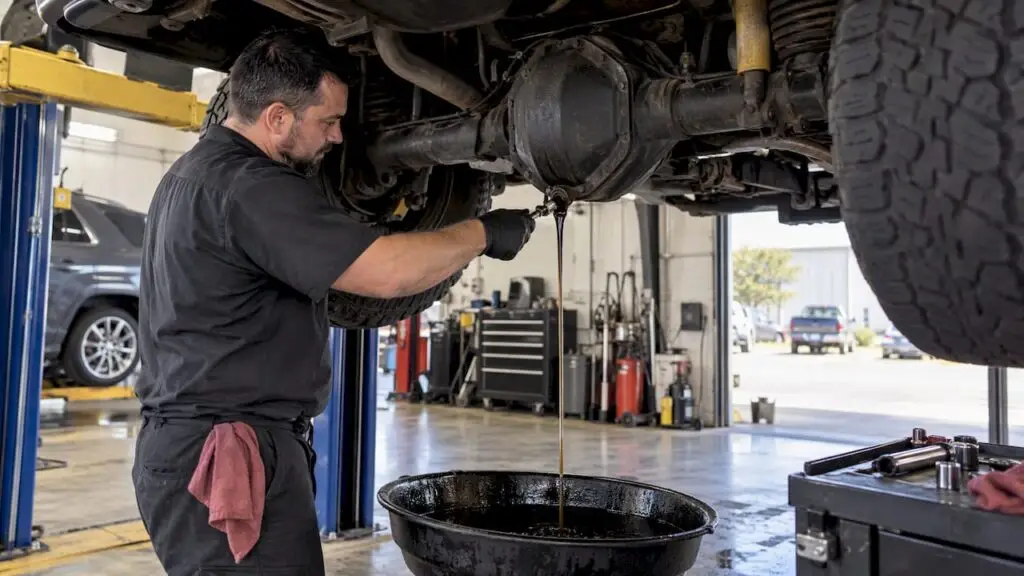
Most vehicles need a differential fluid change every 30,000 to 60,000 miles, with towing, off-road use, or heavy loads pushing that down toward the lower end. If your mileage is approaching that range, check your owner’s manual and inspect the fluid for color and smell. Metal particles, whining, or leaks mean the vehicle needs professional attention now, not at the next scheduled visit.
TL;DR:
- Differential fluid should typically be changed every 30,000 to 60,000 miles, with more frequent checks for vehicles under severe use such as towing or off-road driving.
- Visual and smell inspections can reveal fluid deterioration, metal debris, or burnt odor, indicating the need for immediate professional service regardless of mileage.
- Synthetic gear oils do not extend service intervals unless they match OEM specifications and are used with correct friction modifiers for limited-slip units.
- DIY repairs are feasible for basic drain-and-fill tasks if proper tools, knowledge, and safety measures are followed, but complex issues like bearing wear or seal leaks require professional diagnosis.
- Climate and driving environment influence maintenance schedules, with hotter, humid, or short-trip conditions accelerating fluid breakdown and necessitating more frequent inspections.
Table of Contents
- Typical mileage intervals and how driving changes them
- How to inspect differential fluid and know if it’s overdue
- What a professional differential service costs and includes
- Synthetic gear oil, OEM specs, and limited-slip units
- DIY versus professional differential service
- How Alternative European & Domestic approaches differential service
- How climate and temperature affect your service schedule
- Why manufacturer guidance beats mileage myths
- Getting your differential inspected the right way
- Sources
- FAQ
Typical mileage intervals and how driving changes them
The 30,000 to 60,000 mile range isn’t a vague guess. It reflects how differently gear oil breaks down depending on heat, load, and driving style, which is why general industry guidance lands on a range instead of one number. Some technical sources report intervals stretching toward 100,000 miles for normal driving in certain vehicles, but that figure depends heavily on the specific differential design and fluid type, so it isn’t something to assume applies to your car.
Manufacturers define “severe use” in fairly consistent terms: frequent towing, heavy hauling, off-road driving, extended idling, or lots of stop-and-go short trips that never let fluid reach full operating temperature. Under those conditions, the same guidance points toward 30,000 miles or sooner.
A few practical profiles help translate that into real decisions:
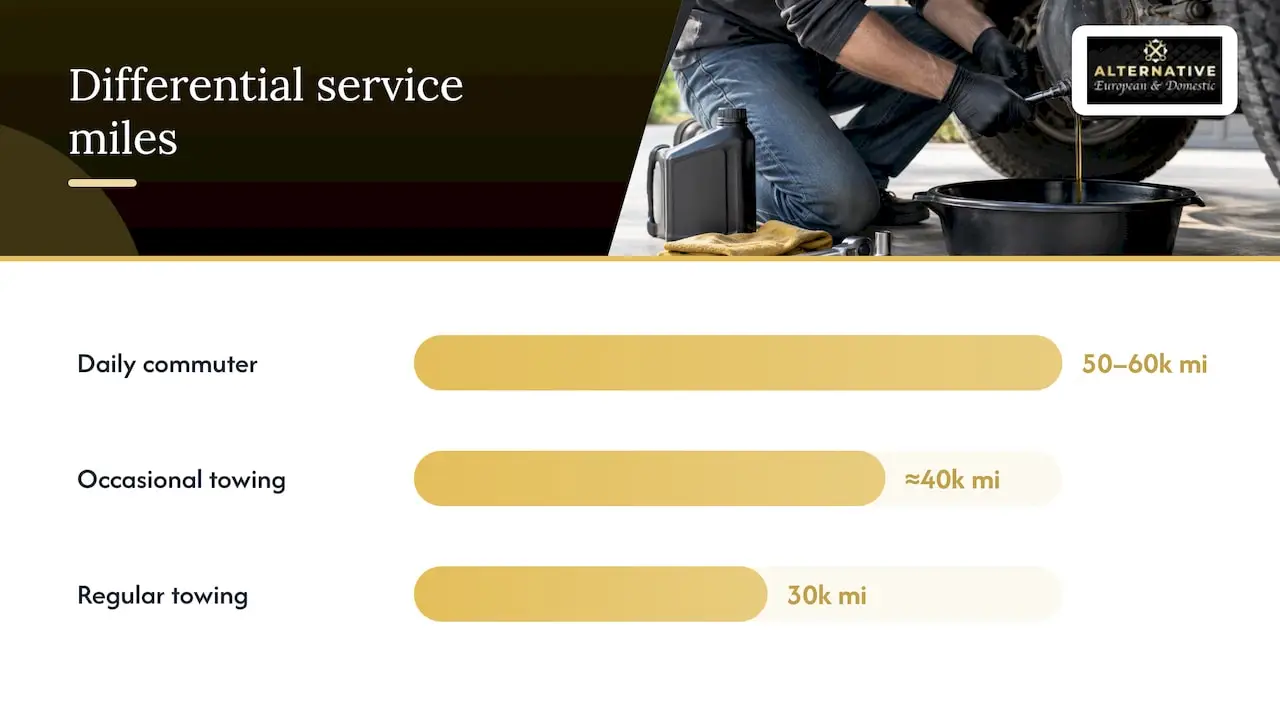
- Daily commuter, light loads: stick to the upper end of the manufacturer’s range, generally 50,000 to 60,000 miles.
- Occasional towing (boat, small trailer a few times a year): plan for the middle of the range, closer to 40,000 miles.
- Regular towing or heavy hauling: shift to the 30,000 mile mark or follow the manufacturer’s severe-use schedule exactly.
- Off-road or rock-crawling use: treat every serious outing as added wear and consider inspecting fluid more often than the interval itself specifies.
The owner’s manual is always the starting point. These profiles are meant to help you interpret that schedule when your driving doesn’t fit neatly into “normal” or “severe,” not to override it.
How to inspect differential fluid and know if it’s overdue
Checking differential fluid isn’t complicated, and doing it yourself can tell you a lot before you ever call a shop.
- Warm the vehicle briefly, then park on level ground and locate the fill plug on the differential housing.
- Remove the fill plug and dip a clean finger or small tool to pull a fluid sample.
- Check color and clarity. Healthy gear oil is typically amber to brown and translucent, not black, milky, or cloudy.
- Smell the sample. A sharp, burnt odor signals the fluid has broken down under heat and stress.
- Look for metal particles or a gritty texture between your fingers. Fine metal filings suggest normal wear; larger flakes suggest a developing problem.
A magnet run through a drain pan sample during an actual fluid change catches metal debris that a simple fill-plug check can miss. This matters because topping off low fluid never removes the metal particles already circulating inside the housing, and those particles keep grinding against gears and bearings every mile you drive.
Certain symptoms mean the differential needs attention well before any scheduled interval: whining or humming that changes with speed, grinding or clunking on turns, overheating after moderate driving, visible leaks around the housing or axle seals, or unusual play when you rock the vehicle in gear. When any of these show up, a shop should pull a drain sample for a closer look, check bearing play, and inspect seals rather than just topping off fluid and hoping the noise goes away.
Pro Tip: If your fluid sample looks dark but doesn’t smell burnt, it may just be old. Dark and burnt-smelling together is the combination that usually points to real wear.
What a professional differential service costs and includes
Shop pricing for a differential fluid change varies based on whether it’s the front or rear unit, whether the vehicle has a limited-slip differential requiring a friction modifier additive, and whether anything beyond the fluid itself needs attention. A straightforward drain-and-fill is usually a quick job, often under an hour according to one trade industry overview, but that time grows substantially if a technician finds a leaking seal, worn bearing, or pinion play that needs correcting.
A proper service generally includes:
- Draining the old fluid and inspecting the sample for color, smell, and debris.
- Running a magnet check through the drain pan to catch metal filings.
- Checking torque on the fill plug, drain plug, and any accessible fasteners.
- Replacing the crush washer or gasket if the design calls for one.
- Refilling with the correct fluid type and quantity to the manufacturer’s spec.
Extra repairs, seal replacement, bearing work, or pinion adjustment, add both labor time and parts cost, which is why a simple fluid change and a differential overhaul aren’t the same conversation even though they start with the same drain plug.
Synthetic gear oil, OEM specs, and limited-slip units
Synthetic gear oil holds up better under heat and resists breakdown longer than conventional oil, but it does not automatically extend your factory-specified change interval. Industry guidance is direct on this point: owners should prioritize the manufacturer’s maintenance schedule over assumptions about fluid chemistry.
A few things matter more than whether the fluid is synthetic:
- Matching the exact OEM viscosity grade and additive package, not just a general “gear oil” label.
- Confirming whether your differential is open, limited-slip, or locking, since limited-slip units typically require a specific friction modifier additive that standard gear oil lacks.
- Understanding that metal debris accumulates inside any differential over time regardless of fluid quality, which is why periodic replacement still matters even with premium synthetic fluid.
When in doubt, the owner’s manual or a dealer technical document is the final word on spec, not a general recommendation from a blog or forum.
DIY versus professional differential service
A competent DIYer with the right tools can often handle a basic drain-and-fill. Here’s what that actually takes:
- A jack and jack stands or a lift, since most differentials need the vehicle raised and supported safely.
- A drain pan and the correct tools to remove fill and drain plugs without stripping them.
- A torque wrench, because fill and drain plugs have specific torque values that protect against leaks and stripped threads.
- The exact gear oil type and quantity specified for your vehicle, including any friction modifier for limited-slip units.
- A plan for disposing of used fluid responsibly.
Some situations belong with a shop, no exceptions: metal shavings in the drained fluid, suspected bearing or pinion wear, a leaking seal that needs replacement, limited-slip service requiring specialized additives, or a vehicle with restricted underbody access. If you do take it to a shop, ask what the drain sample showed, whether they checked for play in the pinion or axle bearings, and what specifically justified any extra repair beyond the fluid change. Using the wrong fluid or skipping proper torque specs risks both mechanical damage and any applicable warranty coverage.
How Alternative European & Domestic approaches differential service
Our inspection process starts with a drain sample review, checking color, smell, and clarity before anything goes back in. A magnet check follows to catch metal filings a visual inspection alone would miss, and we measure play in axle components to catch early bearing wear before it becomes a bigger repair.
European and high-performance vehicles often show specific wear patterns tied to how they’re driven, and our maintenance plans are built around that reality rather than a generic schedule. We also offer fluid exchange services as part of broader drivetrain maintenance.
For your appointment, it helps to bring:
- Any service records showing your last differential fluid change and mileage.
- Notes on recent noises, leaks, or unusual handling.
- Your owner’s manual or a note of your vehicle’s severe-use driving pattern, if applicable.
How climate and temperature affect your service schedule
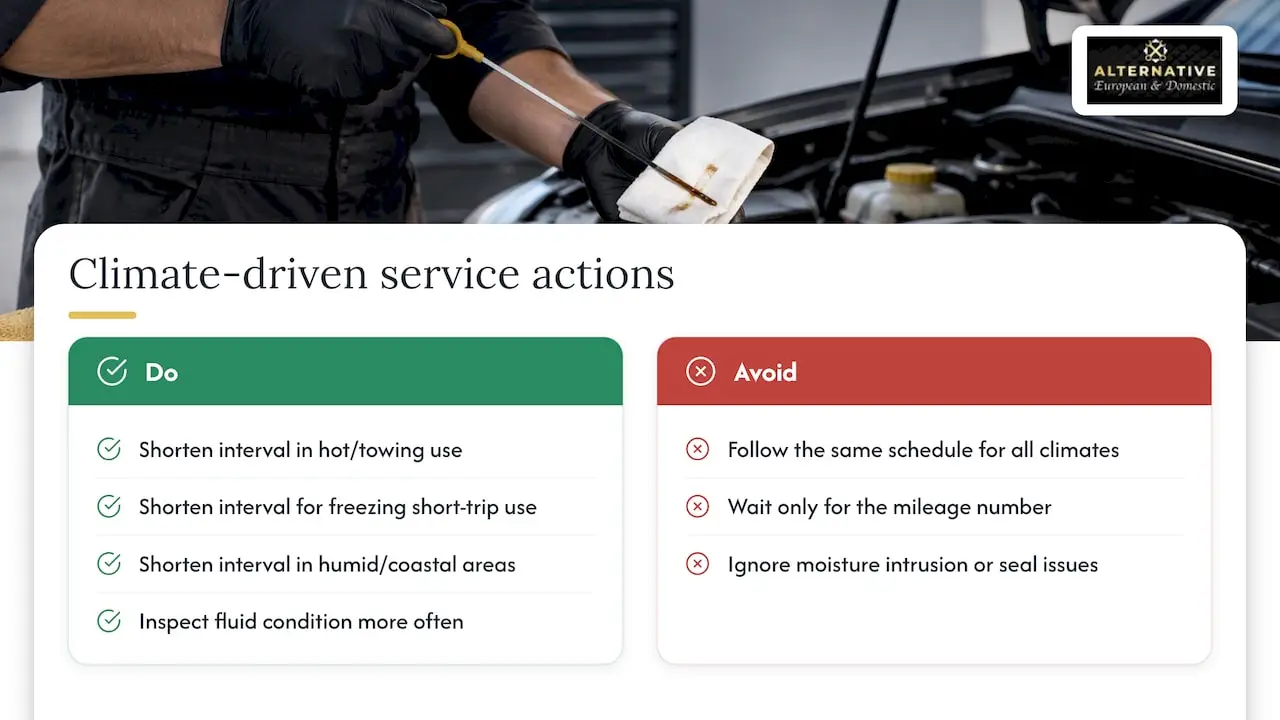
Extreme heat accelerates how quickly gear oil breaks down, since differentials already run hot under normal operation and high ambient temperatures push that further. Vehicles regularly driven in prolonged summer heat, especially while towing or hauling, tend to need closer attention to fluid condition even within a standard interval.
Cold climates present a different issue. Fluid thickens in low temperatures, and short trips in freezing weather may never let the differential reach a temperature where moisture and condensation fully evaporate out of the fluid. That trapped moisture can contribute to internal corrosion over time.
Humid or coastal environments add another layer, since moisture intrusion through seals or breather vents is more likely where humidity stays high year-round. None of this changes the basic interval math on its own, but it does mean an owner in a hot, dry climate towing a trailer regularly and an owner in a mild climate driving mostly short errands shouldn’t necessarily follow the same schedule. When climate conditions are extreme in either direction, lean toward the shorter end of the manufacturer’s recommended range and inspect fluid condition more often rather than waiting strictly for a mileage number.
Why manufacturer guidance beats mileage myths
The biggest mistake owners make with differential service is treating it like an afterthought behind oil changes and brake pads. A differential rarely announces problems early, it runs quietly until wear becomes expensive, which is exactly why mileage-based guidance matters more here than for most other maintenance items.
The conventional advice floating around online, pick a number and stick to it, misses the point. The manufacturer’s severe-use definition should drive your decision far more than any single mileage figure borrowed from a forum post. A tow-heavy truck and a mild-mannered sedan simply don’t belong on the same schedule, even if they rolled off the same factory line a few model years apart.
If you take one thing from all of this, prioritize the inspection over the interval. A fluid sample pulled at 40,000 miles that looks and smells fine tells you more than blindly changing fluid at a number pulled from a forum post. Trust the manufacturer’s baseline, adjust for how you actually drive, and let what you see and smell in the fluid settle any remaining doubt.
— Alternative European & Domestic
Getting your differential inspected the right way
If you’re not sure where your vehicle falls on that severe-use scale, or it’s been a while since anyone looked at the differential fluid, that uncertainty is exactly what a proper inspection resolves. This shop specializes in European, domestic, and high-performance vehicles and offers dealer-level diagnostics to accurately determine your drivetrain needs.
We build customized maintenance plans around how you actually drive, whether that’s daily commuting, regular towing, or weekend track days, rather than a one-size-fits-all mileage sticker. If a drain sample shows metal particles or a seal needs attention, we explain exactly what we found and why it matters before any work begins.
If your differential fluid is due, or you just want a straight answer on where your vehicle stands, schedule a maintenance appointment with our team.
Sources
- Differential fluid maintenance guidance — UTI blog
- Do You Need to Change Differential Fluid? — Engine Builder Magazine
FAQ
How much does it cost to replace diff fluid?
Cost depends on whether it’s a front or rear differential, whether your vehicle has a limited-slip unit requiring special additive, and whether any seals or bearings need attention. A shop can give you an accurate estimate once they’ve inspected your specific vehicle, since no single price applies across all makes and models.
What happens if I don’t change differential fluid?
Old fluid breaks down and loses its ability to protect gears and bearings, letting metal particles accumulate and accelerate wear. Left unchecked, this can lead to whining noises, grinding, and eventually bearing or gear damage that costs far more to repair than routine fluid service.
Is it ever too late to change differential fluid?
If metal shavings, grinding noise, or abnormal play are already present, a simple fluid change may not solve the underlying problem, and the differential should be inspected for bearing or gear wear first. Catching fluid breakdown early, following the 30,000 to 60,000 mile guidance, is always better than waiting for symptoms.
How many years does rear differential fluid last?
There’s no universal age-based limit since mileage and driving conditions matter more than calendar time, but a vehicle driven rarely can still go years without hitting the mileage interval. Even in that case, it’s worth inspecting fluid condition periodically rather than assuming low mileage means no wear.