
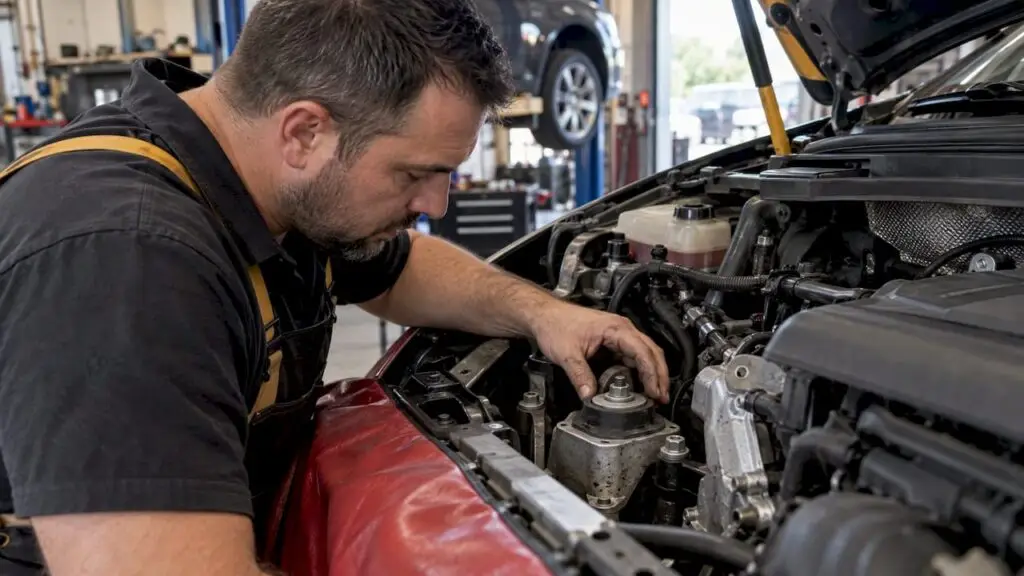
A failing engine mount drives up cabin vibration and raises the risk of secondary damage to hoses, wiring, and exhaust components nearby. If you hear clunking on acceleration, feel heavy shaking at idle, or see the engine shift noticeably when you rev it, limit your driving and get a professional diagnostic as soon as possible rather than waiting for the symptom to pass.
TL;DR:
- Because exhaust shields, wheels, axles, and transmission mounts can mimic mount failure, a shop should confirm the cause through inspection, load tests, and elimination checks.
- Mild idle vibration without clunking or visible engine movement may permit a careful drive to a shop; loud impacts, contact, or control changes require towing.
- Replacement commonly costs $400 to $1,000, with labor driving much of the bill; vehicle access, shop rates, and the number of mounts affect the total.
- When age weakens one mount, ask whether similarly worn mounts should be replaced during the same visit to avoid paying labor twice.
- Oil or coolant leaking onto mounts accelerates rubber breakdown, so fix leaks promptly and ask for mount checks during routine maintenance.
Table of Contents
- Symptoms: Observable Signs That Suggest a Mount Is Failing
- Common Causes That Make Mounts Fail Sooner
- How a Shop Diagnoses a Failing Engine Mount
- Urgency and Safety: When to Drive, Limit Driving, or Tow
- Repair Options and What Determines the Cost
- Lifespan Expectations and Prevention Tips
- How Alternative European & Domestic Approaches Diagnosis and Repairs
- Differences in Engine Mount Failure Symptoms Across Vehicle Makes and Models
- Types of Engine Mounts and How Failure Symptoms Vary by Type
- Steps to Temporarily Mitigate Engine Mount Failure Before Repair
- Warranty and Insurance Considerations for Engine Mount Repairs
- A Technician’s Perspective on Engine Mount Repairs
- Schedule an Inspection at Alternative European & Domestic
- FAQ
- Sources
Symptoms: Observable Signs That Suggest a Mount Is Failing
Engine mounts hold the engine and transmission steady while absorbing the twisting force the drivetrain produces every time you accelerate or brake. When rubber or hydraulic mounts weaken, that isolation breaks down, and you feel the engine’s movement directly through the chassis instead of it being absorbed.
The symptoms usually show up in a few predictable ways:
- Vibration at idle that you feel through the steering wheel, floorboard, or seat, often worse in gear than in park or neutral.
- Clunking, banging, or popping when you accelerate hard, decelerate suddenly, or shift gears.
- Visible engine movement when you rev the engine with the hood open, especially a noticeable lurch or sideways shift.
- Fluid-soaked or visibly cracked mounts, which you or a technician can sometimes spot during an oil change or inspection.
- Increased road noise and harshness that seems to come from the engine bay rather than the tires or suspension.
Mount symptoms get confused with other issues fairly often. A rattling exhaust heat shield, an unbalanced wheel, or a failing transmission mount can all produce similar vibration or clunking, which is exactly why a controlled inspection matters more than guessing from the driver’s seat.
Common Causes That Make Mounts Fail Sooner
Most mounts degrade gradually, but certain conditions shorten their service life considerably.
- Age and heat cycling. Rubber hardens and cracks after repeated heating and cooling, losing its ability to flex and absorb vibration.
- Fluid exposure. Oil or coolant leaks that drip onto a mount soften the rubber compound and accelerate breakdown; environmental stressors like heat and road salt have a similar effect on rubber components generally, according to tire and rubber safety guidance.
- Impact or collision damage. A hard pothole hit or a minor collision can bend a mounting bracket or tear a mount even when the rest of the vehicle looks fine.
- Poor installation or cheap parts. A mount installed incorrectly, or a low-quality aftermarket part that does not match factory specifications, can fail within a fraction of its expected service life.
Performance modifications that add torque or horsepower without upgrading supporting components also put extra strain on mounts that were never designed for the added load.
How a Shop Diagnoses a Failing Engine Mount
Diagnosing a mount problem correctly takes more than listening for a noise once. A proper inspection follows a sequence designed to confirm the mount is the actual cause before any part gets ordered.
- Visual inspection. A technician checks each mount for separated rubber, a cracked or broken bracket, and fluid contamination from nearby leaks.
- Controlled test drive. Reproducing the clunk or vibration under real acceleration, braking, and shifting conditions helps confirm which mount is involved and how severe the wear is.
- Static load tests. Rev-with-brake checks and engine-support pry tests measure how much the engine actually moves against the mount compared to normal tolerance, according to a stepwise mount diagnostic guide.
- Elimination checks. When symptoms are ambiguous, technicians also rule out driveshaft, axle, exhaust, or transmission mount issues, since CV axle wear and similar components can produce comparable noise and movement.
This sequence matters because misdiagnosis is one of the more expensive mistakes in auto repair. Replacing the wrong part because a symptom looked like a mount problem wastes money and leaves the actual issue unresolved, a point AAA’s guidance on auto repair on diagnostic accuracy makes directly.
Urgency and Safety: When to Drive, Limit Driving, or Tow
Not every worn mount is an emergency, but some symptoms mean you should stop driving and arrange a tow instead of continuing on your own.
Generally safe to drive carefully to a shop:
- Only mild vibration at idle, with no clunking and no visible engine shift when revved.
Stop driving and arrange a tow:
- Loud clunking or banging on every acceleration or gear change.
- Visible engine shift, hoses or wiring rubbing against the chassis, or exhaust components contacting the frame.
- Any sensation that the drivetrain is affecting steering or control.
Continuing to drive on a severely failed mount risks chafed wiring, torn hoses, exhaust damage, and added stress on CV joints and other drivetrain components that were never designed to absorb that extra movement.
Pro Tip: If you must move the vehicle short distances, keep speeds low, avoid hard acceleration, and skip the highway entirely until a technician has looked at it.
Repair Options and What Determines the Cost
Once a mount is confirmed as the problem, the repair itself is usually straightforward, though the decision tree has a few branches worth understanding.
- Single versus multiple mounts. Most vehicles have two to four engine and transmission mounts working together; if one has failed from age, technicians often recommend replacing mounts showing similar wear in the same visit to avoid a second round of labor.
- OEM versus aftermarket parts. OEM mounts typically match factory fit and durability specifications, while aftermarket options vary in quality, so the trade-off is worth discussing with your shop before you decide.
- Labor dominates the bill. The mount itself is a relatively simple, inexpensive part, but reaching it often means removing other components, dealing with rusted hardware, or working around limited access, which is why labor time, not the part price, usually explains most of the cost.
- Typical cost range. Total engine mount replacement commonly falls between $400 and $1,000, depending on the vehicle, the number of mounts involved, and shop labor rates.
Accurate diagnosis up front prevents paying for a mount replacement when the actual noise was coming from a CV axle or another nearby component. You can see how our diagnostic fee structure supports that first step before any repair is quoted.
Lifespan Expectations and Prevention Tips
Engine mounts are built to last years under normal conditions, but heat exposure, fluid leaks, and aggressive driving habits all shorten that window.
- Ask your shop to check mounts during routine maintenance visits, particularly if your vehicle has higher mileage or has been exposed to frequent hard acceleration.
- Fix fluid leaks promptly. Oil or coolant dripping onto a mount accelerates rubber breakdown far faster than age alone.
- Avoid repeated hard launches if you drive a performance vehicle, since the added torque stresses mounts beyond their typical design load.
- Replace corroded mounting hardware during other service work rather than reusing weakened bolts or brackets.
- Consider replacing adjacent mounts together when one fails from age, since it avoids paying for the same labor twice within a short period.
How Alternative European & Domestic Approaches Diagnosis and Repairs
Our diagnostic process includes visual inspection, a controlled test drive to reproduce the symptom, and static engine-support checks to assess engine movement. Before starting any work, we explain the findings and discuss repair options, including whether replacing additional mounts simultaneously may be beneficial.
Differences in Engine Mount Failure Symptoms Across Vehicle Makes and Models
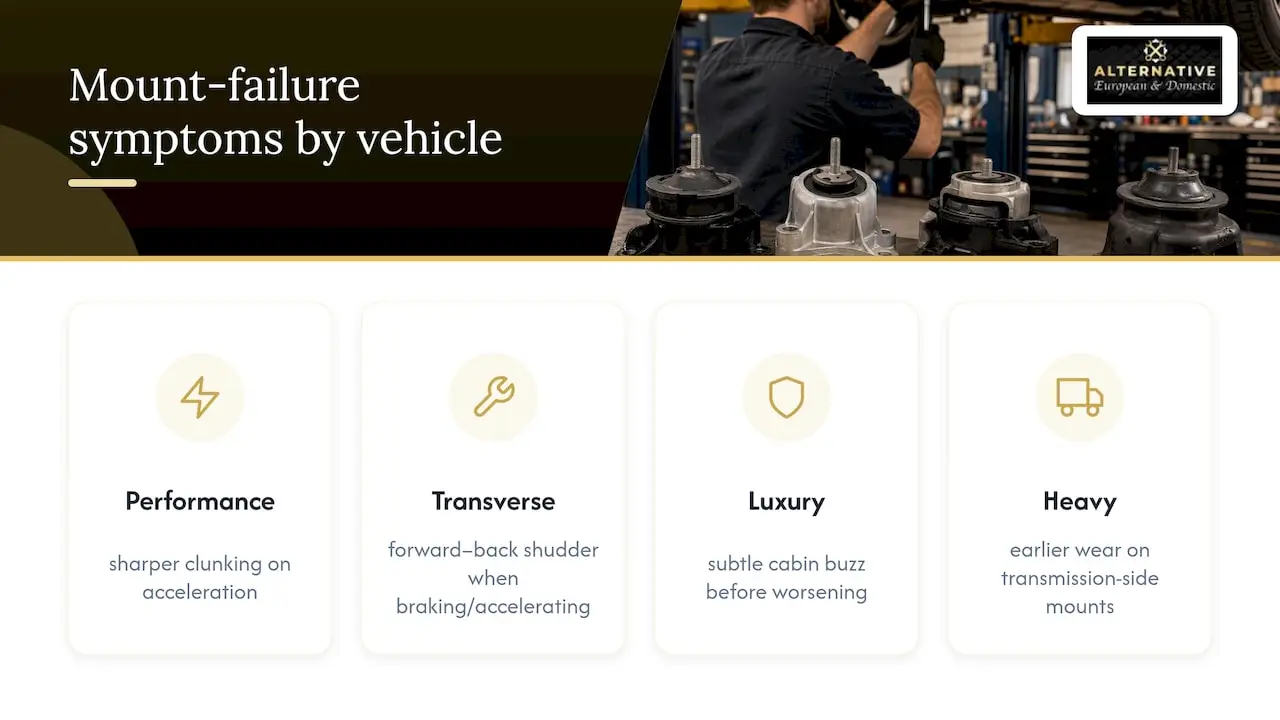
Mount symptoms are not identical across every vehicle. European performance cars and turbocharged engines tend to produce more torque at lower RPM, which can make mount wear show up as sharper, more immediate clunking during acceleration compared to a naturally aspirated domestic sedan. Vehicles with transverse-mounted engines, common in many front-wheel-drive domestic and European models, often rely on a torque strut or dogbone mount in addition to the main mounts, so a worn strut mount can produce a distinct forward-and-back shudder during braking and acceleration that differs from the side-to-side rock typical of a failing primary mount.
Luxury and performance vehicles frequently use hydraulic mounts designed to dampen vibration more aggressively than basic rubber mounts, so their failure symptoms can feel subtler at first, a slight increase in cabin buzz rather than an obvious clunk, before worsening noticeably. Heavier vehicles, including larger domestic trucks and SUVs, place more static load on their mounts, which can mean earlier wear on the mounts supporting the transmission side of the drivetrain.
Because these differences depend on engine layout, mount design, and typical duty cycle, a technician familiar with your specific vehicle type is better positioned to know which mount is most likely at fault and where to start testing first, rather than relying on symptoms alone.
Types of Engine Mounts and How Failure Symptoms Vary by Type
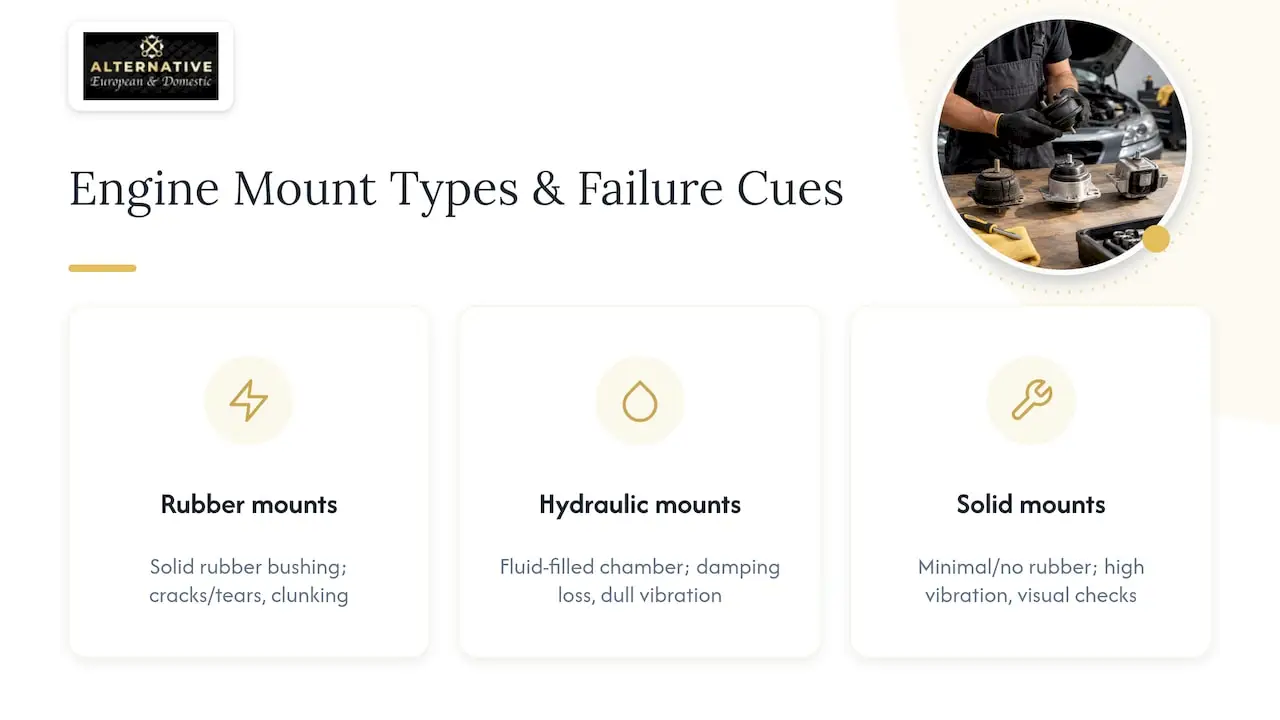
Most vehicles use one of three mount designs, and the type installed affects how failure actually feels to the driver.
Rubber mounts are the simplest and most common design, using a solid rubber bushing to absorb vibration. When they fail, the rubber typically cracks, tears, or separates from its metal backing, producing noticeable clunking and a rougher ride as the engine shifts more freely than it should.
Hydraulic mounts use a fluid-filled chamber inside the rubber housing to dampen vibration more effectively, which is why many performance and luxury vehicles use them. Failure often shows up as a loss of fluid damping rather than outright rubber tearing, so the symptom can start as a dull vibration increase before progressing to looser engine movement as the internal fluid leaks out or the chamber ruptures.
Solid mounts, sometimes used in racing or heavily modified applications, use minimal rubber or none at all. They transmit far more vibration to the cabin by design, so a failure is harder to detect by feel alone and often requires a visual check for cracked metal or broken welds rather than relying on a change in ride feel.
Knowing which type your vehicle uses helps a technician set expectations for what a failure will feel like and how early it is likely to be noticed.
Steps to Temporarily Mitigate Engine Mount Failure Before Repair
If you cannot get to a shop immediately, a few precautions reduce the risk of the problem worsening or causing secondary damage on the way there.
- Drive gently and briefly. Avoid hard acceleration, abrupt braking, and sharp turns that place extra strain on an already weakened mount.
- Stay off the highway. Lower speeds reduce engine torque demand and limit how much the engine can shift under load.
- Check for obvious contact points. Look under the hood for hoses, wiring, or the exhaust resting against the engine or frame, and reroute or secure anything you can safely reach.
- Avoid towing a trailer or hauling heavy loads until the mount is repaired, since added load increases the force the mount has to absorb.
- Schedule the inspection promptly rather than waiting for symptoms to worsen, since continued driving on a failing mount raises the chance of damaging the components around it.
These steps reduce risk but do not fix the underlying problem, so they should only buy you time until a professional inspection, not replace one.
Warranty and Insurance Considerations for Engine Mount Repairs
Shops commonly back replacement parts with a limited warranty covering both the part and the labor to install it, though the scope and duration vary by shop and by the parts used, so it is worth asking directly what is covered before authorizing the repair, a point AAA’s guide to auto parts pricing also emphasizes. If your vehicle is still under a manufacturer’s factory warranty, mount failure caused by a defect may be covered, but wear-and-tear failure from age typically is not, so checking your specific warranty terms before paying out of pocket is worthwhile.
Insurance coverage for mount repair depends on the cause. A mount damaged in a collision is typically covered the same way as other impact-related repairs, which is why a collision repair assessment should include a check of the mounts after any significant impact. Mount failure from normal age and wear is not an insurance matter, since standard auto policies do not cover maintenance-related breakdowns. Keeping records of when mounts were inspected or replaced can also help if a dispute ever arises over whether a failure was pre-existing or collision-related.
A Technician’s Perspective on Engine Mount Repairs
The owners who come out ahead are the ones who get a mount checked at the first sign of clunking instead of waiting for it to get worse. A short diagnostic visit, with a clear look at the actual failed part and a written estimate before any work starts, almost always costs less than the damage that comes from driving on a mount that has already let go.
— Alternative European & Domestic
Schedule an Inspection at Alternative European & Domestic
If you are hearing clunking, feeling heavy vibration, or noticing engine movement under the hood, we offer a diagnostic inspection that evaluates your mounts and surrounding components, with a full explanation of findings and cost before any repairs start.

When you call or book online, it helps to describe:
- When the noise or vibration happens (idle, acceleration, braking, or turning).
- Any recent impacts, pothole hits, or collisions.
- Any check-engine or warning lights currently on.
You can schedule an appointment directly, or start with our maintenance service page to see how a mount check fits into a routine visit.
FAQ
Can I still drive with bad engine mounts?
You can usually drive short distances carefully if the symptom is mild vibration with no clunking or visible engine shift. Loud clunking, engine movement you can see, or any hose or exhaust contact means you should stop driving and arrange a tow instead.
How expensive is it to fix an engine mount?
Total replacement cost typically runs $400 to $1,000, depending on the vehicle, how many mounts need replacing, and shop labor rates. Labor usually accounts for most of that cost since the part itself is relatively inexpensive but can be difficult to access.
Is it worth fixing engine mounts?
Yes, since a failed mount left unaddressed raises the risk of secondary damage to wiring, hoses, and exhaust components that cost considerably more to repair. Fixing it promptly after an accurate diagnosis also avoids the added labor of repeat visits if a second mount fails shortly after.
How long do engine mounts usually last?
Engine mounts are designed to last for years under normal driving conditions, but heat exposure, fluid leaks, and aggressive driving habits can shorten that lifespan considerably. Having mounts checked during routine maintenance visits helps catch wear before it turns into a drivability or safety issue.
Sources
- How Much Does it Cost to Replace an Engine Mount – Car Talk
- Auto Parts Prices Explained | AAA Automotive
- How To Diagnose A Failing Engine Mount