
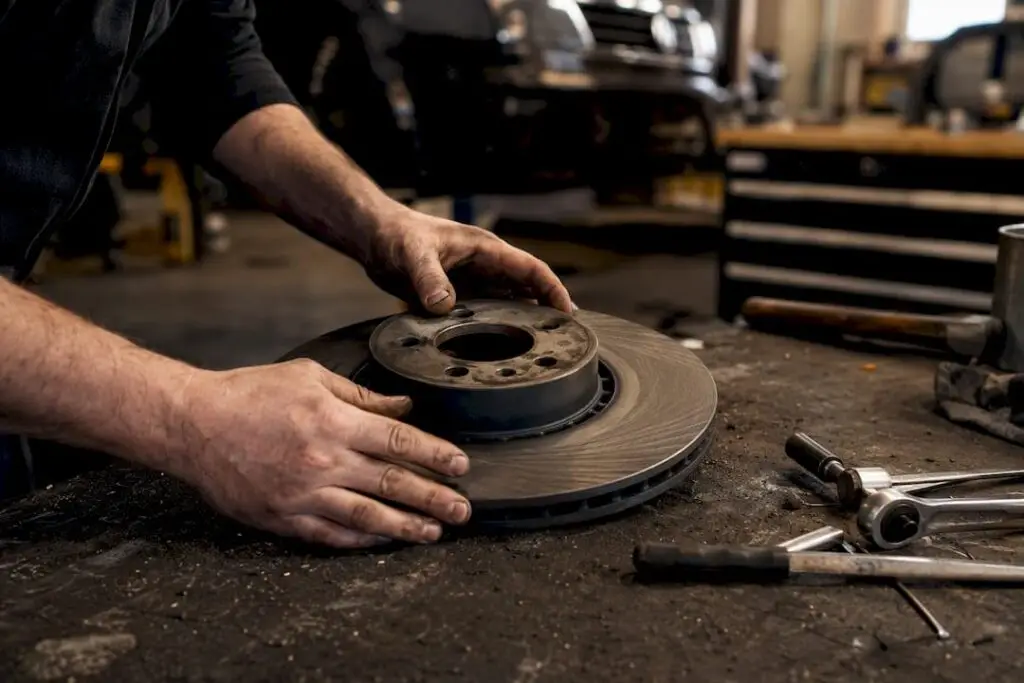
That pulsing you feel in the pedal is almost never a “warped rotor.” In the overwhelming majority of cases, it’s Disc Thickness Variation, DTV, tiny differences in rotor thickness that force the caliper piston to push and retract as the disc spins, or a buildup of pad material baked onto the rotor surface. It’s generally safe to drive a short distance at moderate speeds, but pull over and call a shop if the pedal goes soft, the pulsation gets worse under hard braking, or you smell burning.
Two quick clues help narrow it down before you even pop the hood:
- Speed dependence: pulsation that shows up only above 40 mph and fades at low speed usually points to rotor thickness variation.
- Pedal-only vs. steering wheel: a shaky steering wheel or seat usually means a front rotor problem; a pulsing pedal with no wheel shake often points toward rear rotors or hydraulic issues.
Key Takeaways
Brake pedal pulsation is caused almost entirely by Disc Thickness Variation or pad transfer deposits, not by rotors physically warping from heat.
| Point | Details |
|---|---|
| Name the real cause | DTV and pad transfer deposits, not heat warping, explain most pedal pulsation complaints. |
| Check where you feel it | Pedal-only pulsing suggests rear brakes; steering wheel shake points to the front rotors. |
| Measure before replacing | A dial indicator reading of installed runout should come before any parts get swapped. |
| Fix the whole system | Caliper sliders, hub cleanliness, and lug torque matter as much as the rotor itself. |
| Ask for the numbers | Alternativecarcare provides dealer-level diagnostics with a numeric TIR reading before recommending repairs. |
Table of Contents
- What Causes Brake Pulsation: The Mechanical Reality
- How to Diagnose Brake Pedal Pulsation Yourself
- What It Costs to Fix Brake Pulsation
- Preventing Brake Pulsation From Coming Back
- When to Bring in a Professional Diagnostic
- The Warped Rotor Myth Needs to Die
- Get Your Brake Pulsation Diagnosed the Right Way
- Sources
- FAQ
What Causes Brake Pulsation: The Mechanical Reality
Rotors don’t warp from heat the way most drivers assume. Disc Thickness Variation is the real culprit behind most pedal pulsation complaints technicians see, and it’s a measurable, mechanical problem, not a shape-memory issue with the metal.
Here’s the actual sequence of events, broken into the five mechanisms that matter most:
- Disc Thickness Variation (DTV). As a rotor spins, even a difference of a few thousandths of an inch in thickness pushes the caliper piston back and forth with each rotation. At highway speed, that happens dozens of times a second, and you feel it as a rhythmic pulse in the pedal.
- Pad material transfer and glazing. A hard stop from high speed, or riding the brakes down a long grade, can bake a thin layer of pad material onto the rotor surface. Even a deposit as thin as 0.0007 inch can produce a noticeable pulsation, which is thinner than a sheet of paper.
- Lateral runout and hub corrosion. If the rotor doesn’t sit perfectly flat against the hub, often because of rust flakes, road debris, or a rotor installed slightly off-center, it wobbles as it spins. That runout accelerates uneven wear and creates DTV over time, even on a rotor that started out perfectly true.
- Sticking calipers or seized slide pins. When a caliper doesn’t release cleanly, one pad drags longer than the other on every stop. The result feels exactly like a warped rotor, but the rotor itself may be fine. This is one of the most commonly missed causes because it doesn’t show up on a simple visual inspection.
- ABS and wheel-speed sensor faults. ABS activation produces its own pulsing sensation, usually during hard stops or on wet and gravel surfaces, and it’s a separate issue from mechanical DTV. It’s annoying, but it’s not the safety concern that a mechanical fault is.
A 2024 SAE modeling study adds another layer: disc thickness variation interacts with suspension tuning to determine how strongly a given amount of DTV gets transmitted into the pedal and steering wheel. Two cars with identical rotor wear can feel completely different behind the wheel because of how their suspensions carry that vibration.
How to Diagnose Brake Pedal Pulsation Yourself
Before you book a shop visit, a few minutes of observation can save you a diagnostic fee and help the technician skip straight to the fix.
Start with where you feel it:
- Pedal pulses but the steering wheel is calm: points toward rear rotors or a hydraulic issue.
- Steering wheel or seat shakes along with the pedal: almost always a front rotor or hub problem.
- Pulsation only during hard braking or on wet pavement: likely ABS engagement, not a mechanical fault.
- Pulsation on every stop, even light ones on dry pavement: that’s the signature of a true mechanical cause like DTV or pad transfer.
Next, think about timing. Did it start right after a brake job? Pulsation that appears immediately after rotor or pad replacement usually traces back to improper bedding, a rotor installed with debris behind it, or wheel lug nuts torqued unevenly. Did it start after hitting a pothole or curbing a wheel? That’s a strong hint toward bent components or hub damage rather than gradual wear.
Test the parking brake on a hill or in a driveway. If a hand brake that works only on the rear wheels seems to isolate the shake, that tells the shop to focus their inspection there first.
Pro Tip: Write down the exact speed range where you feel the pulse, whether it happens on the first stop of the day or only after several hard stops, and whether a recent brake job preceded it. That handful of details often cuts a diagnostic visit from an hour to fifteen minutes.
What It Costs to Fix Brake Pulsation
Once a shop confirms the cause, the fix depends on how far the rotor has drifted from its design spec.
- Resurfacing (machining the rotor): an option only if the rotor’s remaining thickness stays above the minimum stamped on the hat. Resurfacing removes a thin layer to true up the surface, but many modern rotors are made thin enough that they can’t tolerate a cut without dropping below spec, which is why replacement has become the more common recommendation.
- Rotor and pad replacement together: the standard fix when thickness variation is significant. Shops replace both because a used pad on a fresh rotor wears unevenly and can reintroduce the same problem within months.
- Caliper rebuild or replacement: needed when a sticking piston or seized slide pin caused uneven pad contact. Skipping this step is the single most common reason a “fixed” pulsation comes back within a few thousand miles.
- Hub cleaning and correct wheel torque: an inexpensive step that’s frequently skipped. A wire-brushed hub face and lug nuts torqued in a star pattern with a torque wrench prevent the rotor from seating slightly off-true from day one.
- ABS sensor or tone-ring repair: addresses electronic pulsing rather than a mechanical fault, and usually resolves without touching the rotors at all.
If pulsation returns within a few months of a repair, ask the shop to check runout at the hub itself and inspect the wheel bearing for play. A rotor can measure perfectly true on the bench and still develop runout once it’s bolted onto a hub with a corroded mating surface or a worn bearing.
Preventing Brake Pulsation From Coming Back
Most repeat pulsation complaints trace back to skipped steps during the last brake job, not bad parts.
- Bed in new pads and rotors with controlled stops. A series of moderate decelerations from about 40 mph, without coming to a complete stop or holding the brake, lets pad material transfer evenly instead of baking onto one hot spot.
- Clean the hub mating surface before installing a rotor. A wire brush and some penetrating oil on rust remove the debris that creates runout later.
- Torque lug nuts in a star pattern with a torque wrench. An impact gun set to “close enough” is a leading cause of rotors seating unevenly.
- Match pad compound to how the car is actually driven. Aggressive track-oriented pads on a daily commuter generate more heat and glazing than the car needs.
- Check caliper sliders and bearing play at every service interval, not just when a customer complains.
When to Bring in a Professional Diagnostic
A proper diagnosis goes beyond a visual glance at the rotors. A thorough shop inspection includes pulling the wheel off, measuring installed runout, or TIR, with a dial indicator, checking caliper slide function by hand, cleaning the hub face, and reading the wear pattern on the pads for signs of uneven contact.
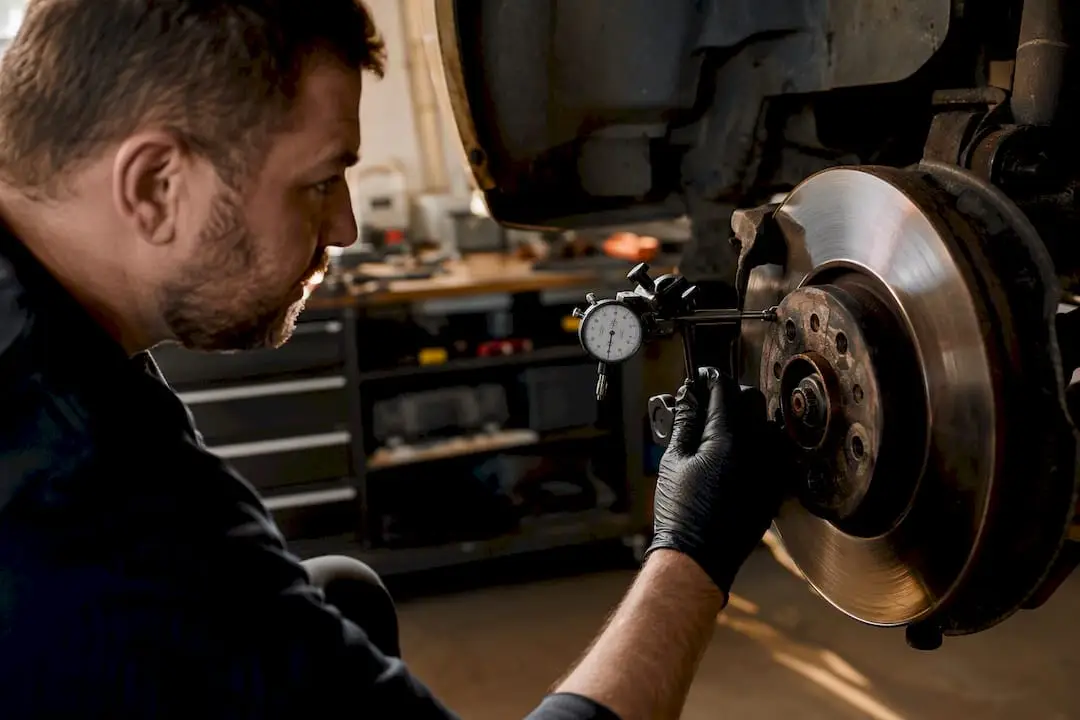
Alternativecarcare applies dealer-level diagnostics to exactly this kind of intermittent, easy-to-misdiagnose complaint, backed by transparent, itemized recommendations rather than a guess-and-replace approach. When you bring a car in for pulsation, ask for the numeric TIR reading, the rotor’s minimum thickness spec, and confirmation that the hub was cleaned and calipers lubricated before reassembly. A shop willing to hand you those numbers is a shop that measured the problem instead of assuming it.
The Warped Rotor Myth Needs to Die
Calling it a “warped rotor” gives drivers the wrong mental model, and it costs them money. If you believe metal bent from heat, the obvious fix seems to be a new rotor. But if the real cause is a sticking caliper slide pin or a corroded hub face, a brand new rotor develops the exact same DTV within a few thousand miles, and you’re back where you started.
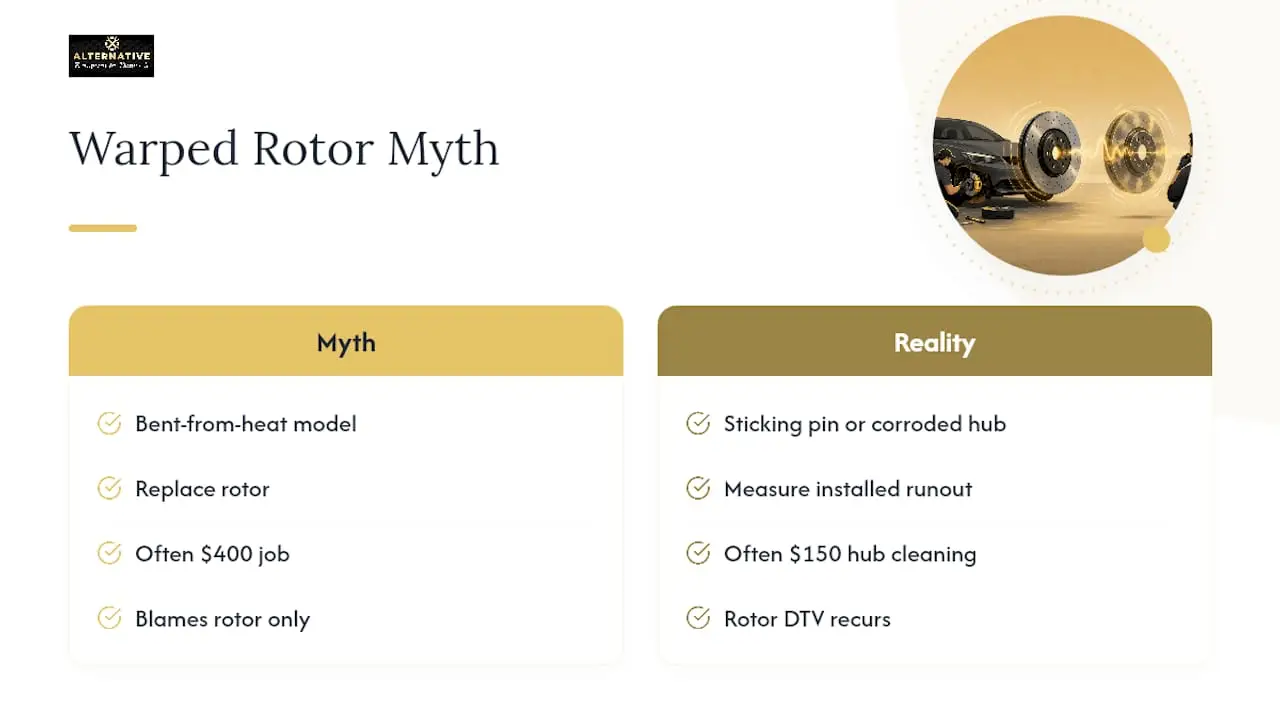
The conventional advice to “just replace the rotors” skips the diagnostic step that actually matters: measuring installed runout with a dial indicator before anything gets swapped. That five-minute check separates a $150 hub cleaning from an unnecessary $400 rotor and pad job.
There’s also a dangerous driver instinct worth naming directly. When the pedal pulses under hard braking, the reflex is to ease off, worried something is breaking. That instinct can extend stopping distance right when you need every foot of braking power. The pulsation itself, in almost every case, doesn’t reduce your stopping ability. Stay on the pedal, get the car to a shop, and let a technician chase the actual mechanical cause instead of guessing at parts.
— Hassan
Get Your Brake Pulsation Diagnosed the Right Way
Guessing at parts costs more than measuring the problem correctly the first time. Alternativecarcare runs dealer-level diagnostics on European, domestic, and high-performance vehicles, which means a technician measures installed runout with a dial indicator and inspects the hub face before recommending a single part, instead of defaulting to a rotor and pad swap because that’s the easy upsell.

If your pedal has been pulsing for more than a few days, or it started right after a recent brake job, that’s exactly the kind of intermittent complaint that benefits from a shop willing to show you the actual measurements. You’ll get a clear breakdown of what’s causing the vibration, what it costs to fix, and which parts genuinely need replacing versus which just need cleaning or re-torquing. Book a diagnostic appointment and get a straight answer instead of a parts-cannon guess.
Sources
- A suspension tuning parameter study: brake pulsation (SAE)
- Solving brake pedal pulsation complaints (UnderhoodService)
- Why do brake pedals vibrate? (PowerStop)
FAQ
How do you fix pulsating brakes?
The fix depends on the cause: resurfacing or replacing rotors for thickness variation, rebuilding a sticking caliper, cleaning corrosion off the hub face, or repairing an ABS sensor. A dial indicator measurement of installed runout tells a technician which fix actually applies.
Why is my car pulsating when I brake?
Most pulsation comes from Disc Thickness Variation caused by pad material deposits, rotor runout, or hub corrosion, not from rotors warping under heat. A sticking caliper slide pin can produce the identical sensation even with a perfectly good rotor.
Can you drive with pulsating brakes?
Driving a short distance at moderate speed is typically fine, but stop and have it inspected if the pedal feels soft, the pulsation worsens under hard braking, or you notice a burning smell. Mechanical pulsation rarely reduces stopping power on its own, but ignoring it can accelerate wear on other components.
What does it mean when your brakes feel like they are pulsing?
A rhythmic pulse usually means the caliper piston is being pushed back with each rotor rotation because of uneven thickness or a deposit on the rotor surface. If the pulse only happens during hard stops or on wet roads, it’s more likely ABS activation than a mechanical problem.