
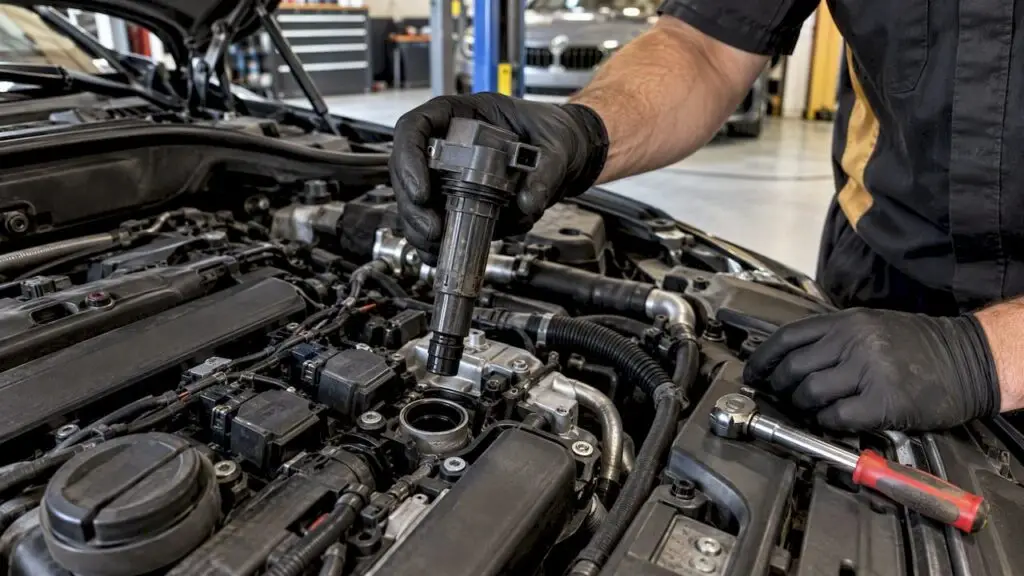
A failing coil pack or ignition coil usually shows up as an engine misfire: a rough idle, hesitation under throttle, worse fuel economy and a check engine light. The coil steps battery voltage up to the thousands of volts a spark plug needs. When it weakens, one cylinder stops firing properly. If the check engine light is flashing, reduce speed and have the car looked at right away. A flashing light signals an active misfire that can damage the catalytic converter.
This guide explains how to recognize the problem, what causes it, when the car should not be driven, how a technician confirms the coil is the culprit, and what the repair typically costs. It is written for Dallas drivers of European, domestic, luxury and high-performance vehicles, from Oak Lawn and Uptown to the surrounding neighborhoods.
TL;DR
- Typical signs of a bad coil: misfire, rough idle, hesitation, lower fuel economy and a check engine light, according to HELLA’s technical guide and the EPA.
- A flashing check engine light means an active misfire. Slow down and get professional diagnostics immediately, because the EPA warns it can quickly damage the catalytic converter.
- A misfire code (P0300 series) does not prove the coil is bad. Fuel injectors, compression loss, wiring and spark plugs can produce the same symptoms.
- Shop pricing in 2026 commonly runs $80 to $350 per coil, and European makes tend to run higher because of labor rates and access.
- Replacing worn spark plugs on schedule is one of the best ways to protect coils.
Table of Contents
- What a coil pack does
- Symptoms of a failing coil pack
- Is it safe to drive with a bad coil?
- What causes ignition coils to fail
- Why the code alone does not prove the coil is bad
- How a technician diagnoses a bad coil
- What coil replacement costs
- Preventing repeat coil failures
- Coil problems on European and performance cars
- Get a coil or misfire diagnosis in Dallas
- FAQ
- Sources
What a coil pack does
A gasoline engine needs a high-voltage spark at the right instant in each cylinder. The ignition coil is a small transformer: a primary winding fed by the car’s 12-volt system and a secondary winding that multiplies that voltage. The engine computer switches the primary circuit on and off, and the collapse of the magnetic field produces the high-voltage pulse.
You will hear several terms used for the same family of parts:
- Coil-on-plug (COP): one coil sits directly on each spark plug. This is the most common layout on modern cars, and it is why a single cylinder can fail on its own.
- Coil pack: a block of coils, or a coil assembly, serving multiple cylinders, often with short boots or wires. Older waste-spark designs fire two cylinders from one coil.
- Distributor-style systems: a single coil feeds a distributor. Rare on anything built in the last two decades.
Many drivers say “coil pack” for all of these. On most late-model European cars, including the turbocharged four-, six- and eight-cylinder engines common in Dallas traffic, you are dealing with individual coils, and a failure typically affects one cylinder first.
Symptoms of a failing coil pack
Symptoms often start subtly and show up under load or in certain weather. Common signs, consistent with HELLA’s description of faulty coils and the EPA’s on-board diagnostics fact sheet:
- Engine misfire. The engine stumbles, shudders or feels like it skipped a beat, most noticeably at a stop or when climbing through the gears.
- Rough idle. The steering wheel or seat vibrates at a light, and the tachometer needle may wander.
- Hesitation or sluggish acceleration. Power drops when you press the pedal, particularly on turbocharged engines that run high cylinder pressure.
- Worse fuel economy. Unburned fuel from a dead cylinder wastes gas.
- Check engine light. A steady light with a misfire code, or a flashing light during an active misfire.
- Hard starting or stalling. Less common with a single weak coil, but possible when several are failing.
Also watch for a gasoline smell from the exhaust, which can mean raw fuel is passing through a cylinder that is not firing.
Steady light versus flashing light
The EPA explains that an illuminated light is a request for service, not necessarily an order to stop. A flashing or blinking light is different: it indicates a misfire severe enough to damage the catalytic converter in a short time. Our guide on what service lights mean and when to stop or tow covers how to tell the warning types apart.
Is it safe to drive with a bad coil?
It depends on what the dashboard and the engine are telling you.
| Situation | What it means | What to do |
|---|---|---|
| Steady check engine light, slight roughness at idle | Likely a developing or intermittent misfire | Schedule diagnostics within days. Drive gently and avoid heavy throttle and towing. |
| Flashing check engine light | Active misfire, catalytic converter at risk | Reduce speed, ease off the throttle and get to a shop. Do not continue a long trip. |
| Flashing light with severe shaking, power loss or limp mode | Serious misfire, possibly more than one cylinder | Stop in a safe place. Towing is the safer choice. |
| Raw fuel smell, smoke, or temperature gauge climbing | Possible overheating or fuel dilution | Stop driving and arrange a tow. |
How long can you drive with a bad coil? There is no honest mileage number. A mild, intermittent misfire may be tolerable for a short trip to a shop, but each mile on a misfiring cylinder sends unburned fuel into the exhaust. The EPA’s guidance says a flashing light can cause catalytic converter damage quickly, and replacing a converter often costs $1,000 to $2,500, far more than a coil. If you are unsure, a tow is cheaper than a converter.
On cars that enter limp mode, the computer is limiting power to protect the engine. Read more about the common causes of limp mode before you try to drive through it.

What causes ignition coils to fail
Coils often last well past 100,000 miles, but several conditions shorten their life:
- Heat and vibration. Coils sit on top of a hot engine. AA1Car notes that heat and vibration can damage the windings and insulation, causing shorts or opens. Over many heat cycles, the internal insulation breaks down, a point also made in Empire Auto Protect’s coil guide.
- Worn spark plugs. As the electrode gap widens, the coil must produce more voltage to jump it. That extra electrical load stresses the coil over time. The spark plug interval matters most on turbocharged and direct-injected performance engines.
- Oil contamination. A leaking valve cover gasket or spark plug tube seal lets oil pool in the plug well and soak the coil boot. Oil-soaked rubber can let voltage leak to the cylinder head instead of the plug.
- Moisture. Water intrusion from a hood wash, a heavy rain or a cracked boot can cause tracking, where voltage arcs along the surface.
- Electrical faults. HELLA lists problems such as a faulty ignition module or output stage in the control unit, and a voltage supply fault that affects coil charging time.
- Poor-quality replacement parts. Cheap coils can fail within months. This is one reason we use quality parts on repairs.
The takeaway for owners: if one coil failed from oil or heat, the others live in the same environment. A technician should look at the whole bank, not only the one that threw the code.
Why the code alone does not prove the coil is bad
A code in the P0301 to P0308 range tells you which cylinder misfired. It does not say why. A misfire can come from:
- A weak or failed coil
- A worn, fouled or incorrectly gapped spark plug
- A clogged or leaking fuel injector
- Low compression from a valve, ring or head gasket problem
- A vacuum or intake leak
- Damaged wiring, a corroded connector or a failing engine computer driver circuit
This is why professional diagnostics matter. Nissens’s technical support material and the research behind this guide stress that replacing parts based only on a code leads to a repeat repair. If a coil is replaced when the real fault is an injector, the misfire returns, and the customer has paid twice.
How a technician diagnoses a bad coil
The sequence below reflects accepted practice. Details vary by make and engine, and some European cars require manufacturer-level software to read freeze frame data and command component tests. We cover that in more detail in our seven-step misfire diagnosis and our guide to diagnosing a check engine light with live data.
- Scan for codes and freeze frame data. Record which cylinders misfired, at what load, speed and engine temperature. Pending and stored codes both matter.
- Inspect visually. Look for oil in the plug wells, cracked or burned boots, carbon tracking, loose connectors and signs of moisture.
- Check live data. Misfire counters per cylinder, fuel trims and sensor readings show whether the problem is mechanical, fuel-related or electrical.
- Inspect the spark plugs. Plug condition tells a lot about mixture, oil consumption and wear. Old plugs are a common reason coils fail again.
- Swap test. Move the suspect coil to another cylinder and clear the codes. If the misfire follows the coil, the coil is at fault. If it stays on the original cylinder, the problem is elsewhere, such as the injector, compression or wiring. This method, sometimes called swaptronics, is described by Tomorrow’s Technician and by Nissens.
- Electrical testing. A technician may measure coil resistance or use a scope to view the primary and secondary waveforms. HELLA lists typical values of roughly 0.5 to 2.0 ohms primary and 8 to 19 kilo-ohms secondary, but these vary by system, so a technician uses the specification for your specific engine.
- Compression or leak-down test. If the fault stays with the cylinder and not the coil, mechanical health comes next.
When the cause is deeper in the wiring or control module, our advanced electrical team follows the process described in how ASE shops test electrical faults.
Pro tip: Ask the shop to show you the swap result or the scan data supporting the recommendation. Our list of questions to ask a mechanic helps you get the findings in writing.
Why not just replace the coil yourself?
The part is often accessible, and some drivers do swap one. The risk is a wrong diagnosis. Skipping the diagnosis can mean a misfire that returns, new coils paired with worn plugs, or an engine fault that gets worse while you chase the wrong part. On many European engines, the coils sit under plastic covers and intake components, and high-voltage parts and fuel systems should be handled with care. Driving with a flashing light while experimenting is the most expensive way to find out.
What coil replacement costs
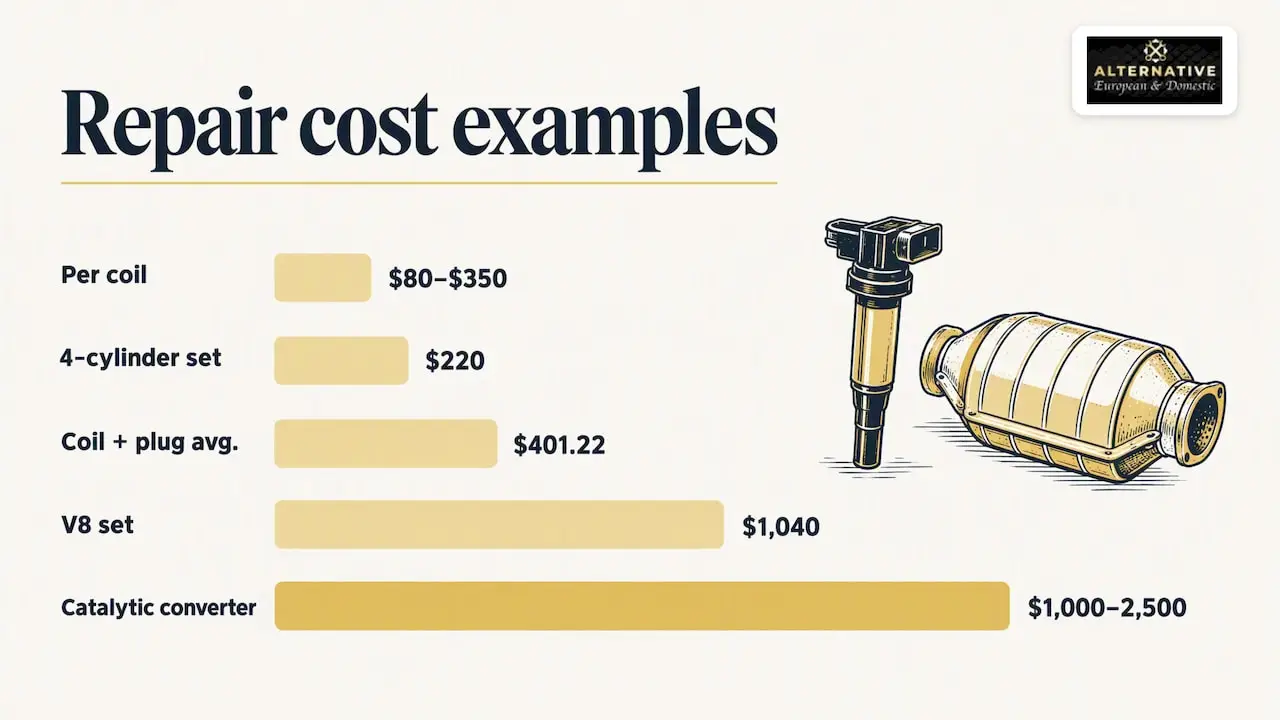
Costs vary by engine layout, parts quality and labor rate. Published 2026 figures from Ignition Coil Cost 2026 put typical shop pricing at $80 to $350 per coil including parts and labor. Replacing a full set runs from about $220 on a four-cylinder economy car to about $1,040 on a V8. The same source reports labor times of 0.3 to 2.0 hours per cylinder depending on how much sits on top of the coil, and European or luxury labor rates of $160 to $220 per hour. AAA’s check engine light guide listed an average of $401.22 for ignition coil and spark plug repairs, dated January 2020.
These are national figures, not our quotes. We do not publish prices for this service because the right repair depends on diagnosis. What drives the final number:
- Number of cylinders and coils replaced. One failed coil does not always mean replacing all of them, but on a high-mileage engine, replacing the set with fresh plugs can save a second visit.
- Access. Engines with intake manifolds or covers that must come off take more labor.
- Parts quality. Original-equipment-quality coils cost more than bargain units but reduce comebacks.
- Related repairs. Oil in the plug wells means the valve cover gasket or tube seals also need attention.
- Diagnostic time. See what to expect in our article on diagnostic fees.
The cost of waiting is also a factor. Spending a few hundred dollars on a coil is a small number next to a catalytic converter replacement, which can run $1,000 to $2,500 according to the EPA fact sheet cited above.
Preventing repeat coil failures
Coil failure is often a symptom of something upstream. A few habits reduce the odds:
- Follow the spark plug interval for your engine. Turbocharged and direct-injected engines are more demanding. Check your owner’s manual and our spark plug interval guide.
- Fix oil leaks early. A weeping valve cover gasket slowly ruins coils and boots.
- Be careful with engine bay washing. Water on hot ignition components invites moisture problems.
- Do not ignore a light. A steady check engine light can be the early warning for a coil that has not failed outright.
- Keep up with routine inspections. AAA says preventive maintenance helps avoid catastrophic repair bills, and waiting for a part to fail completely often leads to secondary damage. A practical look at preventive maintenance explains the same logic about avoiding follow-on repairs.
Our maintenance service covers inspections and customized maintenance plans for European, domestic and high-performance vehicles, which is where plugs, leaks and early misfire signs are caught.
Coil problems on European and performance cars
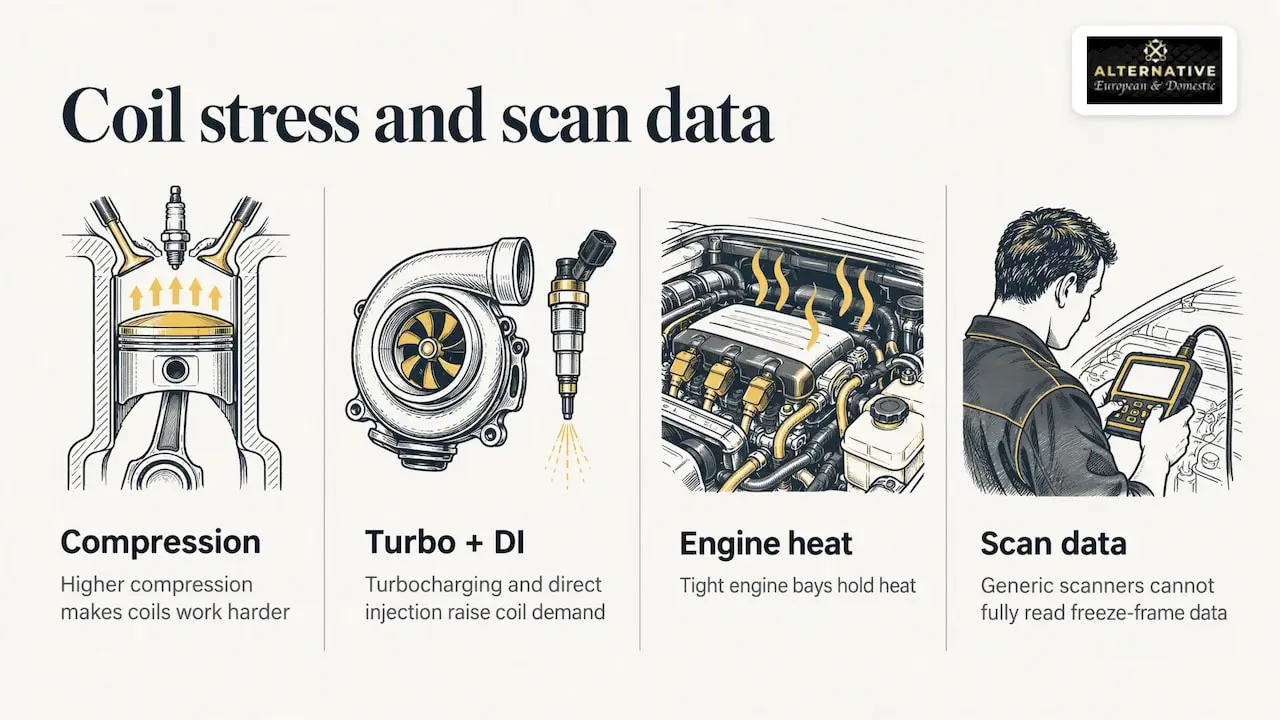
European and performance engines put more demand on the ignition system. Higher compression, turbocharging and direct injection mean coils work harder, and tight engine bays hold heat. Many of these cars also log detailed misfire and freeze frame data that generic scanners cannot fully read. If you drive a BMW, our piece on ISTA freeze frame questions for BMW drivetrain faults shows what to ask. We do not claim a particular coil failure pattern for any specific model here, because that needs model-specific evidence. Your car’s own scan data will show what is happening.
Get a coil or misfire diagnosis in Dallas
At Alternative European & Domestic, our ASE-certified technicians diagnose misfires with dealer-level diagnostics before recommending parts, and we explain the findings in plain language. We work on European, domestic, luxury and high-performance vehicles, and many of our customers come from Oak Lawn, Uptown and nearby Dallas neighborhoods. If a coil, plug or deeper engine problem is behind your misfire, see our engine repair services. Qualifying repairs may be covered by our 24-month/24,000-mile warranty, subject to applicable terms.
If your light is flashing or the engine is shaking, do not wait for the weekend. Slow down, avoid hard acceleration, and arrange a tow if the car loses power. To book an inspection or diagnostic evaluation, schedule an appointment with Alternative European & Domestic.
FAQ
How can you tell if your ignition coil is bad?
The most common signs are a misfire, rough idle, hesitation, lower fuel economy and a check engine light. Confirming it takes more than a code. A technician checks the plugs, runs a swap test and may test coil resistance or waveform, because injectors, compression and wiring faults can feel identical.
How long can you drive with a bad coil?
There is no safe number of miles. With a steady light and a mild stumble, a short, gentle drive to a shop is usually reasonable. With a flashing light, slow down and get service immediately, because the EPA warns a severe misfire can damage the catalytic converter quickly. If the car shakes hard or loses power, have it towed.
How much does it cost to fix an ignition coil?
National 2026 estimates run about $80 to $350 per coil including parts and labor, with full sets from about $220 to $1,040 depending on the engine. European and luxury vehicles tend to land higher because of labor rates and access. A diagnosis first prevents paying for parts you do not need.
Should I replace one coil or all of them?
If one coil has failed on a lower-mileage engine with healthy plugs, replacing just that coil can be reasonable. On a high-mileage engine, or when oil or heat damage affects the whole bank, replacing the set with new plugs may prevent a repeat visit. Your technician should explain which applies to your car.
Can bad spark plugs ruin an ignition coil?
Yes. Worn plugs have a wider gap, which forces the coil to work harder to produce a spark, and that extra electrical load can shorten coil life. Replacing plugs at the interval for your engine helps protect the coils.
Sources
- HELLA: Ignition coil, checking, measuring, faults
- EPA: Frequently Asked Questions About On-Board Diagnostics
- Ignition Coil Cost 2026
- Nissens Support: Ignition coil diagnostics and installation
- AA1Car: How to Diagnose and Test an Ignition Coil
- Empire Auto Protect: Ignition Coil Replacement Cost 2026
- Tomorrow’s Technician: Ignition Systems
- AAA: Top 5 Reasons Check Engine Lights Come On
- AAA: 13 Common Car Problems Explained