

Limp mode is your engine control unit deliberately reducing power to protect the engine or transmission from further damage. If your car suddenly loses power, shows a warning light, or feels sluggish, ease off the accelerator, move to a safe location, and arrange professional diagnostics as soon as possible. Continuing to drive normally can turn a minor sensor fault into an expensive repair.
TL;DR:
- Drive cautiously and avoid long trips in limp mode, as a window of safe driving varies but is generally limited to 22 to 45 minutes.
- Accurate diagnosis requires real-time live-data analysis and manufacturer-specific tests, not just reading generic trouble codes.
- Sensor failures, transmission issues, fuel system problems, electrical faults, and software defects can all trigger limp mode, making correct diagnosis essential.
- Repair costs range from sensor replacements to complex transmission or fuel pump repairs; proper diagnosis minimizes unnecessary expenses.
- Regular maintenance and early addressing of warning signs like rough idle or warning lights can help prevent entering limp mode.
Table of Contents
- What limp mode does and which systems are limited
- Common causes that trigger limp mode
- Symptoms and dashboard indicators
- Safety guidance: can you drive and how far?
- How technicians diagnose limp mode (DTCs, live-data, tests)
- Why professional, dealer-level diagnostics matter
- Typical repair options and cost factors
- Prevention: maintenance checklist to reduce limp-mode risk
- What to tell your mechanic and what to expect at the shop
- When a specialist or second opinion makes sense
- How Alternative European & Domestic can help you get back on the road
- Primary sources and recall-check links
- Sources
- FAQ
What limp mode does and which systems are limited
Limp mode, sometimes called limp home mode or reduced-power mode, is a protective response built into your vehicle’s engine control unit. When the control unit detects a reading outside normal range, it restricts the engine and transmission to reduce the chance of serious damage while still letting you drive to safety.
The exact restrictions depend on the vehicle and the fault, but the pattern is consistent. The control unit cuts back how much torque the engine can produce, which is why acceleration suddenly feels weak. Many transmissions respond by locking into a single gear, often second or third, so the car can still move without cycling through gears that might make an existing problem worse. Throttle response softens noticeably, and some vehicles apply a hard speed limiter that caps you well below highway speeds.
The behavior you notice on the road usually falls into a few categories:
- Reduced acceleration: the throttle feels disconnected from the pedal, and the car takes longer to reach normal speeds.
- Locked or limited gears: the transmission may stay in one gear rather than shifting normally.
- Speed limiting: some systems cap top speed to a fraction of normal, sometimes 40 to 45 miles per hour.
- Warning lights: the check engine light or a dedicated reduced-power icon usually appears at the same time.
None of this is random. It is the control unit’s way of saying a component or system is operating outside its safe parameters, and it would rather you lose performance than risk a blown engine or a burned-out transmission.
Common causes that trigger limp mode
Limp mode is a symptom, not a diagnosis. The control unit reacts the same way to a wide variety of underlying problems, which is exactly why guessing at repairs rarely works out well. The most frequent triggers fall into five groups.
- Sensor failures: a failing throttle position sensor, mass airflow or manifold absolute pressure sensor, wheel-speed sensor, or oxygen sensor can send the control unit a reading it does not trust, triggering protective limits.
- Transmission faults: low or degraded transmission fluid, a failing solenoid, valve body problems, or a torque converter issue are common transmission-side causes.
- Fuel system failures: low fuel pressure or a weakening fuel pump can starve the engine and mimic a mechanical fault. Consumer Reports covers a Ford recall where a failing low-pressure fuel pump caused stalling, often preceded by reduced power or misfires.
- Electrical issues: a weak battery, a failing alternator, or corroded wiring and ground connections can create voltage irregularities that the control unit interprets as a fault.
- Software faults and manufacturer defects: sometimes the cause is not a worn part but a known defect. Consumer Reports has documented ICCU failures in certain electric vehicles that trigger sudden power loss, prompting manufacturer recalls.
Because the same warning light and the same driving behavior can point to five different systems, an accurate diagnosis has to start with real data rather than a guess based on symptoms alone.
Symptoms and dashboard indicators
Limp mode rarely arrives without warning signs, though the signs can look similar to other, less serious issues. Knowing what to watch for helps you react appropriately instead of ignoring something that needs attention.
- Check engine light or a dedicated warning icon appears on the dashboard, sometimes alongside a transmission warning light.
- Sudden loss of power during acceleration, often described by drivers as the car suddenly feeling sluggish or unresponsive.
- Single-gear or limited-gear behavior, where the transmission seems stuck and will not shift normally.
- Noticeably slower acceleration even at moderate throttle input, sometimes paired with a speed cap.
- Early warning signs such as rough idle, occasional misfires, or brief, intermittent power loss before full limp mode engages.
That last category matters more than drivers often realize. A rough idle or an occasional stumble on acceleration is frequently the early version of the same fault that will eventually trigger full limp mode. Addressing it early, before the control unit forces a shutdown of performance, tends to be simpler and less expensive.
Safety guidance: can you drive and how far?
The honest answer is that limp mode is designed to let you reach a safe location, not to serve as a long-term way of getting around. Short, careful driving to pull off the road or reach a repair shop is generally the intended use. Extended driving in a reduced-power state increases the risk of further damage and, in some cases, a complete loss of power.
Manufacturer guidance on how much time you actually have varies by vehicle and by fault. Consumer Reports notes that some electric vehicles affected by ICCU defects may give drivers a window of 22 to 45 minutes to pull over safely before losing power entirely. That range applies specifically to the documented defect in question and should not be treated as a universal rule for every vehicle or every cause of limp mode. Treat any time estimate as a maximum, not a target.
If limp mode activates while you are driving:
- Slow down gradually rather than braking hard, since sudden power loss can catch other drivers off guard.
- Avoid highway speeds if you can safely exit or find an alternate route.
- Turn on your hazard lights if the situation feels precarious, and signal your intentions clearly to other drivers.
- Pull over immediately if drivability worsens, if the steering or braking feels affected, or if you smell burning.
If you cannot safely reach a shop or your home, call for roadside assistance rather than pushing through. A short tow is almost always cheaper than a damaged engine or transmission.
How technicians diagnose limp mode (DTCs, live-data, tests)
A proper diagnosis starts with pulling diagnostic trouble codes, but that is only the first step. AAA recommends scanning for codes as the starting point, while also noting that a code alone often points to a system rather than a specific failed part. A code that reads “low fuel pressure,” for example, could mean a failing pump, a clogged filter, or a wiring fault feeding the pump. The code narrows the search. It does not finish it.
From there, a technician typically moves into live-data analysis: watching fuel pressure, voltage under load, sensor readings, and throttle position in real time as the vehicle runs. This step catches problems that only show up under specific conditions, like a sensor that drifts out of range only when the engine is warm or a voltage drop that only appears under load.
Depending on the suspected fault, the technician may also run activation tests, deliberately triggering a component to confirm it responds correctly rather than assuming it is fine because the code cleared.
- Code readout identifies the affected system and gives a starting point for investigation.
- Live-data monitoring captures readings under real driving or load conditions that a static code cannot show.
- Activation testing confirms whether a suspected component is actually failing or simply reporting an unusual but valid value.
- Recall and technical service bulletin checks rule out known manufacturer defects before assuming a part has simply worn out.
This is also why a basic code read from a parts-store scanner, while useful for a rough idea, often falls short of a full diagnosis. AAA points out that many code readers cannot interpret live scan-tool data or run the activation tests that confirm a component is actually at fault, which is exactly where a misdiagnosis tends to start.
Why professional, dealer-level diagnostics matter
Limp mode has enough overlapping causes that a guess-and-replace approach frequently means paying for parts that were never the problem. A shop working with dealer-level diagnostic tools can capture the same live data and run the same manufacturer-specific tests that a dealership would use, without the guesswork of a generic code scan.
A competent technician working through a limp mode complaint should be able to show you what the live data actually looked like, walk you through which systems were tested and ruled out, and present a prioritized repair plan rather than a single expensive guess. After the repair, the fix should be validated under the same conditions that triggered the original fault, not just cleared and sent out the door.
Pro Tip: Ask for a printed or digital diagnostic report before authorizing repairs, and if a shop recommends major transmission or engine work based on a code alone, a second diagnostic opinion is worth the time.
Typical repair options and cost factors
Once a technician has isolated the actual cause, the repair itself usually falls into one of a few categories. Sensor replacement is often the simplest and least expensive fix, addressing issues like a failed throttle position or mass airflow sensor. Fuel-pressure and fuel-pump repairs cost more, particularly on vehicles where the pump sits inside the fuel tank and requires more labor to access. Transmission-related repairs, from a solenoid replacement to valve body work, tend to sit at the higher end of the cost range because of both parts and the labor time transmission work demands. Electrical and charging-system repairs, and occasional ECU software updates, round out the common categories.
Several factors drive the final cost more than the part itself; dealers must prove a tracker caused a fault before warranty issues arise, as explained by Land Rover and BMW Owners: Dealers Must Prove a Tracker Caused a Fault – LRD Track.
- Parts choice: OEM parts typically cost more than aftermarket equivalents but may carry manufacturer specifications more precisely.
- Diagnostic depth: a fault that requires extended live-data monitoring or activation testing adds labor time before any repair begins.
- Labor intensity: transmission and engine work generally involves more labor hours than sensor or electrical repairs.
- Recall coverage: if the cause turns out to be a documented manufacturer defect, repair costs may be covered under a recall rather than paid out of pocket.
A correct diagnosis tends to lower the total cost of the repair, even though the diagnostic step itself takes time, because it avoids paying for parts that were never the actual problem.
Prevention: maintenance checklist to reduce limp-mode risk
Limp mode is often the end result of a small issue that went unaddressed. Staying ahead of it comes down to consistent maintenance rather than any single fix.
- Follow your scheduled oil and filter changes to keep the engine operating within normal parameters.
- Service transmission fluid on the manufacturer’s recommended interval rather than waiting for symptoms to appear.
- Check battery and charging system health regularly, since a weak battery or failing alternator can create the voltage irregularities that trigger protective modes.
- Address early warning signs immediately, including sluggish acceleration, warning lights, or a rough idle.
- Keep software updates and recall checks current, since some limp mode triggers are resolved through a manufacturer update rather than a physical repair.
Organizations like the Car Care Council recommend routine inspections of batteries, brakes, and fluids as a general defense against the kind of sudden faults that can escalate into a protective shutdown.
What to tell your mechanic and what to expect at the shop
Before your appointment, take a few minutes to note the details that will speed up diagnosis. Write down exactly when the warning appeared, what you were doing at the time, whether the light was solid or flashing, your approximate fuel level, and any recent repairs or maintenance.
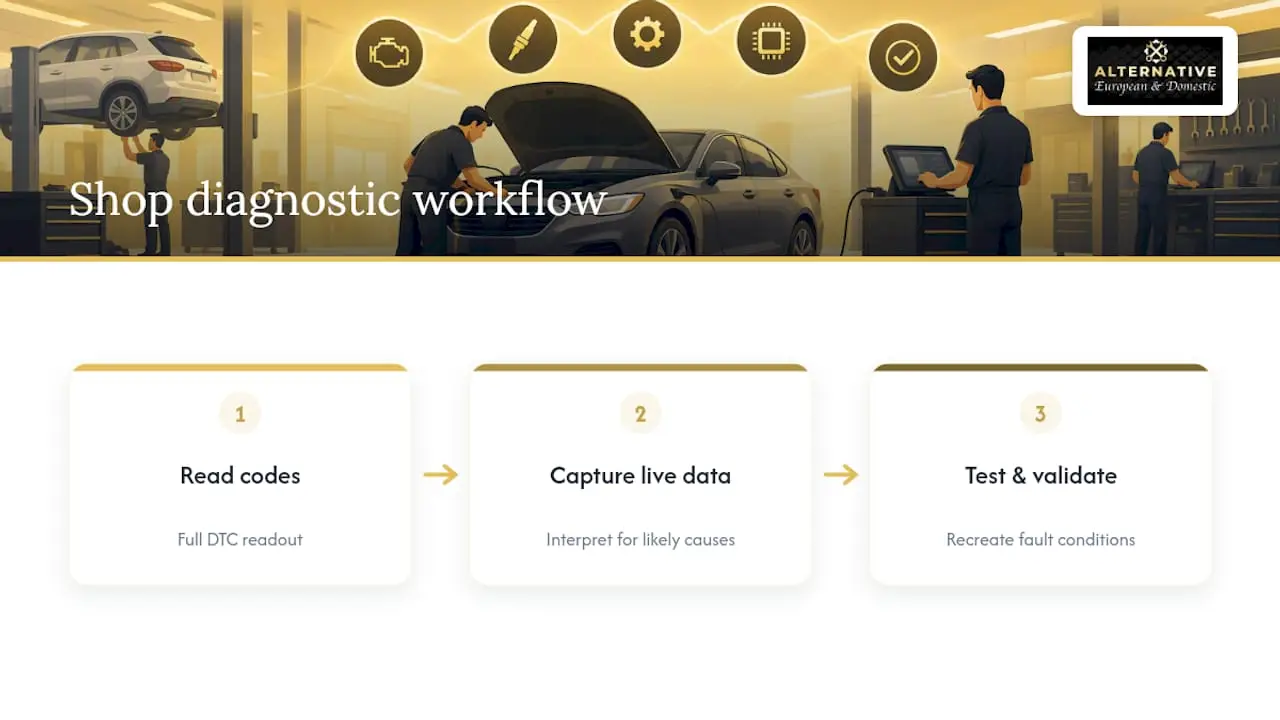
At the shop, expect the technician to start with a full diagnostic trouble code readout, followed by live-data capture if the codes do not clearly point to a single component. A transparent shop will walk you through what the codes and data actually showed, present a prioritized repair plan based on that evidence, and confirm the fix by testing the vehicle under the same conditions that originally triggered the fault. If a shop skips straight to a repair recommendation without showing you the data behind it, that is worth questioning.
When a specialist or second opinion makes sense
Limp mode on a European or high-performance vehicle often involves systems that differ meaningfully from mainstream domestic platforms, and a shop with manufacturer-specific tools and training tends to catch things a generalist might miss. Before authorizing a major transmission or engine repair, a second diagnostic opinion is reasonable, especially when the estimate is based on a single code rather than documented live data. Look for a shop willing to show you the diagnostic evidence and put a clear estimate in writing.
— Alternative European & Domestic
How Alternative European & Domestic can help you get back on the road

Limp mode does not diagnose itself, and a code reader alone rarely tells the full story. This shop uses dealer-level diagnostic tools to capture live data and run the same tests a dealership would, providing a repair plan built on evidence rather than guesswork. That means fewer unnecessary parts, clearer communication, and a technician who can show you exactly what the data revealed before any work begins.
Depending on what the diagnosis turns up, our team handles:
- Engine diagnostics and repair for sensor, fuel, and performance-related faults through our engine repair services.
- Transmission diagnosis and repair for solenoid, valve body, or fluid-related causes through our transmission repair and service.
- Preventative care that reduces limp-mode risk over time through our maintenance service.
If your check engine light is on or your car has gone into reduced-power mode, schedule a diagnostic appointment with a trusted repair shop to get a clear answer instead of a guess.
Primary sources and recall-check links
For deeper reading, AAA’s check-engine light guidance covers diagnostic basics, and Cars offers a practical owner-level overview. To check for open recalls on your specific vehicle, use the NHTSA VIN lookup tool before paying for a repair that might already be covered.
Sources
- My check engine light is on! What do I do? – AAA
- Ford, Lincoln recall for fuel-pump failure – Consumer Reports
- Cars
FAQ
How do I fix limp mode?
There is no single fix, since limp mode is a protective response to an underlying fault rather than a problem itself. A technician needs to pull diagnostic codes and capture live data to identify the actual cause, whether that is a sensor, a transmission component, or an electrical issue, before any repair can resolve it.
Can I still drive my car in limp mode?
Limited driving to reach a safe location or a repair shop is often possible, but it is not meant for normal, extended use. Consumer Reports notes that some vehicle defects may only allow a narrow window before a complete loss of power, so treat any driving in limp mode as a short trip to safety, not a way to keep your normal routine.
Is limp mode expensive to fix?
Cost depends entirely on the underlying cause, ranging from a relatively affordable sensor replacement to more labor-intensive transmission or fuel-pump repairs. An accurate diagnosis before any repair work typically keeps costs lower than replacing parts based on guesswork.
What is the main cause of limp mode?
There is no single main cause. Sensor failures, transmission faults, fuel system problems, electrical issues, and manufacturer software defects can all trigger the same protective response, which is why a proper diagnostic scan and live-data check matter more than assuming the cause.