
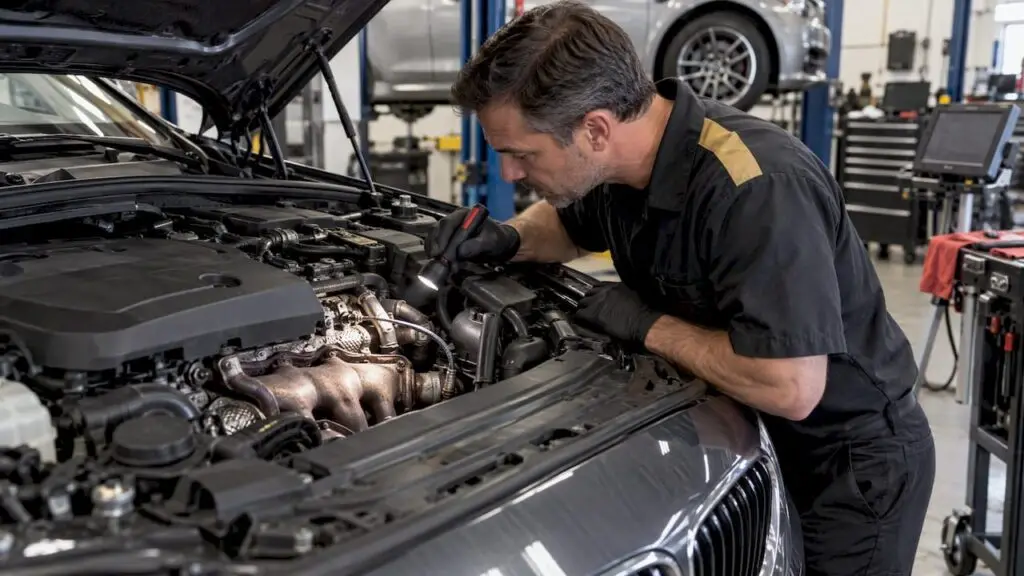
An exhaust smell in your car usually means exhaust gas is escaping before it reaches the tailpipe, or is being drawn back into the cabin. Common sources are a leaking manifold gasket, a cracked flex pipe, a failing joint or a worn seal. Treat it as a safety issue first: exhaust contains carbon monoxide (CO), which you cannot smell. If the odor is strong or you feel dizzy, stop driving, get fresh air and call for a tow.
This guide covers what the smell tells you, how to separate exhaust from look-alike odors, when the car should not be driven, and how a shop finds the leak. We wrote it for Dallas drivers, from Uptown commuters to Oak Lawn owners of European and performance cars.
TL;DR
- Exhaust odor in the cabin points to a leak or an air-path problem. Carbon monoxide is colorless and odorless, so a missing smell does not mean the air is safe.
- If you smell fumes and have a headache, nausea or drowsiness, stop, ventilate, get everyone out and call emergency services if symptoms persist.
- Rotten egg odor points toward the catalytic converter. Sweet, burning or oily smells can be coolant, oil or electrical faults that drivers mistake for exhaust.
- Do not keep driving to “see if it clears.” A proper diagnosis uses a leak test and inspection, not guesswork.
- We inspect exhaust, seals and ventilation paths on European, domestic and high-performance vehicles. Schedule a diagnostic visit if you notice the smell.
Table of Contents
- What an exhaust smell in the car actually means
- Why it is a safety issue, not just a nuisance
- Common causes, by where the smell shows up
- Is it really exhaust? Look-alike smells
- When you should not drive the car
- How a shop diagnoses an exhaust smell
- Repair options and cost factors
- Prevention: keeping the exhaust system tight
- What we do for Dallas drivers
- FAQ
- Sources
What an exhaust smell in the car actually means
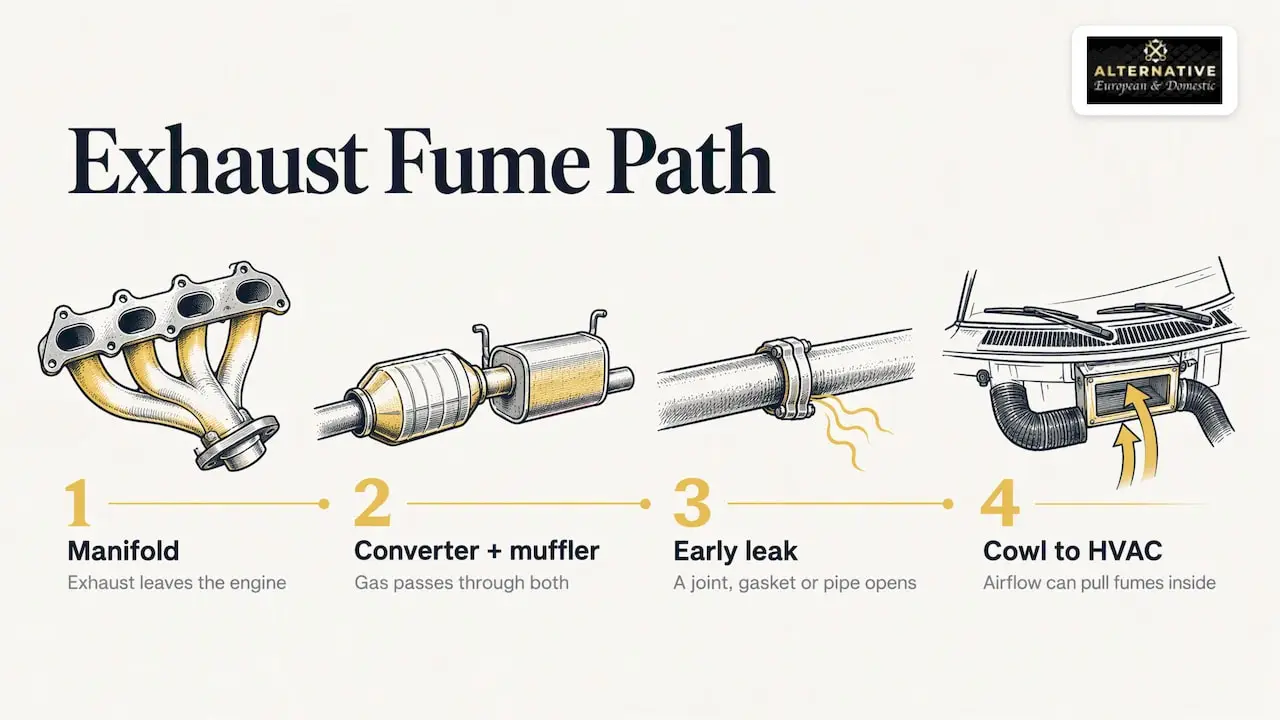
Exhaust gas leaves the engine through the manifold, passes the catalytic converter and muffler, and exits at the rear. A healthy system is sealed from the manifold to the tip. When any joint, gasket or pipe opens, gas escapes early. At idle or low speed, it can collect under the hood or beneath the car and get pulled into the cowl, the intake area at the base of the windshield, which feeds your HVAC system.
AAA’s guide to common car problems lists cracked exhaust manifolds, leaking joints and compromised rear seals among the ways fumes reach the cabin, especially at idle or under acceleration. The same guide recommends professional diagnostic evaluation to confirm the source.
The smell is also not always inside the cabin. A strong odor outside the car after a cold start can be normal as the engine runs rich for a moment. What matters is a smell that is new, persistent, or noticeable inside with the windows up.
Why it is a safety issue, not just a nuisance
Incomplete combustion produces carbon monoxide. The CDC explains that CO can cause headaches, dizziness and nausea, and at high levels loss of consciousness or death. The same page advises having a mechanic check your vehicle’s exhaust system every year.
Two points drivers often miss:
- You may not smell the dangerous part. Other exhaust compounds carry the odor, but CO has none. A faint smell can accompany a meaningful CO level, and a missing smell is no guarantee.
- The leak does not have to be near the cabin. An EPA study of carbon monoxide intrusion found that in police vehicles and taxicabs with elevated CO levels, the gas traveled into the passenger area through the trunk and rear of the vehicle. Rear seals, trunk floors and body openings can act as pathways.
The issue is not limited to old cars. Consumer Reports covered a free repair that Ford offered for about 1.4 million Explorer SUVs after public concern about fumes in the cabin. The repair was intended to seal the interior from exhaust. That is a model-specific example, not a prediction about your vehicle, but it shows how seals and body paths matter.
Common causes, by where the smell shows up
The pattern of when you notice the smell narrows the list. Write down what you observe before you call a shop.
| When you smell it | Likely causes | What a shop checks |
|---|---|---|
| At idle or in traffic, stronger with heater or fan on | Manifold gasket or crack, flex pipe leak, fumes drawn into the cowl | Visual inspection, smoke or pressure test, cowl and HVAC intake inspection |
| On acceleration or uphill | Leaking joint or gasket opening under load, rear seal or trunk path | Exhaust joint inspection, rear body and seal inspection |
| Right after a cold start, fades quickly | Normal cold-start richness, or a small gasket seep | Compare with fuel trim and exhaust inspection if it persists |
| Rotten egg or sulfur | Catalytic converter not processing exhaust properly, often with a fuel or misfire cause upstream | Scan data, converter efficiency, fuel and ignition checks |
| Burning oil smell | Oil leaking onto hot exhaust parts such as a valve cover gasket | Leak tracing, dye or clean-and-recheck |
| Loud rumble with the smell | Broken pipe, failed muffler seam, blown gasket | Lift inspection |
Exhaust manifold and gasket leaks
The manifold sees the highest heat cycles, so cracks and gasket failures are common on higher-mileage cars. Symptoms include a ticking sound on a cold engine that quiets as metal expands, an exhaust smell at idle and soot streaks near the engine. Turbocharged European and performance engines have more exhaust joints near the engine bay, including turbo flanges and downpipes, so there are more places for a leak.
Flex pipes, joints and mufflers
Flex sections absorb engine movement and eventually fatigue. Clamps and gaskets loosen. Rust on older cars, and road debris on any car, can open seams in the muffler. Typical signs are a new rasp or rumble, a vibration under the floor and fumes noticeable when the car is stopped with the windows up.
Catalytic converter trouble
A sulfur or rotten egg odor often points to the converter. AAA’s guide notes that a failing converter can cost $1,000 to $2,500 to replace, which is why we look for the upstream cause first. A converter often fails because something else is wrong: engine misfires, a rich fuel mixture or oil burning. Replacing it without fixing the cause can destroy the new one. If the check engine light is on with a misfire code, our seven-step misfire diagnosis explains the order of checks.
Seals, body openings and the HVAC path
Even with a small leak, whether fumes get in depends on the car. Worn door, window or liftgate seals, open grommets in the floor or trunk, and cowl drains can change how air moves. The AAA guide specifically mentions compromised rear seals such as tailgates and liftgates. This is why wagons, SUVs and hatchbacks deserve a rear-seal check alongside the exhaust.
Fuel and boost-related odors
A raw fuel smell is not exhaust, but it can be just as urgent. Fuel leaks, a stuck injector or an evaporative system problem can create an odor that drivers describe as exhaust-like. On turbocharged cars, a split charge pipe or loose coupling affects the air-fuel mix and can cause rich running. See our guide to boost leak symptoms and pressure testing and our EVAP leak workflow for European performance cars for how those problems are separated from exhaust issues.
Is it really exhaust? Look-alike smells
Drivers often name a smell “exhaust” when it is something else. AAA’s research notes that sweet odors can indicate coolant leaks and burnt electrical smells can be mistaken for exhaust problems.
- Sweet, syrupy: coolant, from a heater core, hose or radiator. Fogging on the windshield or a low coolant level supports this. Overheating is a separate emergency: AAA lists steam or a burning smell among the signs.
- Sharp, hot plastic or fishy: electrical overheating or a shorted component. Switch off what you can and have it checked promptly. Our article on how ASE shops test advanced electrical faults shows why code reading alone is not enough.
- Burning rubber: a slipping belt or a hose touching a hot part.
- Acrid, burning carpet or brake smell: a sticking caliper or heavy braking. If a wheel is smoking or hot, do not continue.
- Chemical, plastic smell in a newer interior: off-gassing from new materials or accessories. If you recently installed new floor mats, for example, it can help to understand how floor mats are tested for VOCs before assuming the smell comes from the engine bay.
A useful test: does the smell change with engine load, speed or fan setting? Exhaust smells follow the engine. Interior material smells stay put when the engine is off.
When you should not drive the car
Be conservative here. These situations call for stopping:
- You smell exhaust inside the cabin and feel headache, dizziness, nausea, drowsiness or confusion. Pull over safely, turn off the engine, get everyone into fresh air and call emergency services if symptoms do not clear.
- The smell is strong and constant with the windows closed.
- The exhaust is visibly dragging, hanging, or has separated, or there is a sudden very loud noise.
- Smoke is coming from under the hood, or there is a raw fuel smell.
- The temperature gauge is climbing or the check engine light is flashing, which can indicate a severe misfire that damages the converter.
When a tow makes sense: a strong cabin smell with any symptoms, a detached exhaust component, fuel or smoke, or a flashing warning light. Towing costs less than the risks of driving on. If the smell is mild and intermittent with no symptoms, drive directly to a shop with the windows open and avoid long idling, but do not delay. Never idle the car in a closed garage, and avoid remote start near living spaces until the leak is repaired.
Do not try to patch an exhaust leak with wraps, sealant tape or putty in a driveway. The system runs very hot, jack stands and hot metal are hazardous, and a temporary patch can hide a leak that still allows CO in. This is work for a lift, proper tools and a technician.
How a shop diagnoses an exhaust smell
Guessing at the cause wastes money, particularly on a car with turbochargers, dual exhaust or complex emissions control. A methodical diagnosis looks like this:
- Interview and history. When does the smell occur, with heater on or off, at idle or under load, and has anything been repaired recently?
- Scan for codes and live data. Misfire counts, fuel trims and oxygen sensor readings show whether the engine is running rich or the converter is struggling.
- Visual inspection on a lift. Technicians look for soot trails, which mark where gas escapes, plus cracked hangers, corroded flanges, broken studs and failed gaskets.
- Leak test. A cold-engine smoke or pressure test of the exhaust, or an intake smoke test when the issue involves charge or vacuum leaks, finds what the eye cannot.
- Cabin path inspection. Technicians check the cowl, HVAC intake, door and liftgate seals, floor and trunk grommets.
- Confirm and explain. You should see what was found and what each option involves, including what is urgent and what can wait.
This is why the AAA guidance recommends specialized diagnostic tools rather than a quick look. If you are comparing shops, our list of questions to ask a mechanic helps you get findings in writing.
Repair options and cost factors
We do not publish a flat price for exhaust diagnosis or repair, because the range is wide. What drives the cost:
- Location of the leak. A clamp or gasket at an accessible joint is a different job than a manifold crack where studs are seized or a turbo must be removed.
- Parts. Quality gaskets, flex sections and converters vary. The repair may require a full section or just a seal.
- Vehicle design. Tight European engine bays, shielding and multiple converters add labor.
- Root cause. If a misfire or oil consumption damaged the converter, the underlying fault must be repaired too. Our Audi oil consumption article shows how oil burning can affect exhaust components.
- Emissions requirements. Dallas County is among the Texas counties that require emissions inspection, and the inspection items include the exhaust system and catalytic converter. A leak or a converter fault can matter at inspection time. See our page on Texas emissions testing.
Our technicians are ASE-certified. Qualifying repairs we perform carry a 24-month/24,000-mile warranty, subject to applicable terms, so ask us what applies to your specific repair.
Prevention: keeping the exhaust system tight
Exhaust problems develop gradually, and routine checks catch most of them early.
- Annual exhaust inspection. The CDC recommends it, and it takes little time during an oil service. Our maintenance service can include this at the same visit.
- Fix misfires and warning lights promptly. Unburned fuel overheats the converter.
- Control oil leaks and consumption. Oil dripping onto exhaust parts causes burning smells and shortens component life.
- Watch for new noises. A change in exhaust tone is often the first sign of a leak.
- Check underbody after impacts. Speed bumps, curbs and debris on I-35E, the Dallas North Tollway or Central Expressway can bend hangers and crack pipes.
- Keep cabin seals and drains clear. Cowl drains blocked by leaves can affect airflow into the cabin.
A carbon monoxide detector designed for vehicles is not a replacement for repair, but it can add a layer of awareness for drivers who carry passengers or children. It does not remove the need for inspection.
What we do for Dallas drivers
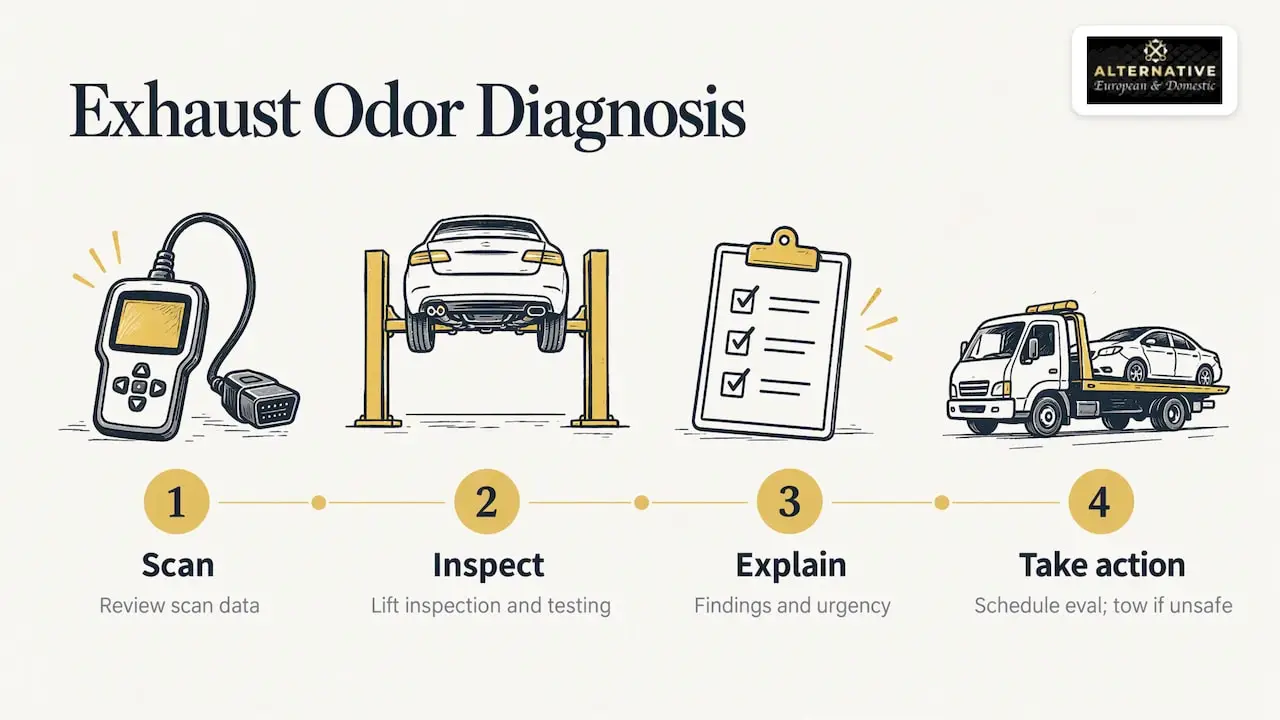
At Alternative European & Domestic, we diagnose exhaust and cabin odor complaints on European, domestic and high-performance vehicles, from daily-driven luxury sedans to turbocharged sports cars. We start with the evidence: scan data, a lift inspection and testing, then explain what we found and what is urgent. Related work, including engine repair, A/C and heating service and the rest of our service list, is handled in one place.
If you notice an exhaust smell, do not wait for it to get worse. Contact Alternative European & Domestic to schedule a diagnostic evaluation, and if the car is unsafe to drive, arrange a tow instead of making the trip yourself.
FAQ
What does it mean when you smell exhaust in your car?
It usually means exhaust gas is escaping from the manifold, a joint, the muffler or a seal and is being drawn toward the cabin. It can also be a rich-running engine or a failing catalytic converter. Because carbon monoxide has no odor, treat any exhaust smell inside the car as a reason to get it inspected quickly.
Can I drive my car if I smell exhaust?
Not if the smell is strong inside the cabin or you feel headache, dizziness or nausea. Stop, get fresh air and arrange a tow. For a faint, occasional smell with no symptoms, drive straight to a shop with windows open, and avoid idling in traffic or enclosed spaces.
Why do I smell exhaust when the heater or fan is on?
The HVAC system draws outside air from the cowl area near the base of the windshield. If a manifold or flex pipe leak puts exhaust near that intake, the fan pulls it inside. Switching to recirculation may reduce it temporarily, but it does not fix the leak, and it can trap fumes already inside.
What does a failing catalytic converter smell like?
Typically a sulfur or rotten egg odor, sometimes with reduced power, a rattle from the converter or a check engine light. AAA notes that a rotten egg smell often points to the converter. A technician should check for the upstream cause, such as a misfire, before replacing it.
How is an exhaust leak diagnosed?
A technician combines scan data, a lift inspection for soot trails and damaged parts, and a smoke or pressure test of the system. They also inspect the cowl, seals and floor openings that can let fumes in. The result should be a clear explanation of the source and the repair options.
Sources
- CDC: Carbon Monoxide Poisoning Basics
- CDC NIOSH: Carbon Monoxide
- AAA: 13 Common Car Problems Explained
- EPA: Carbon monoxide intrusion in sustained-use vehicles
- Consumer Reports: Ford Explorer carbon monoxide leaks
- Texas DPS: Inspection Criteria for Emission Inspection