
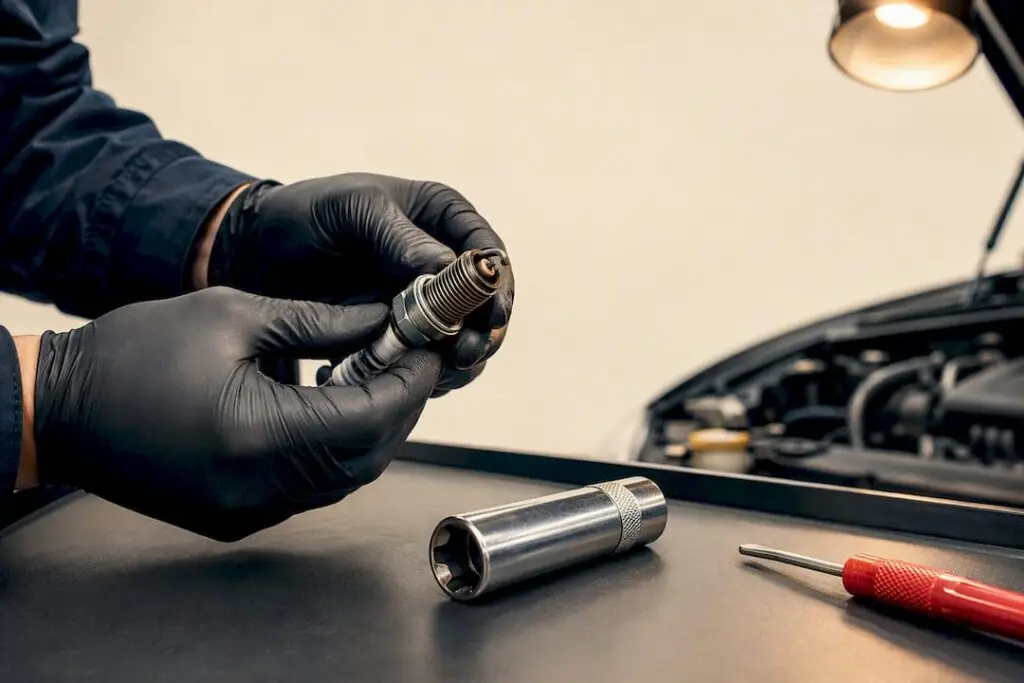
Follow your owner’s manual first, always. Beyond that, copper plugs typically last tens of thousands of miles, standard platinum plugs last about mid-range distances, and iridium or double-platinum plugs generally offer the longest service life, depending on the engine and plug design. Replace sooner if you notice misfires, rough idle, or hard starts, and keep every service receipt since the manufacturer may ask for that record during an emissions warranty claim.
TL;DR:
- Longer-lasting iridium and double-platinum spark plugs are recommended for modern engines, especially those with advanced ignition systems like coil-on-plug setups.
- Short trips, oil leaks, incorrect plug type, and poor ignition coils accelerate early plug wear, often resulting in fouling and reduced lifespan.
- Visual inspection of electrode wear, deposits, and insulator condition can help identify failing plugs before symptoms worsen or engine damage occurs.
- Sticking to the manufacturer’s recommended mileage intervals and keeping detailed service records protects warranty coverage and ensures optimal engine performance.
- Accurate diagnostic testing is crucial when misfires or rough idling persist, particularly in high-performance or European vehicles with complex ignition systems.
Table of Contents
- Spark Plug Replacement Interval by Material and Vehicle Type
- Signs Your Spark Plugs Are Failing Right Now
- What Shortens Spark Plug Life Faster Than Normal
- How to Inspect and Reinstall Spark Plugs the Right Way
- Spark Plug Replacement Cost and Whether DIY Makes Sense
- Why Dealer-Level Diagnostics Matter for Spark Plug Issues
- Where to Verify Your Exact Spark Plug Interval
- Our Take on Spark Plug Intervals
- Get Your Spark Plugs Checked the Right Way
- Sources
- FAQ
Spark Plug Replacement Interval by Material and Vehicle Type
The material inside the spark plug tip determines almost everything about how long it lasts. A copper-core plug wears fastest because the metal erodes under the heat and voltage of thousands of ignition cycles per mile. Platinum and iridium resist that erosion far better, which is why manufacturers can stretch the interval on those parts without risking a misfire down the road.
Here’s how the ranges typically break down:
- Copper plugs: generally shorter service life, common on older or budget-oriented engines and some small-displacement applications.
- Standard platinum plugs: a moderate service life used across many daily-driver vehicles.
- Double-platinum or iridium plugs: the longest service life, depending on the engine and plug design.
NGK, one of the more recognized names in ignition components, notes that precious-metal electrodes resist erosion better than copper, which is exactly why those plugs can go so much longer between changes. The catch is fitment. A precious-metal plug only delivers that extended life when it matches the engine’s heat range and design. Drop the wrong plug into the wrong engine and you lose the durability advantage entirely.
Some newer platforms push even further. Toyota’s owner guidance lists intervals around 80,000 miles on several models, reflecting how far ignition system design has come. Modern coil-on-plug systems and tighter fuel control reduce the stress each plug endures, so OEMs feel comfortable extending the factory schedule well past what older engines could handle.
Time-based replacement rarely matters for a vehicle driven normally, but it does for a seasonal car, a classic, or anything that sits for months at a stretch. If a vehicle covers under a few thousand miles a year, consider replacing plugs every three to five years regardless of mileage, since deposits and corrosion can build up during long idle periods even without heavy use.
Signs Your Spark Plugs Are Failing Right Now
A failing plug rarely fails quietly. Here’s what to watch for, in roughly the order most drivers notice them:
- Rough idle. The engine shakes or feels uneven at a stop, often the first sign something in the ignition chain is struggling.
- Misfires. You feel a stumble or hear a slight popping sound under load, sometimes accompanied by a check engine light with a code in the P0300 to P030x range, where the second set of digits identifies which cylinder is misfiring.
- Poor fuel economy. A worn plug can’t ignite the air-fuel mixture cleanly, so the engine compensates and burns more gas to make the same power.
- Hesitation or slow acceleration. Weak spark under load shows up most when you need power quickly, like merging onto a highway.
- Hard starting. A plug that can’t consistently spark makes cold starts, in particular, noticeably slower or rougher.
AAA Club Alliance identifies rough idling, misfires, poor fuel economy, and difficulty starting as the core symptom set worth acting on. One useful diagnostic clue: a misfire isolated to a single cylinder often points to that specific plug or its coil, while a misfire that jumps between cylinders or affects several at once usually signals a fuel delivery or sensor problem instead. If the check engine light is flashing rather than staying solid, or you feel a hard shudder under acceleration, stop driving and get the car scanned. A flashing light usually means an active misfire is dumping unburned fuel into the catalytic converter, and that can turn a $150 plug job into a much more expensive repair.
What Shortens Spark Plug Life Faster Than Normal
Plugs need to reach roughly 450°C to burn off deposits on their own, a process called self-cleaning. Short trips and constant low-speed city driving often never let the plug get that hot, so carbon and fuel residue build up and the plug fouls out early.
Oil contamination is another common culprit. A leaking valve cover gasket or worn piston rings let oil seep past and coat the electrode, which shows up as a dark, wet-looking deposit if you pull the plug for a look. Wrong heat range, incorrect plug type for the engine, and lean or rich fuel mixtures all accelerate wear too, as can weak ignition coils that force the plug to work harder to fire.
A few habits reduce that risk:
- Take a longer highway drive occasionally if most of your driving is short city trips.
- Address any oil leak near the valve cover before it reaches the spark plug wells.
- Always use the plug type and heat range specified for your engine, not a generic substitute.
- Have the fuel and ignition systems checked if you notice fouling on plugs pulled well before their expected interval.
Pro Tip: If you pull a plug and it’s coated in black, oily residue well ahead of schedule, don’t just replace the plug and move on. Chase down the oil leak first, or you’ll be back in the same spot in a few thousand miles.
How to Inspect and Reinstall Spark Plugs the Right Way
A used spark plug tells a story if you know how to read it. Here’s a practical checklist:
- Check the electrode shape. A rounded, worn tip instead of a sharp edge signals normal wear that’s progressed past its useful life.
- Look at the gap. Compare it to the OEM-specified gap; a gap that’s widened significantly means the electrode has eroded and spark quality has dropped.
- Inspect for deposits. Black, dry soot suggests a rich fuel mixture or short-trip fouling; oily, wet deposits point to oil intrusion; white or blistered deposits can indicate the plug is running too hot for the application.
- Examine the ceramic insulator. Cracks or chips mean the plug needs replacement regardless of mileage, since a compromised insulator can cause misfires or even engine damage.
When installing new plugs, torque them to the manufacturer’s exact specification using a calibrated torque wrench rather than guessing by feel. Ford’s maintenance guidance stresses using the correct gap and OEM-equivalent parts, since the wrong plug can cause performance issues and potentially affect warranty coverage. A good torque wrench guide is worth a look if you’re unsure which type suits this kind of work. Over-torquing can crack the ceramic or damage cylinder head threads; under-torquing risks poor heat transfer and a plug that works loose over time. Only use anti-seize compound if the manufacturer calls for it, since some modern plug coatings are designed to go in dry.
If you’re seeing intermittent misfires that don’t show up clearly on visual inspection, that’s the point to pull OBD-II codes and consider professional diagnostics rather than continuing to guess.
Spark Plug Replacement Cost and Whether DIY Makes Sense
Expect a typical total cost, including labor, somewhere between $100 and $250 for most vehicles, according to AAA. Larger engines, tight engine bay access, or dealership labor rates can push that number past $500, particularly on V6 or V8 layouts where rear cylinders are hard to reach.
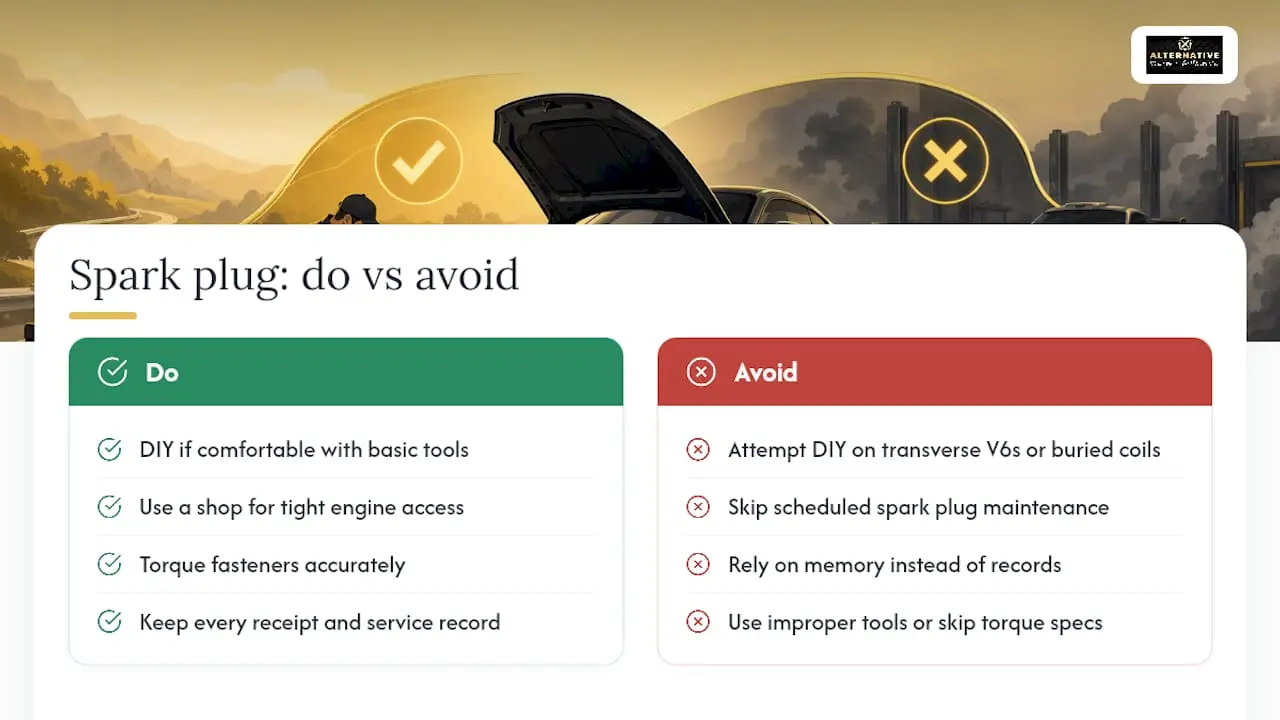
DIY replacement can make sense if you’re comfortable with basic hand tools, have good access to the plugs, and can torque fasteners accurately. It gets harder fast on transverse-mounted V6 engines or anything with coil-on-plug ignition buried under intake components, where a shop’s lift and specialized tools save real time and reduce the risk of a stripped thread or dropped plug down the intake.
Recordkeeping matters more than most owners realize. The EPA notes that skipping scheduled maintenance, including spark plug replacement, can lead to misfires and damage to emissions control components, and manufacturers may request maintenance records if a warranty claim on emissions equipment comes into question.
Keep every receipt and service record tied to spark plug and ignition work. If an emissions-related component fails later and the manufacturer questions whether maintenance was performed on schedule, documentation is what protects your warranty coverage.
A shop visit gets you a written service record automatically, which solves that documentation problem without extra effort on your part.
Why Dealer-Level Diagnostics Matter for Spark Plug Issues
Bring the car in when misfires are intermittent, codes keep returning after a plug swap, or you’re driving a high-performance European engine with tight access and expensive coil packs. A proper diagnostic sequence includes an OBD-II scan, coil primary and secondary testing, and a compression check when a mechanical issue is suspected. That sequence catches problems a visual plug inspection alone misses, including hairline electrode erosion and coil degradation. Documented service also protects your emissions warranty and feeds directly into a maintenance plan built around your specific vehicle.

Where to Verify Your Exact Spark Plug Interval
Your owner’s manual and the manufacturer’s support page list the exact interval for your engine, since factory specs vary by model year and powertrain. The EPA’s maintenance guidance explains why sticking to that schedule protects your emissions warranty, and AAA’s cost and interval data gives a useful real-world benchmark for budgeting the job.
Our Take on Spark Plug Intervals
The manufacturer’s interval isn’t a suggestion you can round up because the car still runs fine at 90,000 miles. It’s calibrated to the exact plug material, heat range, and ignition system in that engine, and pushing past it on a guess is how a $150 plug job turns into a coil pack replacement or, worse, catalytic converter damage. Keep your records. Check the manual before you assume a generic interval applies. If something feels off before that mileage number hits, get it looked at rather than waiting for the check engine light to make the decision for you.
— Alternative European & Domestic
Get Your Spark Plugs Checked the Right Way
Alternative European & Domestic gives you what a generic quick-lube chain can’t: dealer-level diagnostics on European, domestic, and high-performance engines, done by technicians who know exactly how coil-on-plug systems and tight-access V6 and V8 layouts behave when a plug starts to fail.

Instead of guessing at symptoms or gambling on a generic parts-store plug, you get an accurate read on what your engine actually needs, backed by documented service records that protect your emissions warranty down the road. Our Maintenance Service covers spark plug inspection and replacement as part of a maintenance plan built around your specific vehicle, not a one-size-fits-all mileage chart. If your car is showing rough idle, hesitation, or a check engine light, book an appointment with Alternative European & Domestic and get a diagnostic that tells you exactly what’s going on before small ignition issues turn into bigger repairs.
Sources
- Frequent questions related to transportation, air pollution, and climate change | US EPA
- What is the Average Spark Plug Replacement Cost? | AAA Automotive
- Niterra / NGK feature on precious-metal spark plugs
- How To Tell If A Spark Plug Is Bad | AAA Club Alliance
FAQ
How often should a spark plug be replaced?
It depends on the plug material: copper typically needs replacement around 20,000 miles, standard platinum about mid-range distances, and iridium or double-platinum plugs generally offer the longest service life, depending on the engine and plug design. Always check your owner’s manual for the exact interval, since it accounts for your specific engine and ignition system.
What kills spark plugs quickly?
Short trips that never let the plug reach its self-cleaning temperature, oil contamination from a leaking gasket or worn rings, and using the wrong heat range or plug type all cause premature failure. AAA Club Alliance also points to contamination and short-trip driving as common causes of early wear.
Can spark plugs last 20 years?
Mileage matters far more than age for spark plug wear, so a plug can technically sit for many years without failing if the vehicle is driven very little. That said, even low-mileage vehicles benefit from time-based replacement every few years, since corrosion and deposit buildup happen during storage regardless of mileage.
What are four signs a spark plug should be replaced?
The four most common signs are rough idle, engine misfires, poor fuel economy, and difficulty starting the engine. A check engine light with a misfire code, along with noticeable hesitation during acceleration, often accompanies these symptoms and signals it’s time for an inspection.
How much does spark plug replacement typically cost?
Total cost including labor generally falls between $100 and $250, though larger engines or dealership labor rates can push that past $500, according to AAA. Exact pricing details depend on your specific engine and plug type; please refer to the shop’s official sources for current information.