

Advanced electrical diagnostics is a dealer-level service that finds the root cause of complex electrical faults in wiring, sensors, control modules, and charging or starting systems. If your dashboard warnings keep coming back, your lights dim for no clear reason, or a new battery hasn’t solved a starting problem, that’s your signal to book a professional diagnosis rather than swapping parts and hoping.
TL;DR:
- Advanced electrical diagnostics test the entire vehicle electrical system, including wiring, sensors, modules, and CAN bus communication to identify root causes.
- Symptoms like intermittent dimming lights, persistent battery warnings, or unexplained starting issues require professional testing before replacing parts.
- Diagnostic procedures include live-data monitoring, voltage and parasitic load testing, wiring inspections, and specialized tools like oscilloscopes for intermittent faults.
- Real readings, such as around 12.6 volts at rest and 13.0-14.5 volts during running, are essential benchmarks for accurate diagnosis.
- Hybrid and electric vehicles need specialized high-voltage system testing conducted by trained technicians to ensure safety and accurate fault detection.
Table of Contents
- What advanced electrical diagnostics actually covers
- Symptoms that mean it’s time for a professional diagnostic
- How a shop diagnoses complex electrical faults
- The tools and benchmarks behind an objective diagnosis
- Preventing repeat electrical failures
- Safety precautions during advanced electrical diagnostics
- Common diagnostic procedures and techniques
- Challenges and limits of advanced electrical diagnostics
- Why dealer-level diagnostics matter for performance and European cars
- How we handle advanced electrical diagnostics at our shop
- FAQ
- Sources
What advanced electrical diagnostics actually covers
Modern vehicles run dozens of interconnected electronic systems, and a fault in one often masks or mimics a fault in another. That’s why dealer-level diagnostics look at the whole electrical architecture instead of guessing at a single part.
A thorough diagnostic typically examines:
- Battery, charging, and starting systems, including the alternator and its internal diodes
- Wiring harnesses, connectors, and chassis or engine grounds
- Sensors and actuators feeding data to the engine and body control modules
- Control modules themselves, since a module can fail internally or simply misread bad input
- CAN bus network communication, where one bad node can trigger warnings across several systems
Replacing a battery or alternator without testing first often fixes nothing if the real issue is a corroded ground or a failing module. For hybrid and electric vehicles, diagnostics extend further into the battery pack, power electronics, and drive system, which calls for technicians trained to the ASE L3 Light Duty Hybrid/Electric Vehicle Specialist standard rather than general electrical knowledge alone.
Symptoms that mean it’s time for a professional diagnostic
Electrical faults rarely stay quiet. They tend to announce themselves through a pattern of small annoyances before they strand you somewhere inconvenient.
- Flickering or dimming dashboard lights, especially when you turn on the A/C or headlights
- A battery-shaped warning light staying on or flashing intermittently
- Repeated dead batteries even after replacement
- Slow cranking or no-crank starting that comes and goes
- A whining or grinding noise from under the hood that changes with engine speed
- Random, unrelated check engine lights or electronics that cut out and come back
According to AAA’s guide to alternator and battery problems, these symptoms, flickering lights, a battery warning indicator, strange whining noises, and starting trouble that persists after a new battery, point to a charging or wiring issue that needs testing rather than assumptions. A car that won’t start at all, smells of burning electrical insulation, or shows smoke should be towed, not driven. Milder symptoms like occasional dimming usually allow for a same-day shop visit. Before you call, you can safely check that battery terminals are clean and clamped tight, since a loose connection sometimes mimics a deeper fault.
How a shop diagnoses complex electrical faults
A proper diagnostic follows a sequence, not a guess. It starts with intake: a technician reviews your vehicle’s service history and the symptoms you describe, then performs a visual inspection of the battery, terminals, belts, and visible wiring.
From there, the process typically includes:
- Reading OBD2 trouble codes and capturing live data while the engine runs
- Voltage and load testing on the battery and charging system
- Parasitic draw testing to catch something quietly draining the battery overnight
- Inspecting wiring and connectors for corrosion, chafing, or loose pins
- Interrogating control modules when codes point to a communication or software fault
- Specialist testing, such as oscilloscope work, when the fault is intermittent or electrical in nature rather than mechanical
Pro Tip: Bring any past repair receipts or code readouts with you. A pattern of repeat failures helps a technician skip straight to the likely cause.
You should leave with written findings, a plain explanation of what’s wrong, a cost estimate for repairs, and a plan to verify the fix once it’s made. A basic code read and inspection often takes under an hour. In-depth troubleshooting involving intermittent faults, module testing, or wiring traces can take considerably longer, sometimes requiring the car stay overnight so a technician can reproduce the fault under real driving conditions.
The tools and benchmarks behind an objective diagnosis
A credible electrical diagnosis isn’t a guess dressed up with a fancy name. It rests on measurable numbers that either confirm or rule out a suspect.
Shops rely on a standard toolkit:
- An OBD2 scanner with live-data capability to read codes and watch sensor values in real time
- A multimeter for voltage and resistance checks
- A clamp meter for current and parasitic draw testing
- A dedicated battery and alternator tester
- An oscilloscope for intermittent or signal-based faults that a scanner can’t catch
- Wiring probes for checking continuity without damaging connectors
A healthy battery reads roughly 12.6 volts at rest, and the charging system should run between approximately 13.0 and 14.5 volts with the engine on. Readings outside that range, or voltage that drops noticeably when you switch on accessories, point to a charging or wiring problem rather than a simple dead battery.
Technicians isolate the real culprit through voltage-drop testing across connectors and grounds, a charging system run test, and a parasitic draw test with a clamp meter. Each step rules something out before a part gets replaced, which is the difference between a diagnosis and a guess.
Preventing repeat electrical failures
Most electrical breakdowns don’t happen overnight. They build slowly through corrosion, worn connections, or a battery that’s past its useful life, and routine attention catches them early.
A few habits make a real difference:
- Have your battery and charging system checked during scheduled maintenance visits, not just when something fails
- Replace a battery proactively once it’s showing age, rather than waiting for it to strand you
- Keep terminals clean and tightly clamped
- Address a warning light when it first appears instead of resetting it or ignoring it
Pro Tip: A temporary fix, like disconnecting a battery to clear a fault code, almost never addresses the underlying issue and can let a small problem grow into a bigger one.
European and high-performance vehicles tend to carry more sensors and tighter tolerances than typical commuter cars, so a customized maintenance plan with periodic electrical checks catches drift before it becomes a dashboard full of warnings.
Safety precautions during advanced electrical diagnostics
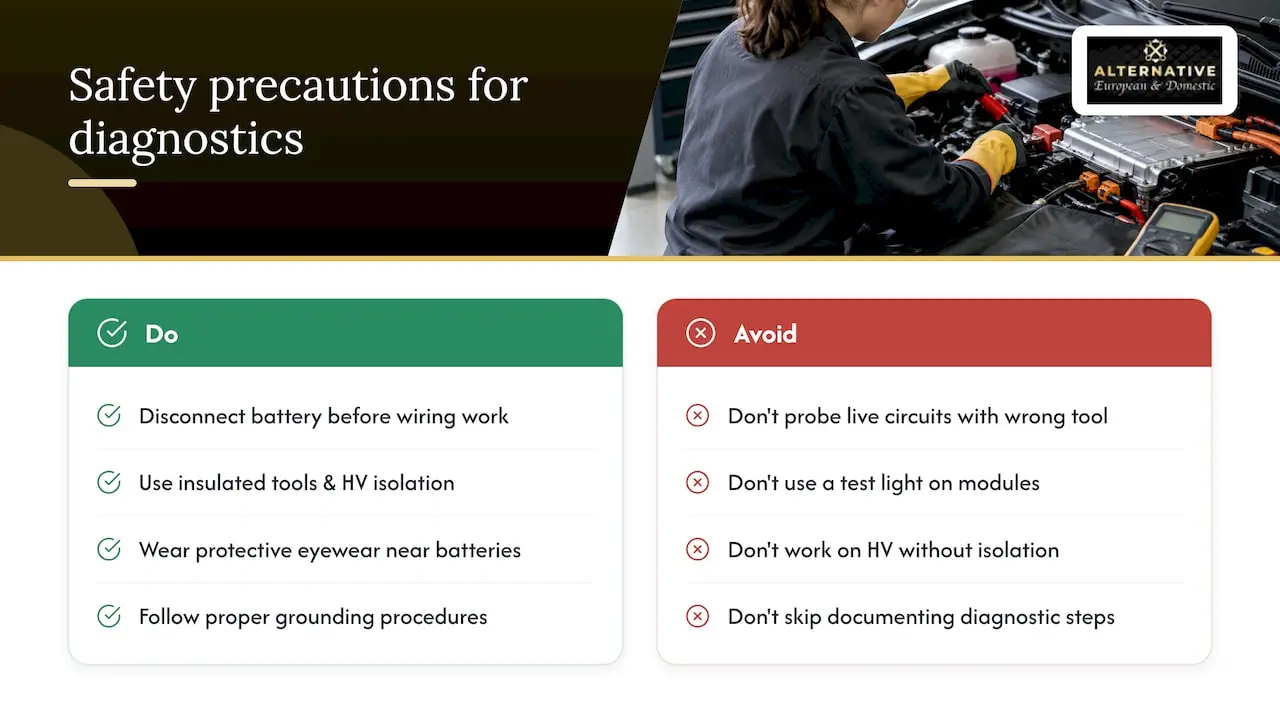
Electrical systems carry real risk, both to the vehicle and to the person working on it, so a competent shop follows a few non-negotiable precautions. Technicians disconnect the battery before working on wiring or modules whenever a short circuit or accidental power-up could cause damage or injury. High-voltage hybrid and electric components are treated with additional caution, since their battery packs operate at voltages far beyond a standard 12-volt system and require insulated tools and proper isolation procedures.
Technicians also avoid probing live circuits with the wrong equipment, since a standard test light can draw enough current to damage a sensitive module. Protective eyewear matters when working near a battery, which can vent corrosive gas or, in rare cases, cause a spark near flammable vapors. Grounding procedures are followed carefully too, since an improperly grounded test can send a false signal through a control module or damage it outright.
Finally, a shop documents each step of a diagnostic before making changes, so that if a fault is intermittent, the technician has a clear record of what was tested, what the readings were, and what hasn’t yet been ruled out. That discipline protects both the vehicle and the accuracy of the final diagnosis.
Common diagnostic procedures and techniques
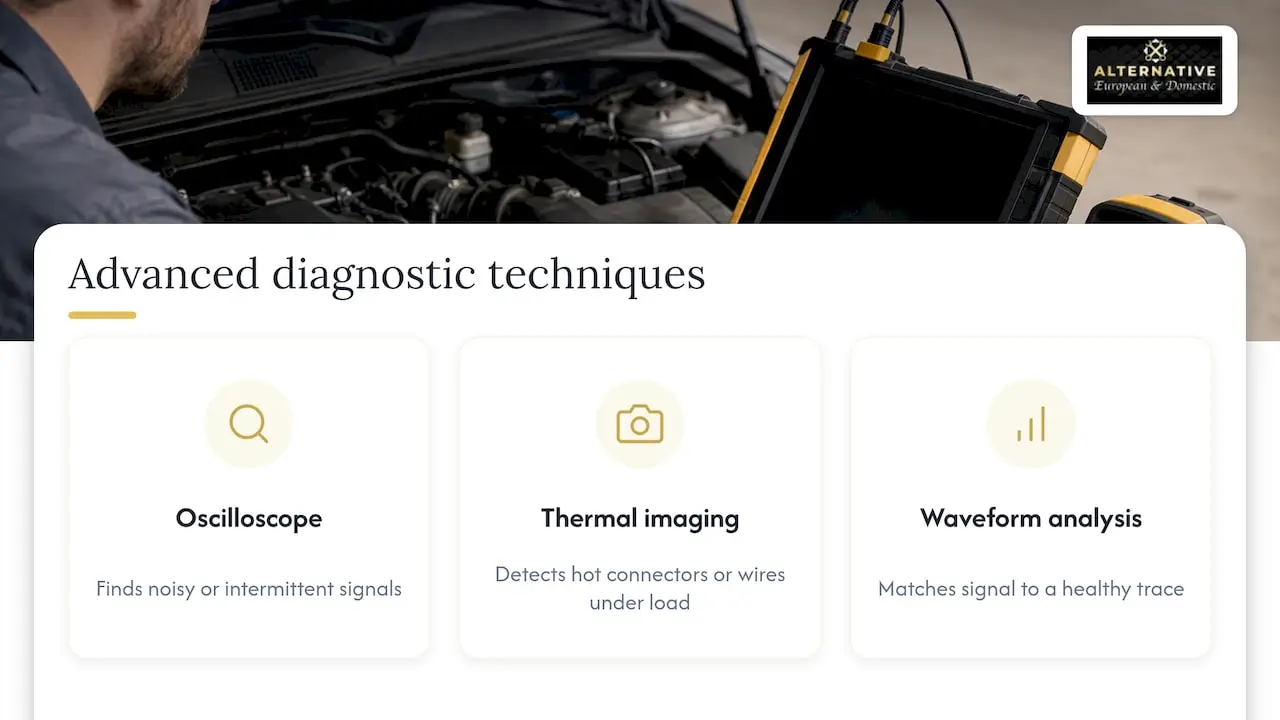
Beyond a basic code read, dealer-level diagnostics draw on a handful of specialized techniques for faults that don’t show up as a clean trouble code. An oscilloscope captures the actual voltage waveform from a sensor or circuit in real time, which matters for problems a scanner can’t describe, like a signal that’s noisy, delayed, or dropping out intermittently rather than simply absent.
Thermal imaging helps spot a connector or wire that’s running hotter than it should under load, often a sign of corrosion or a poor connection before it fails completely. Signal waveform analysis takes the oscilloscope reading a step further, comparing the shape of a sensor’s output against what a healthy signal should look like to catch a fault that would otherwise pass a simple on/off test.
These techniques matter most for intermittent faults, the kind that disappear the moment a car is parked in a bay and a scanner is plugged in. Reproducing the conditions that trigger the fault, whether that’s engine load, a bumpy road, or an accessory switching on, is often the real skill involved, not just owning the equipment.
Challenges and limits of advanced electrical diagnostics
Even dealer-level diagnostics have real limits, and it helps to know them going in. Intermittent faults are the hardest category by far: a connection that only fails when it’s hot, vibrating, or under a specific load might not show up during a short test drive, which can mean more than one visit before the fault is caught.
Proprietary module software on European and luxury vehicles can also require manufacturer-specific scan tools and access to service bulletins that a general-purpose scanner doesn’t cover. A fault that looks electrical sometimes has a mechanical root cause, or the reverse, which means diagnosis occasionally takes longer than expected as one system is ruled out and attention shifts to another.
Cost is a practical limitation too: in-depth testing, including overnight monitoring or module interrogation, takes technician time, and that time is part of what you’re paying for when a diagnosis goes beyond a quick code read. None of this makes advanced diagnostics unreliable, it just means a fair diagnostic process sometimes takes patience, especially on a fault that hides itself the moment it’s being watched.
Why dealer-level diagnostics matter for performance and European cars
Dealer-level diagnostics exist because guessing is expensive. A string of part swaps that don’t fix the actual fault costs more than one accurate diagnosis, and repeated electrical work can quietly erode a vehicle’s resale value if it’s not documented properly.
What separates a dealer-level approach is the combination of proper tools, technicians trained to standards like ASE A6 for electrical and electronic systems, and a willingness to explain what the numbers actually mean rather than just naming a part to replace. You should expect a written explanation of what was tested, what the readings showed, and why a specific repair is recommended, not just a price.
— Alternative European & Domestic
How we handle advanced electrical diagnostics at our shop
We approach every electrical diagnosis with a consistent process: test first, explain clearly, then repair only what the data shows needs fixing. Technicians work through charging system checks, wiring and connector inspection, module testing, and parasitic draw testing before recommending any repair, and findings are explained in plain language with a written estimate.

Our electrical and related services cover:
- Electrical system diagnostics and wiring repairs
- Battery, alternator, and starter testing and replacement
- Control module diagnosis
- Customized maintenance plans that include periodic electrical checks
Before your visit, jot down when the symptoms happen, note any recent repairs, and be ready to leave your car with us if deeper testing is needed to catch an intermittent fault. Book an appointment with Alternative European & Domestic and let our ASE-trained team give you a clear answer instead of another guess.
FAQ
What does advanced electrical diagnostics mean for my car?
It means a dealer-level inspection of your wiring, sensors, control modules, and charging or starting systems that finds the actual cause of a fault rather than replacing parts by trial and error. It typically includes code reading, live-data capture, and voltage testing performed by a technician trained to standards like ASE A6.
How do I know if it’s the alternator or the battery?
A resting battery around 12.6 volts with a running voltage that doesn’t climb into the normal 13.0 to 14.5 volt charging range usually points to the alternator rather than the battery. A quick alternator failure guide also covers dimming lights and whining noises as early warning signs worth checking before assuming the battery is at fault.
Can a cheap code reader diagnose an electrical fault?
A basic OBD2 code reader can pull stored trouble codes, but it usually can’t show live sensor data, voltage drops, or catch an intermittent fault the way shop-grade equipment can. Dealer-level diagnostics combine a scanner with a multimeter, clamp meter, and sometimes an oscilloscope to confirm the actual cause.
How long does an electrical diagnostic take?
A straightforward code read and inspection often takes under an hour, while an intermittent or module-related fault can take longer since it may need to be reproduced under real driving conditions. Some vehicles need to stay with the shop overnight for monitoring before a cause is confirmed.
Do electric and hybrid vehicles need different diagnostics?
Yes, hybrid and electric vehicles carry high-voltage battery packs and power electronics that require specialized training beyond standard electrical diagnostics, covered under the ASE L3 Light Duty Hybrid/Electric Vehicle Specialist certification. These systems need insulated tools and isolation procedures that a standard 12-volt diagnostic doesn’t require.