
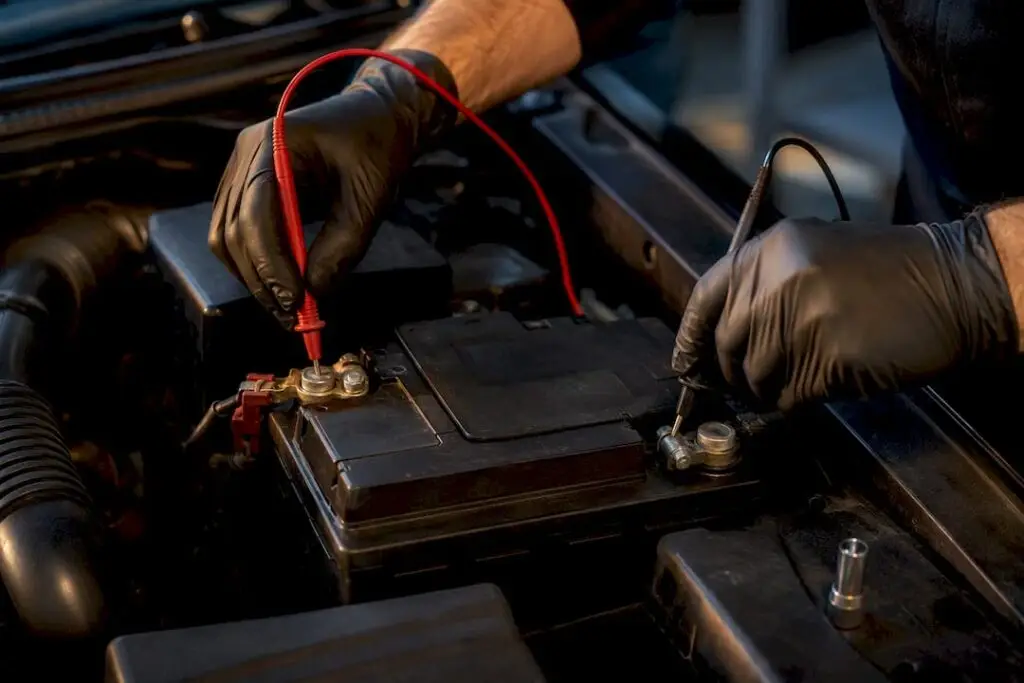
“No crank no start” means the engine won’t turn over at all when you turn the key or press the ignition button. It’s different from “crank no start,” where the starter spins the engine but it never fires up. The single most useful first move is checking your battery terminals for corrosion or looseness and measuring voltage before you touch anything else. Stop cranking immediately if you smell fuel, hear grinding, or the dash lights dim and die with each attempt.
TL;DR:
- A complete battery voltage of at least 12.6 volts at rest and proper grounding are essential for diagnosing a no-crank condition; lower voltage suggests the battery may be dead or failing.
- Rapid clicking during startup indicates a weak battery or poor connections, while a single click usually points to voltage issues with the starter solenoid or corrosion at cable ends.
- Confirming the exact symptom, such as silence, one click, or full crank with no start, guides the troubleshooting focus towards electrical, neutral safety switch, or start-permission systems.
- Checking and cleaning battery terminals and ground straps, as well as performing voltage-drop tests across cables, can reveal hidden wiring or corroded connections causing no-start issues.
- If the engine cranks but does not fire, testing fuel delivery, spark, and compression, along with scanning for diagnostic trouble codes, is necessary to identify mechanical or fuel system faults.
Table of Contents
- Quick Triage Checklist for a No-Crank No-Start
- What Does Silence, a Click, or Rapid Clicking Actually Mean?
- Battery, Cables, and Grounds: The Checks Most People Skip
- Starter, Relays, Fuses, and Start-Permission Systems
- The Engine Cranks but Won’t Start: Fuel, Spark, and Compression
- When to Stop and Call a Professional
- How a Dealer-Level Shop Actually Diagnoses This
- Book a No-Crank No-Start Diagnosis in Dallas
- Sources
- FAQ
Quick Triage Checklist for a No-Crank No-Start
Before you call anyone or start swapping parts, run through this sequence. It takes about ten minutes and rules out the most common culprits, in order of likelihood.
- Confirm the exact symptom. Silence, one click, rapid clicking, or a full crank that just won’t fire are four different problems. Write down which one you have.
- Watch the dash during the attempt. Do the lights come on full brightness, dim, or stay dark? Does a security or immobilizer icon flash?
- Try Neutral and a spare key. Automatic transmissions need to sense Neutral or Park; a bad neutral safety switch blocks crank entirely. A different key rules out a bad transponder chip.
- Check and secure the battery terminals. Wiggle them by hand. If they move or show white or greenish crust, that’s often the whole problem.
- Listen for the fuel pump prime. Turn the key to “on” (not start) and listen for a two-second hum from the rear of the car. Also watch for security lights that stay lit longer than usual.
- Know when to stop. A fuel odor, a grinding sound, or a battery that gets weaker with each try means it’s time to stop and call a shop.
Pro Tip: Keep a small notebook or your phone notes open while you troubleshoot. Recording exactly what happened on each attempt, click count, dash behavior, voltage reading, saves a technician real diagnostic time and often saves you money on the visit.
What Does Silence, a Click, or Rapid Clicking Actually Mean?
The sound (or absence of one) when you turn the key tells you which system to suspect first.
- Complete silence usually points to a control-side issue: a blown fuse, a failed ignition switch, a neutral safety switch out of adjustment, or an immobilizer refusing to authorize the start.
- A single click typically means the solenoid is engaging but the starter motor itself isn’t turning the engine. This is a classic sign of voltage loss between the battery and starter, corroded cable ends, or a worn-out starter.
- Rapid clicking almost always signals battery voltage collapsing under load. The solenoid has enough power to engage but not enough to hold, so it cycles. A jump-start or a battery load test settles this quickly.
- The engine cranks normally but won’t fire shifts your attention away from the starting system entirely and toward fuel delivery, spark, or compression. Pull codes with an OBD-II scanner at this point rather than guessing.
Getting this part right matters more than any other step. Chasing a starter replacement when the real issue is a corroded ground strap wastes both time and money.
Battery, Cables, and Grounds: The Checks Most People Skip
A resting battery should read close to 12.6 volts, with the charging system pushing 13 to 14 volts once the engine runs. Anything under roughly 12.0 volts at rest is a strong hint the battery is the problem, even if it seems to “have some life” when you turn on the headlights.
Jump-starting has a right way and a wrong way. Connect the positive cable to the dead battery’s positive terminal, but run the negative cable to a solid piece of unpainted metal on the engine block, not the dead battery’s negative post. That keeps sparks away from the battery itself, which can vent hydrogen gas.
- Clean corroded terminals with a wire brush and retighten them; a loose or crusted connection can mimic a dead battery entirely.
- Check the braided ground strap between the engine and the chassis. Corroded ground straps hide behind heat shields and wheel wells, and they can cause a no-crank even when your accessories, radio, lights, power windows, work fine.
- If you have a multimeter, run a voltage-drop test across the starter’s positive feed and ground path while a helper cranks the engine. Vehicle Service Pros notes that readings should stay under about 0.5 volts on each side; anything higher points to a corroded cable or a failing ground connection that needs repair, not a new starter.
That last point trips up a lot of DIY diagnosis. A battery that tests fine and a starter that spins on the bench can still fail to crank the car because the connection between them is quietly eating voltage.
Starter, Relays, Fuses, and Start-Permission Systems
Once the battery and cables check out, the next suspects are the parts that control whether the starter is even allowed to engage.
- Locate the starter relay in the fuse box (check your owner’s manual for the exact slot) and swap it with an identical relay if one is available, then retry.
- Test Park versus Neutral directly. If the car cranks in Neutral but not Park, or vice versa, the neutral safety switch or shift interlock needs attention.
- A flashing security or key icon on the dash usually means the immobilizer isn’t recognizing your key. Try a second key before assuming the worst.
- If you or a previous owner installed an aftermarket remote starter or alarm, that module can silently interrupt the starter circuit without tripping any warning light.
- Bench-testing or replacing the starter only makes sense after the relay, fuses, grounds, and permission switches have all checked out clean.
The Engine Cranks but Won’t Start: Fuel, Spark, and Compression
When the starter clearly turns the engine over but it never fires, the problem has moved past the starting system. Listen for the fuel pump’s brief hum when you turn the key to “on.” If you hear nothing, check the fuel pump fuse and relay before assuming the pump itself failed.
Spark issues need a spark tester or a professional check. Don’t pull a plug wire and hold it near metal to “see a spark,” that’s a shock risk and it won’t tell you much anyway.
- Fast, unusually easy cranking with no resistance can mean a timing belt or chain has failed, especially on interference engines where that failure bends valves.
- Recent timing belt work followed by a no-start is a red flag worth mentioning to a technician immediately.
- Pull codes with an OBD-II scanner early. A crankshaft or camshaft position sensor fault often shows up here before you waste time guessing.
Pro Tip: If the engine cranked fine yesterday and suddenly cranks unusually fast with no start today, stop and get it towed rather than cranking it again. That symptom pattern often means a broken timing component, and running the starter repeatedly won’t fix it and may cause more damage.
When to Stop and Call a Professional
Stop cranking the moment you smell fuel, hear grinding metal, or notice the starter cranking slower with each attempt. Repeated cranking can overheat the starter and wash fuel into the cylinders, turning a simple no-start into a harder repair.
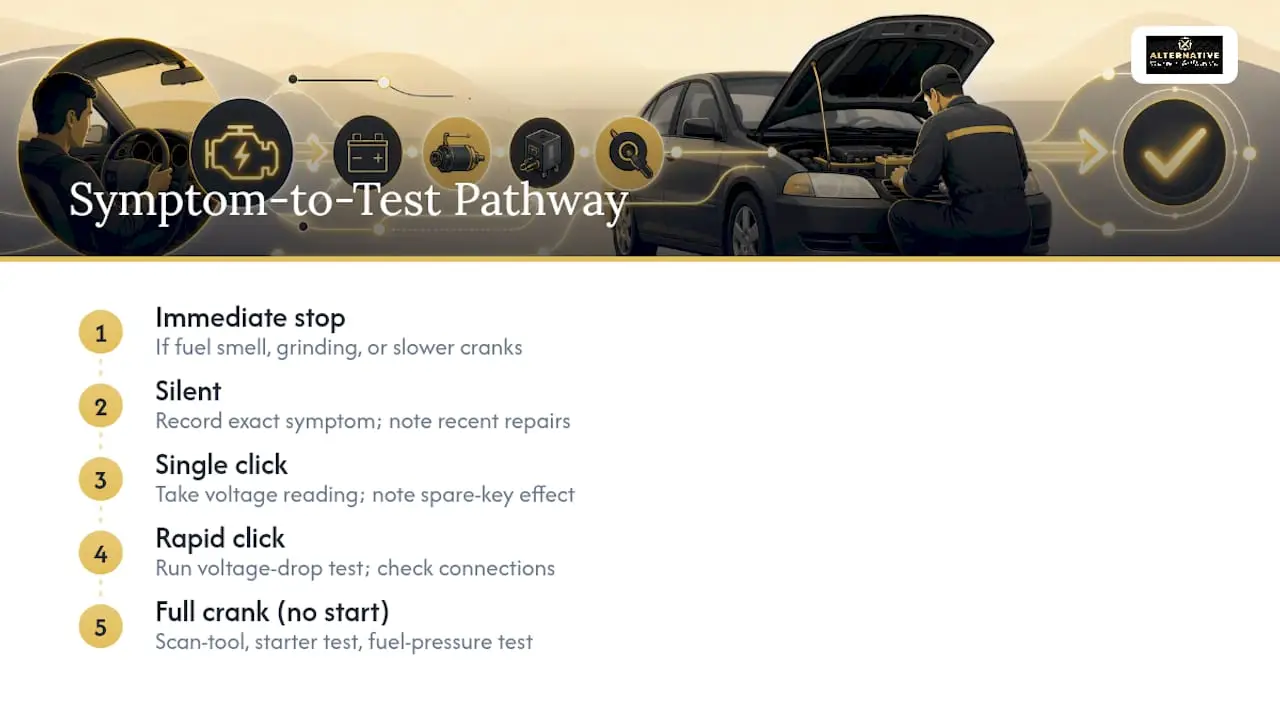
Before you call, jot down the exact symptom (silent, single click, rapid click, or full crank), any recent repairs, whether a spare key changes anything, and any voltage readings you took. That short list lets a shop run scan-tool checks, voltage-drop tests, and starter or fuel pressure testing without repeating steps you’ve already done.
How a Dealer-Level Shop Actually Diagnoses This
A proper no-crank no-start workflow starts with a full module scan, since a code stored in an unrelated system can quietly block starter permission on modern, heavily networked vehicles. From there, technicians move through voltage-drop testing, starter bench or load testing, and, when the symptoms point that way, fuel pressure and compression checks. Transparency in reporting what was actually tested is what keeps customers from paying for parts that were never the problem in the first place.
— Alternative European & Domestic
Book a No-Crank No-Start Diagnosis in Dallas
Guessing at starters, batteries, and relays gets expensive fast, and it rarely fixes a no-crank no-start problem on the first try. This shop runs the same structured sequence covered above—scan, voltage-drop testing, starter and fuel system checks—so you pay for the actual fix instead of a string of parts swaps.

When you arrive, have your VIN, a description of exactly what happened (silent, single click, rapid click, or full crank with no start), any recent repair history, and any voltage readings you already took. That intake information lets the diagnostic move straight to the likely cause instead of starting from zero. If your European, domestic, or high-performance vehicle won’t crank or won’t start, schedule a diagnostic appointment with Alternative European & Domestic in Dallas and get a clear answer before you spend money on parts you may not need.
Sources
- Carparts
- Why doesn’t the engine crank over? | Vehicle Service Pros
- Quick start/no-start guide – Alldata
FAQ
Why Is My Car Not Starting and Not Cranking?
A no-crank condition usually traces back to a weak or dead battery, corroded terminals, a bad ground strap, a failed starter relay, or a start-permission issue like a neutral safety switch or immobilizer refusing to authorize the start.
What Sensors Can Cause a No Crank No Start?
The crankshaft position sensor and camshaft position sensor can prevent a crank-no-start condition, and a fault in an unrelated control module can also block starter permission even though the actual starting system is fine.
I Turn the Key and Nothing Happens, No Click at All. What Does That Mean?
Complete silence with no click usually points to a control-side problem such as a blown fuse, a failed ignition switch, or an immobilizer that isn’t recognizing your key, rather than a dead battery, since a truly dead battery often still produces a faint click or dim light.
What Does Crank No Start Mean?
Crank no start means the starter motor successfully turns the engine over, but the engine fails to fire due to a fuel delivery problem, a missing spark, or a mechanical issue like a broken timing belt, and it requires different checks than a no-crank condition.