
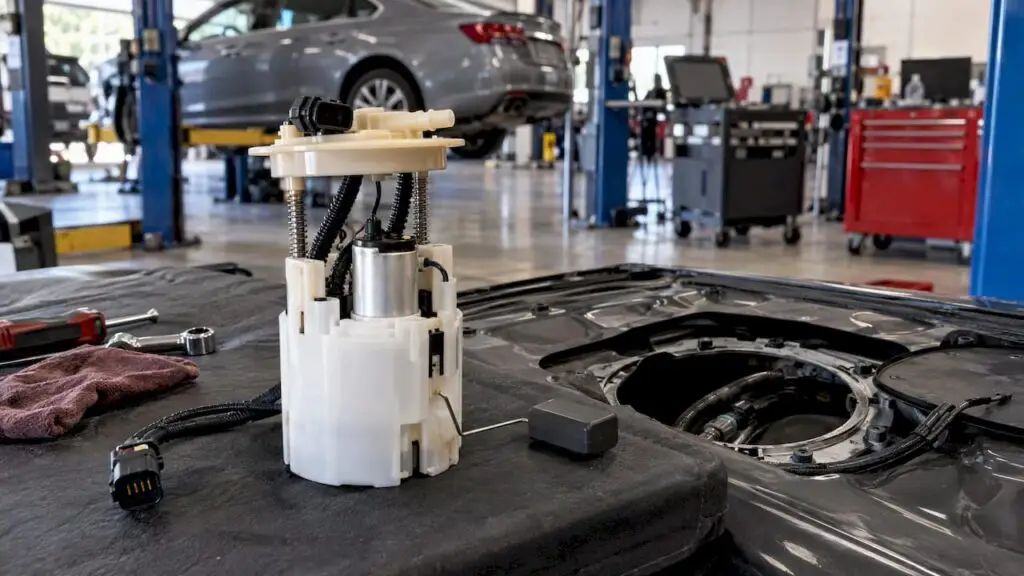
A failing low pressure fuel pump, the in-tank pump that feeds fuel toward the engine, usually shows up as long cranking or a hard start, hesitation or power loss under load, stalling, a whine from the tank, or surging at steady speed. These signs overlap with clogged filters, bad fuel, weak relays and ignition faults, so the pump should not be replaced on symptoms alone. A proper diagnosis measures pressure, volume and pump control while the problem is happening.
This guide is for Dallas drivers of European, domestic and high-performance cars. It covers what to watch for, what else causes the same complaints, when to stop driving, and how a shop confirms the cause before replacing parts.
TL;DR
- Typical symptoms: extended cranking, stalling, hesitation or power loss under load, a whining tank, and intermittent no-start.
- The same symptoms can come from a clogged filter, contaminated fuel, a failed relay or fuse, wiring problems, or injector and ignition faults.
- A pump can hold correct pressure at key-on and still fail under load, because pressure and volume are different measurements.
- Stalling in traffic or at highway speed is a safety issue. Do not keep driving a car that cuts out, and call for a tow when it does.
- Ask for a diagnosis that reproduces the complaint, not a part swap based on a code or one reading.
Table of Contents
- What the low pressure fuel pump does
- Low pressure fuel pump symptoms, in the order drivers notice them
- What else mimics a weak fuel pump
- Why a quick pressure test can mislead
- How a shop diagnoses it
- Electronic control and tuning considerations
- When to stop driving and when to tow
- Does low fuel damage a pump?
- Preventive steps that protect the pump
- Repair options
- Fuel system diagnosis at Alternative European & Domestic
- FAQ
- Sources
What the low pressure fuel pump does
Most modern gasoline cars use two stages. The low pressure pump, usually an electric pump inside the fuel tank, moves fuel forward at moderate pressure. On direct-injection engines, a mechanical high pressure pump on the engine then raises that pressure for the injectors. If the first stage cannot keep up, the second stage has nothing to work with, and the engine runs lean or starves.
That is why a weak in-tank pump can look like an engine problem. The driver feels a misfire-like stumble, and the scan tool may show lean codes or low rail pressure rather than anything pointing at the tank.
Two details matter for diagnosis:
- Many low pressure pumps are controlled by the engine computer and may use pulse-width modulation, so the right question is not simply whether voltage is present. The command, output, ground, current draw and pressure response all need checking.
- On direct-injection systems, there is typically no Schrader valve to hook a gauge to, even on the low side. Pressure is read with a scan tool or a specialized adapter, which is one reason dealer-level equipment matters.
Low pressure fuel pump symptoms, in the order drivers notice them
Long cranking or hard starting
The engine turns over normally but takes several seconds to fire, especially when warm. A pump that is losing output may not build enough pressure in the short key-on prime. Some cars start on the second or third key cycle, which is a classic clue.
Hesitation or power loss under load
The car drives fine around Oak Lawn at 30 mph, then stumbles climbing an on-ramp to I-35E or the Dallas North Tollway, or when towing. Demand for fuel rises with load, and a worn pump cannot deliver the volume. This is the symptom most often missed by quick tests.
Stalling or intermittent cut-outs
The engine dies and restarts after a few minutes, or dies at idle after a hot soak. Heat can expose weak pump motors, tired connectors and failing relays. Because the fault comes and goes, a shop may need to reproduce it rather than just read codes.
Whining or buzzing from the tank
All electric pumps hum. A louder whine, a change in pitch, or noise that grows as the fuel level drops deserves attention. A noise alone does not prove failure, but it supports other findings.
Surging at steady speed
The car speeds up and slows by itself with a steady throttle. Fluctuating fuel delivery can cause it, though throttle, mass airflow and vacuum faults can too.
Rough idle, misfires and a check engine light
Low fuel delivery can set lean codes or misfire codes. Do not assume the code names the failed part. Our guide to finding misfires on European and performance cars explains why a misfire code is the start of the diagnosis, and this walkthrough of check engine light diagnosis shows how live data narrows the cause.
Worse fuel economy and a no-start
Poor mileage is a weak indicator by itself. A complete no-start, with a cranking engine that never fires, is the late stage. If that is your situation, see how to diagnose a no-crank or no-start condition for the order a shop follows.
What else mimics a weak fuel pump
Before a pump is blamed, a technician rules out the cheaper and more common possibilities. Here is how they compare.
| Symptom | Could be the pump | Could also be |
|---|---|---|
| Long crank | Pressure bleeding down or slow to build | Weak battery, crank sensor, leaking injector |
| Stumble under load | Insufficient volume | Clogged filter, ignition coil, boost leak on turbo cars |
| Stall when hot | Heat-weakened pump motor | Relay, connector, crank sensor |
| Surging | Erratic delivery | Throttle body, MAF sensor, vacuum leak |
| No start | Pump not running | Blown fuse, immobilizer, no spark |
Three of these deserve extra explanation.
Fuel filter or restricted lines. A restriction produces low pressure downstream even with a healthy pump. Not every car has a serviceable filter, since many are built into the pump module, so this varies by model.
Contaminated fuel. Bad fuel can cause starvation indirectly. According to an EPA memorandum on water phase separation, liquid water contacting gasoline can lead to phase separation. Collecting a sample and checking for cloudiness, particulates or water before replacing parts is a sensible first step when the complaint began right after a fill-up.
Electrical faults. Fuses, relays, grounds and connectors fail more often than people expect, and heat makes them worse. For the testing logic behind this, read how ASE-certified shops test advanced electrical faults.
On turbocharged cars and trucks, a boost leak can feel like a fuel problem. Pressure testing for boost leaks separates the two.
Why a quick pressure test can mislead
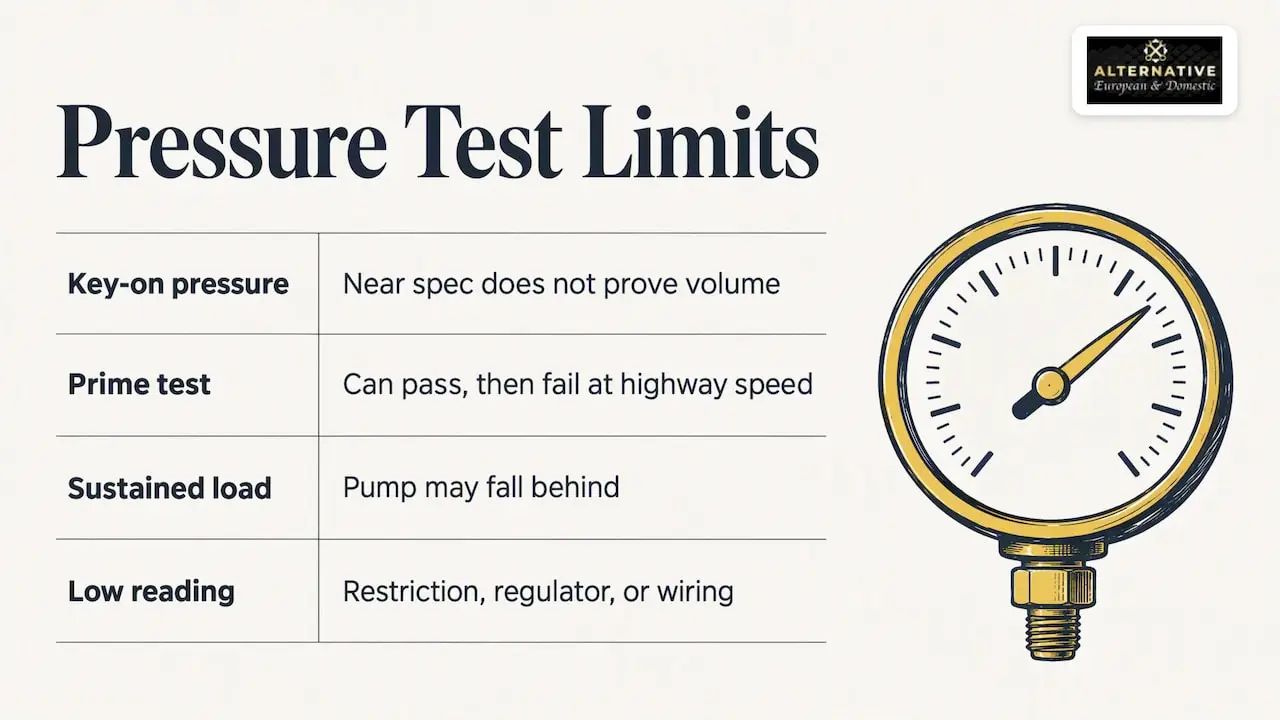
A common shortcut is to connect a gauge, see a number close to spec at key-on, and either condemn or clear the pump. Both conclusions can be wrong.
Correct static pressure does not prove adequate volume under sustained load. A pump can pass a prime test and still fall behind at highway speed. The reverse also happens: a low reading can come from a restriction, a pressure regulator or a wiring problem, not a worn pump.
The ASE Advanced Engine Performance (L1) study guide describes the skills involved: diagnosing hot or cold no-starts, hard starting, stalling, surging and power loss across fuel systems, including direct injection. The ASE L1 test content outline is the industry’s reference for that scope.
How a shop diagnoses it
The exact procedure varies by vehicle, but the order below reflects sound practice. We have not listed any test results or case studies here, because every car differs.
- Verify the complaint. When does it happen: cold, hot, at idle, under load, at low fuel? Notes from the driver help more than most people think.
- Scan for codes and freeze-frame data. Look at fuel trims, rail pressure where available, and misfire counts. Codes point to a system, not a part.
- Check fuel quality. Take a sample if the problem began after refueling.
- Inspect the basics. Fuse, relay, connectors at the pump and tank, and grounds.
- Test pump control. Confirm the commanded duty cycle, the voltage at the pump, ground quality and current draw. A pump drawing abnormal current can be failing even when pressure looks acceptable.
- Measure pressure and volume under the condition that causes the symptom. This may mean a road test with monitored data, or a load simulation, rather than a bench-style key-on check.
- Rule out downstream causes. Injectors, high pressure pump, regulators and ignition components.
- Confirm after repair. Recheck the same data under the same condition that failed.
If you want to know what a shop should be able to tell you after the work, our list of questions to ask a mechanic is a good checklist. For what to expect on fees, see what shops charge for a diagnostic.
Electronic control and tuning considerations
On many late-model European and performance vehicles, pump output is a calculated strategy, not a fixed pressure. The engine computer adjusts low side feed and high pressure pump control based on demand. If the car has been remapped, an unsuitable calibration can request more fuel than the hardware can supply, and the symptoms mimic a weak pump. For background on how feed pressure and pump strategy interact, this overview of high pressure pump control strategy and tuning is a useful reference.
If your car is modified, tell the shop up front. It changes which tests make sense and prevents a good pump from being replaced to solve a calibration issue.
When to stop driving and when to tow
Fuel delivery faults are a safety matter because the engine can lose power without warning.
- Stop driving and call for a tow if the engine stalls repeatedly, dies at speed, restarts only after long waits, or loses power so badly you cannot keep up with traffic. Stalling in a left turn lane on Cedar Springs or Lemmon Avenue is not worth the risk.
- Tow, do not keep cranking, if the car cranks but will not start. Repeated cranking drains the battery and can flood or overheat components.
- Pull over safely and do not continue if you smell raw fuel, see fuel dripping, or see a flashing check engine light. Fuel leaks are a fire hazard, and a flashing light signals active misfire that can damage the catalytic converter. Our guide to service lights and when to stop or tow covers the distinctions.
- Schedule soon if you only notice occasional long cranks or mild hesitation. Intermittent symptoms usually get worse, not better.
If the car enters reduced power mode, see what causes limp mode before you drive on.
We do not recommend dropping the tank or testing fuel lines at home. Fuel is flammable, systems are under pressure, and modern fuel systems often need scan tool access to test safely.
Does low fuel damage a pump?
In many cars the in-tank pump uses the surrounding fuel for cooling and lubrication, so running the tank near empty regularly is a habit worth avoiding. We have not seen a single threshold that applies to every vehicle, so check your owner’s manual. A practical rule is to refuel when the gauge reaches a quarter tank, particularly in Texas summers.
Preventive steps that protect the pump
There is no maintenance item that guarantees a pump lasts a set mileage, but good habits reduce risk.
- Refuel from busy stations with high turnover, and avoid running the tank dry.
- Replace the fuel filter at the manufacturer’s interval if your car has a serviceable one.
- Fix electrical issues early: corroded grounds and weak batteries stress pump circuits.
- Do not ignore small symptoms such as a longer crank. Note when they occur.
- Keep the battery and charging system healthy. See alternator failure symptoms for early warnings.
- Follow a customized maintenance plan based on your car and how you drive.
Repair options
Once testing confirms the pump, the options usually include replacing the pump module or pump assembly with quality parts, along with related items such as the strainer, seals or connectors if they are worn. Whether a pump can be replaced separately from the module depends on the vehicle. After the repair, the fuel system should be rechecked against the original complaint.
Cost depends on the vehicle, how hard the tank is to access, the parts used and how much diagnostic time was needed. We do not publish set prices for fuel system work, so ask for a written estimate that separates diagnosis from repair.
Fuel system diagnosis at Alternative European & Domestic
Alternative European & Domestic is a Dallas-area shop for European, domestic and high-performance vehicles. Our ASE-certified technicians use dealer-level diagnostics to test fuel delivery, pump control and the related electrical circuits before recommending a part, and we explain what we find in plain terms. Qualifying repairs are covered by our 24-month/24,000-mile warranty, subject to applicable terms.
If your car cranks long, stumbles under load or stalls, we can help sort out whether it is the pump, the filter, the wiring or something else. See our engine repair services or schedule an appointment for an evaluation. Drivers in Oak Lawn, Uptown and nearby Dallas neighborhoods are welcome.
FAQ
What are the first signs of a failing low pressure fuel pump?
The earliest signs are usually a longer crank before the engine starts, a louder whine from the tank, and a slight stumble under heavy throttle. They may come and go. If you notice them, note when they occur and have the fuel system tested before the car stalls.
Can bad fuel cause low fuel pressure?
It can cause low effective delivery or starvation, though not always a low pressure reading. Water or phase-separated fuel can stop an engine from running and damage fuel system parts, per the EPA. If symptoms began right after a fill-up, tell the shop so they can check a fuel sample first.
Why does my fuel pump work sometimes and not others?
Intermittent operation often points to heat-sensitive pump motors, worn connectors, a weak relay or a poor ground. Because the fault comes and goes, the shop may need to reproduce it under the same conditions. Replacing the pump without confirming the cause can leave the problem unsolved.
Can I drive with a bad low pressure fuel pump?
We advise against it. A pump that fails while driving can stall the engine in traffic and cause loss of power steering assist and brake booster assist as the engine dies. If the car stalls, hesitates badly or will not restart, have it towed to a shop.
How do I know if it is the pump or the fuel filter?
You usually cannot tell from symptoms alone, because both cause low pressure or low volume. A technician checks pump control, pressure and volume under load, and compares the results against the specification for your vehicle. That testing identifies the failed part, not just the system.
Sources
- Today’s Fuel Pressure Diagnostics, Underhood Service
- Fuel Pressure, Volume, and Pump Control, ASE L1 topic
- ASE Advanced Engine Performance Specialist (L1) Test
- EPA memorandum: Water Phase Separation in Oxygenated Gasoline