
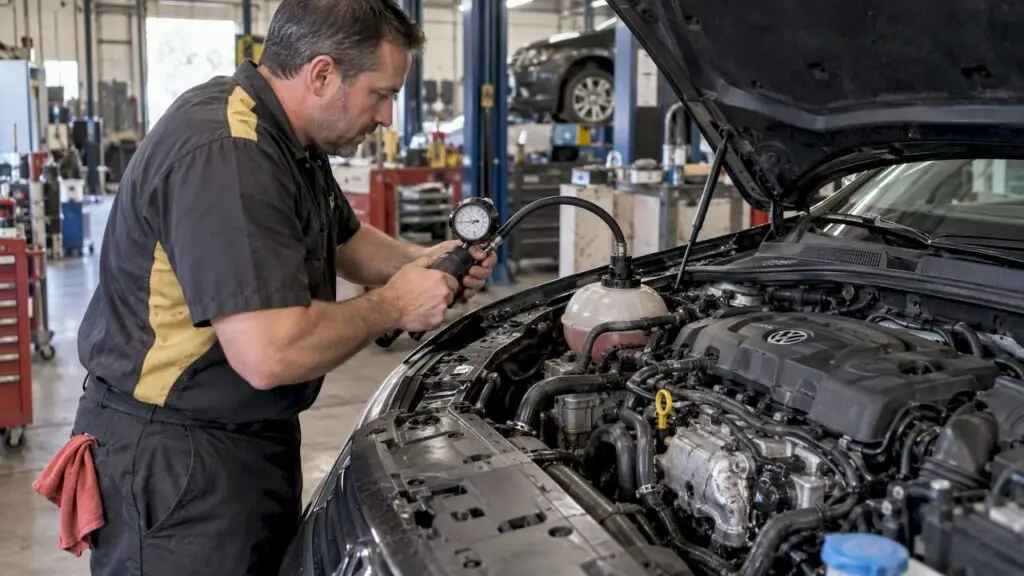
If you’re seeing coolant puddles, a rising temperature gauge, or a low-pitched whine from the engine bay, there’s a real chance your Volkswagen’s water pump is leaking. Stop driving if the car is overheating or leaving large puddles and arrange a tow. Otherwise, the right next step is a cooling-system pressure test so a technician can confirm exactly where the coolant is escaping before any parts get replaced.
TL;DR:
- Coolant puddles, falling reservoir levels, bearing noise, and overheating can also signal thermostat housing, hose, or pipe leaks, so symptoms alone cannot confirm pump failure.
- Tell the shop the coolant color, loss timeline, dashboard warnings, noises, or steam, and request photos plus a written estimate separating parts from labor.
- When pump failure is confirmed, ask whether replacing the thermostat, housing, and seals together avoids paying twice for access labor.
- Costs depend on pump design, access labor, and added components; pumps meeting original equipment standards may outlast budget aftermarket units.
Table of Contents
- Symptoms that suggest the water pump is leaking
- How technicians confirm the pump is the source
- Other parts that look like a pump leak
- Repair options and recommended parts to replace together
- Typical cost range and variables that change the estimate
- Can you drive with a leaking water pump?
- What to tell your shop and what to expect from the inspection
- A short note on diagnosing VW coolant leaks
- Book a pressure test or diagnostic appointment
- FAQ
- Sources
Symptoms that suggest the water pump is leaking
A handful of warning signs point toward the water pump rather than another cooling-system part. Coolant color matters here: VW coolant can be green or pink, and spotting either under the car can indicate a coolant leak, according to RepairPal.
- Puddles of green or pink coolant under the front or center of the vehicle
- A coolant reservoir that keeps dropping or repeated low-coolant warnings on the dash
- A low-pitched grinding or whining noise from the engine bay, often a sign of worn pump bearings
- A climbing temperature gauge or steam from under the hood in more advanced cases
These symptoms overlap with several other cooling-system problems, which is exactly why a proper inspection matters before you assume the pump itself has failed, per RepairPal.
How technicians confirm the pump is the source
Guessing at parts wastes money, so a thorough diagnostic sequence is worth understanding before you approve any repair. Technicians typically work through these steps in order:
- Review your coolant-level history and do a visual inspection, checking for wetness around the pump housing.
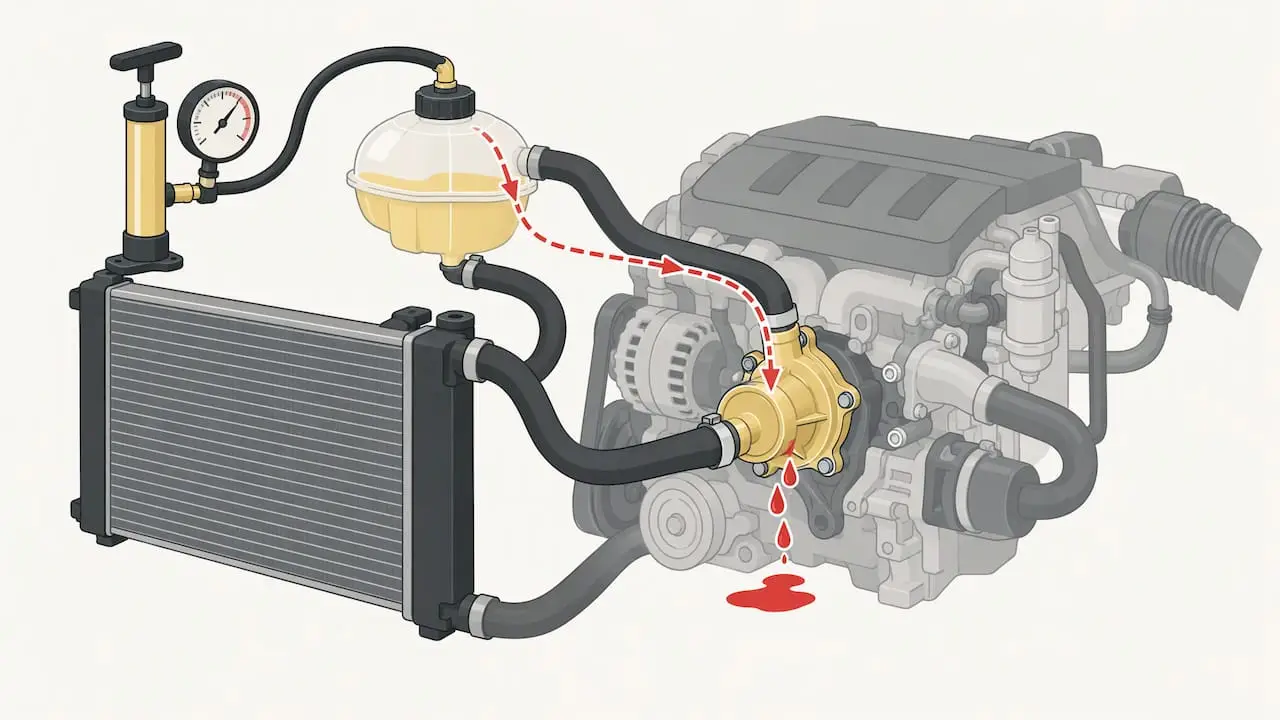
- Perform a cooling-system pressure test to help reveal external leaks.
- If the leak is difficult to locate, ask the technician what additional diagnostic steps may help.
- Have the technician inspect the pump and nearby components for signs of a leak or failure.
Both the visual check and the pressure test are standard steps for isolating a coolant leak, according to RepairPal’s diagnostic notes, and additional testing may help locate leaks that are difficult to see.
Pro Tip: Ask your shop to show you the pressure-test reading and photos of the leak site before you approve a repair. A transparent estimate should point to a specific component, not a guess.
Other parts that look like a pump leak
Several components sit close to the water pump and can produce nearly identical symptoms, which is why diagnostics matter more than assumptions.
- A leaking thermostat housing or its O-ring sits in the same area as the pump and is commonly mistaken for a pump failure, according to RepairPal and parts data from ECS Tuning
- Cracked hoses, loose clamps, or a failing coolant pipe can produce similar puddles and the same steady drop in reservoir level, per RepairPal’s leak overview
- Other nearby cooling-system components can also produce symptoms that resemble a pump failure.
Telling these apart usually comes down to where the wetness actually traces back to during a pressure test, which is why a visual check alone rarely settles the question.
Repair options and recommended parts to replace together
Once a technician confirms the pump itself has failed, internally worn bearings or a failed shaft seal often mean the pump needs to be replaced. Topping off coolant does not repair the leak, according to RepairPal’s cost estimator.
- Because many Volkswagen engines integrate the water pump with or near the thermostat housing, technicians often recommend replacing the thermostat, housing, and related seals in the same visit, since the labor to access the area is a large share of the job, per ECS Tuning
- OE-level pumps generally hold up longer than budget aftermarket units, which mechanics report can fail sooner and lead to repeat labor, according to Kelley Blue Book
- Ask whether the quoted parts are OEM-equivalent, whether belts or pulleys showed coolant contamination, and whether those items are already included in the price
Pro Tip: Ask the technician to explain whether replacing the thermostat housing with the pump is appropriate for your vehicle and why.
Typical cost range and variables that change the estimate
Cost estimates for VW water pump replacement vary widely because the job itself varies widely. The estimate depends on the vehicle and the work required to reach the pump, according to RepairPal.
- Whether the pump is a standalone part or built into a larger housing assembly changes both parts cost and labor time
- Labor hours for access, since some VW engines require more disassembly to reach the pump than others
- Additional parts needed in the same job, including the thermostat, hoses, or belts, per RepairPal and ECS Tuning
- Parts choice between OE and aftermarket, which affects both the upfront price and how long the repair lasts, per Kelley Blue Book
A low advertised part price rarely reflects the final bill. Diagnostics, pressure testing, and the ancillary parts a thorough repair requires all add time and cost on top of the pump itself.
Can you drive with a leaking water pump?
Driving on a confirmed water pump leak is discouraged because it risks sudden overheating and can lead to drive belt slippage or failure, according to RepairPal’s cost estimator.
- Stop driving immediately if the temperature gauge is climbing or the car is leaving large puddles
- A coolant top-off is not a repair. If the leak is confirmed, avoid driving and arrange professional help.
- If belts or pulleys show coolant contamination, towing is the safer call, because coolant contamination can affect nearby components
What to tell your shop and what to expect from the inspection
A clear description of your symptoms speeds up diagnosis and helps the shop avoid replacing parts that aren’t the actual problem.
- Describe the coolant color you’ve seen, when you first noticed the loss, any dashboard warnings, and whether you’ve heard noises or seen steam.
- Ask for a cooling-system pressure test, photos of the leak source, and a written estimate that separates parts from labor.
- Expect the technician to also check the thermostat housing, hoses, belts, and nearby seals, and to recommend replacing several of these together when access to one means access to all of them, per ECS Tuning.
If you want to get a clean look at the engine bay before your visit, MobileDetail.ai covers safe engine-bay cleaning in a way that won’t wash away the evidence a technician needs to see.
A short note on diagnosing VW coolant leaks
We rely on dealer-level diagnostics for cooling-system complaints, including pressure testing and visual tracing before recommending any part. When the thermostat housing shares labor access with the pump, we often recommend replacing both so you’re not paying for the same teardown twice. We back every estimate with photos and a written breakdown of parts and labor.
— Alternative European & Domestic
Book a pressure test or diagnostic appointment
Guessing at a water pump replacement based on symptoms alone can lead to the wrong part and a repeat visit. We run a full cooling-system pressure test and visual trace first, then give you photos and a written parts-and-labor estimate before any work begins.

- Schedule a diagnostic appointment to get your coolant leak pressure tested
- Browse our maintenance service options if your cooling system needs a broader checkup
- Review our engine repair services if the leak has led to other engine concerns
Ask us for photos and a written estimate that separates every part from the labor involved. That’s the clearest way to know exactly what you’re paying for before we touch the car.
FAQ
Can you drive if your water pump is leaking?
Driving with a confirmed water pump leak is discouraged because it risks sudden overheating and belt failure, according to RepairPal. If the temperature gauge is rising or you’re leaving large puddles, stop and arrange a tow instead of continuing to drive.
How much does it cost to replace the water pump in a VW Golf?
Cost depends on whether the pump is a standalone part or integrated into a larger housing, plus labor time and whether the thermostat and hoses need replacing at the same time, according to RepairPal’s estimator. OE-level parts tend to last longer than budget aftermarket pumps, per Kelley Blue Book.
How much does it cost to fix a coolant leak on a Volkswagen?
The cost varies by source and the parts and labor needed. A pressure test can help identify the leak source before the shop provides an estimate, according to RepairPal. A pressure test identifies the actual source before any price is quoted.
Why do Volkswagens leak coolant?
Common causes include a worn water pump seal or bearing, a leaking thermostat housing O-ring, cracked hoses, or failing coolant pipes, according to RepairPal. Several of these sit close together, which is why a visual and pressure-based diagnosis is needed to confirm the exact source.