
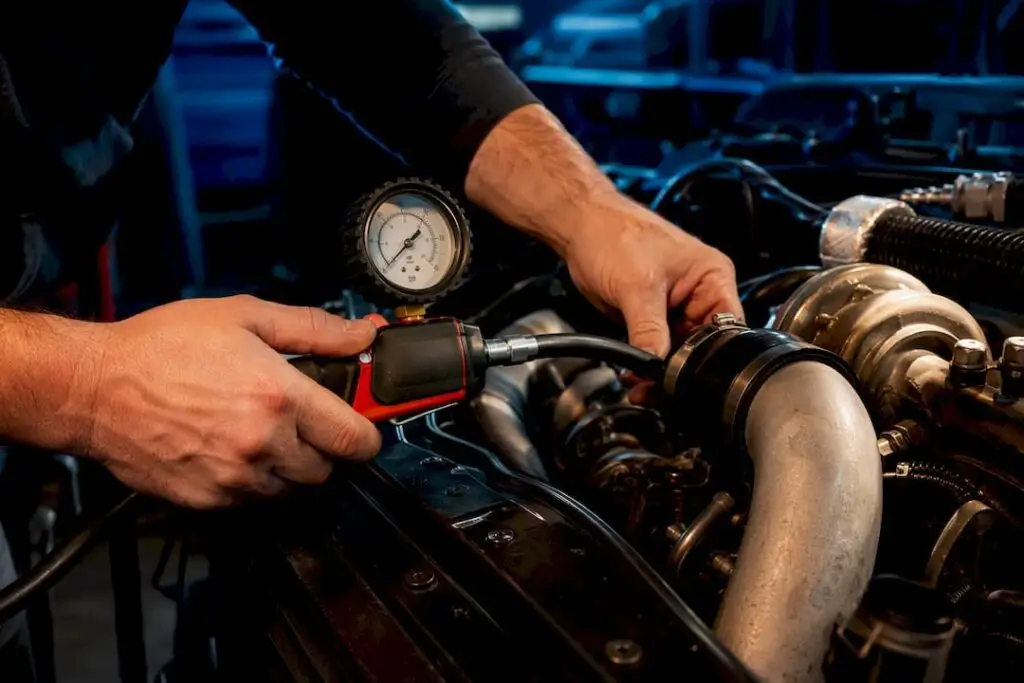
If your turbocharged vehicle hesitates under load, hisses during acceleration, or runs hotter than usual under boost, a boost leak is a leading suspect. The fix starts with a regulated pressure test of the intake tract or a professional diagnostic appointment, not guesswork. Skip the DIY spray-and-hope approach if you hear a loud hiss paired with visible smoke. That combination points to a leak serious enough to book a shop visit now.
TL;DR:
- Small boost leaks often cause subtle power loss, increased turbo lag, and a high-pitched hissing noise during acceleration, which can be confirmed by a pressurized test.
- The most common failure points are couplers and clamps, which degrade from heat and aging, especially on higher-mileage or high-boost vehicles.
- A boost leak rarely triggers a check engine light unless it’s large enough to cause the engine to enter a fault mode like underboost code P0299.
- Accurate diagnosis requires off-engine pressurized testing with soap water and live data logging, rather than simple spray or guesswork.
- Minor leaks can usually be fixed by replacing clamps or couplers, while larger failures may need professional repairs like welding or turbo seal replacement.
Table of Contents
- Boost Leak Symptoms You Can Feel, Hear, and See
- Where Boost Leaks Start: Common Failure Points
- How to Test for a Boost Leak Safely
- How Serious Is Your Boost Leak? A Severity Guide
- Fixing a Boost Leak: What You Can Do and What Needs a Shop
- Preventing Boost Leaks Before They Start
- Why Dealer-Level Diagnostics Matter for Complex Boost Leak Cases
- Book a Boost Leak Diagnostic With Alternative European & Domestic
- Sources
- FAQ
Boost Leak Symptoms You Can Feel, Hear, and See
A boost leak happens when pressurized air escapes the intake tract between the turbo and the intake valves instead of reaching the cylinders. The result is an engine that makes less power than it should, and the symptoms usually show up in a predictable pattern before anyone pulls a code reader.
Power loss under load is the most common complaint. You floor it to merge onto a highway and the truck or sedan feels flat, like someone let air out of the tires. Turbo lag gets worse too. The spool that used to feel immediate now drags, because boost leaks commonly present as power loss under load, sluggish throttle response, and increased turbo lag, often with no warning light at all.
Here’s what to watch for during a normal drive:
- Power loss under load: acceleration feels soft, especially climbing a grade or merging.
- Hissing or whistling under boost: a thin, high-pitched leak noise distinct from the turbo’s normal whine.
- Exhaust smoke: gray or black haze on acceleration, more common and more visible on diesels.
- Inconsistent throttle response or surging: the engine hunts for power instead of building it smoothly.
- Poor fuel economy that creeps up over weeks, not overnight.
The noise distinction matters. A healthy turbo makes a smooth spool sound that rises with RPM. A leak sounds like a tea kettle, a steady hiss that’s loudest right when you get into boost and fades at idle. If you can reproduce it by revving in the driveway, you’ve likely found your leak’s general location just by ear.
Pro Tip: Record a short video with your phone while a friend revs the engine in the driveway. Slow-motion playback often catches a hiss your ear misses in real time, and it gives a technician something concrete to work from before they even pop the hood.
Diesel owners see a slightly different picture. Small leaks can be deceptive, causing slower spooling and higher intake temperatures without a dramatic failure, while larger leaks trigger surging and heavy smoke. Because diesels run higher boost and lean harder on turbo efficiency, a leak that a gas engine shrugs off can cause a diesel to smoke noticeably under acceleration.

Here’s the part that surprises most owners: a boost leak rarely trips the check-engine light on its own. Small and moderate leaks often fly under the radar because the engine computer compensates by adjusting fuel trims. When a leak is large enough to cause the turbo to work outside its programmed range, you may eventually see a code like P0299 (underboost), but by then the leak has usually been present for a while. Don’t wait for a dashboard warning to take symptoms seriously.
Where Boost Leaks Start: Common Failure Points
Knowing where leaks typically occur turns a vague hunt into a focused inspection. Most boost leaks trace back to one of five areas, and they rarely fail without a reason.
- Couplers and clamps: the single most common failure point. Rubber or silicone couplers dry-rot with heat cycling, and clamps loosen or corrode over time.
- Charge pipes: plastic pipes crack with age and heat; metal pipes can develop weld fatigue at bends and flanges.
- Intercooler end tanks: plastic tanks warp or crack at the seam where they’re welded or bonded to the core.
- Gaskets and flanges: the connection points between the turbo, intake manifold, and charge pipes rely on gaskets that harden and shrink.
- Turbo seals: worn internal seals let boost pressure escape into the oil drain or exhaust side rather than the intake.
Clamp slippage is the cheapest and most frequent cause, and it is often the first thing worth checking before assuming a bigger repair is needed. Worm-gear clamps can loosen after repeated heat cycles, especially on couplers near the turbo outlet. Silicone couplers can dry rot over time, developing tiny surface cracks that become apparent when the system is pressurized.
Diesel trucks add another wrinkle. Longer charge-pipe routing between the turbo and intercooler means more clamps, more couplers, and more surface area for something to fail. Diesel systems often need higher test pressures to reveal leaks that only appear under heavy load, and the symptom profile differs from gasoline setups, showing up as smoke and elevated exhaust gas temperatures rather than a subtle power dip. Overspeeding a turbo to compensate for lost pressure accelerates wear on the compressor wheel and bearings, which is exactly why diesel leaks deserve prompt attention rather than a “drive it and see” approach.
How to Test for a Boost Leak Safely
Finding a boost leak reliably means pressurizing the intake tract in a controlled way and watching for where the air escapes. Skip this step and you’re just guessing at parts.
Tools you’ll need:
- A boost leak tester or charge-air pressure tester with a regulator attachment.
- A regulated compressed-air source (a standard shop compressor works if you control output with the regulator).
- A mechanical boost gauge or an OBD-II scan tool capable of showing live data.
- A spray bottle of soapy water.
- Nothing fancier than your own ears in a quiet garage.
Start by isolating the intake tract. Disconnect the air intake tube at the turbo inlet (or wherever your tester’s plate mounts) so you’re pressurizing a closed system rather than the running engine. Pressure testing the intake tract with a regulated air source and calibrated tester reveals leaks via audible hissing, soapy-water bubbling, condensation, or pressure decay, and this off-engine method is more reliable than spraying soapy water while the engine runs, since engine vibration and airflow noise mask smaller leaks.
Here’s the step-by-step process:
- Mount the tester at the turbo inlet or throttle body, sealing off the intake tract you want to check.
- Connect the regulator to your compressed-air source and set it well below your vehicle’s maximum boost rating before opening the valve.
- Pressurize gradually to a safe test level, typically in the low-to-mid psi range for most street gas engines, and hold there.
- Listen first. A hiss you can hear without moving is usually a bigger leak near a coupler or clamp.
- Spray soapy water along every coupler, clamp, weld seam, and gasket line while the system stays pressurized. Bubbles mark the exact spot.
- Watch the gauge for decay. A system with no leaks holds pressure for an extended period. Fast pressure drop means air is escaping somewhere you haven’t found yet.
- Document your findings: note where you found bubbles, how fast pressure dropped, and at what psi the hiss became audible.
A regulated air source and calibrated tester avoid false positives and reduce the risk of damaging components during at-home testing. Pressurizing beyond your engine’s rated boost range risks blowing a marginal coupler off entirely, turning a small leak into a bigger repair.
Pro Tip: If you find one leak but the pressure gauge still shows a faster decay rate than it should after you fix it, don’t assume your repair failed. Multiple small leaks are common on higher-mileage turbo systems, so isolate sections of the intake tract one at a time by clamping off branches to narrow down whether more than one spot is leaking.
A scan tool adds a second layer of confirmation. Live data showing commanded boost versus actual boost, along with mass airflow readings and fuel trim numbers, corroborates what you found with the pressure tester. If actual boost consistently trails commanded boost by a wide margin, that mismatch backs up a hissing sound you heard at the coupler behind the intercooler.
One common pitfall: smoke machines built for vacuum leak diagnosis don’t always generate enough volume or pressure to reveal boost-side leaks the way a dedicated pressure tester does. Spraying soapy water on a running engine also produces false negatives, since airflow through the system can blow the bubbles away before they form. Stick to the off-engine, pressurized method for anything conclusive.
How Serious Is Your Boost Leak? A Severity Guide
Not every leak demands an emergency shop visit, but some absolutely do. Sorting symptoms into severity tiers helps you decide whether to schedule routine service or head in this week.
| Severity | Typical Symptoms | Recommended Action |
|---|---|---|
| Minor | Faint whistle only under hard acceleration, slight MPG dip | Monitor, plan a pressure test at next service |
| Moderate | Noticeable power loss, occasional underboost code, mild surge | Schedule diagnostics within days |
| Severe | Loud hiss at moderate throttle, heavy smoke, power derate | Book service promptly, limit hard driving |
A leak left unaddressed rarely stays minor. Dyno testing often shows torque dropping early and never recovering when a boost leak exists, and the engine’s computer compensates by ripening fuel trims to make up for lost airflow, which raises exhaust gas temperatures over time. That combination, a turbo working harder to hit target boost plus an engine running outside its intended fuel map, accelerates wear on turbo bearings and seals well before it causes an obvious failure.
For diesel trucks, the EPA’s diesel emissions standards shape how modern trucks manage regen cycles and exhaust temperatures, and a boost leak that pushes EGTs higher than normal can trigger more frequent, less efficient regens.
Before calling a shop, gather what you can: the pressure decay rate from your test, a video of the hiss, and any boost-gauge logs you’ve saved. That documentation cuts diagnostic time significantly since a technician starts with data instead of a blank slate.
Fixing a Boost Leak: What You Can Do and What Needs a Shop
Some boost leak repairs are well within reach of a driveway mechanic. Others need a lift, a welder, or specialized turbo tools.
- Replace worn couplers and boots. Cracked or dry-rotted silicone couplers are a straightforward swap if you can access the fitting.
- Tighten or replace clamps. Use the correct clamp type for the application, worm-gear clamps for light duty, T-bolt clamps for high-boost setups, and torque to the coupler manufacturer’s spec rather than guessing.
- Re-seat loose connections. Sometimes a coupler simply isn’t fully seated on its pipe; reseating and re-clamping solves it without buying parts.
Anything beyond that boundary belongs with a professional. Welded intercooler end tanks that have cracked need proper aluminum or plastic-specific repair, not a bead of sealant. Cracked charge-pipe welds require re-welding with the correct process to avoid a repeat failure at the same stress point. Turbo seal and O-ring replacement means partial turbo disassembly, work best left to a shop with the right tools and experience.
Before any shop visit, write down what you’ve found: pressure decay numbers, when the noise happens, any recent intake or turbo work you’ve done. Never overpressurize the system trying to “confirm” a leak further, and keep soapy water away from electrical connectors near the intake, since moisture there causes its own set of problems.
Preventing Boost Leaks Before They Start
A few minutes of routine inspection saves you from chasing an intermittent leak later. Check couplers and clamps visually every time you’re under the hood for an oil change, looking for cracking, glazing, or clamp corrosion.
- Inspect boots and couplers for surface cracking or a glazed, brittle texture at every oil change interval.
- Consider upgrading to constant-tension clamps and higher-grade silicone couplers if you run elevated boost or track the vehicle regularly.
- Check the intake tract after any off-road impact, curb strike, or aggressive driving session that could have stressed a pipe joint.
- Keep a simple log of boost-gauge readings and pressure test results so you can spot a slow decline before it becomes a symptom.
Pro Tip: Keep last year’s pressure test numbers in your glovebox or phone notes. Comparing this year’s decay rate against last year’s baseline catches a slowly developing leak long before it starts costing you power.
Why Dealer-Level Diagnostics Matter for Complex Boost Leak Cases
A soapy-water test in your driveway finds the obvious leaks. It doesn’t always find the ones hiding behind a turbo shield, inside a plastic intercooler tank, or masked by a second, smaller leak nearby. That’s where pressurized intake testing paired with live data logging earns its keep, because it isolates exactly where pressure is escaping instead of leaving you to swap parts on a hunch.
Dealer-level diagnostic tools cut down on unnecessary replacement parts. Instead of guessing between a charge pipe, a coupler, or a turbo seal, targeted testing narrows the field before anything gets disassembled. That’s the difference between a repair estimate built on evidence and one built on a guess, and it’s worth the appointment when a leak has resisted a driveway fix or shows up alongside smoke and power derate.
— Alternative European & Domestic
Book a Boost Leak Diagnostic With Alternative European & Domestic
Our shop runs the same pressurized intake testing described above, backed by dealer-level diagnostic equipment that isolates a leak’s exact location instead of guessing between parts. If you’ve already done a home pressure test, bring your notes: decay numbers, video of the hiss, boost-gauge logs. Technicians will run that testing on-site and walk you through exactly what they find before recommending a fix.

What to expect at your visit: a technician reviews your symptom history, connects a calibrated tester to the intake tract, and pressurizes the system while logging live data alongside the mechanical test. You’ll get a documented estimate that names the specific failure point, whether that’s a coupler, a charge pipe, an intercooler tank, or a turbo seal, rather than a shotgun parts list. For leaks that turn out to involve turbo wear or internal engine work, our Engine Repair Services team handles it under the same roof. Routine boost-system checks also fold naturally into our Maintenance Service visits, so a slow leak gets caught before it turns into a bigger repair.
Ready to get an answer instead of a guess? Schedule a diagnostic appointment with us and bring whatever symptoms, sounds, or readings you’ve noticed. We’ll take it from there.
Sources
For further reading on testing protocols and symptom patterns, see The Drive’s boost leak testing guide, Hot Rod’s breakdown of hidden power loss, and MotorTrend’s soapy-water and hissing detection methods. For a related leak-diagnosis approach on a different vehicle system, Auto Vendors FL’s guide to Mercedes air suspension checks covers comparable inspection techniques.
- What Is Boost Leak? — The Drive
- Boost Leaks: The Power Loss You Don’t See Until It’s Already Gone — Hot Rod
FAQ
Can You Still Drive With a Boost Leak?
Yes, in most cases you can drive with a minor to moderate boost leak, though you’ll notice reduced power and possibly rough throttle response. A severe leak with heavy smoke or a loud hiss warrants limiting hard acceleration and scheduling diagnostics promptly, since the turbo can be forced to work harder than intended to compensate for lost pressure.
What Does a Turbo Boost Leak Feel Like?
A boost leak typically feels like a flat spot under acceleration, weaker than usual power when you floor it, and turbo lag that’s more noticeable than it used to be. Many drivers also notice a hissing or whistling sound during acceleration that wasn’t there before.
Is It Expensive to Fix a Boost Leak?
Cost depends heavily on what’s actually leaking. A worn clamp or coupler is a low-cost, quick fix, while a cracked intercooler end tank or turbo seal replacement takes more labor and parts access. A documented estimate is provided after diagnostic testing pinpoints the exact failure point, available through the Maintenance Service page.
How Do You Fix a Boost Leak?
Fixing a boost leak starts with locating it through a regulated pressure test, then addressing the specific failure point, tightening or replacing a clamp, swapping a dry-rotted coupler, or repairing a welded seam. More involved repairs like turbo seal replacement or intercooler tank welding are best handled by a shop with the right diagnostic tools and turbo experience.