
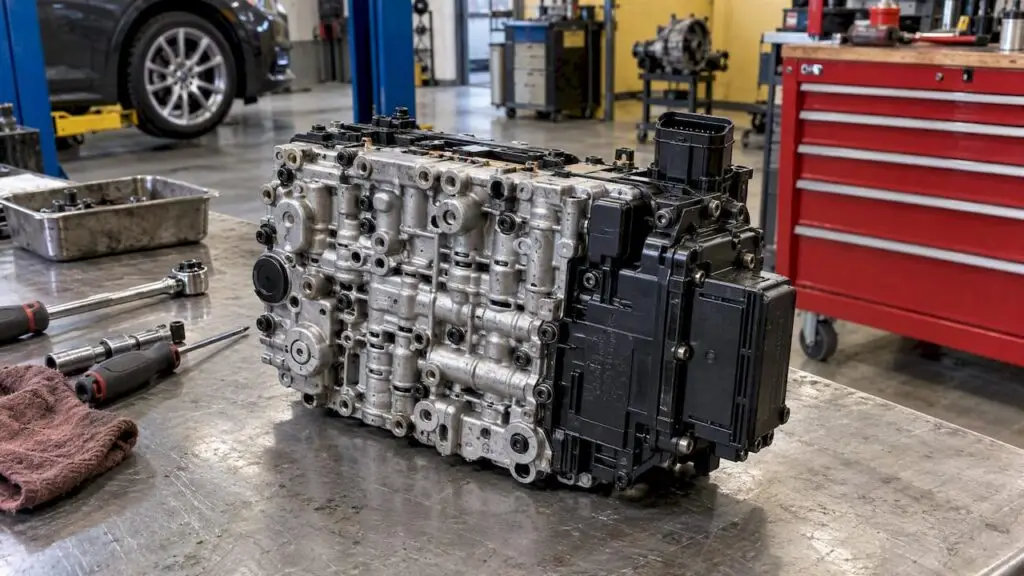
A failing mechatronic unit usually shows up as harsh or delayed shifts, a flashing PRNDS indicator on the dash, limp mode, or a car that will not engage Drive or Reverse. The unit is the control center of a dual-clutch (DSG or S tronic) transmission. Replacement at an independent specialist typically runs $1,600 to $2,800, but a proper diagnosis comes first, because several cheaper problems can look identical.
This guide is for Volkswagen and Audi owners in Dallas, from Oak Lawn and Uptown to the surrounding neighborhoods. It covers what the unit does, how to read the symptoms, what to rule out, and how to decide between repair and replacement.
TL;DR
- The mechatronic unit combines the valve body and the transmission control module. It operates the clutches and gear changes hydraulically.
- Typical warning signs: flashing PRNDS, harsh shifts in stop-and-go traffic, limp mode, and failure to engage a gear.
- Low battery voltage and corroded ground cables can imitate mechatronic faults. Rule them out before approving a four-figure repair.
- Independent replacement commonly costs $1,600 to $2,800, and component-level rebuilds can cost $900 to $1,800, depending on the DSG variant.
- A replacement or remanufactured unit must be coded and the clutches adapted, or the car can shift worse than before.
Table of Contents
- What the mechatronic unit does
- Symptoms of mechatronic unit failure
- What else can look like a failed mechatronic
- How a correct diagnosis works
- Repair or replace: options and typical costs
- Can you keep driving with a failing mechatronic?
- Preventing mechatronic and DSG problems
- How we approach it at Alternative European & Domestic
- FAQ
- Sources
What the mechatronic unit does
In a conventional automatic, a hydraulic valve body and a separate computer decide when to shift. In a DSG, those two functions are fused into one assembly: the valve body plus the transmission control module. Electrohydraulic valves apply pressure to the clutches and shift forks, and the module tells them when.
That is why a single unit can cause so many different complaints. It holds electronics, solenoids, sensors and hydraulic passages in one heat-exposed housing. Common symptoms include a flashing PRNDS indicator, erratic or harsh shifting (especially in stop-start traffic), limp mode, and refusal to engage a gear.
Two transmission families matter most here:
- Dry-clutch 7-speed (DQ200): reported as the problem child, with mechatronic and clutch-pack failures between 60,000 and 100,000 miles.
- Wet-clutch units (6-speed DQ250, 7-speed DQ500 in many Audi and VW models): generally tied more closely to fluid condition and internal wear, though the DQ500 is also reported to suffer internal component degradation in the mechatronic.
Which unit your car has changes the likely cause and the repair path, so the first step is always confirming the exact transmission code.
Symptoms of mechatronic unit failure
Most owners notice a pattern before the car fails outright. Here is what to watch for and what it usually points to.
| Symptom | What it can indicate |
|---|---|
| Flashing PRNDS or a gearbox warning message | A logged transmission fault. The car may be about to enter limp mode |
| Harsh or lurching 1-2 and 2-3 shifts | Clutch pressure control problems, worn clutch, or a failing mechatronic |
| Hesitation pulling away from a stop | Clutch actuation or adaptation issue, or low-voltage faults |
| Shifts fine cold, bangs gears when hot | Heat-sensitive internal electronics or solenoids |
| Stuck in one gear (limp mode) | The module has restricted the transmission to protect it |
| No engagement in Drive or Reverse | Hydraulic or electrical failure, possibly a failed clutch or fork |
The heat-related pattern is worth noting. Owner reports of failing units often describe a car that behaves when cold and fails once warm. Heat is the enemy of the seals, solenoids and electronics inside the unit, and frequent stop-and-go driving, the daily reality on Central Expressway or the North Dallas Tollway at rush hour, accelerates that wear.
If the car has already dropped into limp mode, our guide to the causes of limp mode explains why that protective state is not always a transmission failure.
What else can look like a failed mechatronic
This is the part many owners miss. The transmission control module is very sensitive to supply voltage. Low system voltage or ground cable corrosion can trigger false pressure-related faults and shifting complaints that look exactly like a dying unit.
Before approving a replacement, a good shop should check:
- Battery health and charging output. A weak or aging battery is a common and inexpensive cause of odd electrical behavior in European cars.
- Ground and power cables. Corroded or loose connections cause voltage drops under load.
- Transmission fluid level and condition. Burnt or contaminated fluid points toward clutch wear or a service overdue.
- Software and adaptation status. Some shifting complaints are calibration issues, not hardware failure.
- Clutch pack condition. Worn clutches cause shudder and harsh engagement that can be blamed on the mechatronic.
- Sensor and wiring faults. Speed sensors and connectors can set codes that point at the unit without the unit being the cause.
Electrical testing is a skill of its own. We explain how that works in our article on advanced electrical diagnostics.
How a correct diagnosis works
Pulling a code with a generic scanner is where a diagnosis starts, not where it ends. A code such as P0607 tells you a control module reported an internal performance problem. It does not tell you whether the unit, the wiring, the battery or the software is responsible.
A thorough evaluation goes further:
- Full-system scan of the transmission and related modules, with stored and pending faults recorded.
- Live data logging during a road test, comparing requested against actual clutch pressure and gear position. This separates a transient electrical issue, a software calibration need, or a true mechanical failure.
- Voltage and ground checks under load, as described above.
- Fluid inspection for debris, color and level.
- Measured results in writing, so you can see what was tested and what was found.
The same discipline applies to any warning light. Our walkthrough of live data steps for a check engine light shows the logic. If you are wondering what a diagnostic costs, see what shops typically charge in our diagnostic fee guide. Paying for a real diagnosis is usually far cheaper than replacing the wrong part.
Repair or replace: options and typical costs
Once the mechatronic is confirmed as the fault, you generally have three routes.
| Option | Typical cost | Notes |
|---|---|---|
| Component-level rebuild by a specialist | $900 to $1,800 | Depends on the DSG variant and what has failed (solenoids, circuit board, accumulator) |
| Replacement at an independent specialist | $1,600 to $2,800 | New or remanufactured unit, plus fluid, coding and adaptation |
| Dealer replacement | Often 30 to 60 percent higher than independent quotes | Brand-specific tools and parts access |
These are published ranges, not quotes. Your price depends on the model, the transmission code, whether the clutches also need work, and the part route chosen. Expect the quote to include fluid, filter, coding and adaptation. If it does not, ask why.
Some shops and DIY sites promote repairing the unit yourself. Component-level repair can avoid replacing an entire assembly, but it involves soldering, hydraulic cleanliness and calibration. We do not recommend it as a driveway project: an error here can strand the car or damage a clutch pack.
Coding and clutch adaptation are not optional
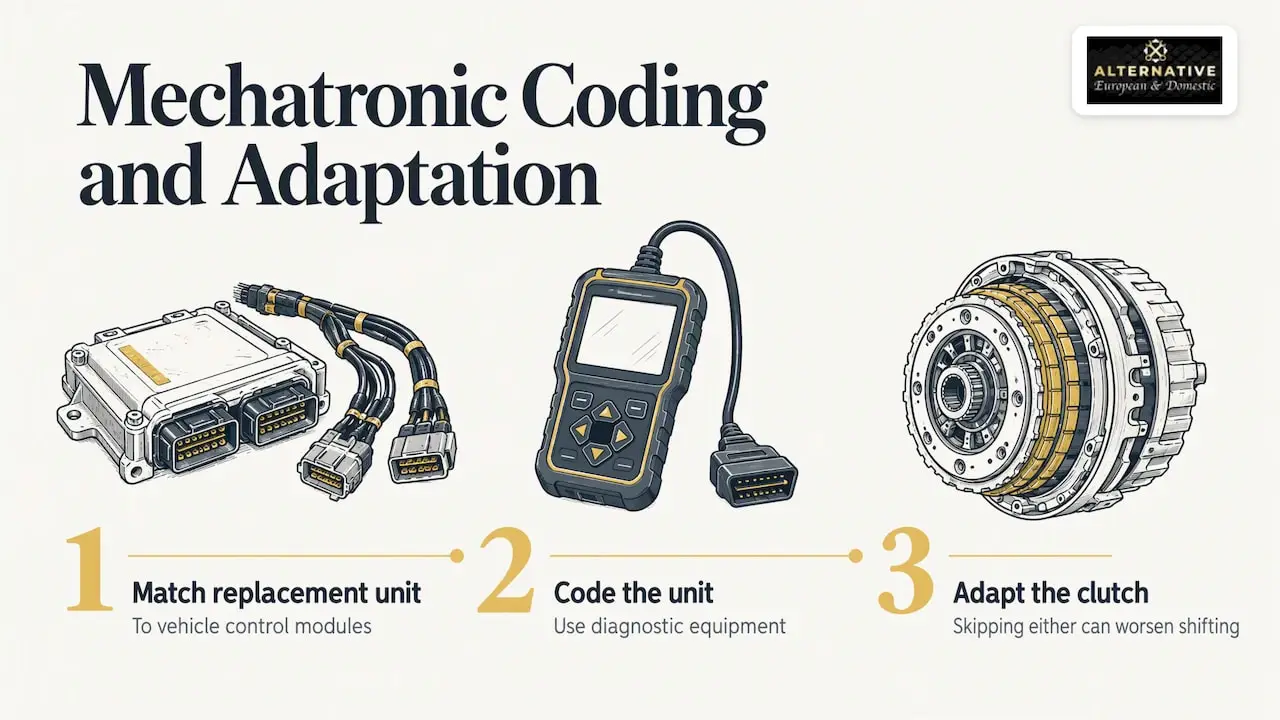
A new or remanufactured unit has to be matched to the car. Installing one without coding it to the vehicle’s control modules using the proper diagnostic equipment, and without the clutch adaptation routine, can leave the car shifting worse than it did with the failed unit. If you are comparing quotes, ask each shop how the unit will be coded and adapted, and what tool does it.
Check for recalls and warranty extensions first
Before paying out of pocket, check your VIN for open campaigns. For example, Volkswagen extended transmission warranty coverage for 2018 to 2020 Tiguan vehicles covered by Recall 24GB, for hesitation or jerking traced to the transmission assembly, once the recall is closed. Coverage terms are specific, so confirm your VIN and mileage with a Volkswagen dealer or at the NHTSA recall lookup. Do not assume any other model or year qualifies.
When repair costs more than the car is worth
On an older, high-mileage car with other problems, a four-figure transmission repair may not make sense. In that case, it is reasonable to look at selling a car with transmission failure as a non-running vehicle rather than repairing it. Get the written repair estimate first, compare it against the car’s market value, and decide with the numbers in front of you.
Can you keep driving with a failing mechatronic?
Sometimes for a short time, but it is a gamble. Treat these as stop-driving situations:
- The car will not engage Drive or Reverse reliably, or rolls unexpectedly.
- It lurches hard at low speed or loses drive at highway speed.
- You see a red transmission warning or hear grinding or banging.
- It stalls out of gear in traffic.
A car that cannot reliably hold or select a gear is a safety risk in an intersection or on a Dallas freeway. In these cases, towing is the right call. A tow costs far less than a clutch pack, and continued driving can send debris through the valve body.
Mild symptoms, such as an occasional harsh shift, are less urgent but not harmless. Worn clutch material can circulate through the mechatronic valve body, scoring bores and sticking solenoids. Early diagnosis often keeps the repair smaller.
Preventing mechatronic and DSG problems
No maintenance schedule makes a weak design immortal, but you can reduce risk.
- Follow the DSG fluid and filter interval. Experts commonly cite about every 40,000 miles for many models. Check your owner’s manual for your specific unit, since intervals differ.
- Keep the battery and charging system healthy. Test the battery before it fails, especially in Texas heat.
- Avoid creeping in stop-and-go traffic on the clutch. Use the brake to hold the car on hills and at lights rather than letting the clutch slip.
- Do not ignore early symptoms. A shudder from a stop or a flashing PRNDS light is a reason to book a diagnostic, not wait.
- Keep software current. Updates can address shift behavior on some units.
A custom maintenance plan built around how you drive (commuter, weekend performance, or fleet) is the practical way to apply this. Our maintenance service covers fluid exchange, filters, battery and electrical checks as part of that approach.
How we approach it at Alternative European & Domestic
Alternative European & Domestic is a Dallas-area repair shop focused on European, domestic and high-performance vehicles. Our ASE-certified technicians start with the measurements: scan data, live road-test data, voltage checks and a fluid inspection. We explain what we find and what it means before any repair is authorized.
If you want an independent second opinion on a mechatronic quote, or you are seeing early symptoms, our transmission repair and service team can evaluate the car. Qualifying repairs carry our 24-month/24,000-mile warranty, subject to applicable terms. If you are deciding between a dealer and an independent shop, three questions to ask will help, and so will these questions to ask any mechanic.
To schedule a diagnostic evaluation, book an appointment with us. Drivers in Oak Lawn, Uptown and across Dallas are welcome. If the car will not move safely, arrange a tow rather than driving in.
FAQ
What are the common symptoms of a DSG mechatronic failure?
The most common signs are a flashing PRNDS indicator, harsh or jerky shifts (especially in stop-and-go traffic), limp mode, and trouble engaging Drive or Reverse. Some cars shift normally when cold and misbehave when hot. Because battery and ground problems can mimic these signs, a diagnosis should confirm the cause before parts are replaced.
How much does it cost to replace a mechatronic unit?
Published figures put independent replacement at $1,600 to $2,800, with component-level rebuilds at $900 to $1,800 and dealer quotes often 30 to 60 percent higher. Your actual price depends on the model, transmission type and whether the clutches also need work. A written estimate after diagnosis is the only reliable number.
Is there a recall on the mechatronic unit in the VW Tiguan?
Not as a general mechatronic recall that we can confirm. Volkswagen did extend transmission warranty coverage for 2018 to 2020 Tiguan vehicles tied to Recall 24GB, for hesitation or jerking within the transmission assembly. Check your VIN with a VW dealer or NHTSA for current status.
Can a bad battery cause DSG shifting problems?
Yes. The transmission control module is sensitive to low voltage, and a weak battery or corroded ground cable can trigger false pressure-related faults. Testing voltage and grounds is an inexpensive step that should come before any mechatronic replacement.
Is it safe to drive with a failing mechatronic unit?
Only if symptoms are mild, and only until you can book a diagnostic. If the car will not engage a gear reliably, loses drive, or lurches hard at low speed, stop driving and have it towed. Continued driving can damage clutches and spread debris through the unit.
Sources
- VW/Audi DQ200 7-Speed DSG Problems and Repair Cost, Gearbox Insider
- VW DSG Mechatronic Unit Failure: 7 Warning Signs + Real Repair Costs, Automatika
- VW DSG Mechatronic Failure: DQ200/DQ250 Symptoms and Cost, AmpAuto
- How to Repair DSG Mechatronic, RapidRepair.blog
- Transmission Hesitation/Jerking Limited Warranty Extension, NHTSA bulletin VWP-22-16