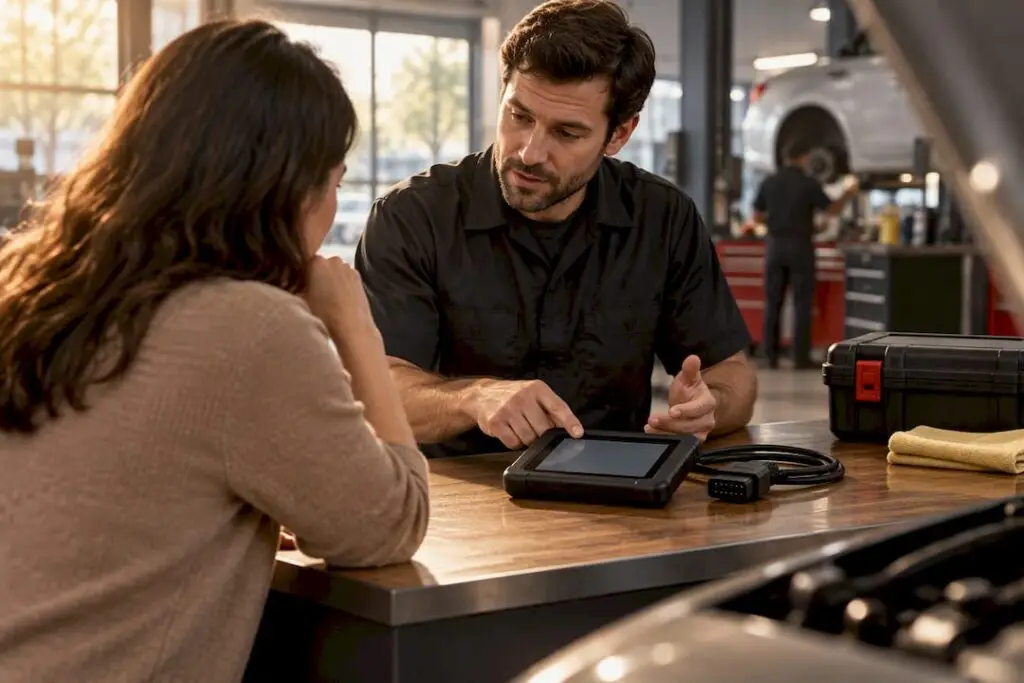
Dealer diagnostics are OEM factory diagnostic software and procedures that let technicians run guided tests, read manufacturer data, and perform ECU programming. Use them for module programming, ADAS calibration, and other OEM-locked tasks. For most routine repairs, a qualified independent shop with pass-through tools and OEM subscriptions will get the job done just as well.
TL;DR:
- Independent shops can perform dealer-level diagnostics successfully if they have active OEM software subscriptions and proper pass-through hardware.
- The most advanced functions, such as module programming and ADAS calibration, often require manufacturer-specific procedures and security clearances, which depend on active certifications or subscriptions.
- Security measures and digital gateways on newer vehicles can restrict write access, making current OEM subscription verification essential for any calibration or reprogramming tasks.
- Diagnostic costs vary widely based on complexity and software access, with guided troubleshooting taking significantly longer and costing more than basic code scans.
- Policy and technology trends indicate that the access gap between dealers and independents is narrowing, but some advanced functions will remain dealer-exclusive due to security and OEM restrictions.
Table of Contents
- What dealer diagnostic systems are and what they do
- How dealer diagnostics differ from OBD-II and independent-shop tools
- How independent shops obtain dealer-level capabilities
- What to expect during the diagnostic process
- Right-to-Repair, EPA guidance, and what it means for access
- Choosing between a dealer and a qualified independent
- How Alternative European & Domestic delivers dealer-level diagnostics
- Where dealer diagnostics are headed next
- Book dealer-level diagnostics for your vehicle
- Sources
- FAQ
What dealer diagnostic systems are and what they do
Dealer diagnostics run on the manufacturer’s own software, connected to the vehicle through an OEM-specific interface rather than a generic scan tool. That software gives a technician access to guided troubleshooting flows written by the automaker, technical service bulletins tied to specific fault patterns, and the ability to reprogram or recalibrate modules that a basic scanner cannot touch.
The practical value shows up in a few core capabilities:
- Live data streaming from every module on the vehicle, not just the ones a generic tool recognizes.
- Module reprogramming and coding, including replacing a control unit and matching it to the rest of the vehicle’s electronics.
- ADAS calibration, aligning cameras and radar sensors after glass replacement, suspension work, or a collision.
- Emissions-related procedures that require manufacturer-specific test sequences to pass inspection or clear a stored fault.
- Guided diagnostic routines that walk a technician through a decision tree built around known failure points for that platform.
Some of these functions are locked behind more than just software. Automakers increasingly require security certificates or temporary digital credentials before a tool can write data to certain modules, a safeguard meant to prevent unauthorized changes to safety or emissions systems. Getting past that gate usually means an active OEM subscription, a verified technician account, or both. That is part of why dealer diagnostics carry a certain mystique: it is not simply a better scanner, it is a combination of licensed software, manufacturer data, and in some cases a digital handshake that has to happen before the vehicle will accept the change.
How dealer diagnostics differ from OBD-II and independent-shop tools
The gap between a basic code reader and a factory system is wide, and understanding where each tool fits saves time and money.
- Basic OBD-II scanners read generic trouble codes and clear check-engine lights, useful for a quick read but blind to most manufacturer-specific systems.
- Multi-brand independent scan tools go deeper, often reading live data across several makes and covering common repair codes, but they may lack the depth for less common modules.
- OEM factory systems cover everything the manufacturer built into the vehicle, including the guided procedures and write access that generic tools cannot reach.
Certain jobs sit squarely in OEM territory regardless of who performs them. ECU reflashes that update engine or transmission software, immobilizer or key programming that ties a new key to the vehicle’s security system, and ADAS recalibration after certain repairs typically require the manufacturer’s own procedure, even when an independent shop is the one running it.
Where independents can and cannot match a dealer often comes down to access rather than skill. A shop equipped with the right hardware and an active OEM subscription can complete the same reflash or calibration a dealership would perform. A shop without that access is limited to reading codes and diagnosing mechanically, which covers a large share of everyday repairs but stops short of anything requiring a White to a protected module.
How independent shops obtain dealer-level capabilities
The tool that closes most of the gap is a J2534 pass-through device, a standardized interface defined under SAE J2534 that lets a laptop running OEM software talk directly to the vehicle’s modules. Instead of buying a proprietary scanner for every brand, a shop connects the pass-through box, loads the manufacturer’s software for that specific vehicle, and runs the same reflash or calibration a dealership would run. According to the Bosch J2534 FAQ, J2534-compliant devices let independent shops run OEM factory software for reprogramming and guided diagnostics without purchasing brand-specific proprietary scanners.
That access comes bundled with a few moving parts:
- OEM subscription services, usually billed by the day, month, or session, that unlock the manufacturer’s diagnostic software for a specific brand.
- Certified third-party devices approved by an automaker to run its software on non-factory hardware.
- Cloud-based integrations that let a shop send scan requests to OEM systems and receive results back through a management platform rather than a standalone tool.
None of this is free of friction. Security gateways on newer vehicles can block write access until a temporary digital certificate is issued, some telematics data stays locked to the manufacturer’s own network regardless of tools used, and older models sometimes lack a modern pass-through pathway altogether. Subscription costs add up quickly for a shop trying to cover several brands, and the software is only as useful as the technician trained to interpret it.
Pro Tip: Ask a shop which OEM subscriptions they currently hold active, not just which brands they have serviced in the past. Subscriptions lapse, and access can disappear between visits.
What to expect during the diagnostic process
A dealer-level diagnostic follows a fairly consistent sequence, whether performed at a dealership or a properly equipped independent shop.
- Intake and symptom review, where the technician records what the owner has noticed and when it happens.
- Full system scan, pulling stored codes from every module rather than just the engine computer.
- Guided testing, following the manufacturer’s decision tree to narrow down the cause.
- Live-data tracing, watching sensor values in real time to confirm a suspected fault under actual driving conditions.
- Programming or calibration, when the diagnosis points to a module update, coding change, or sensor recalibration.
- Verification, rechecking the system and often a road test to confirm the fix holds.
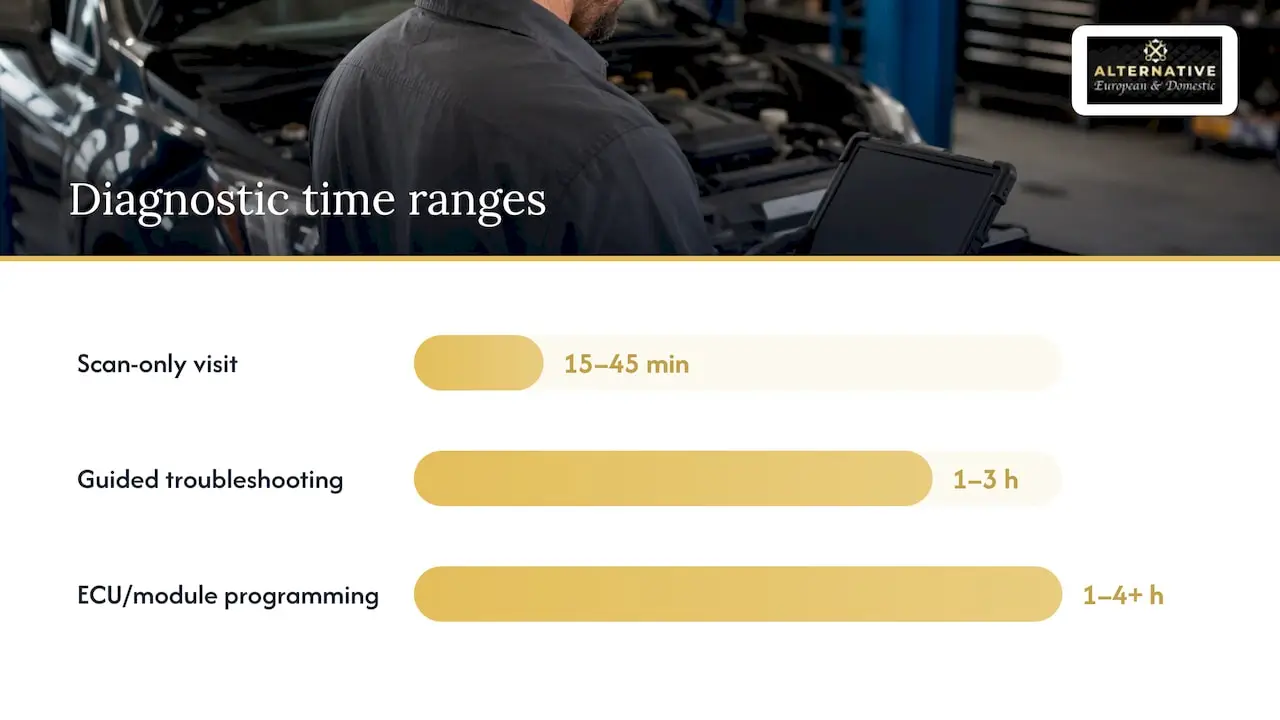
Time varies with the job. A scan-only visit typically runs 15 to 45 minutes. Guided troubleshooting for an intermittent fault often takes 1 to 3 hours, since it involves reproducing the condition rather than just reading a code. An ECU reflash or module programming job, including verification and a road test afterward, commonly runs 1 to 4 hours or more depending on the module involved.
Cost tracks the same variables: technician expertise, the OEM software fees a shop absorbs to maintain access, regional labor rates, and how complex the underlying fault turns out to be. A flat diagnostic fee in the range some shops advertise is not unusual for a basic scan, and a partner resource breaks down what a diagnostic fee actually covers in more detail. Whether a given fee is reasonable depends on what it includes: a quick code pull costs far less time and software overhead than a guided troubleshooting session that ties up a bay for hours.
Right-to-Repair, EPA guidance, and what it means for access
Access to OEM diagnostic data has been a live policy issue for years, and recent movement is narrowing the gap between dealer and independent access. The EPA’s Freedom to Fix guidance clarifies that manufacturers must provide emissions-related service information, OBD data, and passthrough reprogramming information that support independent repair alongside dealer service.
Industry groups have pushed the same direction from the trade side. The Auto Care Association summarizes ongoing Right-to-Repair commitments aimed at ensuring independent shops can access the same diagnostic tools, procedures, and technical data that manufacturers make available to their own dealer networks.
One documented challenge behind this push: CRS reporting notes that a large share of independent repair shops identify data access as a top business obstacle as vehicle complexity increases, a trend pushing more shops toward cloud-integrated diagnostic tools.
For owners, the practical takeaway is simple:
- Ask whether a shop’s OEM access is current, not historical.
- Ask for documentation of any reflash, coding change, or calibration performed, including a post-repair verification note.
- Treat a shop’s willingness to explain its access, rather than dodge the question, as a meaningful trust signal.
Choosing between a dealer and a qualified independent
The right choice usually comes down to three questions, asked in order.
- Does the repair require programming or calibration? If yes, confirm the shop, dealer or independent, has active access to perform it correctly.
- Is the vehicle under warranty or enrolled in a manufacturer program? Some warranty and enrollment terms make dealer service the more direct path.
- Does the fix depend on telematics or security-gated data? Some systems stay locked to manufacturer networks regardless of the shop’s tools.
Once those are answered, a short checklist separates shops that can back up their claims from those that cannot: Do you run OEM software for this brand? Do you have J2534 pass-through hardware and an active subscription? Can you show documentation of a completed reflash or ADAS calibration on a similar vehicle? A shop that answers clearly and can produce a verification report is showing real capability, not just familiarity with the brand name.
Pro Tip: Treat a vague answer about “special tools” as a red flag. A shop confident in its access will name the specific interface and software it uses.
How Alternative European & Domestic delivers dealer-level diagnostics
The shop provides dealer-level diagnostics supported by technicians experienced with European, domestic, and high-performance vehicles. That combination matters because dealer-level access without trained interpretation of the results is only half the job.
The shop applies the same practical workflow independent shops use to close the access gap: pass-through connections paired with OEM software access, run by technicians trained on the specific systems involved, followed by verification steps before the vehicle leaves the bay. Fleet clients have access to service history tracking to assist in managing multiple vehicles.
Maintenance plans tailored to each vehicle’s condition support longevity and consistent performance over time. Owners who want to confirm current capabilities or documentation practices can ask directly when booking, and the shop’s service overview lists the diagnostic and repair services offered.
Where dealer diagnostics are headed next
Parity between dealers and independents is trending in the independent shop’s favor, driven as much by policy as by technology. Regulatory pressure and OEM subscription models are doing more to close the access gap than any single piece of hardware, and that shift will likely continue.
Some friction will not disappear soon. Security gateways, OEM-only workflows for the newest platforms, and the cost of maintaining several brand subscriptions at once will keep a portion of the most advanced work concentrated at dealerships or a handful of well-equipped independents.
The advice for owners does not change with the technology: verify a shop’s current access before assuming capability, and insist on documented verification after any reflash or calibration. A repair is only as good as the check that confirms it worked.
— Alternative European & Domestic
Book dealer-level diagnostics for your vehicle
Dealer-level diagnostics are available for European, domestic, and high-performance vehicles, with transparent communication about repairs and maintenance plans based on vehicle condition rather than generic schedules.
A few things speed up your visit:
- Bring both key fobs if the vehicle uses keyless entry or programming may be involved.
- Note when the symptom happens: cold start, highway speed, after rain, and so on.
- Mention any recent repairs or module replacements, since they often connect to a current fault.
Book a maintenance and diagnostic appointment to get a clear read on what your vehicle needs before any work begins.
Sources
FAQ
What does a dealership diagnostic test consist of?
A dealership diagnostic typically starts with a full system scan across every module, followed by guided tests that walk the technician through the manufacturer’s own decision tree for that fault. It often ends with live-data tracing and, when needed, module programming or calibration followed by a verification check.
Is a $200 diagnostic fee normal?
Diagnostic fees vary by region, vehicle complexity, and how much guided troubleshooting the fault requires, so no single figure applies everywhere. A breakdown of what a diagnostic fee typically covers explains why a basic scan costs less than a multi-hour guided diagnosis.
How much does a diagnostic test on a car typically cost?
Cost depends on the time involved and the software access required, with a quick code scan costing far less than a guided troubleshooting session tied to OEM software fees. Ask the shop directly what a given fee includes before booking, since a flat quote for a simple scan differs from an hourly rate for an in-depth diagnosis.
What is the best automotive diagnostic software?
There is no single best option since manufacturers each maintain their own factory software, and independent shops typically combine J2534 pass-through hardware with OEM subscriptions to access it. The right setup depends on which brands a shop services and which OEM subscriptions it keeps active.