
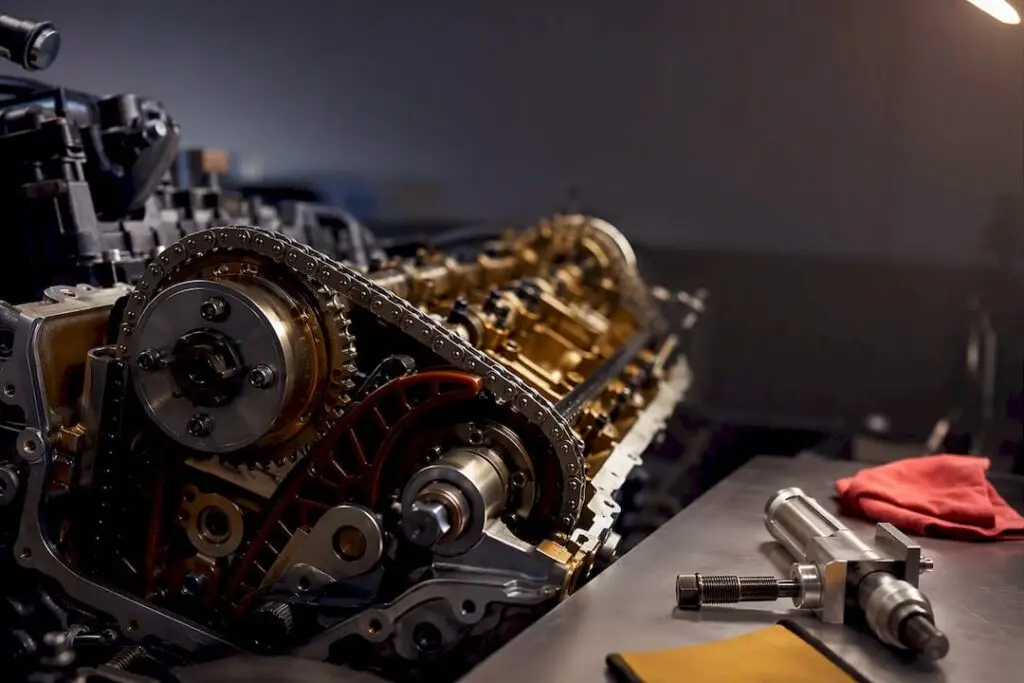
Yes, the BMW N20 timing chain is a real and well-documented failure point, primarily in early-production engines built before January 2015. If your car shows a cold-start rattle, a whining noise, or timing-related fault codes, stop taking long trips and get it inspected now. A proper repair replaces the chain, guides, and tensioner, and usually the oil pump chain module too, with the oil pan pulled and cleaned.
TL;DR:
- The timing chain guides in early BMW N20 engines are prone to brittle plastic failure, leading to debris that can block oil flow and cause severe engine damage.
- Symptoms such as a cold-start rattling noise, a high-pitched whining that tracks RPM, or specific fault codes indicate an imminent timing chain failure, especially in engines built before January 2015.
- Risk is heavily tied to the engine’s actual build date rather than model year, with pre-2015 engines requiring more vigilant inspection and potential proactive replacement.
- A full timing chain repair at a specialist shop usually costs between $2,500 and $4,500, with labor hours ranging from 10 to 15 due to deep engine disassembly.
- Owners should routinely check the oil filter for debris, ensure proper oil quality and intervals, and get diagnostic scans at each oil change to catch failure signs early.
Table of Contents
- BMW N20 Timing Chain Symptoms You Shouldn’t Ignore
- What Actually Fails Inside the N20 Timing Chain System
- Which N20 and N26 Model Years Carry the Highest Risk
- What a Thorough Diagnostic Should Include
- N20 Timing Chain Replacement Cost and What the Job Involves
- BMW’s Technical Bulletin and the 2015 Design Fix
- Preventive Maintenance That Actually Reduces Risk
- What to Expect From a Specialist Shop on This Repair
- What This Engine Teaches Buyers About Trusting a Rattle
- Book Your N20 Timing Chain Inspection With a European Specialist
- Sources
- FAQ
BMW N20 Timing Chain Symptoms You Shouldn’t Ignore
The N20 timing chain problem announces itself before it destroys an engine, but only if you know what you’re listening for. Most owners describe a distinct rattle or clatter for the first one to three seconds after starting the car cold, which fades once oil pressure builds and the hydraulic tensioner takes up slack. That fade is deceptive. It doesn’t mean the problem fixed itself; it means the tensioner is working harder than it should to mask a stretched or slack chain.
As wear progresses, that cold-start rattle can turn into a higher-pitched whine or whir that tracks with engine RPM, especially noticeable during acceleration. Some owners also report a “drivetrain malfunction” dashboard message once timing has drifted far enough to affect drivability, along with a check-engine light. Common fault codes tied to this failure mode include P0011 and P0012, which point to camshaft position being too advanced or retarded, along with camshaft and crankshaft correlation codes that indicate the chain has stretched past its adjustment range.
Watch for these warning signs:
- Rattle or clatter lasting one to three seconds on cold start, especially in cold weather
- A whining or whirring noise that changes pitch with RPM
- Check-engine light with P0011, P0012, or camshaft/crankshaft correlation codes
- A “drivetrain malfunction” or reduced-power warning message
- Metal flecks or plastic debris visible in the oil filter or on the dipstick
- Rough idle or hesitation under load that wasn’t there before
Not every N20 develops this fault. Forum polling on Bimmerpost suggests a majority of owners never see a timing chain failure at all, but a meaningful minority do, concentrated heavily in early-build cars. If your engine is in that risk window and you’re hearing any of the sounds above, the rattle is your cue to book a diagnostic, not to wait and see if it gets worse.
What Actually Fails Inside the N20 Timing Chain System
The root cause almost always traces back to the plastic timing chain guides, not the chain itself. These guides direct the chain around the timing case, and the plastic BMW used in early N20 production becomes brittle with age and heat cycling. Once a guide rail cracks or breaks, it stops doing its job of keeping tension consistent, and pieces of it can break off entirely.
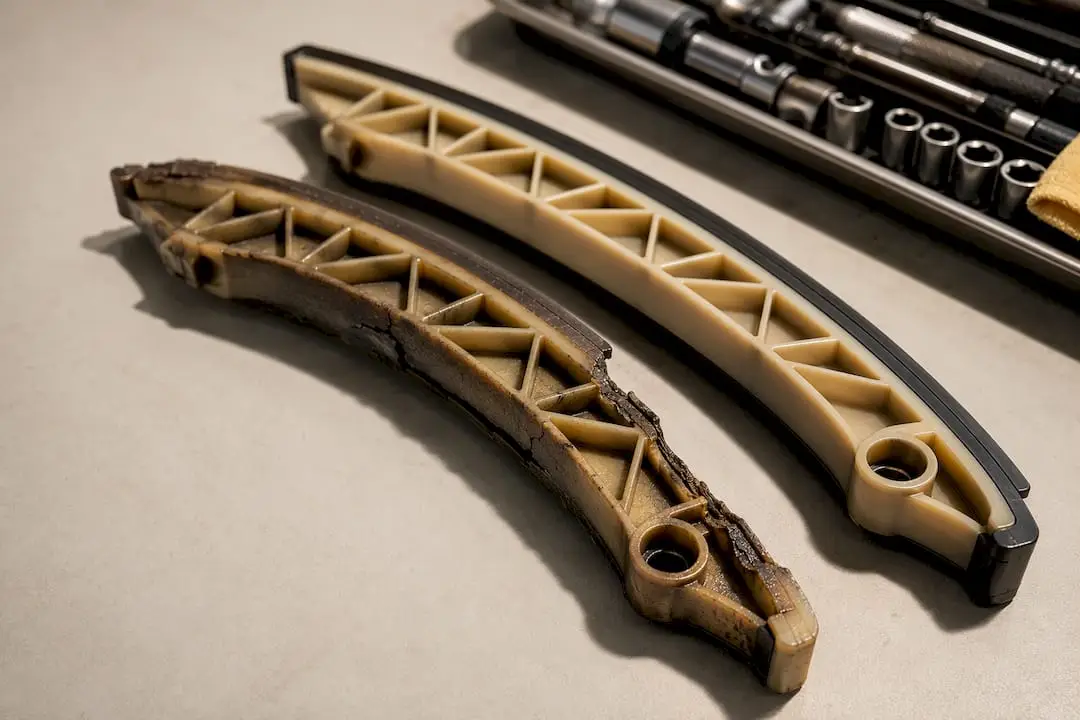
That’s where things get dangerous. The failure typically starts with guide degradation, and the debris from a cracked guide doesn’t just float harmlessly in the oil. It can travel toward the oil pump pickup screen and partially or fully block it, starving the engine’s bearings of oil pressure. That’s how a $30 plastic part turns into a five-figure engine replacement if it goes unaddressed long enough.
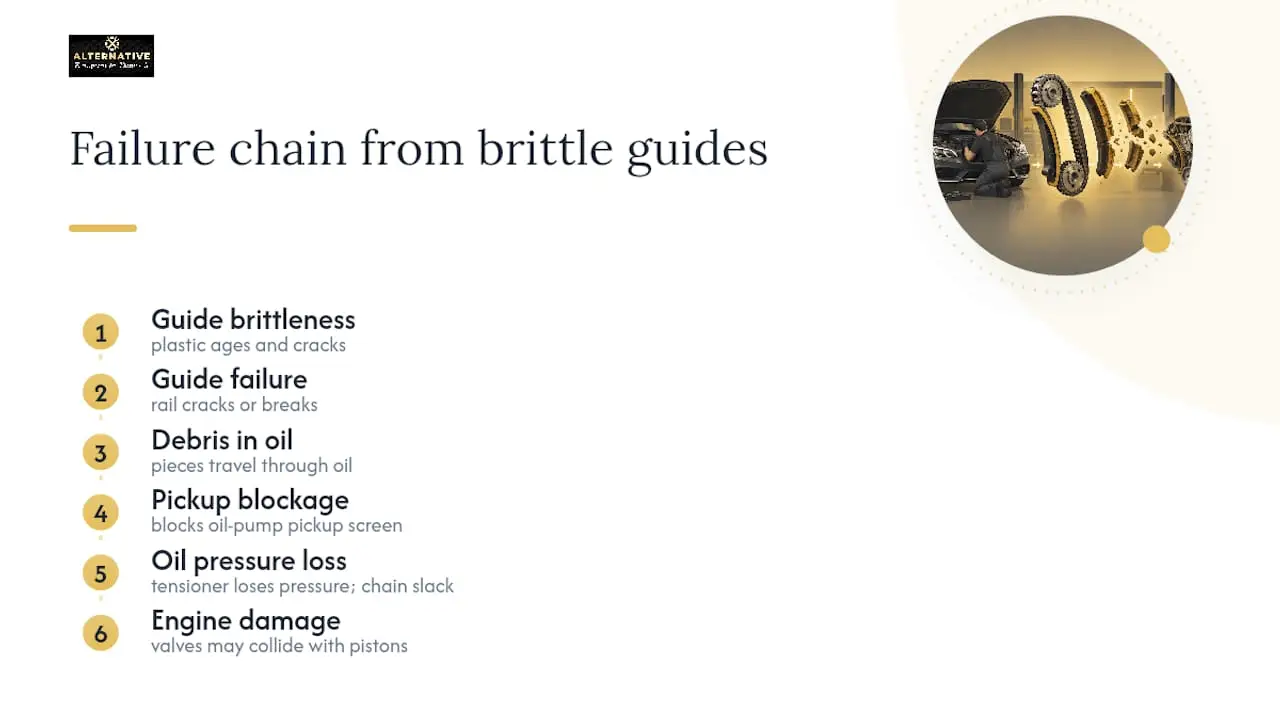
The hydraulic tensioner adds another layer to this. It relies on oil pressure to maintain proper chain tension, which is exactly why the rattle shows up on cold starts: oil pressure takes a moment to build after the engine has been sitting, and a chain that’s already developed slack from worn guides has nothing holding it tight during that gap.
There’s also the oil pump drive chain module, a separate but related chain that drives the oil pump itself. It shares the same guide material and the same failure tendency, which is why specialists usually recommend addressing both at once.
The N20 is an interference engine, meaning the piston travel and valve travel overlap in the same physical space at different points in the rotation. If the timing chain skips even a few teeth from excess slack, the pistons and valves can collide.
Pro Tip: If you’re buying a used N20 and the seller says the car “just got an oil change” but can’t tell you when the timing chain was last inspected, ask to hear a cold start yourself before you commit. A rattle in the first few seconds is the cheapest diagnostic tool you have.
Which N20 and N26 Model Years Carry the Highest Risk
The N20 and its close relative, the N26 (a federalized version with slightly different emissions hardware), showed up across a wide range of BMW models, including the 2-Series, 3-Series, 4-Series, 5-Series, X1, X3, and X4, roughly spanning 2011 through 2016 production.
Risk isn’t evenly spread across that window. It’s tied to production or build date, not the model year printed on the title, which is an important distinction because a “2015 model year” car can have been built in mid 2014, before the fix.
BMW updated the timing chain components with a revised part number around January 2015, and failure rates dropped noticeably in engines built after that point. If you’re evaluating a used N20, the honest way to check risk is:
- Pull the actual production date from the VIN or door-jamb sticker, not the model year
- Ask a BMW dealer or an independent specialist to cross-reference that build date against the technical bulletin
- Treat any pre-January-2015 build as higher risk regardless of mileage
What a Thorough Diagnostic Should Include
A rattle alone tells you something’s wrong, but it doesn’t tell you how far along the damage is. A proper N20 timing chain diagnostic goes through a specific sequence, and if a shop skips steps to save time, you’re the one who inherits the risk.
- OBD-II scan for timing and VANOS codes. The technician should pull codes like P0011, P0012, and cam/crank correlation faults, then explain what each one means for your specific car rather than just clearing them.
- Physical slack check. Where access allows, a technician can check chain slack through the oil filler cap or by removing the cam cover, which gives a direct read on how much play has developed.
- Oil pan drop when debris is suspected. This step is not optional if guide fragments are a possibility. Leaving the oil pan in place means any debris already in the system stays there, and a partially blocked oil pickup screen can cause catastrophic bearing failure within a short time.
- Documentation of findings. You should walk away with photos of the oil filter, any debris found, and a VIN lookup against BMW’s technical bulletin so you know exactly what condition your engine is in.
Pro Tip: Ask any shop quoting a timing chain repair one direct question: “Are you dropping the oil pan?” If the answer is no and debris is a real possibility, get a second opinion before you approve the work.
N20 Timing Chain Replacement Cost and What the Job Involves
A complete N20 timing chain repair is not a quick bolt-on job, and the labor time explains most of the cost. A full repair scope typically includes:
- New timing chain
- Timing chain guides (the parts most likely to have failed in the first place)
- Chain tensioner
- Oil pump drive chain module, replaced alongside the main timing chain in most cases
- Oil pan removal and cleaning of the pickup screen
- New seals, gaskets, and a full oil and filter service
Labor for this job commonly runs 10 to 15 hours, because the timing components sit deep in the engine and require significant disassembly to access. That labor time, more than parts cost, is what drives the total bill.
Independent specialist shops typically land in a range of roughly $2,500 to $4,500 for a complete job, according to cost breakdowns compiled from independent repair specialists, while dealer pricing tends to run higher for the same scope of work. Parts cost varies depending on whether you go with OEM components or quality aftermarket alternatives, but on a job this labor-intensive, parts are usually the smaller line item on the invoice.
Replacing the oil pump drive chain at the same time as the main timing chain adds relatively little extra labor because the engine is already opened up for the primary repair, which is why most specialists recommend doing both in a single visit rather than paying for two separate teardowns down the road.
Here’s the number that should motivate action rather than delay: if a chain skips teeth on an interference engine like the N20, you’re no longer looking at a $2,500 to $4,500 chain job. You’re looking at bent valves, damaged pistons, or a full engine replacement, a cost multiple times higher than catching the problem at the rattle stage.
Warning signs that failure is close include a rattle that’s gotten louder or longer over the past few weeks, a whine that’s become more constant, or any new drivetrain warning light. None of those are “wait until next oil change” symptoms.
BMW’s Technical Bulletin and the 2015 Design Fix
BMW acknowledged the timing chain issue through an official technical service bulletin and limited warranty extension, extending coverage for the timing chain and oil pump drive chain to 7 years or 70,000 miles for eligible US-spec vehicles. The bulletin lists specific replacement components, including the timing chain module and oil pump chain module, and applies to vehicles that meet BMW’s eligibility criteria.
A few practical points for owners:
- Coverage depends on your original in-service date, not just your current mileage, so a car past 70,000 miles may already be outside the window even if it’s within 7 years of purchase.
- Dealer authorization is typically required to confirm eligibility, which means an independent inspection alone won’t activate warranty coverage.
- BMW’s parts update around January 2015 changed the timing chain component design, and failure rates in engines built after that point dropped substantially.
If your car falls in the affected window, checking your VIN against the bulletin costs nothing and takes a few minutes, and it’s worth doing before you pay out of pocket for a repair that might be partially covered.
Preventive Maintenance That Actually Reduces Risk
You can’t guarantee an N20 timing chain will never fail, but you can meaningfully lower the odds and catch problems while they’re still cheap to fix. Oil quality matters more on this engine than on most, because the hydraulic tensioner depends entirely on clean, properly pressurized oil to keep the chain taut.
Stick to BMW LL-01 approved oil and consider shortening your interval slightly below the manufacturer’s default recommendation, particularly if your car falls in the higher-risk production window. At every oil change, ask your technician to listen for a cold-start rattle, run a quick scan for stored codes, and glance at the used filter for metal or plastic debris. These checks add minutes to a routine service and can catch a developing problem months before it becomes a rattle you notice yourself.
- Use BMW LL-01 approved oil and don’t stretch intervals to save money
- Have the filter checked for debris at every service, not just when something feels off
- Ask for a code scan at each oil change, even without symptoms
- If your car is in the pre-2015 risk window with meaningful mileage, ask about proactive replacement before failure forces the issue
Pro Tip: If you’re already committing to a timing chain repair, ask about bundling the water pump replacement if yours is original. Labor overlap on this engine makes tackling both jobs together far more efficient than doing them months apart.
Preemptive replacement makes the most economic sense when you’re already deep into the engine bay for another repair, or when your car is showing early symptoms but hasn’t failed outright. Waiting for full failure almost always costs more than acting early.
What to Expect From a Specialist Shop on This Repair
An N20 timing chain job isn’t a place to cut corners, and the shop you choose should treat it that way. Dealer-level diagnostic equipment matters here because the fault codes involved, particularly VANOS and cam/crank correlation codes, require accurate interpretation, not a generic scan-and-guess approach.
Before you approve any repair, a shop should hand you clear documentation, not just a verbal estimate. That means:
- A VIN lookup against BMW’s technical bulletin to confirm whether your car falls in the eligible warranty window
- Photos of the oil filter and any debris found during inspection
- A written note confirming whether the oil pan was dropped and the pickup screen cleaned
- A transparent, itemized estimate that separates parts, labor, and any additional work found once the timing case is open
Some specialist shops approach N20 repairs with detailed documentation as standard practice, using advanced diagnostics to confirm the engine condition before recommending a repair path. Owners deciding whether to repair, sell, or hold onto an N20-equipped BMW deserve that clarity before they spend a dollar.
What This Engine Teaches Buyers About Trusting a Rattle
The conventional advice around the N20 timing chain tends to swing between two extremes: either it’s presented as a ticking time bomb that dooms every N20 ever built, or it’s dismissed because “most cars are fine.” Neither framing helps you make a real decision. The build date on your specific engine matters more than either narrative, and a five-minute VIN check tells you more than a forum thread ever will.
If you’re buying, verify the production date before you fall in love with the car, and always insist on hearing a cold start. If you already own one and you’ve heard even a faint rattle, the smartest move is inspection now, not after your next long road trip. Waiting rarely saves money. It just moves the decision from “affordable repair” to “engine replacement.”
— Alternative European & Domestic
Book Your N20 Timing Chain Inspection With a European Specialist
A specialist shop serving European car owners in Dallas may offer dealer-level diagnostic equipment paired with technicians experienced in N20-equipped BMWs, able to diagnose issues like cold-start rattle accurately before starting repairs.

If you’ve heard a rattle, a whine, or picked up a drivetrain warning light, the Maintenance Service team can run a full diagnostic scan, check for stored timing and VANOS codes, and give you a documented, transparent estimate before any work begins. For cars that need the full timing chain, guides, tensioner, and oil pump chain module replaced, the Engine Repair Services team handles the complete job, including the oil pan drop and pickup screen cleaning that a shortcut repair would skip. Call Alternative European & Domestic or book online to get your N20 inspected before a manageable repair turns into an engine replacement.
Sources
BMW’s own technical bulletin and warranty extension document is the single most important reference if you’re checking whether your VIN qualifies for coverage. For real-world cost expectations, independent breakdowns like Xerodrive’s repair cost guide lay out labor time and parts ranges clearly. If you want the timeline on BMW’s parts redesign, RightFootDown’s coverage of the January 2015 update explains what changed and why it mattered. For chain-component maintenance context more broadly, Digi Paris Sud’s guide covers general service intervals worth comparing against.
- BMW N20 And N47 Timing Chain Failure: Full Cost Breakdown And Repair Guide – Xerodrive
- BMW N20 Timing Chain Repair | Guide to Failure … – Motronix
FAQ
Do All N20 Timing Chains Fail?
No. Failure is concentrated in engines built before the January 2015 parts update, and owner reports on forums like Bimmerpost suggest most N20 owners never experience a chain failure at all. Risk depends heavily on production date, not simply on the fact that the car has an N20 engine.
How Much Does an N20 Timing Chain Replacement Cost?
A complete repair, including the chain, guides, tensioner, and typically the oil pump chain module, commonly runs about $2,500 to $4,500 at independent specialist shops, with dealer pricing running higher for the same scope. Labor typically takes 10 to 15 hours because of how deep the components sit in the engine.
When Should I Replace My N20 Timing Chain?
Replace it as soon as you notice a cold-start rattle, a whining noise tied to RPM, or a timing-related fault code, since these symptoms indicate the guides or tensioner are already failing. If your car falls in the pre-2015 production window and shows any of these signs, book a diagnostic through a service like Alternative European & Domestic’s maintenance program rather than waiting for the noise to worsen.
What Year Did BMW Fix the N20 Timing Chain?
BMW updated the timing chain component design around January 2015, and failure rates dropped noticeably in engines built after that point. Because production date and model year don’t always match, checking the actual build date on your VIN is more reliable than going by the title year alone.