
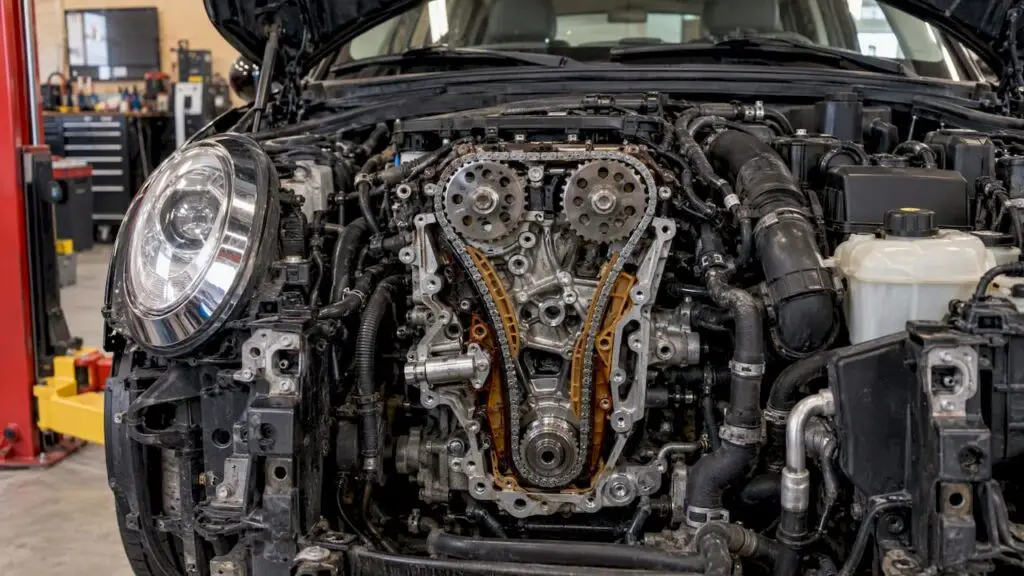
A rattle from the back of a MINI engine in the first few seconds after a cold start usually points to a worn timing chain tensioner, stretched chain or worn plastic guides. It is most common on 2007-2013 turbocharged Cooper S engines. If the noise is brief and the car runs normally, book a diagnostic soon. If it is constant, comes with a check engine light or the engine runs rough, stop driving and have the car towed. Here is how to tell the difference.
TL;DR
- A short, harsh rattle on cold start that fades as oil pressure builds is the classic early sign of a tired timing chain tensioner.
- A rattle that lasts longer, shows up when warm, or arrives with camshaft codes, misfires or a rough idle is more serious. Do not keep driving.
- Replacing only the tensioner averages $669 to $874 on a MINI Cooper, according to RepairPal. A full chain job on European cars typically runs $2,120 to $2,764.
- Not every MINI engine noise is the chain. A proper diagnosis separates it from other rattles before you spend money.
- We diagnose and repair European engines in Dallas. Call before the noise turns into a tow.
Table of Contents
- What the timing chain does, and why it makes noise
- What MINI timing chain noise sounds like
- Common causes behind the rattle
- Is it really the timing chain?
- How a shop diagnoses timing chain noise
- Can you keep driving with a rattling timing chain?
- MINI timing chain replacement cost
- How to reduce the risk of chain trouble
- Why bring a MINI to us
- FAQ
- Sources
What the timing chain does, and why it makes noise
The timing chain links the crankshaft to the camshafts. It keeps the valves opening and closing in step with the pistons. On many engines the chain runs on plastic guides and is held tight by a tensioner that uses engine oil pressure.
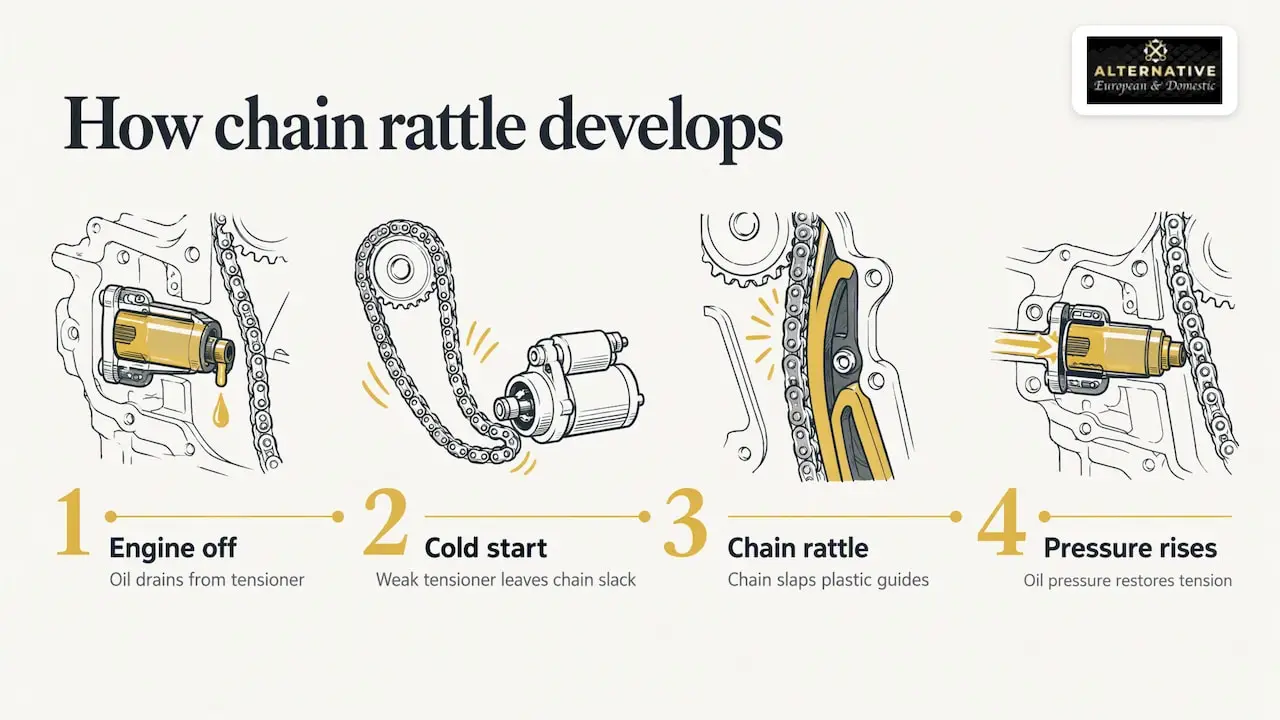
That design explains the sound. When the engine is off, oil drains out of the tensioner. On the next start, a healthy tensioner still holds the chain snug. A weak one lets it go slack for a moment, and the chain slaps the guides until oil pressure catches up. That slap is the rattle.
Unlike a timing belt, a chain is built to last. ConsumerAffairs notes that chains are designed to last the life of the vehicle, often 100,000 to 250,000 miles, with no set replacement interval. Noise is therefore the signal that something has worn, not a mileage reminder.
What MINI timing chain noise sounds like
Owners describe several sounds. They overlap, which is one reason a listening test alone is not enough.
| Sound | When you hear it | What it often means |
|---|---|---|
| Loud metallic rattle, 1 to 3 seconds | Cold start only | Weak tensioner letting the chain go slack |
| Brushing or scraping noise | Cold start, sometimes at idle | Early guide or chain wear |
| Rattle that lingers or returns when hot | Idle after a drive | Advanced wear; chain may have stretched |
| Constant rattle with rough running | Any time | Possible timing slip; stop driving |
Reliability coverage of the Cooper S backs up the cold-start pattern. What Car? tells buyers of the turbocharged 1.6-litre Cooper S to listen for a loud rattle on cold start, caused by a tensioner that fails to maintain tension over time. Autocar says Cooper S models of 2007 to 2013 can give hints first, such as a brushing noise, before the chain fails.
Which MINIs are most affected
The pattern clusters in the turbocharged Cooper S of roughly 2007 to 2013, and the sources above focus on that engine. A class action page tracking litigation alleges that Cooper and Cooper S models from the late 2000s may have been fitted with defective timing chain tensioners. That is an allegation, not a ruling, and we make no claim about any individual car. If you own one of these years, treat a new rattle as worth checking early.
Other model years can have chain noise too. Age, oil condition and mileage all matter, so diagnose the car in front of you rather than the model reputation.
Common causes behind the rattle
- Worn hydraulic tensioner. It bleeds down overnight and does not hold the chain tight at startup.
- Worn plastic chain guides. Broken or thinned guides let the chain move more than it should.
- Stretched chain or worn sprockets. Pins wear over time and the chain lengthens, adding slack the tensioner cannot always take up.
- Oil problems. Low oil level, degraded oil or the wrong grade can slow pressure buildup at startup. This is why regular oil changes and engine lubrication service matter for chain-driven engines.
- Previous repairs done halfway. Replacing guides without addressing the tensioner or sprockets can leave the noise in place.
Is it really the timing chain?
Not always. Several other parts make noises that get blamed on the chain:
- Turbo wastegate actuator linkage. A loose linkage produces a rattle that can be mistaken for chain noise. Our wastegate rattle guide explains the linkage check, which applies to turbocharged BMW-family engines.
- Heat shields and exhaust. Loose shields rattle at specific RPM.
- Accessory drive. Pulleys, tensioners and belts squeal or chirp, usually a different character than a chain slap.
- Engine mounts. A failing mount can add clunks and vibration. See our notes on engine mount failure and repair costs.
- Valvetrain and lifters. A ticking that follows engine speed is a different problem from a slap at startup.
A chain rattle tends to come from the timing cover end of the engine, is loudest at startup, and fades once oil pressure rises. A technician confirms by combining sound location, scan tool data and, when needed, physical inspection.
How a shop diagnoses timing chain noise
A good diagnosis is more than hearing a rattle and quoting a job. Here is the sequence a careful technician follows:
- Interview. When does it happen: cold only, hot, or always? Has it changed? Any recent oil service?
- Cold start observation. The car sits overnight, then the technician listens to the first seconds of startup, ideally with a stethoscope to locate the source.
- Scan for codes. Camshaft correlation or timing codes, misfire codes and live data show whether the cam and crank positions are drifting apart. Our advanced electrical diagnostics approach covers how we read live data rather than guessing from codes.
- Oil check. Level, condition and grade are verified, since they directly affect tensioner behavior.
- Physical inspection. RepairPal notes that a quick inspection can verify suspected chain failure, which involves removing covers to see the chain, guides and tensioner.
- Written findings. You should get what was found, what is urgent, and what can wait.
If you want to know what to expect before authorizing work, read our guide to the diagnostic fee for car owners and our list of questions to ask a mechanic.
Can you keep driving with a rattling timing chain?
It depends on the symptoms. Use these as a guide, not a guarantee.
Book a diagnostic this week if:
- The rattle lasts only a second or two on cold starts.
- The car otherwise runs smoothly, with no warning lights.
- You can drive short, gentle trips to the shop.
Stop driving and arrange a tow if:
- The rattle is constant, loud or getting worse.
- The check engine light is flashing, or the car has camshaft or misfire codes.
- The engine idles roughly, hesitates, loses power or runs out of sync.
- The engine will not start after the noise, or cranks without catching.
The reason for the caution is that many engines are interference designs. If the chain skips a tooth or breaks, pistons and valves can collide, and a rattle repair becomes an engine repair. We cannot say whether your particular engine is an interference design without checking it, so we treat any worsening chain noise as a reason not to drive.
If the car will not crank or start, our no-crank, no-start diagnostic walkthrough explains how we separate electrical causes from mechanical ones.
MINI timing chain replacement cost
Price depends on what is actually worn. These figures are published estimates, not quotes from us.
| Repair | Typical range | Source |
|---|---|---|
| Tensioner replacement, MINI Cooper | $669 to $874 | RepairPal |
| Timing chain replacement, European vehicles | $2,120 to $2,764 | RepairPal |
On the tensioner job, RepairPal estimates labor at $438 to $643 and parts around $231, before taxes and fees. Dallas labor rates, the exact engine, and whether guides and sprockets also need replacing will move the final number.
What drives the cost up or down
- Scope. Tensioner only, tensioner plus guides, or a full kit with chain and sprockets.
- Labor access. Timing components sit deep in the engine, so labor is the largest part of the bill.
- Related leaks and wear. If covers, seals or gaskets are leaking when opened up, they are often best replaced during the same job.
- Waiting too long. A chain that jumps time can add valve and cylinder head repairs on top.
A tensioner-only repair can be a sensible early fix when the guides and chain are in good condition. It is not sensible when inspection shows worn guides or a stretched chain, because the noise returns. This is the point of inspecting first: you pay for what the engine needs.
For a look at how thorough chain diagnosis saves money on a related engine, see our BMW N20 timing chain checklist. The N20 is a different engine, but the logic of inspecting before replacing carries over.
How to reduce the risk of chain trouble
You cannot make a chain last forever, but you can avoid shortening its life.
- Change oil on time, with the correct specification. Chain tensioners rely on clean oil and steady pressure.
- Do not ignore a short cold-start rattle. Early repair is cheaper than late repair.
- Avoid long idling and repeated short trips on a cold, noisy engine until it has been inspected.
- Address oil leaks and low oil promptly. Check the level between services.
- Keep a record. Note when the noise started and how it changed. It helps the technician.
A scheduled maintenance service lets a technician listen to the engine, check fluids and catch changes early, rather than after a tow.
Why bring a MINI to us
Alternative European & Domestic is a Dallas shop that works on European, domestic and high-performance vehicles. Our ASE-certified technicians use dealer-level diagnostics to find the cause of an engine noise before recommending a repair, and we explain what we find in plain terms. Drivers around Oak Lawn, Uptown and the rest of Dallas can bring in a rattling MINI for an evaluation, and our engine repair services cover mechanical work from inspection through repair.
Qualifying repairs may be covered by our 24-month/24,000-mile warranty, subject to applicable terms. Ask us how it applies to your repair.
If your MINI is rattling on cold start, schedule an appointment and tell us when the noise happens. We will diagnose it first and give you the findings before any repair begins.

FAQ
Does a bad timing chain make noise all the time?
Not usually, at least early on. The first sign is often a rattle for a second or two on cold start, which then disappears once oil pressure builds. As wear advances, the noise can linger, return at hot idle or become constant. A constant rattle with rough running is a reason to stop driving.
What are the symptoms of a failing MINI timing chain?
The most common symptom is a metallic rattle at cold start. Others include a brushing noise, a check engine light with camshaft-related codes, rough idle and misfires. Some cars show no warning before failing, so a new startup rattle deserves a diagnostic.
How much does it cost to replace a MINI timing chain?
RepairPal estimates European timing chain replacement at $2,120 to $2,764, and a MINI Cooper tensioner replacement at $669 to $874. Your actual cost depends on the engine, the parts needed and labor rates. A diagnostic inspection tells you which repair applies.
How long does a timing chain last?
Chains are designed to last the life of the vehicle, often 100,000 to 250,000 miles, according to ConsumerAffairs. Certain MINI Cooper S engines have a reputation for tensioner and guide wear well before that. Oil changes on schedule help protect the chain.
Is it safe to drive a MINI with timing chain rattle?
A brief cold-start rattle on an otherwise smooth car may allow short trips to a shop. A constant rattle, flashing check engine light, rough running or power loss means the car should not be driven. Towing is the safer choice, because a skipped or broken chain can damage the engine.
Sources
- RepairPal: Timing Chain Replacement Cost Estimate
- RepairPal: Mini Cooper Timing Chain Tensioner Replacement Cost Estimate
- ConsumerAffairs: Timing chain replacement cost
- What Car?: Used Mini Clubman reliability and common problems
- Autocar: Used car buying guide, Mini Cooper S
- ClassAction.org: Mini Cooper Timing Chain Lawsuit