
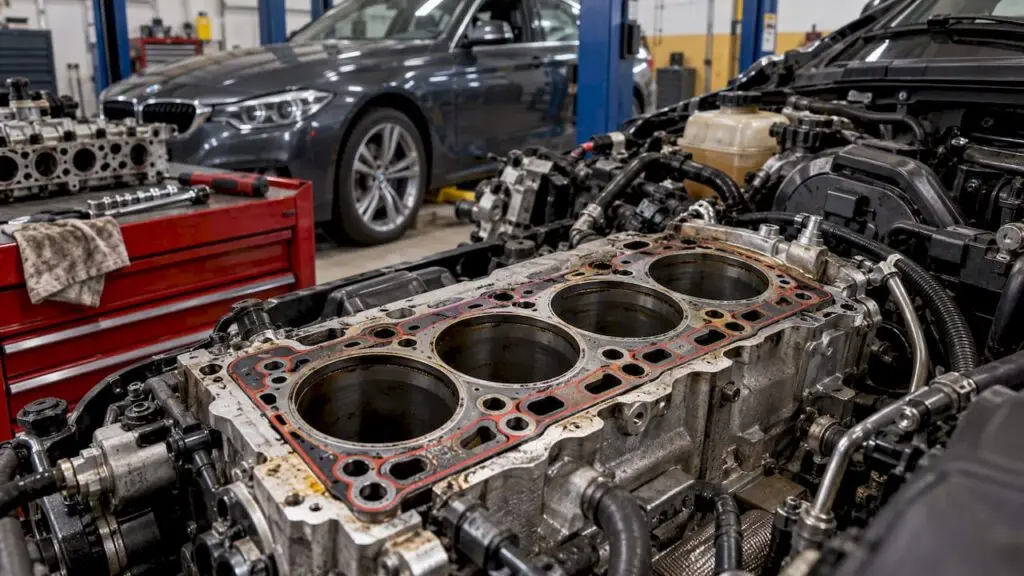
The most common head gasket symptoms are an engine that keeps overheating, thick white exhaust smoke that does not clear when the engine is warm, coolant that disappears with no visible leak, and milky, foamy oil. Any one of these warrants a professional inspection before you drive further, because a failing gasket can turn into a damaged cylinder head or block. At Alternative European & Domestic, we see this pattern often in Dallas traffic, where heat, stop-and-go driving and deferred cooling system service put real stress on European, domestic and performance engines.
TL;DR
- Watch for four main signs: repeated overheating, white smoke that lingers, unexplained coolant loss and milky oil or a milky oil cap.
- Many other faults mimic a bad head gasket, including a stuck thermostat, a weak radiator cap, a water pump leak or a misfire from ignition or injectors. Test before you tear down.
- If the temperature gauge climbs into the red, or you see steam, pull over and shut the engine off. Do not keep driving to “make it home.”
- Confirmation takes a cooling system pressure test, a combustion gas test and, if needed, a leak-down or compression test.
- Repair is labor-heavy. Published averages run roughly $3,400 to $5,500 for common vehicles and higher for some European engines.
Table of Contents
- What a head gasket does
- The main head gasket symptoms, one by one
- Symptom checker: what it usually means
- Is it safe to keep driving?
- How a shop confirms a failed head gasket
- What else gets mistaken for a blown head gasket
- Why head gaskets fail
- What repair involves and what it costs
- How to reduce the risk
- Schedule a diagnostic evaluation in Dallas
- FAQ
- Sources
What a head gasket does
The head gasket is a seal between the engine block, where the cylinders sit, and the cylinder head, which holds the valves and the top of each combustion chamber. It has to hold in combustion pressure while also keeping coolant and oil in their separate passages. That is a demanding job, with extreme heat on one side and pressurized fluids on the other.
When the seal breaks down, one of three things happens, sometimes more than one:
- Combustion gas leaks into the cooling system. This pressurizes the coolant and pushes it out, causing bubbling, overflow and overheating.
- Coolant leaks into a cylinder. It burns off as white smoke and fouls spark plugs.
- Coolant and oil cross-contaminate. The oil turns milky, or coolant looks oily.
A gasket can also fail on the outside edge, leaving oil or coolant seeping down the side of the engine where the head meets the block.
The main head gasket symptoms, one by one
Overheating that keeps coming back
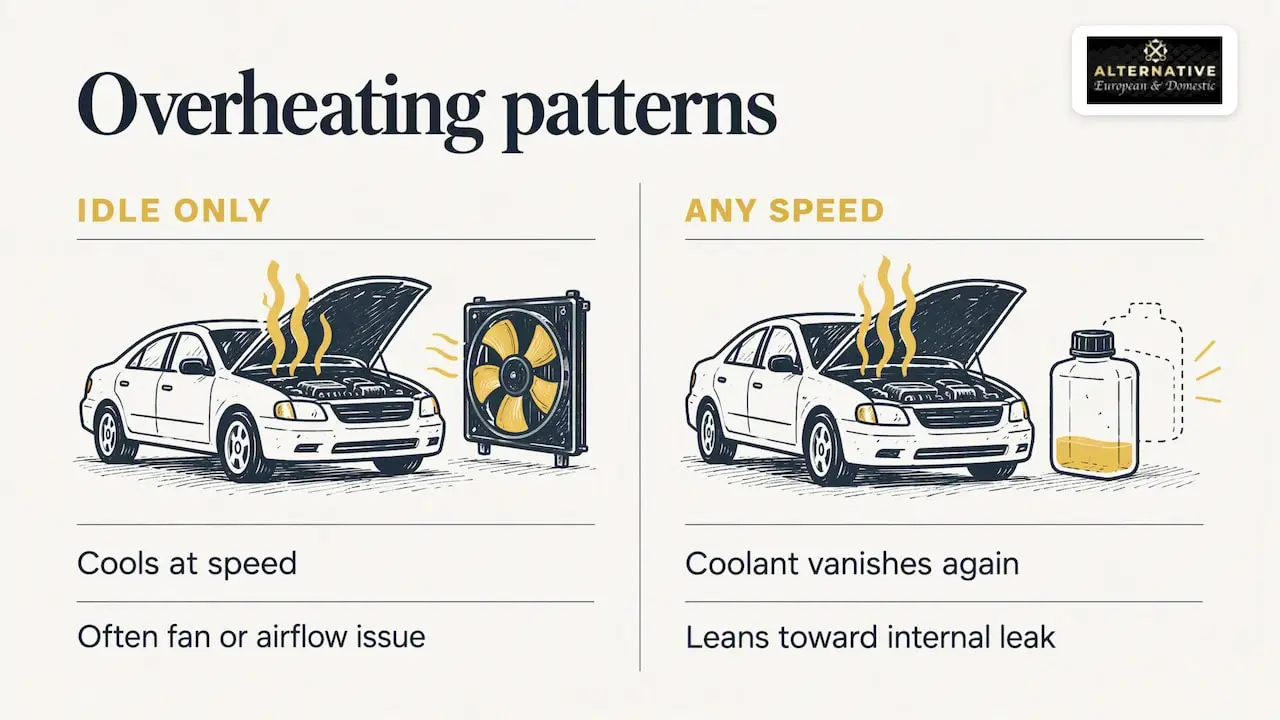
Overheating is the most common sign and the one that most often sends drivers to a shop. A gasket leak lets combustion gas into the coolant, which creates air pockets and displaces liquid, so the engine cannot shed heat. You might see the gauge climb on a hot afternoon on I-35E or the Dallas North Tollway, drop back, then climb again a day later.
The pattern matters. An engine that runs hot only at idle and cools off at speed often points to a fan, a fan clutch or relay, or low airflow through the radiator. An engine that runs hot at any speed, and refills with coolant that vanishes again, leans toward an internal leak. Either way, AAA lists overheating as a serious problem that should be addressed promptly, with steam, a burning smell and a high gauge reading as the usual warnings.
If your car overheats only with the A/C on, the extra load on the cooling fan and radiator is usually the first thing to check, not the gasket. Our guide on A/C that runs warm at idle explains how a shop separates airflow and refrigerant problems from engine-side issues.
White smoke from the tailpipe
A little thin vapor on a cold morning is normal condensation. White smoke is a concern when it is thick, has a sweet smell, and continues after the engine reaches operating temperature. That persistent smoke is a classic indicator of coolant entering the combustion chamber.
Blue-gray smoke is different. That is usually burning oil from valve seals or piston rings, not coolant. Black smoke is excess fuel. Telling these apart is part of a proper diagnosis.
Coolant loss with no puddle
If you top off the reservoir every week or two and never find a drip on your garage floor, the coolant is going somewhere. It may be burning in a cylinder, pushing out the overflow under pressure, or sitting in the oil pan. External leaks are more common than internal ones, though, so a shop will check hoses, the radiator, the water pump and the heater core before pointing at the gasket. Some platforms are known for specific leak points, which is why we wrote about BMW coolant leaks and the 60,000 to 80,000 mile refresh and why VW water pump leaks should be tested before nearby parts are replaced.
Milky or foamy oil
Pull the oil filler cap. A tan, milkshake-like residue on the underside, or a milky look on the dipstick, suggests coolant has mixed with oil. Milky oil indicates the oil and coolant passages have been bridged. Contaminated oil does not lubricate properly, so bearings are at risk the longer you drive.
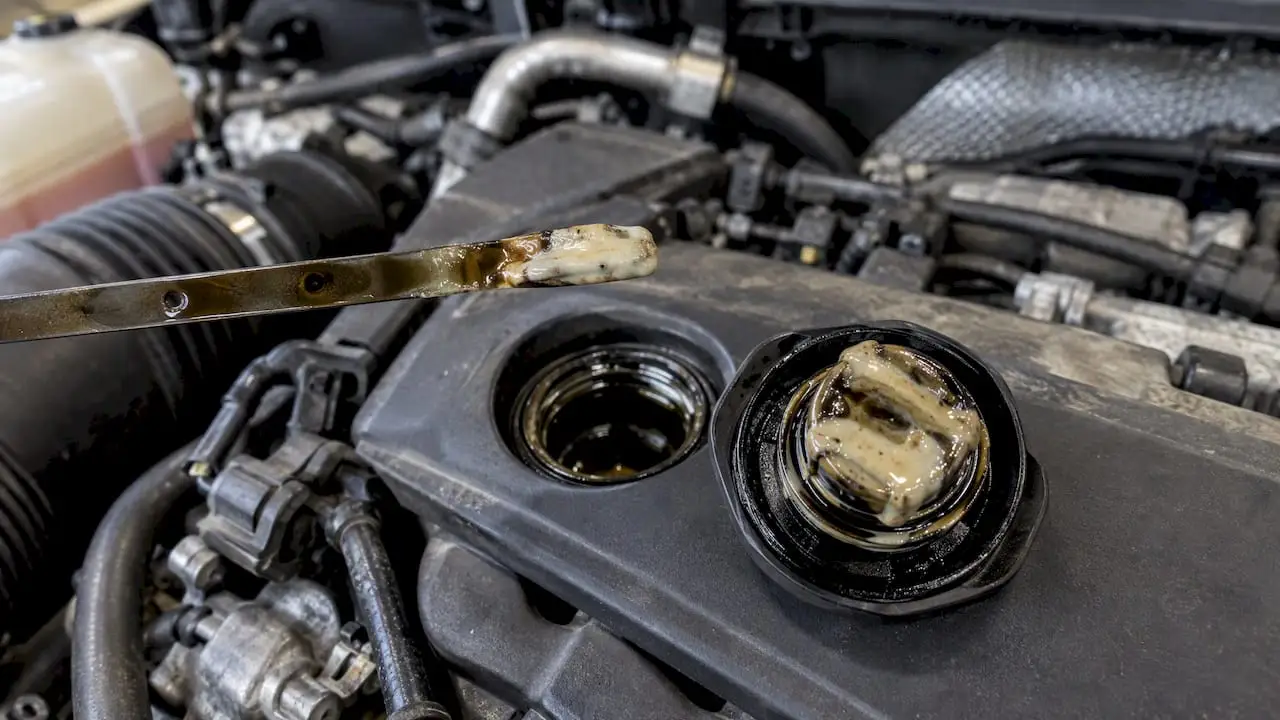
A caution: a little condensation on the cap is common on short winter trips and does not always mean a failed gasket. The dipstick and the oil on a drain are better evidence than the cap alone. Never keep driving a car you believe has coolant in the oil.
Bubbles in the coolant
Bubbling in the reservoir or an open radiator on a warm engine suggests combustion gas is entering the system. Do not open a hot radiator or reservoir cap. Scalding coolant under pressure can cause serious burns. This is a check for a technician with the engine at a safe temperature, not a roadside experiment.
Misfires, rough idle and power loss
Coolant in a cylinder can foul a spark plug or wash oil from the cylinder wall, which causes a misfire and a check engine light. Compression loss between cylinders or to the outside does the same. Drivers describe it as a stumble at idle, hesitation under load, or a car that feels flat. Because misfires also come from coils, plugs and injectors, this symptom alone proves nothing.
External oil or coolant seepage
Streaks of oil or coolant running down the engine at the head-to-block seam can show an outer-edge failure. Valve cover leaks look similar and are far cheaper to fix. Our valve cover gasket leak triage shows how to tell them apart.
Symptom checker: what it usually means
| What you notice | Possible head gasket cause | Other causes a shop rules out |
|---|---|---|
| Overheating in traffic or at idle | Combustion gas in coolant | Cooling fan, thermostat, radiator cap, low coolant, clogged radiator |
| Thick white smoke after warm-up | Coolant burning in a cylinder | Faulty injectors, intake manifold leak on some engines |
| Coolant level drops, no puddle | Internal leak | Small external leak that evaporates, failing cap |
| Milky oil | Oil and coolant mixing | Condensation, failed oil cooler or cooler seals |
| Misfire and rough idle | Fouled plug or low compression | Coil, plug, injector or vacuum leak |
| Bubbles in the coolant | Combustion gas entering | Air trapped after a coolant service |
An oil cooler or intake manifold gasket can imitate a head gasket on certain engines. Which parts do this varies by design, so we do not guess by model.
Is it safe to keep driving?
No, not if you see any of these:
- The temperature gauge in the red zone, or a warning message about engine temperature.
- Steam from under the hood or a strong sweet or burning smell.
- Milky oil, or a low oil pressure light.
- Heavy white smoke with a rough-running engine.
Pull over somewhere safe, shut the engine off and let it cool. Driving even a few more miles overheated can warp an aluminum cylinder head, and that turns a gasket job into a head replacement or machine work.
Towing is the right call when the gauge has hit red, when coolant is pouring out, when oil looks milky, or when the engine is running very rough. If the car overheated once, has since cooled, and the level is only slightly low, a short, careful trip straight to a shop is sometimes reasonable, but when in doubt, tow it. A tow costs far less than a new engine.
How a shop confirms a failed head gasket
This is where the guesswork ends. Replacing a head gasket means removing the cylinder head, so you want the diagnosis to be right first. The standard sequence looks like this:
- Visual and fluid check. Coolant condition, oil condition, level history, external leaks, belts, hoses and fans.
- Cooling system pressure test. The system is pressurized and watched. One published procedure describes holding 138 kPa (20 psi) and treating a drop of more than 27.57 kPa (4 psi) over five hours as a strong sign of internal leakage. A fast drop with no external leak is a clue.
- Combustion gas (block) test. A chemical tester samples the air above the coolant for exhaust gases. Inexpensive kits can give false negatives, for example when the leak is between two cylinders, so a negative result does not clear the gasket by itself.
- Compression or cylinder leakage test. Cylinder leakage testing measures the percentage of compressed air lost from a cylinder at top dead center, which shows the sealing condition of valves, rings and head gasket without disassembly. Air bubbling into the radiator during the test points to the gasket.
- Scan data and misfire history. Live data and stored codes show which cylinders misfire and under what conditions.
The technician’s training matters here. Fluid in a cylinder or a dead cylinder can come from several faults, and an ASE-certified technician is taught to prove the cause before authorizing a teardown. Bumper puts diagnostic testing at roughly $75 to $150 at reputable shops. Prices vary by shop and by vehicle, and a European engine with limited access can take more time.
What else gets mistaken for a blown head gasket
This list is longer than most owners expect, and it is the reason a diagnostic evaluation comes before any quote for an engine teardown.
- A stuck thermostat. A thermostat stuck closed causes quick overheating. One stuck open causes slow warm-up and poor heater output. See our walkthrough on diagnosing a thermostat stuck open.
- A weak radiator cap. It cannot hold pressure, so coolant boils and is lost through the overflow.
- A failing water pump or hose. Both cause coolant loss and heat.
- Cooling fan or relay failure. This typically causes overheating at idle and in traffic only.
- Ignition or fuel injector faults. These cause misfires and rough running that look like gasket trouble.
- An oil cooler leak. This can put coolant in oil without a head gasket failure.
- Boost leaks on turbo engines. They cause power loss and rough running. See our notes on boost leak symptoms.
Why head gaskets fail
The gasket is often the victim, not the original cause. Running an engine low on coolant or with an existing cooling fault builds heat, and thermal stress is what tends to destroy the seal. A few common triggers:
- Overheating events. Aluminum heads expand more than iron blocks, and repeated heat cycles stress the seal.
- Neglected coolant. Old coolant loses corrosion protection, and deposits and corrosion restrict flow.
- A failing cooling component. A weak fan, thermostat or pump that goes unaddressed leads to heat.
- Detonation or high cylinder pressure. This is more relevant to modified or tuned engines, where pressure and heat are higher than stock.
- Age and mileage. Seals harden over time, and some designs are known to be weaker than others. We do not name specific models without evidence.
Fleets face the same problem. If you manage multiple vehicles, this engine overheating prevention guide covers the routine checks that catch heat problems early.
What repair involves and what it costs
The job is labor-intensive. The head comes off, surfaces are inspected and, where needed, machined flat. New gaskets and often new head bolts go in, since many engines use torque-to-yield bolts that must not be reused. Coolant and oil are replaced, and the cooling system is bled and tested afterward. Many European and high-performance engines specify tightening sequences and angles that must be followed exactly.
On cost, ConsumerAffairs reports labor at roughly 70 to 85 percent of the total. Its examples: a 2017 Honda Civic averaged $3,456.90, and a 2019 BMW 740i averaged $5,459.10. Some high-end European vehicles go past $6,000. For a local reference point, RepairPal’s Dallas estimate for a 2026 Toyota Tundra runs from $5,644 to $7,55x, which shows how much engine layout drives the price. These are published averages, not quotes from our shop.
The main cost factors:
- Engine layout: V6, V8, boxer and dual-overhead-cam engines need more disassembly than a simple inline four.
- Whether the head needs machining or replacement because of overheating damage.
- Related parts replaced while the engine is open, such as the water pump, thermostat, timing components and hoses.
- Parts quality and the vehicle’s accessibility.
Is it worth fixing? That depends on the car’s condition, the engine and your plans for it. When the repair is done correctly, with proper machining and quality gaskets, the engine can be restored to reliable service. Ask for the findings and the estimate in writing. Our list of questions to ask a mechanic is a good place to start.
How to reduce the risk
Preventive cooling system care is the most effective protection:
- Follow your manufacturer’s coolant service interval and use the specified coolant type. European makes are often particular about this.
- Check the coolant level when the engine is cold, and treat any recurring loss as a symptom.
- Replace thermostats, caps, hoses and water pumps on a schedule, not after a failure.
- Never ignore a temperature warning. Stop, do not push on.
- Keep oil changes current, and have any misfire diagnosed promptly.
These items fit into a regular maintenance service, which for Dallas drivers who sit in summer heat in Uptown, Oak Lawn or on the Tollway is worth taking seriously.
Schedule a diagnostic evaluation in Dallas
If your car is overheating, losing coolant or smoking, the next step is a diagnosis, not a guess. Alternative European & Domestic works on European, domestic and high-performance vehicles with dealer-level diagnostics and ASE-certified technicians. We test before we recommend, and we explain what we find in plain terms. Our engine repair services cover the mechanical work when a repair is needed. Qualifying repairs may be covered by our 24-month/24,000-mile warranty, subject to applicable terms.
If the car is safe to move, schedule an appointment for a diagnostic evaluation. If the gauge is in the red or the oil looks milky, have it towed.
FAQ
Can a car run with a blown head gasket?
Sometimes, for a short time, but it is risky. Small leaks may only show as slow coolant loss, while larger ones cause overheating, misfires and oil contamination. Each mile driven overheated raises the chance of warping the head or damaging bearings, so get it checked quickly.
Why does my car overheat at idle or in traffic?
At idle there is little airflow through the radiator, so the cooling fan has to do the work. A failed fan, relay, low coolant or a weak cap is the more common cause. A head gasket leak can also cause it, especially if coolant keeps disappearing. A cooling system pressure test separates the two.
What does white smoke from the exhaust mean?
Thin vapor on a cold start is normal condensation. Thick, sweet-smelling white smoke that continues after warm-up usually means coolant is burning in a cylinder. A head gasket is a common cause, but a cracked head or a different internal leak can produce the same sign.
How do I know if it is coolant in the oil?
Look for a tan, milky film under the oil cap or on the dipstick, and check the coolant for an oily film. A little condensation can occur on short trips, so a shop will confirm with fluid inspection and pressure testing. Do not keep driving if you suspect coolant in the oil.
Is it worth fixing a blown head gasket?
Often yes, when the rest of the engine is sound and the vehicle is worth keeping. A correct repair with proper machining and quality parts can restore reliability. Get a written estimate and compare it against the vehicle’s value and your plans.
Sources
- Blown Head Gasket Symptoms: How to Tell and What to Do, Bumper
- Head gasket replacement cost, ConsumerAffairs
- 13 Common Car Problems Explained, AAA
- Cylinder leakage test lesson, MasterTechPrep ASE A8
- 2026 Toyota Tundra Head Gasket Replacement Cost in Dallas, TX, RepairPal