
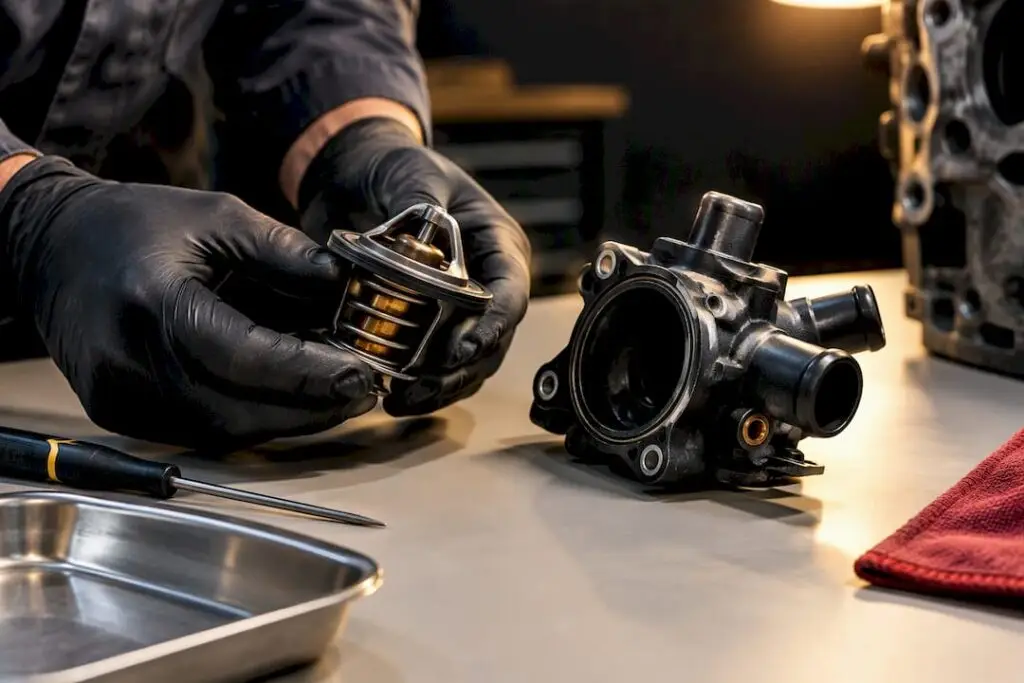
A thermostat stuck open keeps your engine running too cool, which leads to weak heater output, lower fuel efficiency, and a possible check engine light tied to code P0128. Short trips are usually safe while you sort out the cause, but the problem will not fix itself. Run a quick diagnostic check or book a service visit once symptoms show up.
TL;DR:
- A stuck-open thermostat causes the engine to run below its optimal temperature, leading to reduced fuel efficiency and increased tailpipe emissions.
- It often presents as a lower-than-normal temperature gauge, lukewarm heater output, and a P0128 code indicating cool coolant.
- DIY diagnosis involves scanning for codes, checking hose temperatures, and bench testing the thermostat in hot water to confirm failure.
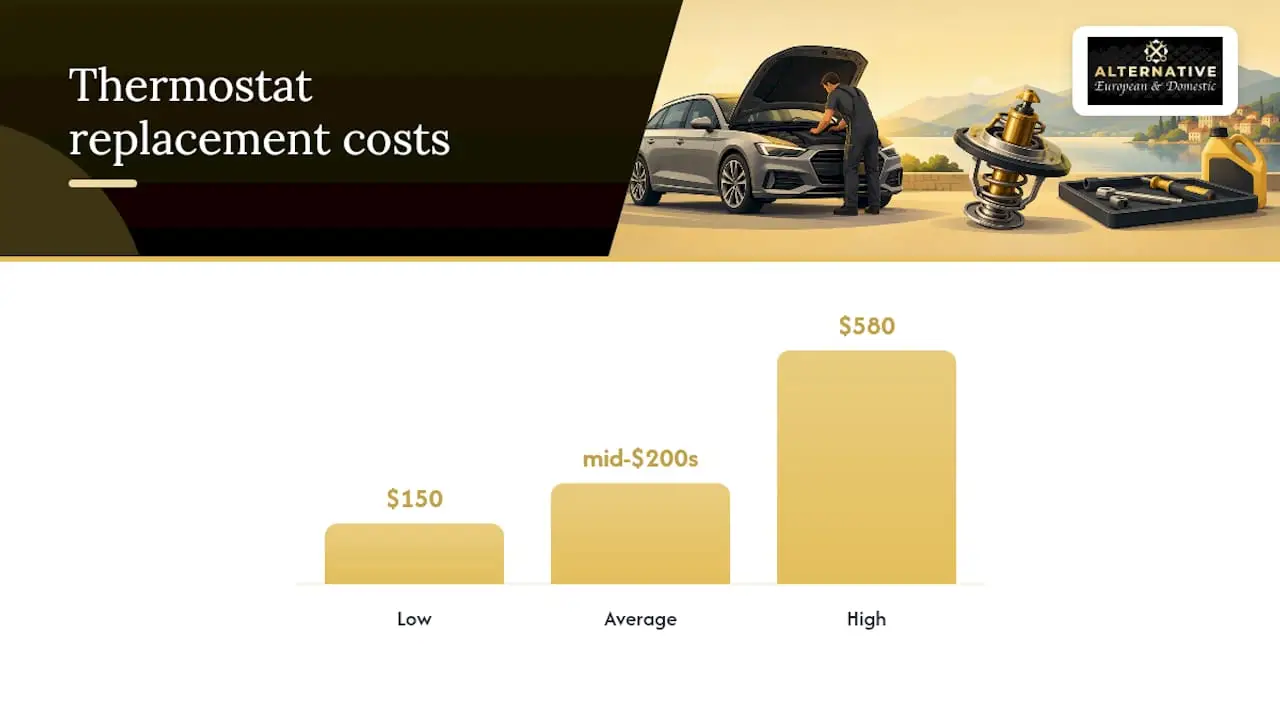
- Replacement costs typically range from $150 to $580, with European models often requiring careful bleed procedures and specialized parts.
- Driving short distances on a stuck-open thermostat is generally safe, but continued operation gradually worsens fuel economy, emissions, and engine oil thinning.
Table of Contents
- Signs and risks of a thermostat stuck open
- Why a stuck-open thermostat causes these problems
- How to diagnose a stuck-open thermostat yourself
- Fixing it: DIY replacement versus a shop visit
- How long you can drive and when to stop
- How a shop diagnoses and resolves thermostat failures
- What matters most when a thermostat sticks open
- Book a thermostat diagnostic with Alternative European & Domestic
- Sources
- FAQ
Signs and risks of a thermostat stuck open
A stuck-open thermostat is easier to live with day to day than a stuck-closed one, but it still points to a part that needs replacing soon. The clearest signs show up on the dashboard and in the cabin, not under the hood.
- The temperature gauge sits lower than normal or never reaches its usual position.
- The heater blows lukewarm or cold air even after several minutes of driving.
- Warm-up to normal operating temperature takes noticeably longer than usual.
- Fuel economy drops because the engine management system compensates for a colder-than-expected coolant reading.
- The check engine light comes on with a stored P0128 code, which means the coolant temperature is staying below the thermostat’s regulating point.
A stuck-closed thermostat produces the opposite pattern: the gauge climbs fast, the engine overheats, and you may see steam or a coolant smell. That version is the more urgent one.
A stuck-open thermostat can raise tailpipe emissions, since EPA documentation on temperature-adjusted emission rates shows that engines running colder than intended tend to produce more hydrocarbons and carbon monoxide. Left alone long enough, the constant cold-running also thins combustion efficiency and can contribute to sludge buildup from incomplete oil warm-up.
Why a stuck-open thermostat causes these problems
The thermostat is a small valve mounted in the cooling system, built around a wax pellet or spring that expands with heat. It stays closed while the engine warms up, then opens at a set temperature, usually somewhere in the 180 to 200 degree Fahrenheit range depending on the vehicle, to let coolant flow to the radiator.
When it sticks open, coolant circulates constantly instead of holding still during warm-up. The engine never reaches its designed operating temperature, which means combustion runs less efficiently and oil stays thinner than it should for longer stretches. A stuck-closed thermostat causes the reverse problem: no coolant flow to the radiator at all, which traps heat and overheats the engine fast. Both failures point to the same worn part, just opposite symptoms.
How to diagnose a stuck-open thermostat yourself
A few checks, done in order, will confirm the diagnosis before you buy parts.
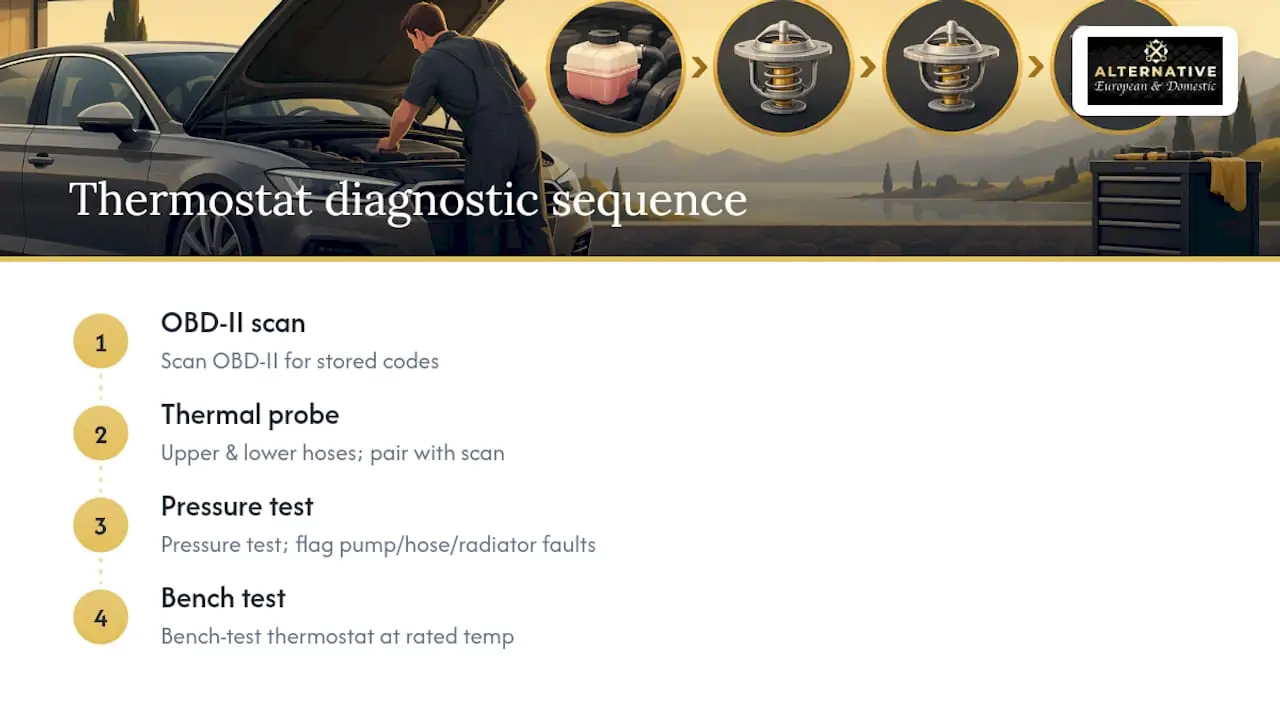
- Scan for codes. A basic OBD-II scanner will show P0128 if the engine control module has flagged coolant temperature staying below the thermostat’s regulating point.
- Check hose temperatures. After roughly ten minutes of running, the upper radiator hose should feel hot. Industry guidance on warm-up behavior notes that the lower hose should stay cooler until the thermostat opens; if both hoses feel equally hot early on, coolant is flowing freely and the thermostat likely never closed.
- Bench test the thermostat. Pull it and suspend it in a pot of water on the stove. Accepted shop practice heats the water about 10 to 15 degrees above the unit’s rated opening temperature and watches whether the valve opens; a thermostat that fails to open, or opens too early, confirms the failure.
- Rule out a bad sensor or trapped air. A failing coolant temperature sensor or an air pocket in the system can mimic these symptoms without a bad thermostat. If the bench test shows the thermostat working correctly, look at the sensor wiring and bleed the system before replacing more parts.
Pro Tip: Let the engine cool completely before opening the cooling system: pressurized hot coolant can cause serious burns, and gloves plus eye protection are worth the extra minute.
Fixing it: DIY replacement versus a shop visit
Replacing a thermostat is one of the more approachable DIY cooling-system jobs on many vehicles, though the layout matters a lot.
- Drain a portion of the coolant, remove the housing, swap the thermostat and gasket, then refill and bleed the system to clear trapped air.
- Basic tools needed are a socket set, a drain pan, and a replacement thermostat rated for the correct opening temperature.
- Common mistakes include installing a thermostat with the wrong temperature rating and skipping a proper bleed, which leaves an air pocket that causes overheating pockets even with a good part installed.
Thermostat replacement typically runs from $150 to $580 in total, averaging in the mid-$200s, according to cost data from AutOwner, with the range driven by labor access, vehicle layout, and whether extra bleeding or coolant is required. Consumer Reports notes that thermostat replacement costs are generally low next to the cost of repairing an engine damaged by an ignored cooling problem.
European and high-performance engines often mount the thermostat in a tighter space, sometimes integrated with the housing or requiring a specific bleed sequence to clear air from the system correctly. Repeated P0128 codes after a replacement, or any sign of a broader cooling-system issue, are good reasons to move the job to a shop rather than keep guessing.
How long you can drive and when to stop
A stuck-open thermostat is usually safe to drive on for a short stretch while you arrange diagnostics or a repair, since the immediate risk is a cold-running engine, not an overheating one. It is not a problem to leave alone for weeks, though: the emissions and wear effects add up.
Stop driving and arrange a tow if you see steam from under the hood, an active coolant leak, a gauge pinned at the hot end, or a noticeable loss of power. Those point to a different, more urgent cooling failure. In the meantime, keep an eye on the gauge, run the heater to confirm cabin warmth, and avoid long highway loads or heavy stop-and-go traffic until the thermostat is replaced.
How a shop diagnoses and resolves thermostat failures
A dealer-level diagnostic workflow starts with an OBD-II scan for stored codes, then moves to a thermal probe check on the upper and lower hoses to confirm actual coolant flow behavior rather than relying on the dashboard gauge alone. Technicians pressure test the cooling system to rule out leaks, then bench test the removed thermostat to confirm whether it opens at its rated temperature. Pairing scan data with a thermal probe check helps rule out a false positive from a failing coolant sensor or trapped air rather than the thermostat itself.
If pressure testing or thermal checks turn up a failing water pump, a cracked hose, or a clogged radiator, a shop will flag that work separately instead of replacing parts that were not actually the problem. That distinction matters most on European cooling systems, where housings and bleed points are less forgiving of guesswork.
What matters most when a thermostat sticks open
The DIY checks in this guide are genuinely worth doing: a scan tool and a pot of hot water will settle the diagnosis for a fraction of what guessing costs. Where a lot of owners go wrong is treating a stuck-open thermostat as low priority because the engine is not overheating. Cold-running is quieter damage: it shows up as gradually worse fuel economy, a heater that never quite warms the cabin, and oil that spends more time thinned out than it should.
The other overrated habit is buying a replacement thermostat by price alone. The temperature rating has to match the original, and on European engines the housing and bleed sequence often matter as much as the part itself. If a DIY bleed leaves the gauge acting strange after a swap, that is air in the system, not a bad part.
Prioritize the scan and the hose check first. They cost nothing and tell you whether you are actually chasing a thermostat problem before you spend on parts or shop time.
— Alternative European & Domestic
Book a thermostat diagnostic with Alternative European & Domestic
If the gauge, heater, or a P0128 code has you second-guessing your cooling system, we start with a proper diagnostic, not a guess. 
- Diagnostics: OBD-II scan and thermal checks to confirm the actual failure.
- Cooling system repair: thermostat replacement, hose and pump work when needed.
- Heater and A/C checks: confirming whether cold cabin air traces back to the thermostat or elsewhere.
We give you a clear estimate before any repair starts. Schedule a maintenance and diagnostic appointment or browse our full service list to get started.
Sources
- Car Thermostat Replacement Cost – AutoZone
- Thermostat Replacement Cost: $150 – $580 (2026) | AutOwner
- Emission adjustments for temperature (EPA MOVES3 documentation)
- What to do if your car overheats | Consumer Reports
FAQ
Will a stuck open thermostat cause AC not to work?
No, a stuck-open thermostat does not affect the air conditioning compressor or refrigerant circuit. It can make the heater blow weak or cold air, which sometimes gets mistaken for an AC problem, but the systems operate independently.
How long can I drive with a thermostat stuck open?
You can typically drive short term while arranging a repair, since a stuck-open thermostat causes a cold-running engine rather than an overheating one. Do not put it off for weeks, since reduced efficiency and higher emissions build up the longer it runs unfixed.
How do you test a thermostat that will not close?
Pull the thermostat and suspend it in a pot of water heated to roughly 10 to 15 degrees above its rated opening temperature, then watch whether the valve responds correctly as shop testing practice describes. A unit that stays open throughout the test, or opens far below its rating, confirms the failure.
How much does it cost to fix a stuck open thermostat?
Thermostat replacement typically runs $150 to $580 in total, averaging in the mid-$200s, depending on the vehicle and labor involved. European and high-performance layouts can run toward the higher end if the housing is harder to access or the bleed process takes longer.
What causes a thermostat to get stuck open in the first place?
Thermostats stick open most often from a worn spring, mineral or corrosion buildup on the valve, or age-related wear on the wax pellet mechanism inside. Regular coolant changes and flushing help slow that buildup, which is why preventive maintenance matters as much as the eventual replacement.