
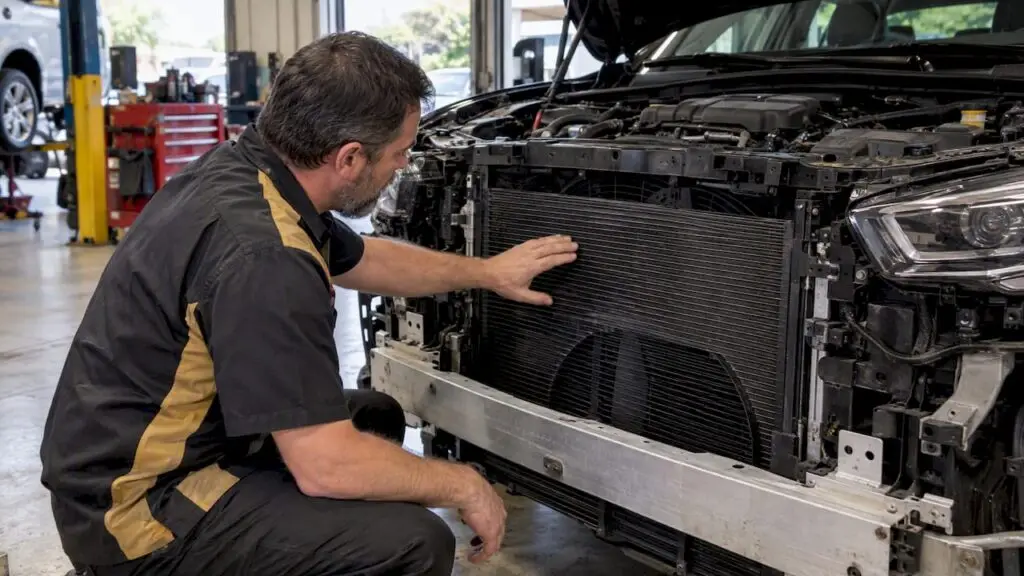
Your AC is warm at idle because the condenser cannot shed heat efficiently without enough airflow, and the compressor loses output as engine RPM drops. The most common causes are a blocked or dirty condenser, a weak or failed cooling fan, low refrigerant from a slow leak, or a compressor that cannot sustain pressure at low speed. Start by watching the fan and vents with the engine idling, skip anything involving refrigerant, and book a shop visit if the warm air persists.
TL;DR:
- Blockages low on the condenser cause the most significant impact on idle cooling performance, often due to debris or bent fins at the bottom.
- A weak or cycling cooling fan at idle can fail to cool effectively, even if the vehicle’s speed provides sufficient airflow at higher speeds.
- Loss of refrigerant from leaks reduces system pressure and cooling efficiency, especially noticeable during idling when airflow is minimal.
- Belt-driven compressors lose output at low RPM, so a compressor that cannot sustain pressure and makes noise suggests mechanical wear.
- Confirming fan operation and inspecting the condenser for debris are quick checks that can identify most common causes before professional diagnostics.
Table of Contents
- Why idle conditions strain an automotive AC system
- Root causes behind warm air at idle
- Quick, safe checks to narrow the cause
- What a professional diagnostic involves and why it matters
- Repair options and what to expect from each
- How a technician approaches AC diagnosis and repair
- When a quick check is enough, and when it’s time to call a shop
- Get your AC diagnosed and repaired correctly
- FAQ
- Sources
Why idle conditions strain an automotive AC system
An AC system cools cabin air by moving heat out through the condenser, a radiator-like unit mounted in front of the engine. At highway speed, air rams through the condenser fins and carries heat away efficiently. At idle, that ram air disappears, so the system depends entirely on the electric cooling fan to pull air through. Any weakness in that fan shows up immediately, while it might go unnoticed at 60 miles per hour.
The compressor adds another layer to the problem. On most vehicles, a belt spinning off the engine’s crankshaft drives the compressor, so its output scales with RPM. Idle speed, which is lower than cruising speed, gives the compressor far less mechanical energy to work with. That lower output means less refrigerant movement and less heat extraction exactly when the condenser already needs more fan help to compensate.
A few patterns are worth knowing before you diagnose anything:
- Condensers depend on airflow, and idle removes the vehicle’s natural ram air entirely.
- Belt-driven compressors lose mechanical output as RPM drops, weakening refrigerant circulation.
- Electric or hybrid-assist compressors reduce this RPM dependency but still rely on functioning cooling fans.
- Stop-start systems can briefly cut the engine at idle, which pauses belt-driven compressor function until the engine restarts.
One detail matters more than most drivers expect: condenser airflow blockages hurt idle performance more than highway performance, and blockages located at the bottom of the condenser cause the worst idle cooling loss, according to SAE research on condenser airflow blockages. That is why a seemingly minor patch of debris low on the grille can cause a noticeable idle-only warm-air complaint.
Root causes behind warm air at idle
Several distinct problems produce the same symptom, so narrowing the cause matters before any repair.
- Condenser restriction: Debris, bent fins, or insects packed into the lower condenser block airflow where it hurts idle cooling the most.
- Cooling fan failure: A fan that runs weakly, cycles on and off, or doesn’t spin at all at idle will cool fine on the highway but fail at a stoplight.
- Low refrigerant: A slow leak drops system pressure gradually; the AC may cool acceptably when the system is fuller after a recent top-off, then warm again as pressure drops further.
- Compressor or clutch wear: A compressor that can’t sustain pressure at low RPM, along with unusual clutch noise or cycling, points toward mechanical wear inside the compressor itself.
- Sensor, relay, or blend-door faults: A failing pressure sensor, stuck relay, or malfunctioning blend door can mimic every symptom above without any refrigerant or airflow problem at all.
Pro Tip: If the AC blows cold right after startup and only warms up as the engine idles longer, suspect the cooling fan before anything else; that pattern points to heat buildup the fan isn’t clearing.
Quick, safe checks to narrow the cause
These checks require no tools and no refrigerant handling, just careful observation.
- With the AC on and the engine idling, look through the grille or from above the radiator to confirm the cooling fan is spinning; briefly rev the engine and see whether fan behavior changes.
- Inspect the condenser face for packed debris, bent fins, or oily residue, since oil stains often mark a refrigerant leak point.
- Feel or measure vent temperature at idle, then again after a short drive; a clear improvement on the move points toward an airflow or fan problem rather than a refrigerant shortage.
- Stop there. Never open a refrigerant line, service port, or attempt a DIY recharge; the EPA’s Section 609 rules require certified technicians and approved recovery equipment for any work that opens the AC circuit.
If the vent temperature barely changes between idle and driving, or if you notice oil residue, a professional diagnostic is the next step rather than further home testing.
What a professional diagnostic involves and why it matters
A proper shop diagnostic replaces guesswork with measurements. Technicians check high-side and low-side pressures against temperature readings, then run a pulldown test comparing cabin temperature drop at idle versus while driving to replicate the exact symptom you’re experiencing.
- Pressure and temperature readings on both sides of the system identify whether the shortfall is refrigerant, airflow, or compressor capacity.
- Electrical tests on the fan motor, relays, and fuses confirm whether the fan is drawing proper current or failing intermittently.
- Leak detection using UV dye or an electronic sniffer locates the source of a slow leak rather than masking it with a top-off.
This approach matters because AAA notes that intermittent warm air at idle is often an early warning sign, and ignoring it lets leaks and low refrigerant accelerate compressor wear over time. Any service that opens the refrigerant circuit must follow EPA Section 609 requirements for certified recovery and recycling equipment, which is one reason DIY recharge kits rarely solve the underlying problem.
Repair options and what to expect from each
Repairs range from inexpensive cleaning to full compressor replacement, depending on what the diagnostic finds.
- Condenser cleaning or fin repair: Often the lowest-cost fix, and it frequently restores idle cooling on its own when blockage was the cause.
- Fan motor, relay, or shroud repair: Addresses weak or inconsistent fan speed and typically resolves idle-specific warm air once the fan runs at full strength.
- Leak repair plus evacuation and recharge: More durable than topping off, since the EPA notes that topping off restores cooling temporarily but doesn’t fix leaks, while a proper evacuation and recharge removes moisture and contaminants and sets the correct manufacturer charge.
- Compressor or clutch replacement: Becomes necessary when the compressor can’t sustain pressure at any RPM; it costs more but avoids repeat failures from a worn internal component.
How a technician approaches AC diagnosis and repair
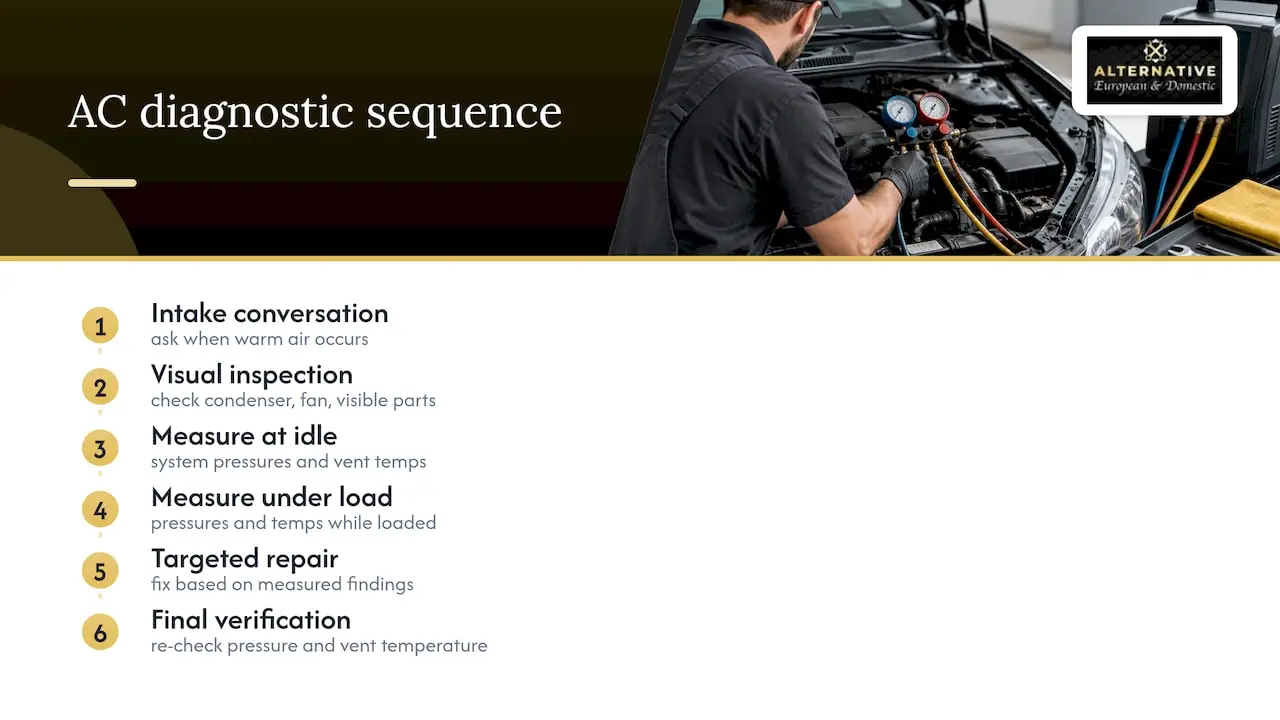
A thorough AC diagnostic starts with an intake conversation about when the warm air happens, followed by a visual inspection of the condenser, fan, and visible components. From there, technicians measure system pressures and temperatures at idle and under load to pinpoint whether airflow, refrigerant, or the compressor is the limiting factor. A targeted repair follows the findings rather than guessing, and the fix gets verified with another pressure and vent-temperature check before the vehicle leaves. That sequence reduces the chance of chasing the wrong part or triggering a secondary failure later.
When a quick check is enough, and when it’s time to call a shop
A minor cooling dip with no oil residue on the condenser and no unusual noise is worth a few days of observation; try the checks above and book service if the warm air doesn’t resolve. Sudden loss of cooling, visible oil stains, or new noises from the compressor area mean it’s time to stop troubleshooting at home and get the system inspected before a small leak or worn part turns into a bigger repair.
— Alternative European & Domestic
Get your AC diagnosed and repaired correctly
Chasing warm air at idle with guesswork wastes time and money. 
We perform refrigerant service alongside detailed diagnostics to ensure the fix addresses the actual cause rather than a symptom.
- A full inspection of the condenser, cooling fan, and system pressures at idle and under load.
- A transparent estimate before any repair work begins.
- Leak repair, fan or component replacement, or compressor work as needed, followed by a verification check.
Book a visit through our Auto A/C Repair & Service page, or visit our service overview to see how AC work fits alongside maintenance, electrical, and cooling system care.
FAQ
Why does my AC get warm when I’m idling?
The AC warms at idle mainly because the condenser loses the ram air it gets while driving, forcing the cooling fan to do all the work, and because a belt-driven compressor produces less output at low RPM. Common underlying causes include a blocked condenser, a weak cooling fan, low refrigerant, or a compressor that can’t sustain pressure at idle.
Why does my AC get warm when I’m parked?
The same airflow and RPM limitations apply when parked as when idling in traffic, since the vehicle isn’t moving and isn’t generating ram air through the condenser. If the fan isn’t compensating properly or refrigerant is low, warm air at idle and warm air while parked usually share the same root cause.
Why does my AC stop being cold when idling?
This pattern typically points to a cooling fan that isn’t spinning fast enough or at all once the vehicle stops moving, or to a condenser that’s partially blocked low on the grille. According to AAA, this kind of intermittent warm air is often an early sign of low refrigerant or an airflow problem worth addressing before it worsens.
What are signs of a failing AC compressor?
Warning signs include warm air that doesn’t improve even while driving, unusual grinding or squealing noises from the compressor area, and a clutch that cycles rapidly or inconsistently. If the compressor can’t maintain pressure at any engine speed, that’s a stronger indicator of compressor wear than idle-only warm air.
Sources
- Is Your Car’s Air Conditioner Trying to Tell You Something? | AAA Club Alliance
- EPA — Regulatory requirements for motor vehicle air conditioning system servicing (snapshot)
- Options for recharging your air conditioner | US EPA
- Experimental investigation of condenser airflow blockages and A/C performance — SAE