
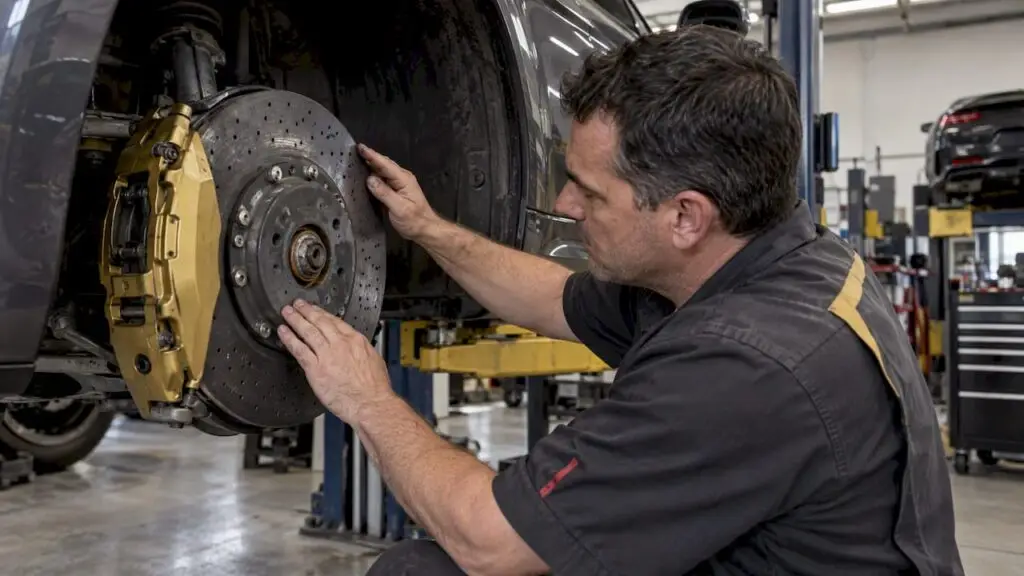
Carbon ceramic brakes are rotors made from a carbon fiber and ceramic composite, built to shrug off extreme heat. They pay off for track days and high-performance driving, where Brembo cites a road-use life of roughly 150,000 km and stable friction at high temperatures. For a normal daily driver, the high entry price usually outweighs the benefits.
TL;DR:
- Brembo estimates road life at about 150,000 km, but says extreme track use can reduce it to roughly 2,000 km.
- Use pads made for carbon ceramic rotors, and require guided wheel removal because impacts from wheels or tools can chip or crack the surface.
- Cold squeal or grab can be normal and may ease as the brakes warm, but persistent noise or a changed pedal feel warrants professional inspection.
- For cleaner, quieter daily braking, ceramic pads on iron rotors are not carbon ceramic rotors; coated iron is another lower dust option where offered.
Table of Contents
- How carbon ceramic rotors are made and why the material matters
- Performance advantages: heat, fade resistance, stopping power, and handling
- Lifespan and durability: what to expect in road use vs track use
- Cost and value: upfront option, replacement, pads, and ownership math
- Maintenance and service considerations for owners and technicians
- Alternatives and related choices: ceramic pads, coated iron rotors, and who should pick what
- Buying and installation checklist: what to ask your shop and what to expect
- Compatibility with different vehicle models and brake systems
- Common issues and warning signs specific to carbon ceramic brakes
- Environmental considerations and recyclability of carbon ceramic brake materials
- Technological advancements and innovations in carbon ceramic brake development
- Shop perspective: when we recommend carbon ceramic brakes
- Brake service and installation with our team
- FAQ
- Sources
How carbon ceramic rotors are made and why the material matters
A carbon ceramic rotor starts as carbon fibers bound into a shape, then goes through high-temperature furnace processing and siliconization. Brembo’s overview of the ceramic composite process describes how that treatment produces a material very different from cast iron. Because the furnace work and the diamond tooling needed to finish the parts are specialized, production is costly, and that cost follows the rotor to your invoice.
What the material gives you:
- Lower weight: Brembo reports roughly 50% less mass than cast iron.
- Corrosion resistance: the composite does not rust the way iron does.
- Hardness: the surface resists wear far better than a standard iron disc.
- Stable friction: grip stays consistent under heavy thermal load.
Pads matter just as much as the rotor. Carbon ceramic rotors need pads formulated for that material, and standard iron-rotor pads are not a substitute. Matching the pad to the rotor is part of how the system performs as designed.
Performance advantages: heat, fade resistance, stopping power, and handling
Heat is the enemy of any brake. Iron rotors lose bite when repeated hard stops push temperatures past what the friction material can manage. Carbon ceramic rotors keep working in that range, which is why they appear on supercars and track-focused cars.
Brembo reports consistent braking at up to 750°C, with transient peaks near 1000°C, and says stopping distance in demanding conditions can drop by up to 3 meters in a 0–100 km/h test. That is a manufacturer figure, so treat it as a best-case benchmark rather than a promise for your car.
Here is what that means in practice:
- Fade resistance: lap after lap, the pedal feels the same as it did on the first stop.
- Consistent friction: the brake responds predictably when it is hot, not just when it is cool.
- Less unsprung weight: lighter rotors mean the suspension has less mass to control, which can sharpen turn-in and ride over rough pavement.
- Reduced dust: many owners notice cleaner wheels compared with iron rotors, though results depend on the pad.
Independent coverage backs the broad picture: Edmunds describes these brakes as lightweight and highly resistant to fade, with tradeoffs in cost and low-temperature behavior.
Lifespan and durability: what to expect in road use vs track use
Brembo states carbon ceramic discs typically last at least four times longer than cast-iron equivalents. Its figure for road use is approximately 150,000 km, while extreme track use can cut that to around 2,000 km, according to Brembo’s disc page. The same Brembo announcement on aftermarket CCM repeats that road estimate.
Those numbers describe two very different lives. A gentle commuter may never wear the rotors out. A car run hard at the limit on a circuit can consume them quickly.
Durability comes with a catch:
- Fragility on impact: a dropped wheel or careless tool contact can chip or crack the surface.
- Expensive damage: historical reporting on Porsche’s system notes that a single ding can be extremely costly to repair.
- Corrosion advantage: the rotors do not rust in storage or after wet weather, unlike iron.
Careful wheel handling during service is the single biggest thing that protects a set.
Cost and value: upfront option, replacement, pads, and ownership math
Carbon ceramic brakes carry a high price at purchase and again at replacement. We are not going to quote a figure here, because costs vary widely by vehicle, supplier and labor, and an unsupported number would mislead you. Ask any shop for an exact written quote for your car.
What drives the premium:
- Manufacturing complexity: long furnace cycles and specialized finishing.
- Special pads: the friction material must match the composite rotor.
- Labor risk: extra care during wheel removal and installation takes time.
- OEM option pricing: carbon ceramic rotors are typically sold as an expensive option, often bundled into performance packages, as Car and Driver’s Corvette Z06 Z07 test illustrates.
The ownership math depends on how you drive. A longer service life can offset the premium for someone who drives high mileage or tracks the car often. For an average daily driver, Autotrader’s editorial coverage concludes they rarely justify the cost. If your car already has them, keep them. If you are choosing between options, be honest about how you actually drive.
Maintenance and service considerations for owners and technicians
These rotors are not hard to live with, but they punish carelessness. Whoever touches them should follow a protective routine.
- Support the wheel and use alignment pins or guides so it never swings into the rotor.
- Keep tools and torque wrenches clear of the friction surface.
- Confirm the pads are rated for carbon ceramic rotors before installing.
- Follow the correct bedding procedure for the new pads. Our brake bedding guide explains pad bedding for European and performance cars.
- Inspect the rotor faces, hats and mounting hardware at every service interval.
Cold behavior is a quirk. Brembo notes these brakes can squeal or feel grabby at low speed and low temperature, and that warming them up mitigates the issue. Our 3–5 stop test for brake squeal helps separate normal cold-brake noise from a real fault.
Pro Tip: Tell your technician up front that the car has carbon ceramic rotors, so the wheel-off procedure gets extra care from the start.
Alternatives and related choices: ceramic pads, coated iron rotors, and who should pick what
“Ceramic brakes” can mean two different things, and mixing them up is expensive. Ceramic pads are a friction material that pairs with ordinary iron rotors. Carbon ceramic brakes replace the rotor itself with a composite. Consumer Reports explains that ceramic pads run cleaner and quieter than standard pads, at a higher price.
A third category sits between them. Porsche’s tungsten-carbide-coated iron rotors are positioned as a lower-cost, low-dust alternative to carbon ceramic, though they need compatible pads and have a thin coating wear limit.
Who should pick what:
- Daily drivers: quality ceramic pads on iron rotors for clean, quiet stopping.
- Dust-sensitive owners without track plans: coated iron rotors, where the vehicle offers them.
- Track-focused or high-performance owners: carbon ceramic rotors, where heat and longevity justify the cost.
Buying and installation checklist: what to ask your shop and what to expect
Before you commit to carbon ceramic brakes, put these questions to the shop:
- Which pads do you recommend for these rotors, and why?
- How much experience do you have servicing carbon ceramic rotors?
- What wheel-removal precautions do you follow to avoid damage?
- What bedding procedure will you use, and what should I do afterward?
- How will you verify torque specs and mounting after installation?
Expect a careful, unhurried job. A good shop checks mounting hardware, confirms torque to specification, and has the diagnostic tools to verify the system afterward. If a shop cannot answer these questions clearly, keep looking. A specialist with dealer-level diagnostics is the safer choice for rotors this costly.
Compatibility with different vehicle models and brake systems
Carbon ceramic brakes are not a universal bolt-on. They are engineered as a complete system: rotor, caliper, pads, hub and wheel all have to work together. Many are fitted at the factory on performance models, and manufacturers have developed them for premium cars as well as track-oriented ones. An SAE technical paper on carbon silicon carbide brakes describes work by Bentley and other manufacturers to make these systems refined enough for premium road cars.
Several things decide whether a swap is feasible:
- Caliper and rotor size: the rotor diameter and thickness must fit the caliper and the wheel.
- Wheel clearance: a larger rotor needs a wheel that clears it.
- Pad matching: the pad must be made for carbon ceramic rotors, not just any ceramic pad.
- Electronics: modern stability and braking systems are tuned to the original hardware.
Aftermarket options exist. Brembo has expanded its CCM material to the aftermarket, and specialists such as E6 Carbon list engineered brake upgrades for specific exotic models. Before buying anything, confirm fitment for your exact vehicle and brake system with the supplier and with your shop.
Common issues and warning signs specific to carbon ceramic brakes
These brakes rarely fail without warning, but the signs differ from what you know from iron rotors. Learn them so a small problem does not become a very expensive one.
Watch for:
- Visible surface damage: chips, cracks or gouges on the rotor face or around the mounting area. Any impact damage deserves a professional look.
- Low-speed noise or grab: squeal or an abrupt pedal feel when cold is common, but it should ease as the brakes warm up.
- Persistent pulsation: a pedal that pulses is worth diagnosing. Our article on brake pedal pulsation causes explains what the symptom can mean.
- Uneven pad wear: this can point to a caliper or mounting issue.
- A change in pedal feel: a softer or longer pedal needs inspection before the next drive.
Edmunds notes the low-temperature squeal or grab tradeoff, and Brembo says warming the brakes mitigates it. If noise continues after the brakes are warm, or the pedal changes, have a qualified shop inspect the system. Do not keep driving on a rotor you suspect is cracked.
Environmental considerations and recyclability of carbon ceramic brake materials
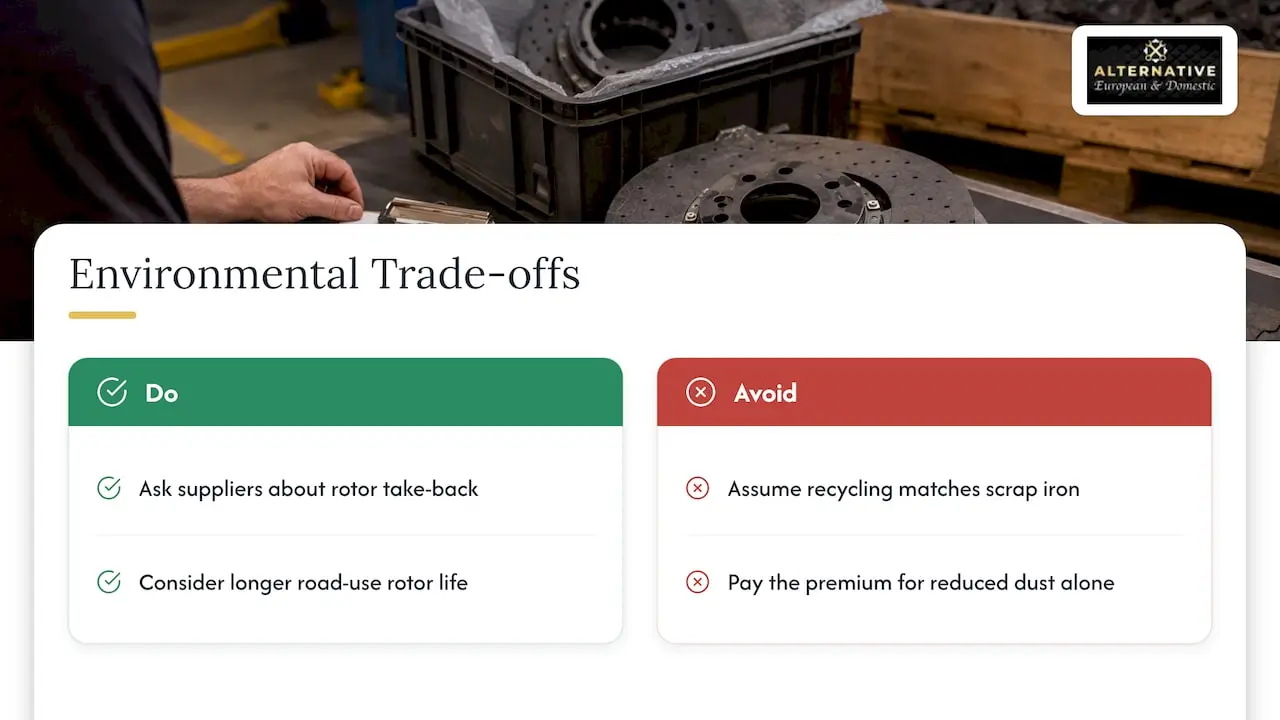
The environmental picture has two sides, and the sources we have do not settle all of it. On the plus side, the composite does not corrode, and longer service life in road use means fewer replacement rotors over time. Many drivers also see less visible brake dust on their wheels compared with iron setups.
On the other side, production is energy-intensive. The furnace and siliconization steps require specialized processes, and the same article explains why they account for high manufacturing cost.
Recyclability is where we will not overstate. We have no manufacturer-published recycling figures to share, and the composite is not handled like scrap cast iron. If environmental impact matters to you, ask the brake supplier directly what take-back or recycling options exist for worn rotors.
Dust is also a trade between categories. Car and Driver’s reporting on low-dust rotors covers coated iron rotors that claim large manufacturer-reported dust reductions, so reduced dust alone is not a reason to pay the carbon ceramic premium.
Technological advancements and innovations in carbon ceramic brake development
Carbon ceramic brakes began as a racing technology. Brembo’s history describes bringing racing carbon discs to road cars, then refining the ceramic composite material and production steps to suit road use.
Engineering work has focused on a few problems. An SAE technical paper on friction materials for ceramic composite disks compares the composite with gray cast iron and discusses thermal loads, friction material development and engineering tradeoffs for road applications. Refinement matters too. Manufacturers have worked to reduce noise, vibration and harshness so the brakes feel at home on a premium road car, as the Bentley-linked carbon silicon carbide research describes.
Availability is changing as well. With CCM material reaching the aftermarket, owners have more options than factory fitment alone. Coated iron rotors have also narrowed the gap for drivers who mainly want low dust and long life.
Shop perspective: when we recommend carbon ceramic brakes
We recommend carbon ceramic rotors for consistent track use, high-performance cars, and owners who prioritize low dust and longevity. We protect them in service with careful wheel handling, matched pads and proper bedding. If you are considering the upgrade, bring the car in and we will inspect it with you.
— Alternative European & Domestic
Brake service and installation with our team
When you are ready, our team handles brake diagnostics, pad and rotor service, careful wheel procedures and bedding guidance, with transparent recommendations and dealer-level diagnostics.
- Review our brake service page.
- Schedule an appointment to talk through your car.
FAQ
How much do carbon ceramic brakes cost?
They cost far more than iron brakes, both to buy and to replace. We do not quote a fixed price because it depends on your vehicle, the supplier and labor, so ask a shop for an exact written quote.
Do carbon ceramic brakes produce brake dust?
They produce less visible dust than many iron setups, though not zero, and the result depends on the pads. Coated iron rotors also claim large dust reductions, so dust alone is a weak reason to choose carbon ceramic.
Are Brembo brakes ceramic?
Not all of them. Brembo makes carbon ceramic discs, and it also makes ceramic pads for use with ordinary rotors, which is a different product. Check the exact part on your car rather than assuming from the brand.
What is the life expectancy of ceramic brake pads?
It varies with driving style, vehicle and pad type, so no single number fits every car. Our brake pad replacement interval guide explains how to judge it for European luxury and performance cars.