
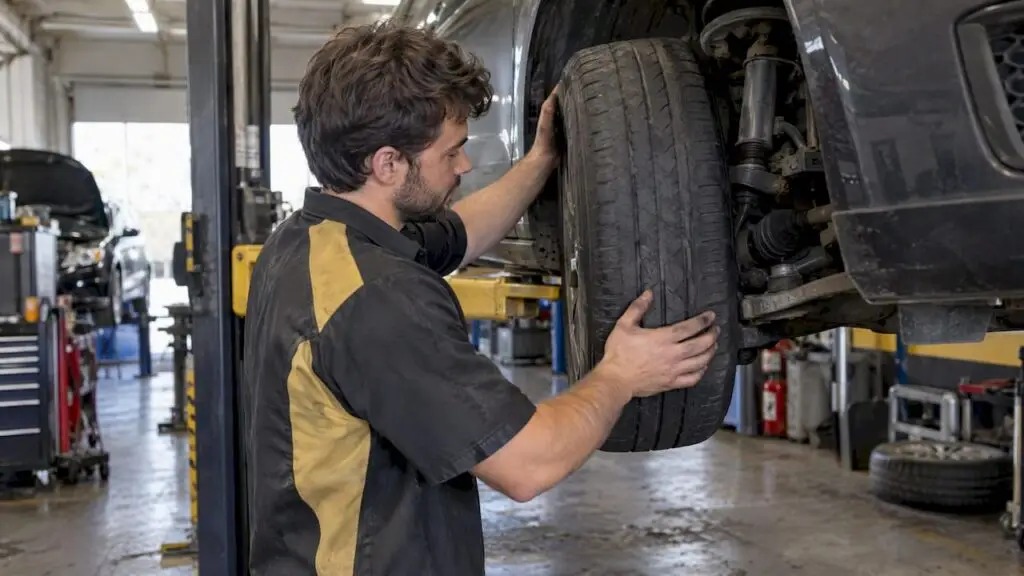
A clunk over bumps most often points to worn sway bar end links, a failing shock or strut, loose control arm bushings or ball joints, or hardware that has simply worked itself loose. The noise alone rarely tells the full story, so we recommend a quick visual check at home and a diagnostic appointment soon after. Short, careful driving to a shop is usually fine unless the clunk comes with a handling change or a visibly loose part.
TL;DR:
- A sharp knock over small bumps often indicates worn sway bar links, while a heavy boom over speed bumps points to worn shocks or struts.
- Stop driving and arrange a tow if a clunk arrives with changed steering, a visibly tilted wheel, or loss of control over bumps.
- With normal handling, drive carefully to a shop for an isolated clunk, then schedule inspection within a few days; worsening noise needs attention that week.
- A bounce test and visual check for loose exhaust parts are safe at home, but ball joint, bushing, and alignment checks require shop tools.
- Diagnosis should combine a road test with checks for component play; end links, bushings, and struts call for different repairs.
Table of Contents
- How the Clunk Sounds and When It Happens
- Common Mechanical Causes, Explained by Component
- How a Technician Isolates the Source: A Step-by-Step Diagnostic Checklist
- Safety and Drivability: What Is Urgent and What Can Wait
- Typical Repair Paths, Time, and Cost Factors
- What Our Diagnostics Look Like and What to Bring to Your Appointment
- When DIY Checks Are Useful, and When to Stop and Call a Pro
- Schedule a Suspension Diagnostic With Our Team
- FAQ
- Sources
How the Clunk Sounds and When It Happens
The sound itself is a clue. A single sharp thud over one bump usually points to a specific worn part, while a repeating knock over rough pavement suggests something is loose and moving with every wheel cycle. A deep, heavy boom often means a shock or strut has failed internally, while a sharper metallic clunk leans toward a bushing, end link, or ball joint with play in it.
Timing matters as much as tone. Note whether the noise happens over every bump or only on one side, whether it shows up during turns, and whether it changes between low speed and highway speed. Pair that with any other symptoms you have noticed, since they narrow the diagnosis considerably:
- Steering that pulls to one side or feels looser than usual
- Vibration through the wheel or seat at certain speeds
- Uneven tread wear on one or more tires
- Dashboard warning lights related to stability or traction systems
Before calling a shop, two safe checks help. Press down firmly on each corner of the car and release: if it bounces more than once or twice, a shock or strut may be worn. A quick visual look under the wheel wells can also reveal an obviously disconnected link or a dangling exhaust hanger, both of which can mimic a suspension clunk.
Common Mechanical Causes, Explained by Component
Most clunks trace back to a short list of parts, and knowing how each one fails helps you describe the problem accurately when you call a shop.
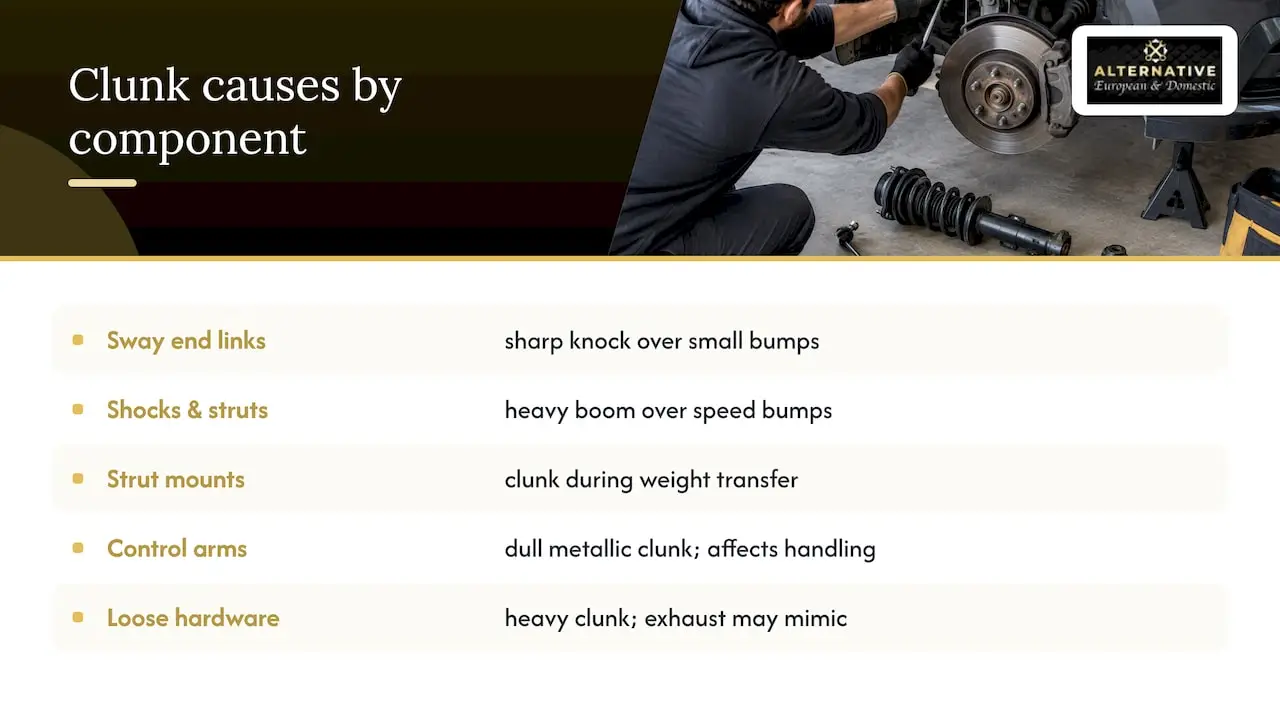
Sway bar end links and bushings connect the stabilizer bar to the suspension and are one of the most frequent sources of a bump clunk. As the small ball joints or rubber bushings in these links wear, they develop play that produces a sharp knock, usually over smaller, sharper bumps rather than long dips.
Shocks and struts control how the suspension absorbs impact, and when their internal components fail or leak, that control disappears. Booms or clunks over speed bumps commonly point to worn shocks or struts, and the sound tends to be a heavier boom rather than a sharp knock. A loose top mount on a strut assembly can add a secondary clunk as the suspension transfers load during compression and rebound.
Strut mounts, sometimes called top mounts, sit between the strut and the chassis and can wear or loosen over time. When they fail, you typically hear the clunk during weight transfer, such as braking hard into a dip or turning while crossing uneven pavement.
Control arm bushings and ball joints allow the suspension to pivot while keeping everything aligned. Worn bushings introduce play that produces a dull, metallic clunk, and because these parts are directly tied to wheel geometry, worn suspension parts can also contribute to handling issues and uneven tire wear. We cover how these symptoms show up in more detail in our guide to control arm bushing symptoms.
Loose suspension hardware, including bolts on sway bar brackets or control arm mounts, can back out over time and create a clunk that sounds almost identical to a worn bushing. Exhaust hangers and heat shields are common mimics here too: a heavy clunk when going over bumps is sometimes nothing more than a loose shock absorber or a loose underbody part like the exhaust rattling against the frame.
Less common mimics round out the list. A failing wheel bearing tends to produce a rumble that changes with speed rather than a clunk tied to bumps, a worn CV joint usually clicks during turns rather than over bumps, and steering linkage play can feel similar to a control arm issue but shows up more during steering input than suspension travel. Our breakdowns of wheel bearing noise and CV axle noise walk through how to tell these apart.
Pro Tip: Record a short video of the noise with your phone, including the speed and road surface, so a technician can match the sound to a likely cause before the car is even on the lift.
How a Technician Isolates the Source: A Step-by-Step Diagnostic Checklist
A proper shop diagnostic follows a sequence, not a guess. Combining a controlled road test with static checks and jacked inspections minimizes unnecessary part replacement, which keeps repair costs tied to the actual problem rather than a parts-cannon approach.
- Visual inspection first. A technician looks for fluid leaks on the shocks or struts, cracked or torn bushings, broken mounts, loose bolts, and exhaust hangers that have separated from the body.
- Bounce and push-pull checks. Pressing down on each corner and watching the rebound, along with pushing and pulling on individual components by hand, reveals play that is not visible at a glance.
- Wheel-off inspection on a lift. With the wheel removed and the suspension unloaded, a technician can move each joint and bushing by hand to isolate exactly where the play lives. Appropriate lift and jack stand use is standard shop practice here, since suspension components carry real load even when the car is off the ground.
- Road test protocol. Driving over low-speed bumps and through controlled turns helps confirm whether the clunk happens under compression, rebound, or steering input, which narrows the diagnosis to a specific component or side of the vehicle.
- Dealer-level tools when needed. For European and high-performance platforms with adaptive or air suspension, a shop may use manufacturer-level scan tools to verify sensor data or confirm a part before ordering it.
Safety and Drivability: What Is Urgent and What Can Wait
A few signs mean you should not keep driving: a sudden clunk paired with a noticeable change in steering feel, a wheel that looks visibly misaligned or tilted, or any loss of control over bumps. In those cases, stop and arrange a tow rather than risk driving further, since a serious suspension failure can be a genuine safety hazard, as seen in cases like a rear suspension fracture recall that produced clunking before a more serious failure.
If the clunk is isolated to one noise over bumps with no change in handling, driving carefully to a nearby shop is generally reasonable. That said, continued driving on a worn component accelerates wear elsewhere: a loose ball joint stresses tires unevenly, a bad bushing throws off alignment, and a failing strut mount can eventually affect steering precision. We recommend scheduling an inspection within a few days for mild, consistent clunks and the same week for anything that seems to be getting louder or more frequent.
Typical Repair Paths, Time, and Cost Factors
Repairs are matched directly to the diagnosis rather than applied broadly. Sway bar end links are usually a straightforward swap, strut or shock assemblies take longer since they involve removing and reinstalling a loaded component, and bushing replacement can range from simple to labor-intensive depending on whether the bushing is press-fit into the control arm.
A few factors shape both time and cost:
- Parts choice, since OEM components typically cost more than aftermarket equivalents but may match factory fit and durability more closely
- Labor complexity, as pressing in a new bushing takes longer than bolting on a new end link
- Alignment needs, since worn suspension parts can contribute to misalignment and technicians typically recheck alignment after replacing control arms or bushings
- Vehicle class, since European and performance platforms often use multi-link suspension with more components per corner than a simpler domestic setup
A thorough shop avoids replacing parts on suspicion alone. Testing first, then repairing only what the inspection confirms, is what keeps a suspension repair from turning into a cycle of swapped parts that never quite solves the noise.
What Our Diagnostics Look Like and What to Bring to Your Appointment
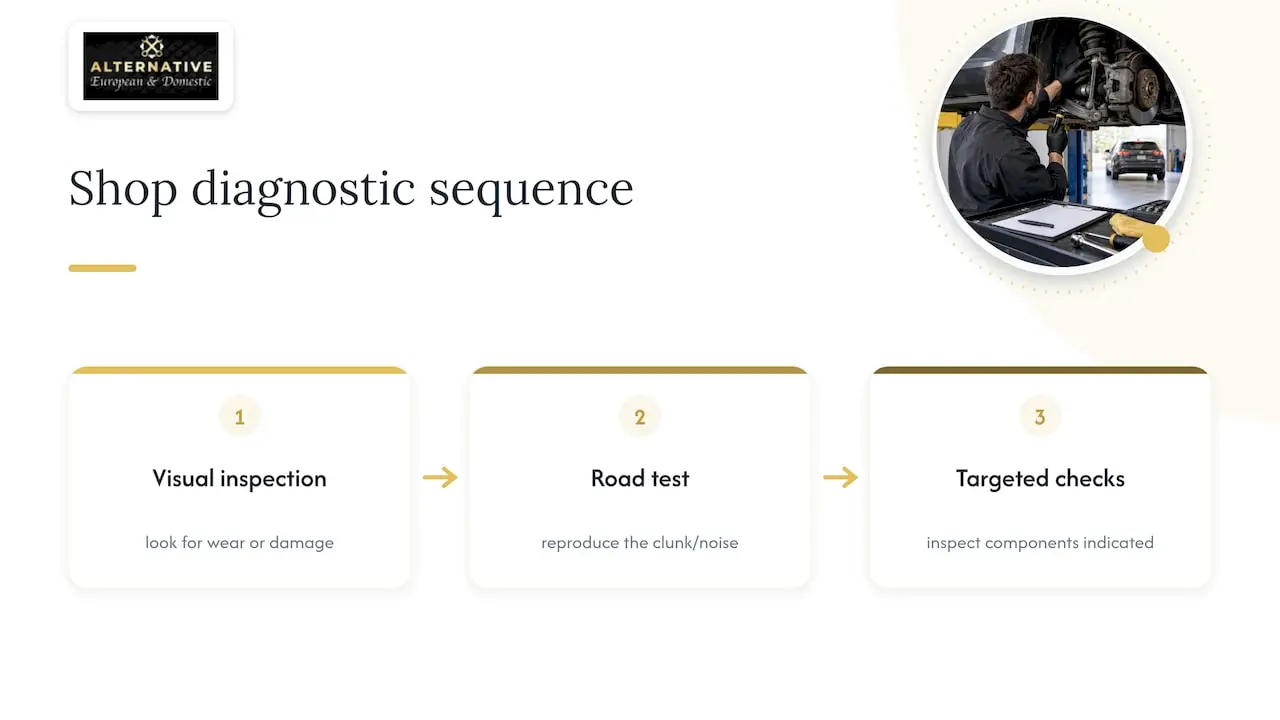
The diagnostic process typically starts with a visual inspection, moves into a road test to reproduce the noise, and finishes with targeted checks on the specific components the first two steps point to. A trusted shop should walk you through exactly what they find before any repair begins, including which parts are worn, which are fine, and why a given fix is the right one for your vehicle.
A few details help us diagnose faster: describe when the clunk happens, mention any recent pothole hits or curb strikes, and bring up any suspension or alignment work already on record. That context, combined with advanced diagnostic tools for European and high-performance vehicles, helps confirm a cause instead of guessing at one.
When DIY Checks Are Useful, and When to Stop and Call a Pro
A bounce test, a visual look for loose exhaust hangers, or watching for uneven tire wear are safe and genuinely useful. Where DIY checks run out is anything involving press-fit bushings, ball joint preload, or alignment angles, since those need shop tools to measure and correct properly. Document what you notice and resist the urge to swap parts on a guess: a part replaced without a diagnosis is a part that might not have needed replacing at all.
— Alternative European & Domestic
Schedule a Suspension Diagnostic With Our Team
A suspension clunk over bumps is worth checking before it turns into uneven tire wear or an alignment problem, and a professional shop with dealer-level expertise can handle that diagnosis alongside engine, brake, and electrical work.

When you bring your vehicle in, a typical process includes a visual inspection, a road test, and targeted component checks, followed by an explanation of findings and recommended repairs. Relevant services for addressing suspension clunks often include shocks and struts inspection and replacement, suspension and steering component repair, alignments after suspension work, and maintenance planning for ongoing suspension health.
For readers who want a broader inspection checklist before their visit, this 8-point suspension clunk inspection guide and this ball joint failure symptom breakdown cover useful prep steps, and this shocks and struts service overview explains what a strut replacement typically involves.
Ready to get the noise diagnosed? Schedule your appointment and we will get you on the lift.
FAQ
Can I drive with clunking suspension?
Short, careful driving is usually acceptable if the clunk is isolated to bumps and your steering feels normal, but you should avoid longer trips until a technician inspects it. If the clunk comes with a handling change, a visibly misaligned wheel, or sudden worsening, stop driving and arrange a tow instead.
How much does it cost to fix clunking suspension?
Repair cost depends entirely on which component has failed, since a sway bar end link, a strut assembly, and a pressed bushing all involve different parts and labor time. We do not quote repair costs until a diagnostic confirms the cause, since an accurate diagnosis is what keeps the repair matched to the actual problem.
What does suspension knocking sound like?
Suspension knocking typically presents as a sharp, repeating clunk over uneven pavement, often tied to play in a bushing, ball joint, or end link. A heavier, deeper boom over speed bumps instead usually points to worn shocks or struts rather than a loose joint.
What does a failing suspension sound like?
A failing suspension can sound like a metallic clunk, a dull thud, or a heavy boom depending on which part is involved, and the sound often changes with turning or braking. A heavy clunk over bumps can indicate a broken suspension component and should be inspected soon even if it is not an immediate emergency.
Sources
- Vehicle Noises You Should Never Ignore | AAA Club Alliance
- What You Need to Know About Tire Alignment | Bridgestone