
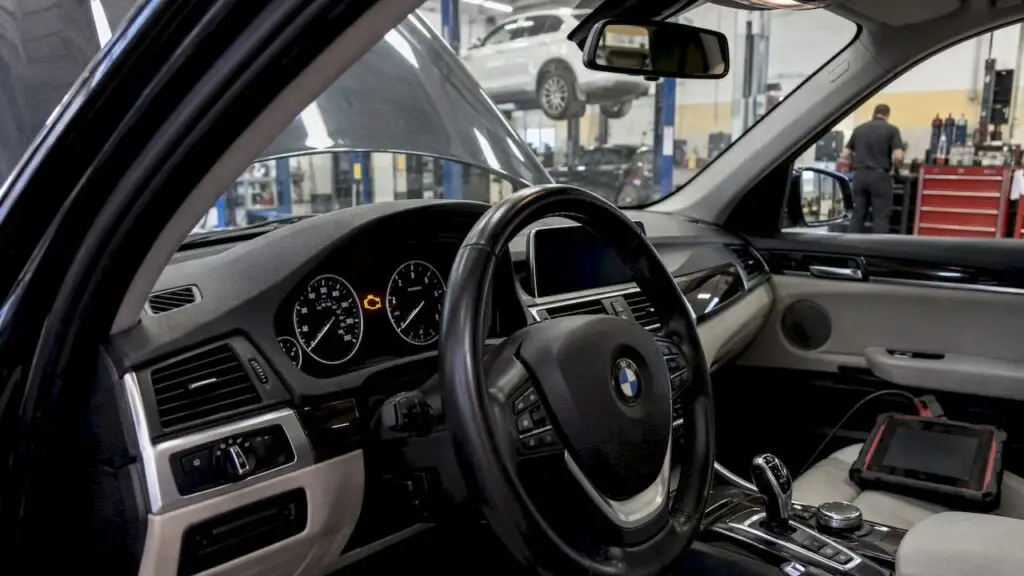
A BMW check engine light usually means the engine electronics found a fault that could raise exhaust emissions. The cause can be as small as a loose fuel cap or as serious as an active misfire. A steady light means get it checked soon. A flashing light means reduce speed and get the car to a shop right away. Only a BMW-capable scan and a proper diagnosis tell you which one you have. At Alternative European & Domestic in Dallas, that diagnosis is where every check engine visit starts.
TL;DR
- A steady yellow engine light means a fault in the emissions-related systems. The car can usually still be driven, but it should be checked soon.
- A flashing light points to a heavy misfire. Slow down, avoid full throttle and have the car looked at right away, because the catalytic converter can be damaged quickly.
- The most common causes are a loose fuel cap, oxygen sensor wear, ignition coil failure, VANOS solenoid problems, a weak battery and fuel or air metering faults.
- A generic code reader only sees the emissions subset of codes. BMW has many more modules, so a BMW-capable scan and live data give a truer picture.
- Red warnings, reduced-power messages, rough running, overheating or a smell of fuel mean stop and call for help.
Table of Contents
- What the BMW check engine light actually means
- Steady vs. flashing: how urgent is it?
- The most common BMW check engine light causes
- Turbocharged BMWs and reduced power
- Why a BMW-specific diagnosis matters
- How preventive maintenance cuts check engine visits
- Cost factors without the guesswork
- Promo: dealer-level diagnostics in Dallas
- FAQ
- Sources
What the BMW check engine light actually means
BMW’s engine electronics monitor the parts that affect the exhaust through on-board diagnosis. According to a summary of BMW owner’s manuals, when the system finds a fault that makes the exhaust dirtier, the yellow engine symbol comes on, usually with a Check Control message. BMW often calls it the emissions warning light rather than a “check engine” light.
The wording matters because the light is a summary, not a diagnosis. It says the system stored a fault. It does not say which part failed or how urgent the failure is.
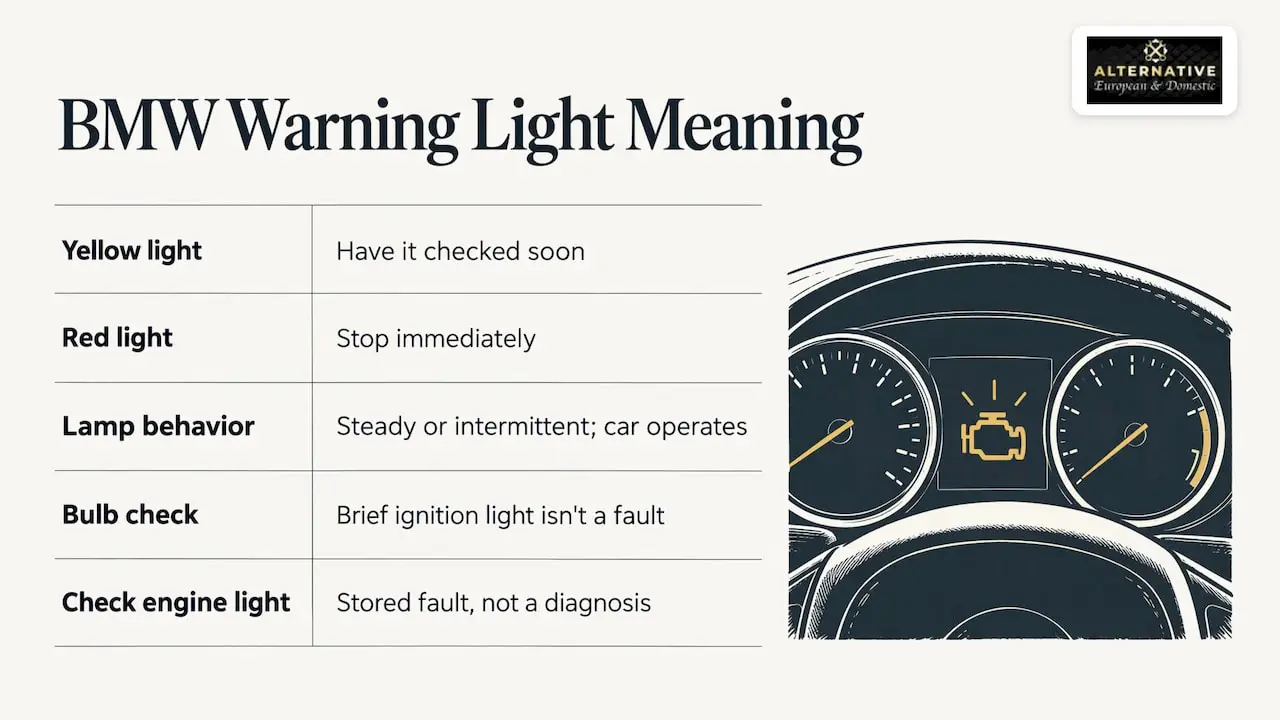
The color key in BMW manuals is a useful guide. The 2004 545i (E60) owner’s manual says that yellow means have it checked soon, while red means stop immediately. That manual also says the emissions lamp can come on steadily or intermittently, the car remains operational, and the systems should be checked at the earliest opportunity. For a broader look at warning lamps, see our guide to service light types and when to stop or tow.
One harmless behavior: the light comes on briefly when you switch the ignition on. That is the bulb check, not a fault.
Steady vs. flashing: how urgent is it?
The light’s behavior is the first thing to tell your technician. It sets how fast you need to act.
| Light behavior | What it usually means | What to do |
|---|---|---|
| Steady yellow, car drives normally | A stored emissions-related fault, such as a fuel cap, a sensor or a minor mixture issue | Book a diagnostic visit soon. Avoid hard driving until then. |
| Steady yellow with power loss or a reduced-power message | The engine management is limiting output to protect the engine | Treat it as urgent. Drive gently to a safe place and arrange service or a tow. |
| Flashing | An active misfire severe enough to endanger the catalytic converter | Reduce speed, avoid full throttle and get the car checked immediately. If it runs roughly, shakes or smells of fuel, do not keep driving. |
| Red warning (oil pressure, coolant temperature) | A condition that can damage the engine | Stop safely and switch the engine off. Do not drive on. |
The owner’s manual summaries describe a flashing light as heavy misfiring. They advise reducing speed, avoiding full throttle and getting the car checked right away, because the catalytic converter can be seriously damaged in a short time. The OBD-II standard that has applied to US vehicles since 1996 defines it the same way, as an active misfire severe enough to damage the catalytic converter.
If the light flashes and then goes steady again, do not assume the problem went away. The misfire rate may have dropped below the damage threshold, but the fault remains stored and returns under the same conditions.
When the car should not be driven
Do not keep driving, and consider a tow, when any of these are true:
- The light is flashing and the engine shakes, stumbles or loses power.
- You smell raw fuel or see smoke from the exhaust.
- A red warning lamp or a coolant or oil pressure message appears alongside the engine light.
- The car goes into reduced power and will not accelerate safely in traffic.
- You hear knocking or ticking that gets louder.
On Dallas highways like I-35E, the Dallas North Tollway or US-75, a car that loses power suddenly is a hazard to you and to traffic around you. A tow costs far less than a new catalytic converter or an engine repair.
The most common BMW check engine light causes
The causes below are listed roughly from the simplest to the most involved. Which one applies depends on the engine, the mileage and how the car was maintained.
1. Fuel filler cap not seated
BMW’s own manuals give this as the standard example of a steady light: the fuel filler cap was not screwed on fully. A loose cap lets fuel vapor escape, and the evaporative emission system detects the leak. US models also have a separate “Check Gas Cap” lamp, according to the E60 manual. After you tighten the cap until it clicks, the light may take several drive cycles to clear. If it stays on, the cause is something else.
2. Oxygen sensor wear
Oxygen sensors measure the exhaust gas so the engine computer can balance fuel and air. BimmerTalk’s 2026 causes guide lists oxygen sensor faults (codes P0130 to P0167) as the most common check engine light cause across BMW engines. It puts typical failure on N52, N54 and N55 engines at around 80,000 to 120,000 miles. A worn sensor can raise fuel use and emissions before you notice any driveability change.
3. Ignition coils and spark plugs
A failing coil or worn spark plug causes misfires. The same guide says ignition coils on those inline-six engines fail regularly at about 60,000 to 80,000 miles. A mild misfire may show only as a steady light and a slightly rough idle. A severe one makes the light flash. If you want to understand what happens when the misfire only shows up when you accelerate, read our article on BMW misfire under load. We also explain how misfires are traced on European and performance cars.
4. VANOS solenoids and timing
VANOS is BMW’s variable camshaft timing system. Its fault codes typically mean a solenoid is stuck or clogged with oil sludge, or the cam timing has drifted out of specification. According to the BimmerTalk diagnostic writer, regular oil changes with quality BMW-spec oil prevent most VANOS issues. That makes this one of the more preventable causes, and a good reason to keep oil change and engine lubrication service on schedule.
5. Weak or failing battery
Low voltage confuses control modules. A battery that is no longer healthy can set a string of unrelated codes, and several owners on enthusiast forums report that a battery load test cleared up a randomly appearing light. If the engine light arrives with slow cranking, flickering displays or a battery symbol, start with the electrical system. Our guide to the battery warning light on European and performance cars covers what that symptom means.
6. Mass airflow, fuel trim and vacuum leaks
The engine computer constantly adjusts fuel delivery, known as fuel trim. A dirty airflow sensor, a cracked intake hose or a fuel delivery problem pushes the trims out of range and sets a lean or rich code. These faults sometimes appear and vanish, which is why a light that “comes on randomly” still needs a scan. Long-term and short-term fuel trim values are among the first things we check in live data before a part is replaced.
7. Catalytic converter efficiency
A code such as P0420 says catalyst efficiency is below threshold. It is a general code, and on its own it does not prove the converter is bad. Oxygen sensors, exhaust leaks and misfires can all produce it. This is a classic case where a BMW-specific scan and live data prevent an expensive wrong guess. A converter that was damaged by a misfire, though, is exactly what the flashing-light advice is meant to prevent.
8. Cooling system and other engine faults
Water pump or thermostat problems, oil leaks and other engine faults can also set codes, either directly or through a protective strategy. If the coolant temperature is climbing, stop. If you suspect something deeper inside the engine, our engine repair service handles the mechanical side once the cause is confirmed.
Turbocharged BMWs and reduced power
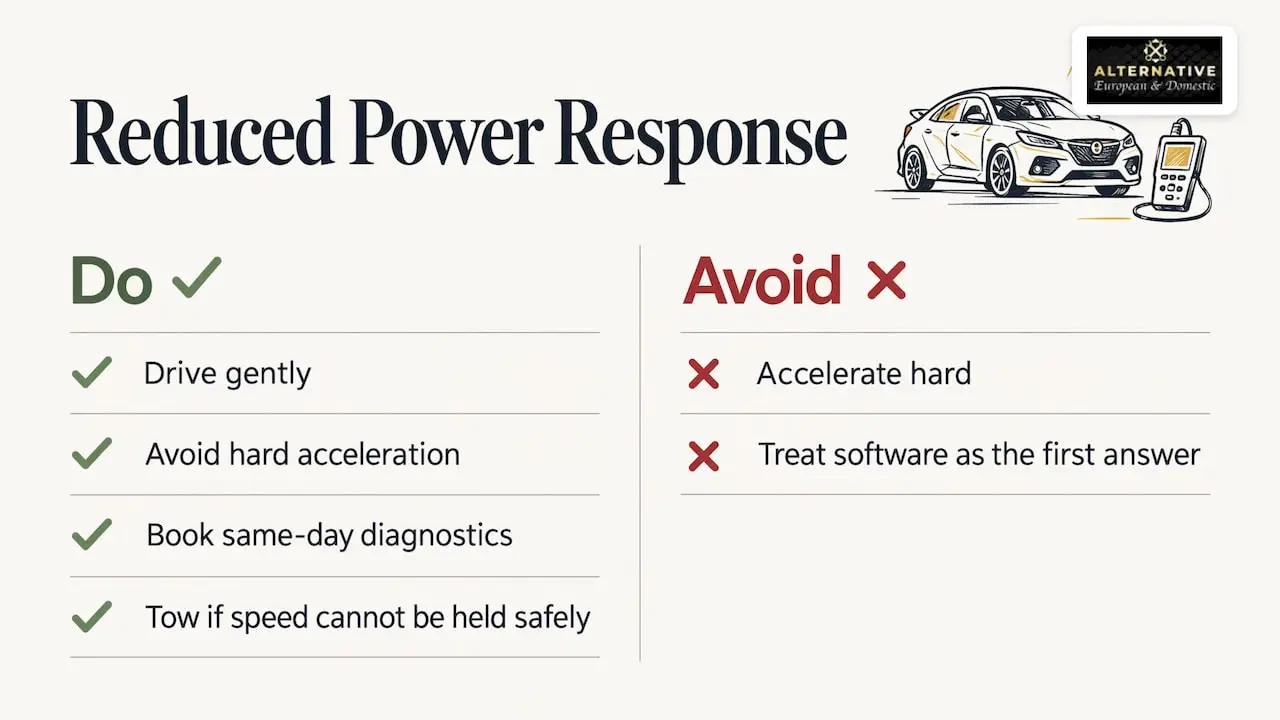
On turbocharged engines such as the N54, N55 and B58, the engine control unit (DME) can turn on the check engine light and reduce boost as a protective measure. Parts retailers describing the 3 Series note the same pattern: a steady light with noticeable power loss, or an “Engine Malfunction: Reduced Power” message, should be treated as urgent.
In practice, the car is telling you it found something that could harm the engine. Drive gently, avoid hard acceleration and book a diagnostic visit the same day if you can. If the car will not hold speed safely, have it towed.
Some owners also look into engine software when a turbo car shows a power-reduction warning. Because the DME’s software is tied to the car’s exact engine variant, shops that work with ECU data use original, unmodified ECU software files searched by model, engine and identifiers. A software file is rarely the first answer, though. The fault that triggered the reduction has to be found and fixed first.
Why a BMW-specific diagnosis matters
A basic reader plugged into the port under the driver’s-side dash will pull emissions codes. According to BimmerTalk’s scanner guide, generic readers only access the emissions subset of codes defined by federal law. BMW has dozens of other modules, including ABS, airbag, tire pressure, steering, the body modules, transmission and iDrive. For anything beyond a simple engine light on the main engine computer, a BMW-specific tool is needed.
BMW’s factory diagnostic software, ISTA, goes further. OEMTools describes it as reading and clearing codes, showing live data, running bi-directional activations and automated tests, and giving access to BMW service information, repair procedures and wiring diagrams.
The steps behind a good check engine diagnosis look like this:
- Interview. When did the light come on? Was there a hesitation, a rough idle, a recent fill-up or a recent repair?
- Full code scan. All modules, stored and pending codes, not just the engine computer.
- Freeze frame review. The data saved at the moment the fault was set: speed, load, temperature and fuel trims. Our article on freeze frame data for BMW drivetrain faults explains why this matters.
- Live data. Watching sensor values, fuel trims and cam timing while the engine runs. See our guide to live data steps for a check engine light.
- Targeted tests. Smoke testing for leaks, coil and injector checks, electrical load testing, and wiring inspection.
- Written findings. What failed, how urgent it is, and what the repair involves, in plain language.
One point to remember: a code points to a circuit or a system, not to a part. Replacing the part named in the code description without testing is how owners end up paying for a new sensor that was never the problem. Clearing the code does not fix anything either. The fault returns when the same conditions repeat.
If you want to know what to ask any shop, our list of questions to ask a mechanic helps you get the findings in writing. For electrical faults that hide behind several codes, we explain how ASE shops test advanced electrical issues.
How preventive maintenance cuts check engine visits
Many of the common causes tie directly to maintenance:
- Oil changes on time with BMW-spec oil protect VANOS solenoids and keep timing components clean.
- Spark plug and coil service at sensible intervals reduces misfires.
- Battery testing before winter or summer extremes avoids electrical ghost codes. Dallas heat is hard on batteries.
- Filter and fluid service keeps airflow and fuel delivery in range.
- Scheduled inspections let a technician catch a seeping gasket or a weak sensor before it sets a light.
A customized maintenance plan, built around your model, mileage and how you drive, is how we approach long-term reliability. Our maintenance service covers European, domestic and high-performance vehicles.
Cost factors without the guesswork
We do not publish fixed prices for check engine work, because the range is wide. The cost depends on:
- Which fault it is. A cap is trivial. A coil set, an oxygen sensor, a VANOS solenoid or a catalytic converter are very different jobs.
- Engine and model. Parts and access vary across inline-six, V8 and turbocharged engines.
- How early you act. A misfire fixed early is a coil or plug. The same misfire driven on can become a catalytic converter.
- Diagnostic time. Intermittent faults take longer to catch than constant ones.
The cheapest path is a correct diagnosis first, then one repair, instead of a series of guesses.
Promo: dealer-level diagnostics in Dallas
Alternative European & Domestic is a Texas repair shop that specializes in European, domestic and high-performance vehicles. We provide dealer-level diagnostics with ASE-certified technicians, and we explain our service recommendations and what we found in clear terms before work begins. Drivers in Oak Lawn, Uptown and across Dallas bring us check engine lights, electrical faults and mechanical repairs.
Qualifying repairs are backed by our 24-month/24,000-mile warranty, subject to applicable terms.

If your BMW’s light is on, schedule a diagnostic evaluation through our services page or contact Alternative European & Domestic at alternativecarcare.com.
FAQ
Can I drive my BMW with the check engine light on?
If the light is steady and the car runs normally, you can usually drive it, but have it checked soon. If it is flashing, the car is misfiring, so slow down, avoid full throttle and get it checked right away. Stop and arrange a tow for red warnings, reduced power, rough running or a smell of fuel.
Can a loose gas cap really turn on the light?
Yes. BMW’s own manuals use a fuel filler cap that is not fully screwed on as the example for a steady light. Tighten it until it clicks. It can take several drive cycles for the light to clear, and if it stays on, there is another cause.
Can I drive four hours with the light on?
Only if it is steady, the car drives normally and there are no red warnings or power loss, and even then a check before a long trip is wiser. A flashing light, reduced power or a rough engine is a reason not to start the trip. A long drive on a misfire can damage the catalytic converter.
Why did my BMW’s light come on and then go off?
The system turns a light off automatically after enough clean drive cycles, so an intermittent fault can hide. The code and freeze frame data stay stored, and the fault returns under the same conditions. A scan can still read what happened.
Why does a BMW need more than a basic code reader?
Generic readers only see the emissions subset of codes. BMW has many other modules, and live data and BMW-specific tests narrow a code down to the failed part instead of a guess.
Sources
- BMW Check Engine Light: Flashing vs Steady, What to Do
- 2004 BMW 545i (E60) Owner’s Manual
- BMW Check Engine Light: Common Causes and How to Fix Them
- Best OBD Scanner for BMW
- Flashing Check Engine Light Then Stops
- BMW diagnostic software overview
- BMW original ECU files