
A light squeal after new brake pads is often normal and usually fades during the first 200 to 500 miles as the pads and rotors bed in. Noise that happens in every driving condition, gets louder, or comes with grinding, pulling, vibration or a changed pedal feel is not normal and needs an inspection. If you are in Dallas, from Uptown to Oak Lawn, we can sort out which one you have.
TL;DR
- Mild squeal in the first few hundred miles is common while new pads lay down an even layer of friction material on the rotors.
- Noise that only shows up in certain conditions, such as cold mornings or damp days, usually fades by itself. Noise in every condition points to a repair.
- Common causes of persistent squeal: glazed pads, contamination, missing or reused shims and clips, worn or uneven rotors, and sticking caliper hardware.
- Never spray lubricant on pads or rotors. Grinding, pulling, a soft pedal or a brake warning light means stop driving and call a shop.
- A shop that checks rotors, calipers and hardware finds the cause. Guessing usually does not.
Table of Contents
- Is squealing after new brake pads normal?
- What bedding-in does, and why it affects noise
- Why squeal can persist: the common causes
- Why squeal is worse when it is cold or damp
- What not to spray or do
- When not to drive the car
- How a shop finds the cause
- European and performance cars need extra care
- Get the noise diagnosed at Alternative European & Domestic
- FAQ
- Sources
Is squealing after new brake pads normal?
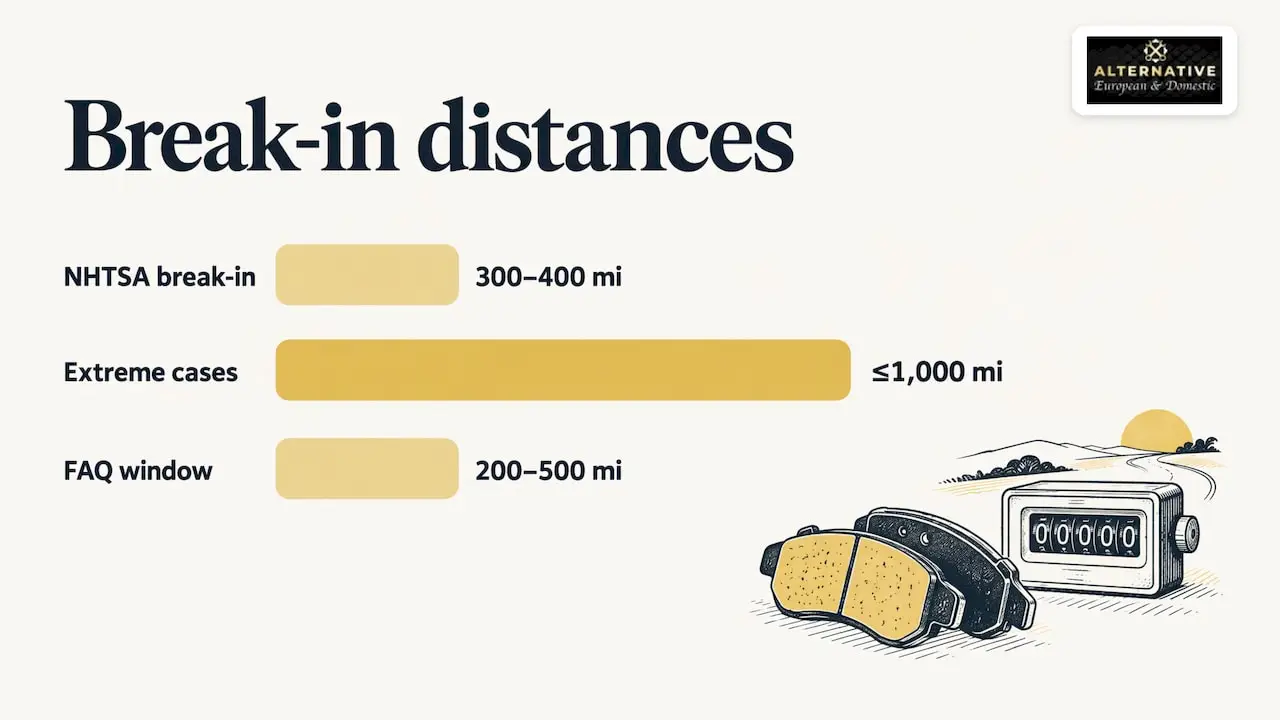
Often, yes. Fresh pads and rotors have microscopic surface roughness. A manufacturer service bulletin hosted by NHTSA explains that during break-in, stick-slip between these still-new surfaces can produce squeaking. The same document says the break-in phase usually lasts the first 300 to 400 miles and can run up to 1,000 miles in extreme cases.
A brake manufacturer’s FAQ gives a similar window: squeal usually goes away after the first 200 to 500 miles. Its FAQ also says a used rotor with a lip or uneven surface can double the time the noise takes to stop.
The pad compound matters too. Semi-metallic and performance pads tend to be noisier than softer compounds, and AAA notes that some high-performance brakes are noisy by nature and work best when fully heated. That is common on enthusiast cars, and it is a different situation from a squeal caused by a defect.
The quick sorting rule
Use this to decide whether to wait or call:
| What you notice | Likely meaning | What to do |
|---|---|---|
| Light, high squeak in the first few stops of the day | Moisture or temperature, bedding-in | Drive normally and gently, watch the trend |
| Squeal that fades over a few hundred miles | Normal bedding-in | No action needed |
| Squeal in every condition after 500 miles | Contamination, glazing, hardware or rotor issue | Book a diagnostic evaluation |
| Grinding, clunking or noise with no pedal pressure | Installation or mechanical problem | Have it inspected right away |
| Pulling, soft pedal, vibration, burning smell, warning light | Possible safety issue | Stop driving and see the safety section below |
The bulletin makes the same split: noises that occur only in specific conditions usually disappear by themselves, while noise in every condition likely means a repair is needed.
What bedding-in does, and why it affects noise
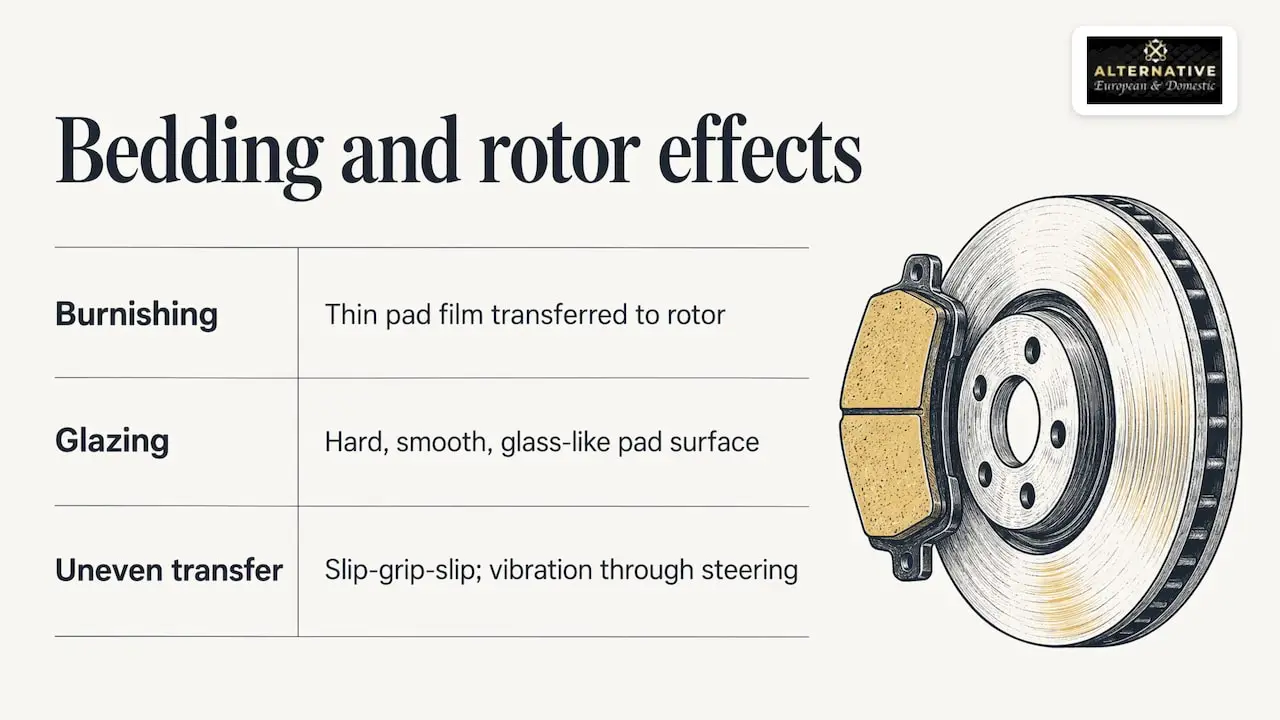
Bedding-in (also called burnishing) is the process of transferring a thin, even layer of pad material onto the rotor face. That film is what gives smooth, quiet, consistent friction. Without it, the contact is patchy.
HELLA’s technical page describes the opposite problem, glazing: a hard, smooth, glass-like pad surface that generally appears on new pads with little service time. It can come from overloading the pads during bed-in, repeated high-temperature swings at short intervals, or long periods of light pedal pressure. The results are lost friction, one-sided braking and squeaking.
Uneven transfer has a second symptom. ADVICS explains that leftover compound on a rotor creates a slip-grip-slip pattern that sends vibration through the suspension and steering wheel and is often misdiagnosed as a warped rotor. If your squeal arrives with a pulsing pedal, our guide to why a brake pedal pulsates explains the usual causes.
What the published procedures have in common
Brake pad makers publish different recipes, but the principles match: a series of moderate stops to build heat gradually, cool-down time between them, and no panic braking, towing or hauling until the pads are seated. A few examples:
- ADVICS describes a 30-30-30 rule: 30 slow stops from 30 mph with at least 30 seconds between stops, with full bedding by 400 to 500 miles.
- Ferodo says overheating new pads can permanently change their underlying structure, so temperature has to be built in stages.
- Hawk calls for moderate stops, no dragging the brakes and a cool-down before any hard braking.
The right procedure depends on the pad compound and the car, which is why we cover it separately in our brake bedding guide for European and performance cars. Do not improvise a hard-braking routine in Dallas traffic. Bed in on a quiet road with plenty of clear distance.
Why squeal can persist: the common causes
When noise outlasts bedding-in, the new pad is often not the problem. Brembo says squeals after new parts are often not a defect in the new component but the poor condition of other worn parts. Here are the usual suspects.
Rotors that were not addressed
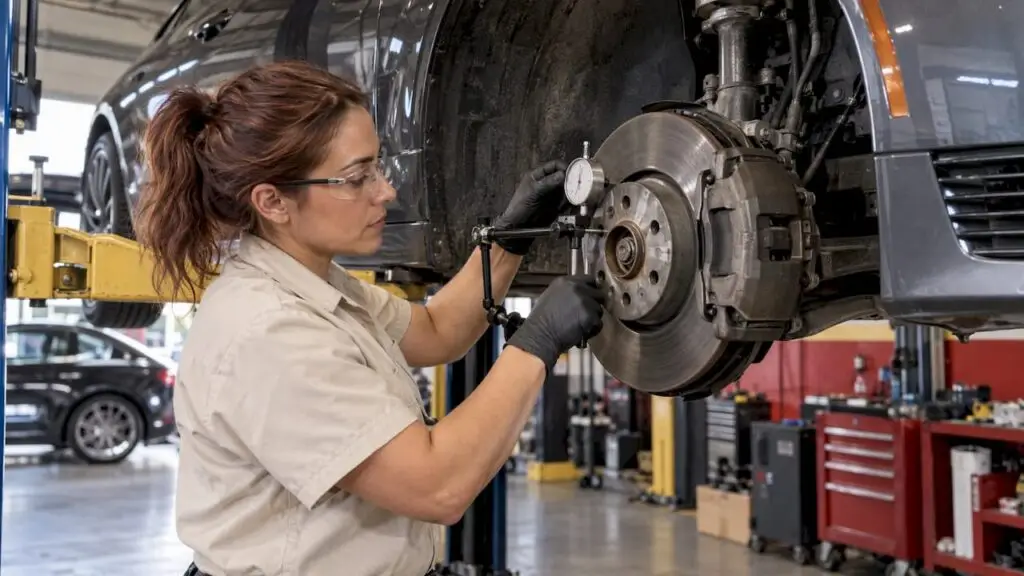
New pads on a rotor with grooves, a lip or uneven wear never mate properly. Brembo recommends checking disc wear whenever pads are changed and keeping disc oscillation (runout, or wobble) at or below 0.10 mm, with the hub alone at 0.050 mm. Rust or debris on the hub-to-disc mounting surface can also create runout. Measuring this takes a dial indicator and a clean setup, which is part of a proper brake inspection.
Missing, reused or wrong shims and hardware
Shims are thin plates on the pad backing that damp vibration. Brembo advises fitting new anti-noise shims if the pad uses them and never reusing old ones. Wagner’s guidance says brake noise generally comes from vibration caused by rust, distorted or loose components, or worn parts. Clips and abutment hardware that are bent, corroded or left out are a classic source of a squeal that started the day the pads went in.
Sticking caliper slides and pistons
A caliper that does not release fully keeps the pad dragging on the rotor. That causes heat, glazing and constant noise, and it wears the pads fast. EBC says caliper sliders and pins corrode with age and that calipers need servicing every 5 to 7 years to avoid pad drag, overheating and squeal. If one wheel runs hotter than the others or the car pulls, read about a stuck brake caliper.
Contamination
Oil, grease, dirt and cleaning chemicals on the friction surfaces cause noise and reduced braking. An Audi technical service bulletin covering 2012 to 2023 models lists chemical contamination from wheel or tire cleaner sprayed directly on the disc among its causes of brake noise. The same bulletin lists pads or discs near their wear limit, new parts not properly embedded, aftermarket parts, debris between disc and pad, and rusted or grooved discs. Goodyear Brakes’ guidance also warns that over-applied hardware grease can reach the braking surface.
Glazed or overheated pads
If the pads were overheated early, for instance by hard stops before bedding, the surface can harden. Glazed pads typically need to be resurfaced or replaced along with the rotor correction that makes the next set last.

Why squeal is worse when it is cold or damp
If the noise shows up at the first stop on a cool morning and disappears after a few brake applications, that pattern is usually environmental. AAA says moisture can leave a thin rust layer on pad surfaces that squeaks until a few stops clear it.
Temperature plays a role as well. The service bulletin notes that extremely low or high ambient temperatures change the material properties of pads and system lubricants, so temperature-related noises usually disappear by themselves at normal temperatures. A damp winter night in Dallas followed by a squeaky first stop is a good example. Noise that stays after the brakes are warm is a different matter.
What not to spray or do
It is tempting to reach for a can of WD-40 or a squeak spray. Do not. Popular Mechanics warns never to apply lubricant, gels, liquids or sprays to brake friction surfaces, including rotors and pad friction material. Anything on those surfaces can reduce stopping power, and the squeal usually returns once it wears off.
Brake-specific lubricant has a place, but only on hardware contact points such as slide pins and pad backing plate edges, applied sparingly. Getting that right is work for a technician who is also checking pad fit, clip condition and rotor surface at the same time. Removing wheels and handling brake parts at home carries real risk if anything is left loose or contaminated.
While you wait for the noise to fade, avoid:
- Hard or panic braking, except in a real emergency, until the pads are bedded.
- Towing or hauling heavy loads. Phoenix Friction says to avoid towing or hauling during break-in.
- Spraying wheel cleaner directly on the rotor and pad area.
- Dragging the brakes down long grades, which overheats new pads.
When not to drive the car
A squeal alone is not an emergency. Some combinations are. Motor1 lists grinding, longer stopping distances, a soft or unusual pedal, vibration, a burning smell, pulling under braking and a brake warning light as signs that warrant attention. It also notes that grinding can mean pad material is exhausted and metal is contacting the rotor, which makes the repair more expensive.
Stop driving the car and call a shop if:
- The pedal goes soft, sinks, or needs more travel than before.
- The car pulls hard to one side when you brake.
- You smell burning or see smoke from a wheel.
- A brake warning light stays on.
- You hear metal grinding or clunking, especially with no pedal pressure.
Towing is the right call when the pedal is unreliable, a wheel is smoking or too hot to approach, or the car will not stop predictably. Driving a few miles to the shop is not worth the risk. If the car feels predictable but the noise is persistent, schedule a prompt inspection rather than waiting for it to wear in. For a soft pedal specifically, see our three tests for diagnosing a soft brake pedal.
How a shop finds the cause
A proper diagnostic for new-pad squeal is a sequence, not a guess. Based on the factors above, it includes:
- Road test and symptom mapping. When does it squeal: cold, warm, light pedal, heavy pedal, turning, no pedal at all? Our 3 to 5 stop test shows what to note before you bring the car in.
- Wheel-off visual inspection. Pad wear pattern, glazing, contamination, shim and clip presence, dust shield position and debris between pad and rotor.
- Rotor measurement. Thickness, surface condition and runout against the specification for the car.
- Caliper check. Slide pin movement, piston retraction and seal condition.
- Correction. New hardware, cleaned and correctly lubricated contact points, rotor resurfacing or replacement, or new pads if the compound is glazed or contaminated.
- Re-bed and retest. The new friction layer has to be established again after the correction.
A used-parts-first shortcut, such as re-greasing the old clips and reinstalling the same pads, often returns the noise. A parts kit with fresh hardware costs little compared with repeating the job.
European and performance cars need extra care
High-output European and luxury cars brake harder and hotter than average commuters. They often use specific pad compounds, wear sensors, two-piece rotors or, on some models, carbon ceramic discs. Pad and rotor combinations are matched, so a pad that fits is not necessarily the right pad. Mismatched or aftermarket parts appear in the Audi bulletin’s list of noise causes.
Three practical points for owners in Oak Lawn, Uptown and across Dallas:
- Ask what pad compound and rotor were installed, and whether new shims and hardware were used.
- Ask whether the rotors were measured or just reused.
- Ask for the bedding instructions that suit that pad. If you have carbon ceramics, read our carbon ceramic brake guide first.
Also keep an eye on timing. Pads worn to the limit are a cause of noise on their own, and the right interval varies by car and driving style. Our brake pad replacement interval guide covers it for European luxury and performance cars.
Get the noise diagnosed at Alternative European & Domestic
If your new pads are still squealing after a few hundred miles, or the noise comes with any of the warning signs above, bring the car to us. Our ASE-certified technicians handle brake pad replacement and brake service for European, domestic and high-performance vehicles, with dealer-level diagnostics to trace the cause rather than only mask the sound.

Qualifying repairs are covered by our 24-month/24,000-mile warranty, subject to applicable terms. To have the brakes inspected, schedule an appointment and describe when the noise happens. Those details speed up the diagnosis.
FAQ
How long should new brakes squeal before I worry?
Mild squeal commonly fades within the first 200 to 500 miles, and bedding-in can take longer on some compounds. If it persists past 500 miles, or is loud in every driving condition, have it inspected. Do not wait on any noise that comes with grinding, pulling or a change in pedal feel.
Can I spray WD-40 on brakes to stop squeaking?
No. Lubricants and sprays on pads or rotors can reduce braking performance, and the noise tends to return. A technician can address the real cause, such as hardware, shims or rotor condition, without putting anything on the friction surfaces.
Why do my brakes squeal in the morning after a pad replacement?
Moisture can form a thin rust film on the rotor overnight, and cold temperatures change pad material behavior. This kind of squeak usually clears after a few stops. If it continues once the brakes are warm, schedule an inspection.
Is it safe to drive with squealing new brakes?
A light squeal with normal pedal feel and straight stopping is generally not an immediate danger. Stop driving if you notice grinding, pulling, a soft pedal, burning smells or a brake warning light. Have the car towed if you cannot rely on it to stop.
Do new rotors stop squealing faster than resurfaced ones?
Rotor condition matters more than whether it is new or resurfaced. A rotor with a lip, grooves or excess runout can extend the noise, and a measured, true surface lets the pad bed in properly. A shop should measure the rotors before deciding.
Sources
- Manufacturer service bulletin on brake break-in noise (NHTSA-hosted)
- EBC Brakes FAQ
- AAA: The most common reasons for squeaky brakes
- HELLA: Failure modes of brake discs and brake pads
- ADVICS: Bedding-in brake rotors and brake pads
- Ferodo: Squeaky brakes tech tips
- Hawk Performance: How to bed in brakes
- Brembo: Squeaky brakes and noises
- Wagner Brake: Squealing brakes and vibration
- Audi technical service bulletin on brake noise (NHTSA)
- Popular Mechanics: How to fix squeaky brakes
- Motor1: Why your brakes squeak and when to worry
- Phoenix Friction: Bedding-in process