
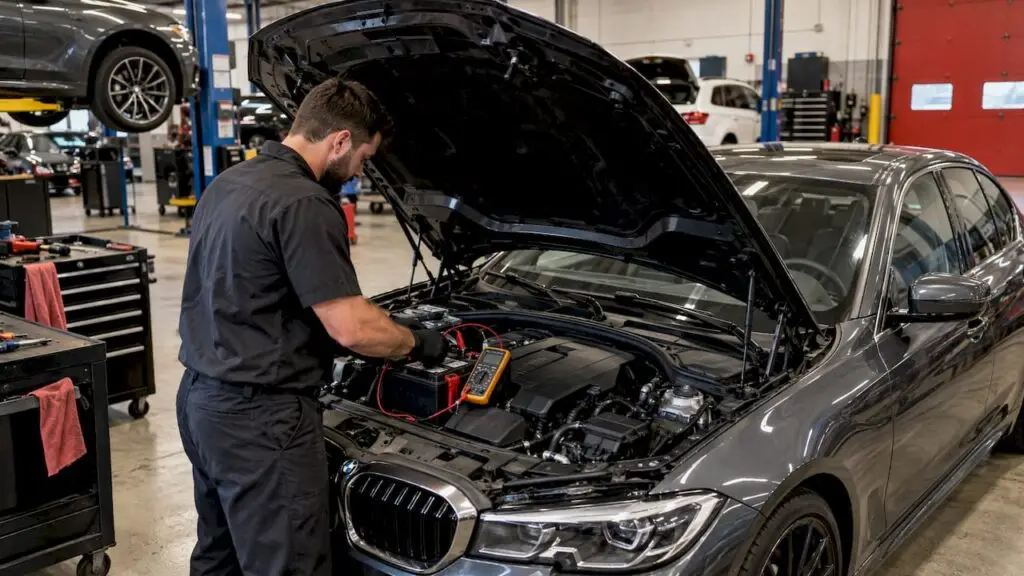
A battery that keeps dying overnight is usually not the real problem. The cause is most often a parasitic draw, meaning something stays powered after the car is off, or a charging fault that never fully refills the battery. A new battery will fail the same way until the cause is found. At Alternative European & Domestic in Dallas, this is a diagnostic job: measure the drain, isolate the circuit, then repair it.
TL;DR
- Most overnight failures come from a module that will not go to sleep, a faulty relay or switch, an aftermarket accessory, corroded connections, or a failing alternator.
- A healthy car settles to a small draw (a few dozen milliamps) after its modules shut down. A draw of around 1 amp can flatten a battery overnight.
- Replacing the battery without testing the drain and the charging system usually means a second dead battery.
- Do not keep driving with the charging warning light on. It can mean the battery is no longer being recharged.
- Our ASE-certified technicians trace the draw circuit by circuit, so you pay to fix the cause rather than swap parts.
Table of Contents
- Why a battery dies overnight
- The most common causes
- Quick guide: symptoms and likely causes
- What the warning light is telling you
- How a shop finds the drain
- Battery or alternator: how to tell the difference
- When not to drive, and when to tow
- If the car is dead right now
- Why the cause matters more than the battery
- How to prevent repeat failures
- Get the drain diagnosed in Dallas
- FAQ
- Sources
Why a battery dies overnight
Your car never fully switches off. Even parked, it powers the clock, keyless entry, alarm and the memory that stores your settings. That normal draw is small. Service guidance from MOTOR magazine says modules should enter sleep mode within about 75 minutes of shutdown with the doors closed, and that draw should then not exceed 50 milliamps (0.050 amp).
When something breaks that routine, the battery pays. The same article notes that a small drain under 1 amp takes a couple of days to discharge a battery, while a drain over 1 amp commonly kills one overnight. A smaller draw can still strand you after a weekend or a week at the airport.
There are two broad families of cause:
- Something is pulling power with the car off. This is a parasitic draw.
- The battery is not being recharged properly while you drive. This is a charging-system problem, or the battery itself has reached the end of its life.
The symptom is identical in both cases: the car was fine yesterday and is dead this morning. That is why guessing wastes money.
The most common causes
A control module that stays awake
Modern European and performance cars carry dozens of networked control units. If one fails to go to sleep after the car is locked, it keeps the network awake and the draw stays high. Causes include a software fault, a failing module, or a neighboring component that keeps sending a wake-up signal.
This is also why a draw can come and go. A car can sit quietly for a week, then drain overnight when a module wakes on a bad signal.
Aftermarket electronics
Alarms, remote starters, amplifiers, dash cameras and GPS trackers draw power continuously. A 2025 service bulletin hosted by NHTSA notes that these devices can add up to an excessive overall draw. MOTOR also lists amplifiers and other add-ons among typical culprits.
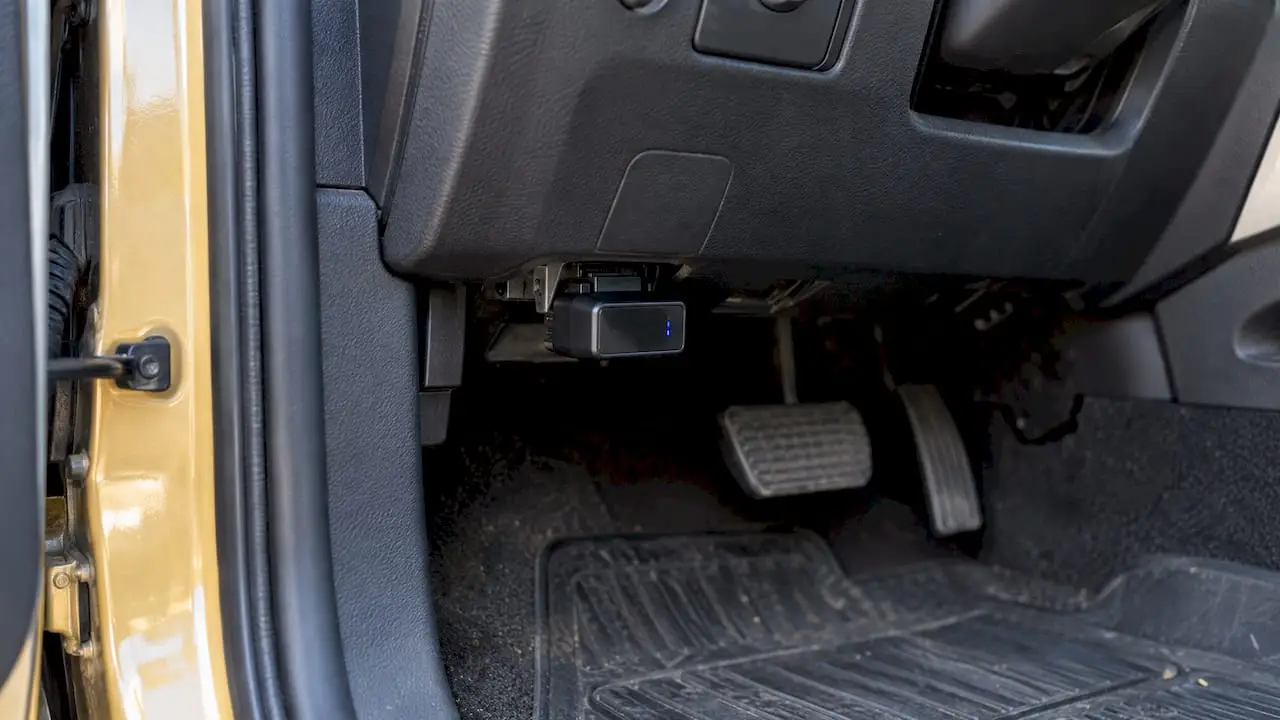
A small plug-in device can be enough. Motor1 reported on a truck whose battery kept dying because of a Bluetooth OBD-II dongle that stayed powered with the ignition off. If you plugged in a tracker, insurance dongle or diagnostic reader recently, mention it when you book.
Faulty relays, switches and stuck lights
A relay that sticks closed, a trunk or glovebox light switch that fails, or a door latch sensor that never reports “closed” can keep circuits live. The same Motor1 report notes that a stuck accessory, a faulty relay or a glovebox light that stays on can push the draw well past 100 milliamps. A battery can go flat in a couple of days from that.
A charging fault, including a failing alternator
The alternator recharges the battery while the engine runs. If it undercharges, the battery starts every day a little emptier until it quits. A failed internal diode can also let current flow backward and drain the battery with the engine off. For the symptoms to watch for, see our guide to alternator failure symptoms and the right diagnostic order.
Corroded or loose connections and worn wiring
Corroded terminals and damaged cables restrict current in both directions. They can keep the battery from charging fully and make a marginal battery look dead. Frayed or chafed wiring can also create a short that bleeds current at rest.
A battery that has simply worn out
Batteries age, and heat is hard on them. Short trips that never let the alternator catch up add to the wear. Cars that sit for long periods also suffer repeated deep discharges, which shorten battery life. If the battery has been drained flat several times, it may no longer hold a charge even after the original fault is fixed.
Battery registration on some European cars
Some European cars expect the control system to be told when a new battery is installed, so that charging is managed for that battery. If the new battery is not registered, it can be undercharged and fail early. We cover this in detail for BMW owners who need to register a new battery, and in our note on BMW increased battery discharge. Some Mercedes models also have an auxiliary battery whose faults can mimic a main-battery problem. See Mercedes auxiliary battery faults.
Quick guide: symptoms and likely causes
| What you notice | Likely cause | Urgency |
|---|---|---|
| Dead only after sitting several days | Small parasitic draw, aging battery | Book a diagnostic soon |
| Dead every morning, fine after a jump and a drive | Larger draw or module that will not sleep | Book a diagnostic this week |
| Battery or charging light on while driving | Alternator or charging-circuit fault | Stop driving soon, see below |
| Headlights dim at idle, brighten with revs | Undercharging | Book promptly |
| Dead right after a new battery | Unregistered battery, draw, or charging fault | Return for diagnosis |
| Slow crank, clicking, then recovery | Weak battery or corroded connections | Book a battery and charging test |
What the warning light is telling you
A battery or charging-system light is normal for a moment at startup. GMC’s support page explains that if it stays on or appears while driving, the electrical system may have a problem, and driving with it on can drain the 12-volt battery. It advises turning off electrical features such as the radio. Hyundai’s service site likewise says the car should be inspected as soon as possible if the light stays on after starting or comes on while driving.
The same logic applies to European and performance cars, whose electrical systems are even more dependent on stable voltage. For more on what different lights mean, see our battery warning light guide.

How a shop finds the drain
This is a measured procedure, not guesswork. Here is what proper diagnosis involves and why it takes patience.
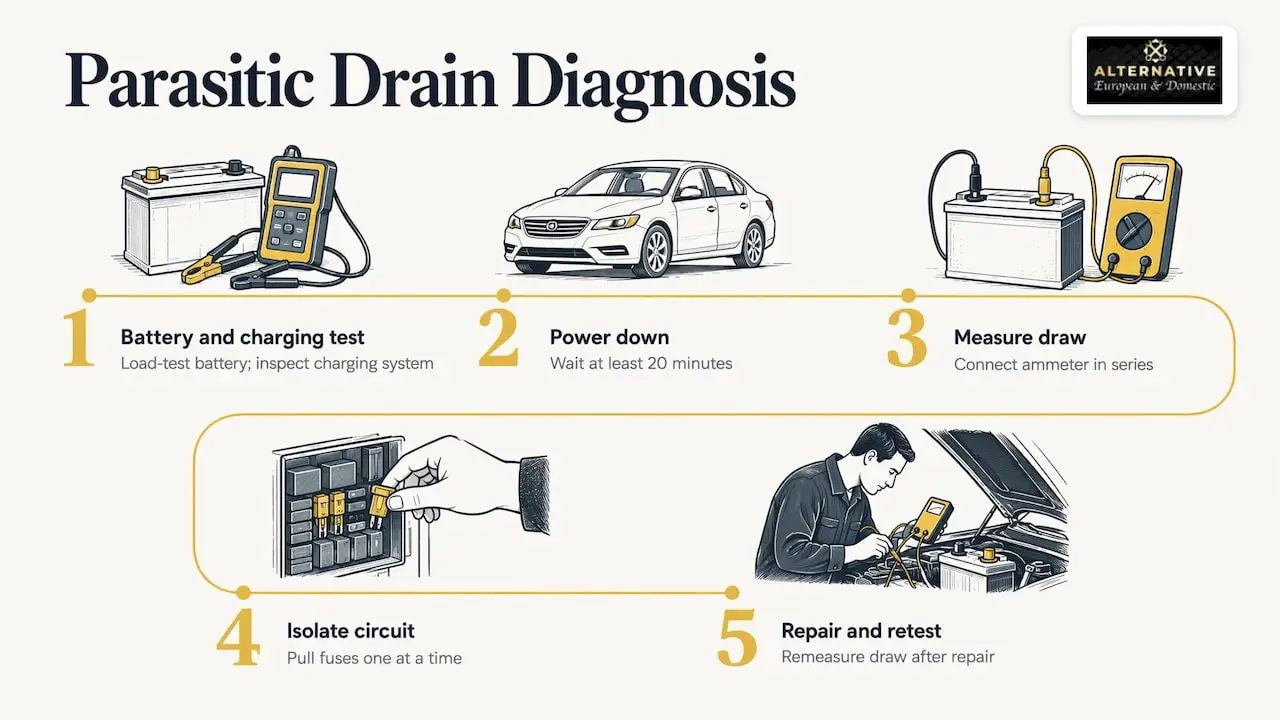
1. Test the battery and charging system first. MOTOR’s Roy Dennis Ripple advises checking the battery itself with a load test and visual inspection before hunting for a drain, because a bad battery will kill itself. Voltage tells a lot. DENSO’s charging-system guidance gives 12.0 to 12.6 volts with the engine off and 13.0 to 14.5 volts with the engine running as the healthy range. Readings outside that range point to a weak battery, poor connections, a failing alternator or a regulator fault.
2. Let the car power down. The NHTSA-hosted bulletin states that the vehicle’s self-test and power-down take a minimum of 20 minutes on most models before testing. Measure too early and you see the normal wake-up current, which leads to false conclusions. Some vehicles need longer.
3. Measure the draw in series. A technician connects an ammeter between the negative battery post and its cable. The bulletin gives a normal draw as typically under 70 milliamps. Different makers set different limits, so a technician works to the specification for your vehicle.
4. Isolate the circuit. If the reading is high, fuses are pulled one at a time. When the reading drops sharply, for example from 300 milliamps to 40, that circuit is the culprit. Wiring diagrams then lead to the faulty module, shorted wire or stuck relay.
5. Repair, retest and confirm. After the repair, the draw is measured again to confirm the car settles into sleep mode.
The tricky part is that on a late-model European car, disturbing the wrong thing can wake the network or set fault codes. Pulling fuses, hooking up meters and interpreting network behavior takes training and the right data. That is why we do this work in the shop with dealer-level diagnostics rather than leaving owners to experiment. Our advanced electrical diagnostics guide explains how ASE-certified technicians approach it.
Battery or alternator: how to tell the difference
Owners often ask which one failed. Some clues help, though only testing settles it:
- Car starts after a jump, then dies later while driving: points toward the alternator or charging circuit.
- Car starts after a jump and keeps running fine, but is dead again by morning: points toward a draw or a battery that no longer holds a charge.
- Lights dim at idle and brighten with revs: suggests undercharging.
- Battery smells of sulfur, looks swollen or is leaking: a possible overcharging or internal failure. Do not keep driving; have it inspected.
A repeatedly dying battery rarely stands alone. If the battery is replaced without addressing a charging fault or a draw, the new battery is at risk too.
When not to drive, and when to tow
Safety comes first. Some situations call for stopping:
- Charging light on while driving, plus dimming lights or a weak engine: the car is running on stored battery power. Turn off nonessential electrical loads, drive only as far as a safe stop or nearby shop, and do not make long trips.
- Burning smell, smoke, or a hot or swollen battery: pull over safely and shut the car off. Do not keep driving.
- Power steering or brake assist feels different, or warning lights multiply: low system voltage can affect electronic systems. Stop and arrange a tow.
- Car will not start and you suspect a short: do not repeatedly crank it. Have it towed to the shop.
Towing is the right call when the car cannot be started safely, when a warning appears alongside electrical symptoms, or when you are in traffic or an unsafe location. On modern cars, an electrical fault can compound if you keep trying.
If the car is dead right now
A jump-start gets you moving, but treat it as a temporary fix. Consumer Reports describes the standard order: connect positive to positive, then the donor’s negative to a ground point away from the dead battery, start the donor car, then yours. Let the car run at least 20 minutes afterward. Its testers warn that improper jump-starting can damage a key electronic component, and recommend following the owner’s manual. If in doubt, seek help.
European and performance cars often have specific jump points and sensitive electronics, so check the manual first. If the car will not start after a jump, call for roadside help rather than repeating attempts. Then book a diagnostic so you find out why it died.
Why the cause matters more than the battery
Here is the cost logic for a budget-conscious owner. A battery swap fixes a weak battery. It does nothing for a stuck module, a failing alternator or an aftermarket device. Skipping the diagnosis can mean a second battery, a second tow and a second day without a car.
Cost depends on what is found: the battery type, whether it needs registration, whether the cause is a module, a wiring repair or an alternator, and how long the draw takes to trace. An intermittent draw takes longer than one that is present all the time. We ask that you describe exactly when the car died, how long it had sat, and what has been added to it, because that shortens the search.
How to prevent repeat failures
- Have the battery and charging system tested as part of regular maintenance, especially before summer and winter. Dallas heat is hard on batteries. Hot climates can shorten battery life considerably.
- Keep terminals clean and tight, and have corrosion cleaned during service.
- If the car sits for long periods, tell your technician. Repeated deep discharges shorten battery life.
- Have aftermarket electronics installed and checked by a technician who knows your vehicle’s network.
- Treat a lit charging warning as an appointment, not a suggestion.
Our maintenance service is built around customized plans that support long-term reliability, so battery health can be checked alongside the other items your car needs.
Get the drain diagnosed in Dallas
If your battery keeps dying, Alternator, starter, battery and electrical system work is part of what we do for European, domestic and high-performance vehicles. Our ASE-certified technicians use dealer-level diagnostics to find the cause before recommending a repair, and we explain what we find and why. Qualifying repairs may be covered by our 24-month/24,000-mile warranty, subject to applicable terms. See our battery, alternator and electrical services, or schedule an appointment.

Whether you drive in Oak Lawn, Uptown or elsewhere in Dallas, bring the car in before the next dead morning. If it will not start at all, our guide on diagnosing a no-crank, no-start shows how we sort battery, starter and supply faults.
FAQ
How much battery drain is normal overnight?
A small amount. MOTOR says modules should be asleep within about 75 minutes and draw should then stay at or below 50 milliamps. The NHTSA-hosted bulletin gives under 70 milliamps as typical, and the exact limit varies by vehicle. Draw of 1 amp or more can flatten a battery overnight.
Can a bad alternator drain the battery when the car is off?
Yes. A failed diode inside the alternator can create a path that lets current flow out of the battery with the engine off. An alternator that undercharges while you drive also leaves the battery lower each day. A technician tests both the output and the draw to tell them apart.
Will a new battery fix a car that dies overnight?
Only if the old battery was the cause. If a module is staying awake, an accessory is drawing power or the charging system is weak, the new battery will drain too. On some European cars, a new battery also needs to be registered to the car.
Is it safe to keep driving if the charging light is on?
Not for long. GMC notes that driving with the charging light on can drain the 12-volt battery. Turn off nonessential electrical loads, avoid long trips and have the car inspected as soon as possible. If lights dim or the car runs poorly, stop and arrange a tow.
How long can a car sit before the battery dies?
It depends on the battery’s condition and the car’s draw. A healthy battery with normal draw can last weeks, but a faulty module or accessory can shorten that to days or even one night. If your car dies after sitting, ask for a draw test.
Sources
- Diagnosing a Battery Drain, MOTOR
- Car Battery: Why Does It Keep Dying?, Motor1
- Service Information Bulletin, NHTSA
- Charging System Diagnosis, DENSO Auto Parts
- Identify Warning Lights, GMC Vehicle Support
- Hyundai Warning Lights, Hyundai USA Service
- How to Jump-Start a Car With a Dead Battery, Consumer Reports