
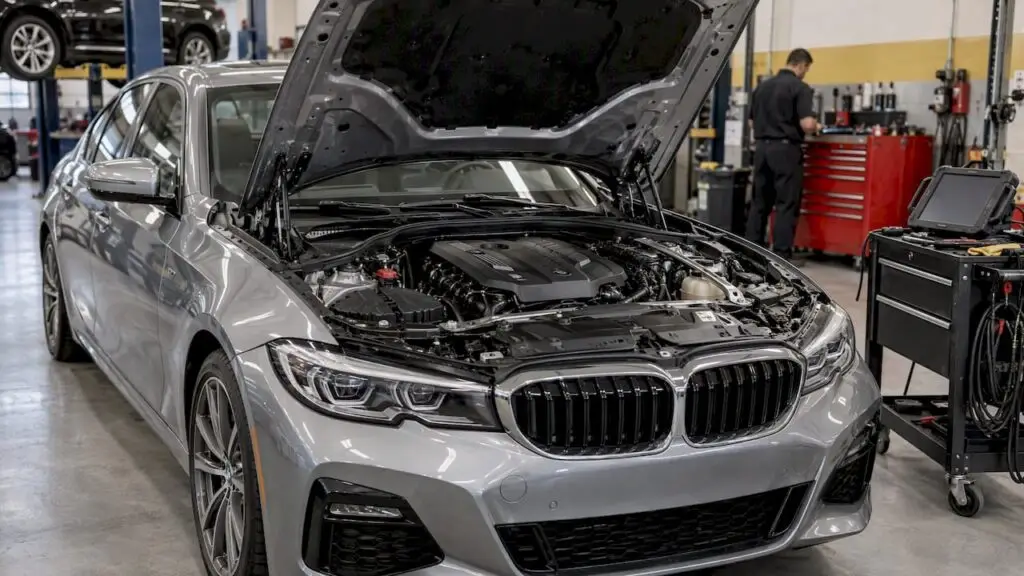
A BMW that misfires under load, meaning when you accelerate hard, climb a grade or build boost, most often has a weak ignition component (a spark plug or ignition coil), a fuel delivery fault, or an air leak in the intake. Cylinder pressure is highest under load, so a marginal part that idles fine fails when the engine works hardest. If the check engine light is flashing, reduce power and get the car to a technician promptly. If it is flashing and the car runs rough, do not keep driving it.
At Alternative European & Domestic, we see this complaint from Dallas owners of turbocharged BMWs and other European performance cars. This guide explains what is usually behind it, how a proper diagnosis works, and how to tell a “schedule it this week” problem from a “tow it now” problem.
TL;DR
- Misfires that appear only under load are most often caused by worn spark plugs, a failing ignition coil, a fuel delivery problem or an intake air leak.
- A flashing check engine light means active misfires that can send unburned fuel into the catalytic converter. Ease off the throttle and have the car looked at right away.
- Read the stored fault codes and freeze-frame data before replacing parts. Guessing is how owners pay for the same repair twice.
- Do not drive a car that shakes badly, loses power or flashes the warning light. Towing is cheaper than a ruined catalytic converter or engine damage.
- Keeping up with plug intervals, clean fuel and intake maintenance lowers the odds of a repeat.
Table of Contents
- What a misfire under load actually is
- The most common causes on a BMW
- Symptoms that help narrow it down
- What a flashing check engine light means
- When the car loses power while driving
- How a technician diagnoses a misfire under load
- Repair options and what drives the cost
- Do not skip the electrical side
- Tuned and high-performance cars
- Preventing repeat misfires
- Book a misfire diagnosis in Dallas
- FAQ
- Sources
What a misfire under load actually is
An engine misfire happens when a cylinder fails to burn its air and fuel mixture properly, or burns it at the wrong moment. The engine control unit (ECU) detects it by watching tiny variations in crankshaft speed and stores a misfire fault code, usually in the P0300 family. P0301 through P0306 identify the specific cylinder.
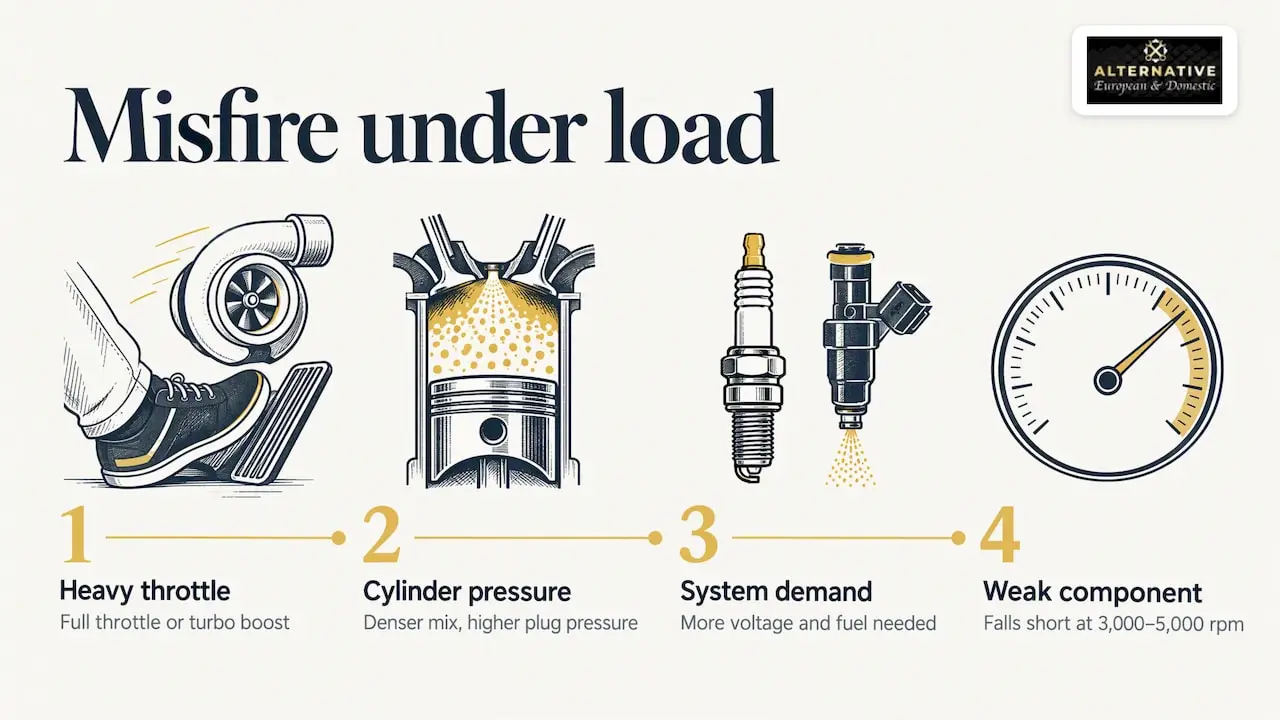
Load changes everything about the conditions inside a cylinder. Under heavy throttle, or with a turbocharger making boost, the mixture is denser and the pressure at the spark plug is higher. The ignition system has to generate more voltage to jump the plug gap, and the fuel system has to deliver more fuel. A component that is only slightly weak can handle idle and light cruising, then fall short at 3,000 to 5,000 rpm or at full throttle.
That is why owners often describe the same pattern: smooth around town, then a stumble, hesitation or surge when passing on Central Expressway or merging onto the Dallas North Tollway.
The most common causes on a BMW
The causes fall into three groups: spark, fuel and air. Mechanical issues sit behind them, less often but more expensively.
Worn spark plugs
Plug electrodes erode with use, which widens the gap. A wider gap needs more voltage, and under high cylinder pressure the coil may not be able to supply it. The result is a misfire only when the engine is loaded. Turbocharged and tuned engines are harder on plugs, which is why we cover intervals separately in our guide to the spark plug interval for performance cars.
Failing ignition coils
BMW uses one coil per cylinder. A coil can test fine at idle and break down when hot or loaded. BMW’s own service bulletin for the N51, N52, N52K and N52T engines names a failed ignition coil as the most likely cause of a misfire with the check engine light on, and notes it can often be confirmed with basic diagnosis (NHTSA, BMW service bulletin SB-10058489-9490). The same bulletin directed technicians to replace the original Bosch coils with Delphi coils in specified cases.
On tuned turbocharged cars, a worn plug and a tired coil often fail together, because the extra cylinder pressure stresses both. If your car has a tune, expect ignition parts to need attention sooner than on a stock car.
Fuel delivery problems
A lean condition, meaning too much air for the fuel supplied, can cause a misfire when demand is high. Typical sources are a weakening high-pressure fuel pump, a clogged or failing injector, or uneven fuel delivery. These faults tend to show up at higher load because the fuel system has the least margin there. A fuel pressure reading taken while the engine is under load tells a technician far more than a reading at idle.
Intake air leaks and airflow sensor faults
Split hoses, cracked charge pipes, loose clamps and vacuum leaks let unmetered air into the engine. That upsets the air-fuel ratio, and the effect grows with boost. A dirty mass airflow (MAF) sensor can mislead the ECU in a similar way. BMW’s diagnostic guidance for the N14 engine includes checking the intake track for leaks or restrictions and reviewing recorded fuel pressure in cylinder-specific misfire fault data (NHTSA, BMW bulletin SB-10034867-5414). If you suspect a leak on a turbo car, see our notes on boost leak symptoms and pressure testing.
Carbon deposits on direct-injection engines
Direct-injection engines spray fuel straight into the cylinder, so nothing washes the intake valves. Over time, deposits build up. For listed N54 and N54T models, BMW has identified intake-valve and port carbon deposits as a cause of drivability complaints and misfire faults (NHTSA, BMW bulletin MC-10149286-9999). Cleaning is a specific procedure, and we explain when it makes sense in our article on walnut blasting for N54 and N55 engines.
Less common causes
- Wastegate or boost control faults that cause erratic boost. A rattling actuator is worth checking before replacing it; see our wastegate rattle guide.
- Coolant leaks that foul a plug or cylinder, covered in our BMW coolant leak article.
- Timing chain stretch on engines such as the N20, which is a mechanical fault and not an ignition one. Our N20 timing chain checklist explains the signs.
- Low compression from valve, ring or head gasket damage. This is the least common cause, and the one you rule out last.
Symptoms that help narrow it down
The way the car behaves gives a technician a starting point. None of these is a diagnosis on its own.
| What you notice | Points toward | Urgency |
|---|---|---|
| Stumble or hesitation only at full throttle or high boost | Plugs, coils, boost leak | Schedule soon |
| Misfire in one cylinder that stays the same | Coil, plug or injector on that cylinder | Schedule soon |
| Misfire that moves between cylinders | Fuel pressure, air leak, or a general ignition weakness | Schedule soon |
| Rough running with a flashing check engine light | Active misfire, risk to the catalytic converter | Stop driving, tow if needed |
| Loss of power, shaking and a fuel smell | Unburned fuel, possible injector or leak | Stop driving |
| Misfire plus rising temperature gauge or low oil | Mechanical or cooling fault | Stop immediately |
| Misfire only when cold, gone when warm | Often injector or carbon related | Schedule soon |
What a flashing check engine light means
A steady check engine light says a fault is stored. A flashing one says the ECU has detected a misfire severe enough to threaten the exhaust system. Unburned fuel entering the catalytic converter can overheat and damage it (Liqui Moly). The exact cause is found by reading the fault memory.
What to do:
- Lift off the throttle. Avoid hard acceleration and towing loads.
- If the light stops flashing and the car runs smoothly, drive gently and directly to a shop. Do not make it a long trip.
- If the light keeps flashing, the car shakes, or power drops, find a safe place and stop.
- Arrange a tow. Repeated misfires can damage a catalytic converter, and replacing one on a European car is a costly repair.
Do not clear the code and hope. Clearing it removes the freeze-frame data a technician needs, and the misfire will return.
When the car loses power while driving
Power loss is a different and more urgent problem when it happens suddenly in traffic. A car can lose power or stall from running out of fuel, a failing fuel pump, an alternator fault or another failure. Consumer Reports advises that if the engine dies, you should steer gradually to the roadside and stop as soon as you can (Consumer Reports).
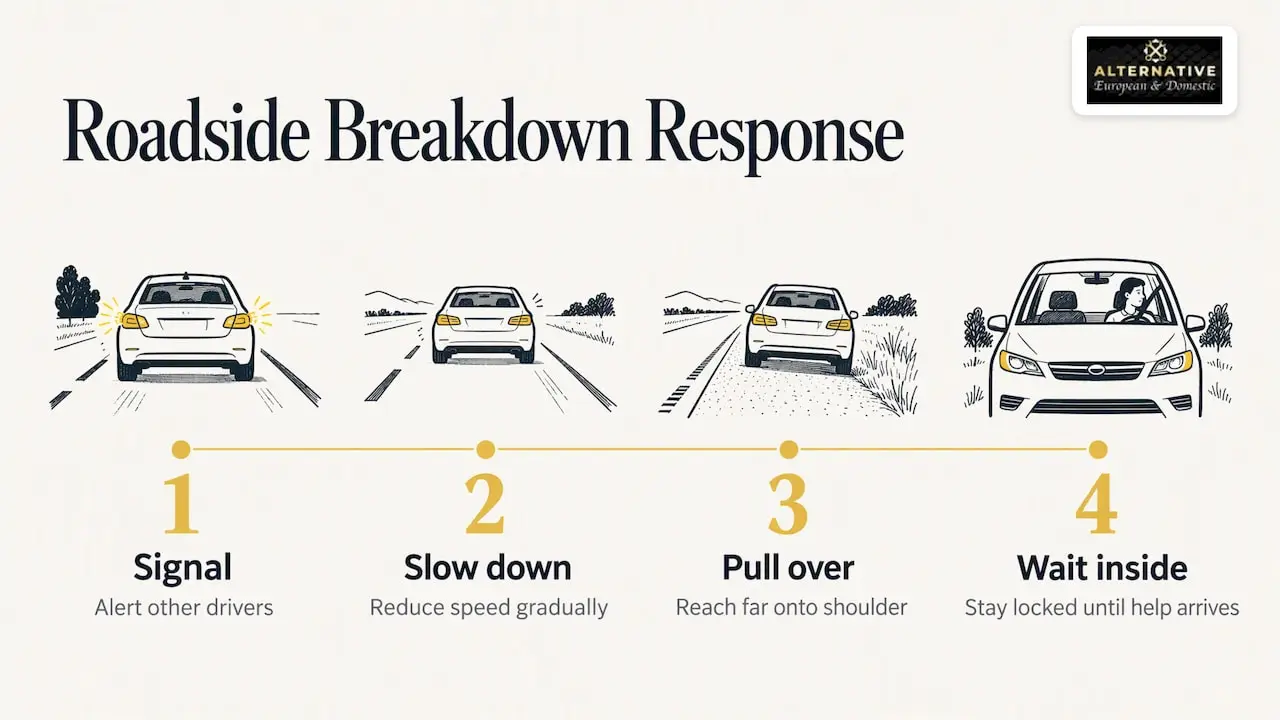
AAA’s guidance for a mechanical breakdown is to signal, slow down gradually and pull onto the shoulder as far off the road as possible. Once clear of traffic, it is generally safest to stay in the vehicle with the doors locked until law enforcement or road service arrives (AAA). On Dallas freeways, where shoulders are narrow and speeds are high, this matters.
When not to drive the car
Do not drive a BMW that is misfiring if any of these apply:
- The check engine light is flashing.
- The engine shakes hard at idle or under light throttle.
- It loses power on the freeway or will not hold speed.
- You smell raw fuel or hot, burning odors from the exhaust.
- The temperature gauge climbs or the oil pressure warning appears.
In those cases, towing is the right call. The tow fee is small next to the cost of a damaged catalytic converter or a scored cylinder.
How a technician diagnoses a misfire under load
Good diagnosis follows an order. It starts with the codes and ends with the part, not the other way round.
- Scan all modules and read the fault memory. Misfire counters per cylinder, freeze-frame data and any related codes (fuel trim, boost, camshaft) show when the misfire happens. For N63 misfire faults, BMW directs technicians to run the misfire test plan first and repair as directed before other engine or fuel-system tests, to avoid incorrect diagnosis and repeat repairs (NHTSA, BMW bulletin SB-10049439-6684).
- Inspect the basics. Plug condition and gap, coil boots, wiring, and the intake path from the air filter to the throttle.
- Check the data live. Fuel trims, fuel rail pressure, boost, and misfire counts while the car is loaded show what a parked car will not.
- Test the intake under pressure. A boost leak test finds split pipes and loose couplings that are invisible by eye.
- Swap components between cylinders. Moving a coil to another cylinder shows whether the misfire follows the coil. If it does, the coil is bad. If it stays in the same cylinder, attention turns to the injector or a mechanical cause.
- Go deeper only if needed. Compression and leak-down tests, injector balance tests, and a borescope look into the cylinder separate a mechanical fault from an ignition or fuel fault.
- Verify the repair. Clear codes, road test under the same load that caused the problem, and confirm the misfire counters stay at zero.
This is the process we describe in more detail in our seven-step misfire diagnosis guide. The reason to follow it is simple: replacing a coil that is not at fault costs money and leaves the real fault in place.
Why professional diagnostics matter
A cheap code reader tells you a cylinder misfired. It does not tell you why. A shop with BMW-capable diagnostic software can read the car’s modules, view live data and run the manufacturer’s test procedures. Our technicians are ASE-certified, and we use dealer-level diagnostic tools to follow the factory path for the engine in front of us.
Before you authorize any repair, it helps to know what to ask. Our list of questions to ask a mechanic covers getting findings in writing.
Repair options and what drives the cost
We do not publish a flat price for misfire repair, because the same symptom can have a $-small cause or a large one. These are the factors that move the bill:
- Engine and cylinder count. Six- and eight-cylinder engines have more plugs and coils, and some are hard to reach.
- Access. On some models the intake or other components must come off to reach the plugs.
- Parts quality. Original-equipment or equivalent-quality coils and plugs matter on a turbocharged engine. Cheap parts are a common reason a misfire returns.
- How many parts failed. A plug and a coil may be worn together. Replacing plugs as a set is common practice.
- Carbon cleaning or injector work. These add labor on direct-injection engines.
- Root cause. A boost leak or fuel pump fault adds its own repair.
A written estimate that lists the finding, the part and the labor lets you compare fairly. When a qualifying repair is completed at our shop, it may be covered by our 24-month/24,000-mile warranty, subject to applicable terms.
Do not skip the electrical side
Misfires are not always an ignition-part problem. Low or unstable system voltage can weaken spark and upset sensors and injector control, and an aging battery or a weak alternator can mimic an ignition fault. The role of the battery in engine management systems is worth understanding if your BMW has had other odd electrical behavior. If a battery test or charging check looks marginal, we confirm it during diagnostics and cover how in our piece on advanced electrical diagnostics.
Tuned and high-performance cars
On a car with a tune, extra boost raises cylinder pressure, so ignition parts work harder. A tuner’s calibration also changes how the ECU handles fueling and timing. If your BMW is tuned and you see a misfire under load, tell the shop. It changes what we test first, and it often changes the replacement interval for plugs and coils. We would rather have the full picture than guess.
Preventing repeat misfires
Prevention is mostly ordinary maintenance done on time.
- Replace spark plugs on schedule, and earlier if the car is tuned or driven hard.
- Replace coils that test weak, rather than waiting for a failure at speed.
- Use quality fuel and stay on top of fuel filter and air filter replacement.
- Keep oil changes current. Prevention generally involves timely oil changes, filter replacements and quality fuel to keep the systems clean (AutoZone).
- Inspect hoses, clamps and charge pipes at service intervals, especially on turbo cars.
- Address carbon buildup on direct-injection engines before it causes drivability complaints.
- Do not ignore small symptoms. A slight stumble under boost is usually the early version of a bigger failure.
General upkeep also matters in ways that seem unrelated to the engine. Good habits are explained well in these vehicle maintenance best practices, which fit a long-term reliability plan. We build customized maintenance plans for European, domestic and high-performance vehicles around how you drive, so intervals fit the car and not a generic chart.
Book a misfire diagnosis in Dallas
If your BMW stumbles under acceleration, drops power on the tollway or has thrown a check engine light, a diagnostic evaluation is the right first step. At Alternative European & Domestic, we serve drivers across Dallas, including Oak Lawn and Uptown, with advanced diagnostics and precision repairs using quality parts. You can see the full list of maintenance and repair services we offer, from check engine diagnostics and electrical work to fuel system and filter service.

If the light is flashing right now, do not drive it in. Arrange a tow, then contact Alternative European & Domestic to schedule a diagnostic evaluation. We will read the codes, test under the conditions that cause the misfire and tell you what we found before any repair begins.
FAQ
Why does my BMW only misfire when I accelerate hard?
Hard acceleration raises cylinder pressure and fuel demand. A worn spark plug, a weak coil, a tired fuel pump or a small boost leak may be fine at idle and fail under that stress. A scan of the stored codes and live data under load shows which one it is.
Can I keep driving with a flashing check engine light?
No. A flashing light signals an active misfire that can send unburned fuel into the catalytic converter and damage it. Reduce power, stop in a safe place and arrange a tow if the car shakes or the light keeps flashing.
Is a misfire under load usually the spark plugs or the coils?
Those are the most frequent causes, and BMW’s own bulletin for several six-cylinder engines names a failed coil as the most likely cause. A technician confirms by swapping the coil to another cylinder and seeing whether the fault follows it. If the misfire stays in the same cylinder, the injector or a mechanical fault is next.
How often should BMW spark plugs be replaced?
It depends on the engine, how you drive and whether the car is tuned. Turbocharged and modified engines generally need plugs sooner than stock ones. Check the interval in your owner’s manual and ask your shop; our spark plug interval guide explains how we approach it.
Will clearing the code fix the misfire?
No. Clearing the code only turns off the light and erases the data a technician needs. The misfire will return until the underlying cause is repaired.
Sources
- NHTSA: BMW service bulletin SB-10058489-9490 (N51, N52 ignition coils)
- NHTSA: BMW service bulletin SB-10034867-5414 (N14 misfire diagnosis)
- NHTSA: BMW bulletin MC-10149286-9999 (N54 carbon deposits)
- NHTSA: BMW service bulletin SB-10049439-6684 (N63 misfire test plan)
- Liqui Moly: Why is the engine warning light flashing?
- Consumer Reports: What to do if your car engine dies when you’re driving
- AAA: What to do when your vehicle breaks down
- AutoZone: BMW check engine light on