
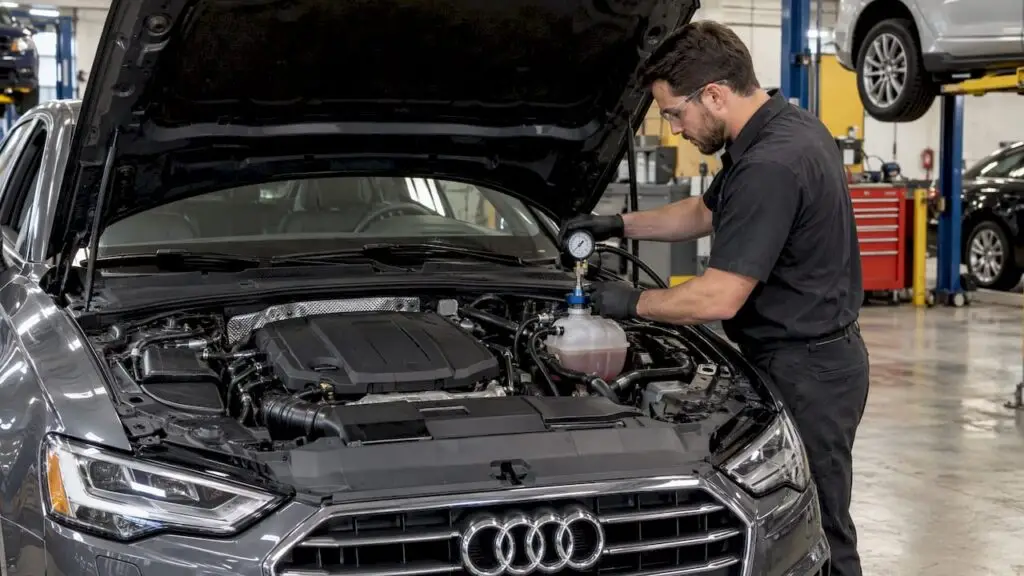
Most Audi cooling system problems start as a slow coolant leak at a plastic part, usually the thermostat housing, water pump or a coolant flange. The first signs are a dropping reservoir level, a sweet smell after parking or a coolant message on the dash. If the warning is red, or the temperature is climbing, stop driving. At Alternative European & Domestic, we diagnose these faults for Dallas drivers before a small leak becomes engine damage.
TL;DR
- A falling coolant level means a leak somewhere, even with no puddle under the car. Audi’s own owner’s manuals treat any coolant loss as a leak to be inspected.
- The usual suspects are the thermostat housing, water pump, coolant flanges and plastic pipes. Which one fails depends on the engine.
- A red coolant warning, steam, or a coolant light together with the alternator light means stop and shut the engine off. Tow it if needed.
- Do not open the expansion tank when the engine is hot. Do not top up an empty tank and drive on.
- Proper diagnosis (pressure testing, not part swapping) is what keeps the repair bill down.
Table of Contents
- What the Audi coolant warning actually means
- What to do in the first few minutes
- Early signs before the warning light
- Common causes by engine and model
- Why guessing at parts gets expensive
- What a proper repair involves
- Preventive maintenance that protects the cooling system
- Cost factors
- Cooling system service at Alternative European & Domestic
- FAQ
- Sources
What the Audi coolant warning actually means
The coolant symbol is not a generic engine light. It reports one of two things: the coolant level is too low, or the coolant temperature is too high. The message wording tells you which.
According to the owner’s manual text for a recent Audi, there are three distinct messages:
| Message | What it means | What to do |
|---|---|---|
| Turn off engine and check coolant level | Level is too low | Do not continue driving |
| Coolant temperature too high, let engine run while stationary | Engine is hot | Let it idle until the indicator goes out |
| Coolant system malfunction, turn off engine | A system fault | Do not continue driving; have it inspected |
A flashing symbol follows the same logic. The A4 owner’s manual says it means the temperature is too high or the level is too low, and tells the driver to stop, switch off the engine, check the level once it is safe, and wait for the symbol to go out before driving on.
The red version is the one that matters most. A red coolant temperature warning means the engine is overheating or the car has detected a fault serious enough to need immediate attention, and the advice is to leave traffic as soon as it is safe, switch off and let the engine cool.
The coolant light and the battery light together
If the coolant light comes on at the same time as the alternator warning lamp, stop at once. Audi’s driver information text explains that the coolant pump is then no longer being driven, which risks engine damage. A broken drive belt is a likely cause. Our guide to battery and charging warning lights explains how that side is diagnosed.
What to do in the first few minutes
The priority is a controlled exit from traffic, then shutting the engine off.
- Signal and pull over as soon as it is safe.
- Switch the engine off and let it cool.
- Do not open the hood if steam or coolant is escaping. The Audi A5 manual warns of scalding risk.
- Do not open the expansion tank cap on a hot engine. The A4 owner’s manual cautions about burns.
- If the tank is empty, do not add coolant and drive on. The same manual says air in the system raises the risk of engine damage, and the Q5 manual says to get professional help instead.
Turning the cabin heater to maximum is sometimes suggested to pull heat off the engine. It is not a repair, and it should never be used to justify finishing the trip.
A clean engine bay also makes it easier to see wet residue and crusty coolant trails when a technician or you look at the car cold. If you wash it, safe engine bay cleaning keeps water away from sensitive connectors.
When to drive and when to tow
Drive only if the message is the mild “temperature too high, let engine idle” type, it clears while the car is stationary, and the shop is close. Tow the car if any of these are true:
- The warning is red or reappears right after you restart.
- You see steam, smell strong hot coolant, or lose cabin heat.
- The car has reduced power.
- The coolant tank is empty.
- The alternator light is on alongside the coolant light.
The cost of a tow is small next to a warped cylinder head or damaged engine.
Early signs before the warning light
The dash message often comes late. Earlier clues include:
- A sweet, syrupy smell after you park, especially from the front of the engine bay.
- A reservoir that needs topping up every few hundred miles.
- White, crusty or pink residue around the thermostat housing, hoses or water pump.
- Cabin heat that is weak or comes and goes.
- A faint mist or steam on a hot day in Dallas traffic.
One point that surprises owners: you can lose coolant without ever seeing a puddle. On VW and Audi engines, a plastic flange or thermostat housing can weep only when hot and pressurized, then seal as it cools, so the drops evaporate off hot parts. Coolant can also escape as steam, into the cabin through the heater system, or into the engine itself.
Common causes by engine and model
Cooling problems are not random. Several Audi engines have well-documented weak points, many of them plastic parts that age with heat cycles.
2.0 TFSI / 2.0T (A3, A4, A5, A6, Q3, Q5, TT)
The thermostat housing and water pump area is the best-known source. An NHTSA technical service bulletin from 2020 covers coolant loss from the thermostat housing or coolant pump on these models:
- A3 (2007–2013)
- A4 (2007–2016)
- A5 (2010–2016)
- A6 (2012–2015)
- Q3 (2012–2018)
- A8 (2013)
- Q5 (2011–2017)
- TT (2009–2014)
An earlier bulletin identifies a leak where the water pump meets the hose to the heater core on 2.0 TFSI A4, A5 Cabriolet, Q5 and A6 models from 2009 to 2013. Our own write-up on Audi thermostat failure covers the symptoms owners notice on this part.
Newer coolant pump complaints
A 2023 bulletin addresses coolant loss attributed to the coolant pump. Its procedure is revealing: photograph the leak, clean and dry the area, fill the system to max, then reassess after driving a few miles before replacing any parts. That is the logic of a careful diagnosis: confirm the source first.
4.0L V8 TFSI (A8, S8, SQ7, SQ8, RS Q8, RS6, RS7)
Audi’s December 2024 bulletin covers overheating and red coolant warnings on these V8 models, including 2019–2021 A8, 2020–2024 S8, 2020–2025 SQ7 and SQ8, 2020–2023 RS Q8 and 2021–2024 RS6 Avant and RS7. It describes the switchable coolant pump and its N649 valve. If coolant is found in the vacuum line or at the N649 connection, the instruction is to replace the pump and the vacuum hose too.
Other patterns
Shop and parts-industry sources also point to coolant leaks on the 3.0 TDI water pump and on 3.0T supercharged engines. Cracked expansion tanks are reported on some B8-generation A4 and Q5 models, and water pump failures on some C7 A6 and A7 cars. Treat model lists like these as pointers. Your own car’s mileage, history and a pressure test decide what is actually failing.
Why guessing at parts gets expensive
The cooling system is a pressurized loop: pump, thermostat, radiator, hoses, heater core, expansion tank, sensors and, on turbocharged engines, extra circuits. A leak at one joint can drip onto another part and mislead you. Replacing the nearest part that looks wet often leaves the real leak in place.
Our shop guide on why shops test before replacing nearby parts on VW-group engines applies to Audi too. The same discipline matters on the BMW side, as in our coolant leak article.
How a proper diagnosis runs
- Verify the loss. Check the level cold, note how much is missing and how fast it goes.
- Read the car. Scan for stored faults and check live coolant temperature data. Dealer-level diagnostics make this step reliable on Audi’s modules.
- Inspect visually. Look for residue, wet spots and cracked plastic at the housing, flanges, hoses and expansion tank.
- Pressure test cold. A cold pressure test is the standard way to expose a leak that only appears hot. The tester pressurizes the system to its rated pressure while the technician watches for seepage. UV dye is an option for very slow losses.
- Trace the source. Leaks run downhill and sideways, so the source sits above the wet spot.
- Look inside if nothing shows. If no external leak exists, coolant may be entering the heater system or the engine, which needs further testing.
The point of all this is accuracy. You pay to fix the part that failed, not the three parts around it.

What a proper repair involves
A repair is more than swapping a housing. Three details separate a lasting fix from a repeat visit.
Use the right coolant. According to an NHTSA-hosted Audi technical background bulletin, model year 2018 and older Audis use G13 coolant, and 2019 and newer use G12evo. G12++ and G13 are fully compatible. Only distilled water should be mixed with coolant, and drained coolant must not be reused. So the answer for a 2018 A4 is G13, mixed to the specified freeze-protection ratio.
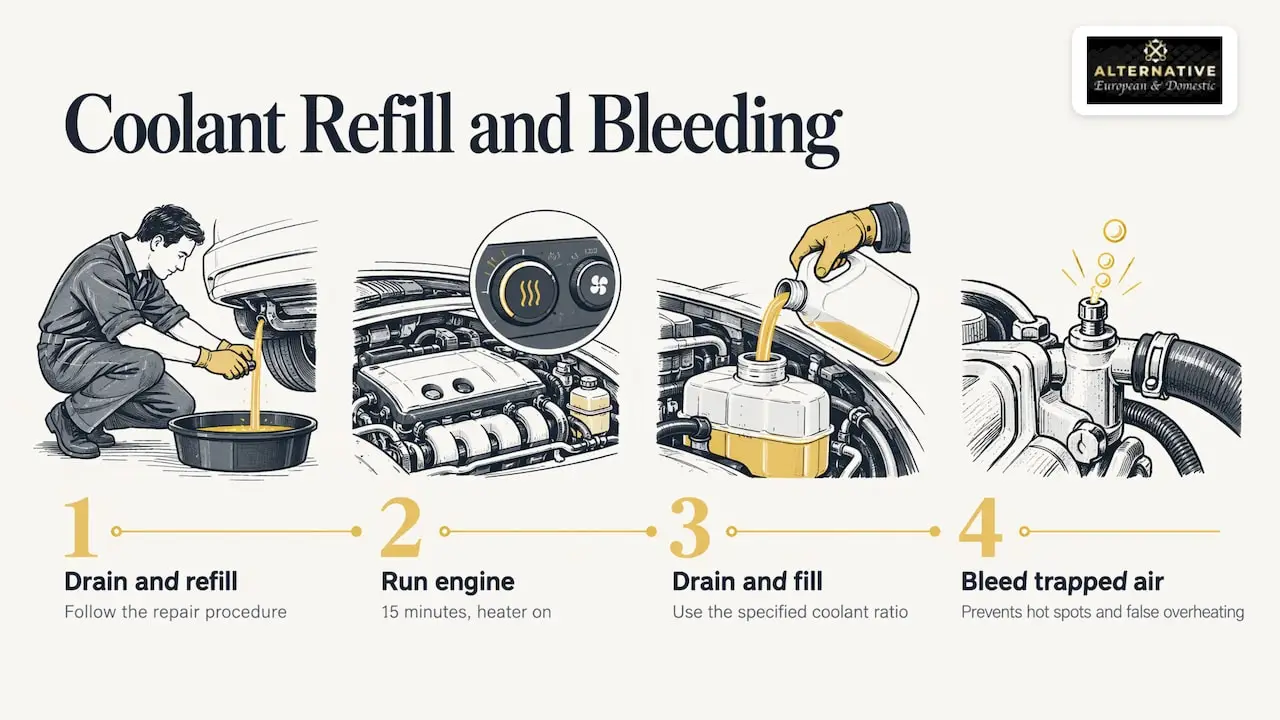
Refill and bleed correctly. The same bulletin describes draining and refilling by the repair manual procedure, running the engine for 15 minutes with the heater on, then draining and filling to the correct ratio. Trapped air causes hot spots and false overheating, which is why bleeding is not a driveway job on most Audis. Factory procedures involve removing covers, opening bleeder screws, filling adapters and holding the engine at set speeds. If the warning returns after a top-up or recent coolant service, have a technician do it.
Replace aging plastic together. When a housing or flange fails from age, nearby plastic connectors and lines have lived through the same heat cycles. Your technician should assess them while the system is open, and explain which ones are worth doing now and which can wait.
Preventive maintenance that protects the cooling system
A quick check is part of routine Audi service. The 2016 Audi maintenance schedule lists a coolant level check, topped up if necessary, within the major service: first at 15,000 miles or two years, then every 20,000 miles or two years. Newer models differ, so follow your own car’s schedule.
Audi’s coolant is also unusual. The same bulletin notes Audi is one of the few manufacturers whose coolant has no fixed change interval. That makes inspection more important, not less, because nothing prompts you to look at it.
Practical habits for Dallas drivers:
- Check the reservoir level cold, once a month, and before long highway trips.
- Watch for coolant smell after parking, especially after stop-and-go traffic on Central Expressway or the Tollway in summer heat.
- Note the temperature gauge on hot days. It should sit steady in the middle.
- Look under the hood for residue when the engine is cold.
- Have the system pressure tested at the first sign of loss, not after the third top-up.
- Keep AC and cooling issues in view together. Our guides on AC cooling intermittently and AC warm at idle cover fan and airflow problems that overlap with engine cooling.
If you are tracking other fluid losses on the same car, see Audi oil consumption causes and testing to keep the two issues separate.
Cost factors
We do not publish fixed prices for cooling repairs, because the bill depends on what the diagnosis finds. The main drivers are:
- Which part failed. A thermostat housing, a water pump with its housing, a set of coolant lines and an expansion tank are very different jobs.
- Engine layout. Parts buried under the intake or other components take more labor to reach.
- How far the problem went. Catching a slow leak early is far cheaper than repairing an overheated engine.
- Collateral parts. Belts, seals, sensors and coolant that must be replaced while the system is open.
- Towing and diagnostic time. Driving a warning light home can turn a housing repair into an engine repair.
A written estimate that separates diagnosis, parts and labor, and explains each recommendation, lets you decide with full information.
Cooling system service at Alternative European & Domestic
If your Audi is losing coolant, running hot or showing a warning, we start with diagnosis: scan, inspection and pressure testing, then a clear explanation of what failed and what the repair involves. Our ASE-certified technicians work on European, domestic and high-performance vehicles, and we use quality parts. Qualifying repairs carry our 24-month/24,000-mile warranty, subject to applicable terms.
You can read about our engine repair services and our maintenance service, which includes customized maintenance plans built around how you drive and how long you plan to keep the car.

If you are in Oak Lawn, Uptown or elsewhere in Dallas, schedule an appointment for a diagnostic evaluation. If the car is overheating right now, do not drive it in.
FAQ
Is it safe to drive an Audi with a coolant warning?
Not if the warning is red, the temperature gauge is climbing, or the message says to turn the engine off. Audi’s manuals tell drivers to stop and shut the engine off for low-level and malfunction messages. Driving on a hot engine can cause head gasket and cylinder head damage.
Why is my Audi losing coolant but there is no leak on the ground?
A small leak at a plastic housing or flange can open only when the engine is hot and pressurized, then close as it cools. The coolant evaporates off hot surfaces. It can also enter the heater system or the engine. A cold pressure test is the way to find it.
What coolant does a 2018 Audi A4 use?
According to Audi’s technical bulletin, model year 2018 and older vehicles use G13, and 2019 and newer use G12evo. Do not mix in tap water, and do not reuse drained coolant. Have the system filled to the specified ratio.
How often should I check the cooling system on my Audi?
Check the reservoir level cold every month, and have the system inspected at every scheduled service. Audi’s coolant has no fixed change interval, so a regular inspection is what catches a slow loss early.
Can I bleed the cooling system myself?
We recommend leaving it to a technician. The procedure varies by engine and uses specific fill adapters, bleeder screws and engine speeds, and air left in the system causes overheating. Safe handling also means never opening a hot expansion tank.
Sources
- NHTSA TSB MC-10185224-0001 (2020), thermostat housing and coolant pump leaks
- NHTSA TSB SB-10053906-2539 (2013), water pump to heater hose leak
- Audi TSB MC-11012482-0001 (2024), 4.0L V8 TFSI overheating
- NHTSA TSB MC-10242918-0001 (2023), coolant pump loss
- NHTSA technical background MC-10176873-0001 (2020), Audi coolant
- 2016 Audi Maintenance Schedule
- Audi owner’s manual coolant messages
- Audi A4 manual, cooling system fault
- Audi A4 auto-check control
- Audi A5 manual, cooling system
- Audi A4 2018 manual, coolant reservoir
- Audi Q5 2018 manual, topping up coolant
- Coolant temperature warning guide
- Losing coolant with no visible leak on a VW or Audi
- Coolant leak on Audi: causes by model and engine