
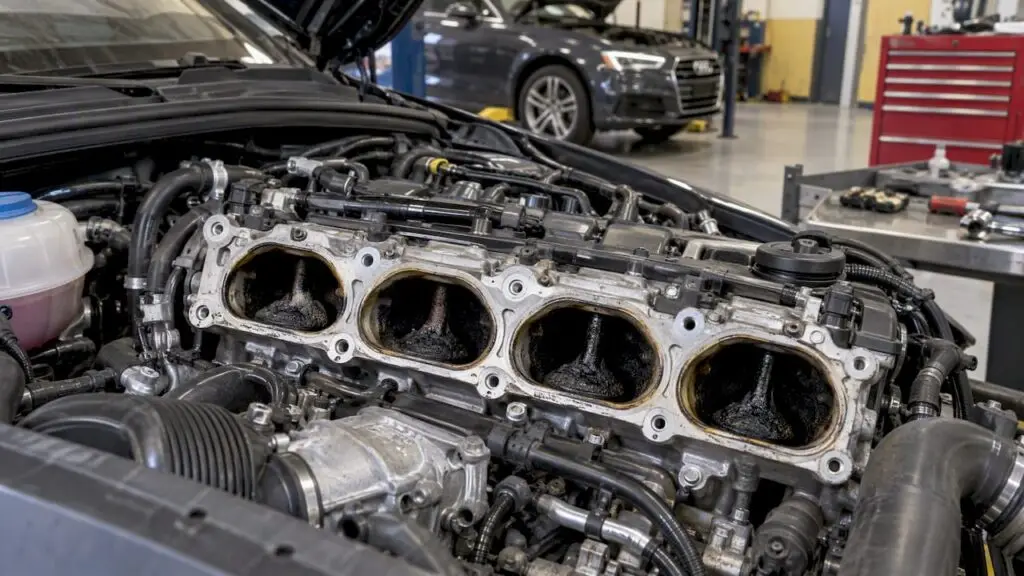
The most common sign of carbon buildup in an Audi is a rough, shaky run right after a cold start, often with a misfire at idle. Other symptoms include hesitation, weaker acceleration, higher fuel use and a check engine light. None of these proves carbon is the cause. Ignition, fuel and air faults look nearly identical, so the only reliable answer comes from a structured diagnosis, ideally with a borescope look at the intake ports. At Alternative European & Domestic, we see this pattern often on direct-injection Audis from drivers across Dallas.
TL;DR
- Carbon forms on the intake valves of Audi direct-injection (FSI/TFSI) engines because fuel no longer washes over them.
- Typical symptoms: rough cold start, misfires at idle, hesitation, reduced power, poorer fuel economy and a check engine light.
- Coils, injectors, leaks and fuel quality cause the same symptoms, so confirm before you pay for a cleaning.
- Walnut-shell cleaning can cost about $1,000 at some shops because the intake manifold has to come off.
- A flashing check engine light or a hard misfire means reduce load and get the car inspected promptly.
Table of Contents
- Why Audi engines build carbon in the first place
- The symptoms of carbon buildup in an Audi
- Symptoms that look like carbon but are not
- How carbon buildup is confirmed
- Secondary air port deposits: a separate Audi issue
- When to stop driving and when to tow
- Audi carbon cleaning: options and what it costs
- Slowing buildup: what is supported
- Carbon service from Alternative European & Domestic
- FAQ
- Sources
Why Audi engines build carbon in the first place
Older port-injected engines sprayed fuel into the intake port, upstream of the valve. That fuel acted as a solvent and rinsed the back of the intake valve every time it opened. Audi’s direct-injection engines, badged FSI and TFSI, inject fuel straight into the combustion chamber instead. According to Automotive Tech Info, fuel never touches the intake valves on these engines, so oil vapor and combustion byproducts that reach the intake side are not washed away and bake onto the valves.
The deposits are mostly a mix of crankcase vapor (oil mist routed back into the intake by the ventilation system) and combustion residue. Over thousands of miles the layer thickens. It disrupts airflow into the cylinder, and in heavy cases it can hold fuel and oil like a sponge, which is why the first symptoms tend to show up when the engine is cold.
This is a design trait of the engine type rather than a sign of neglect. Careful owners get it too. The difference is how early it is caught and how accurately it is separated from other problems.
The symptoms of carbon buildup in an Audi
Symptoms rarely arrive all at once. They usually start mild, often only on cold mornings, and get steadier as deposits build. Automotive Tech Info describes rough running and sporadic misfires, often at idle, with rough running after a cold start as the number one symptom. Vehicle Service Pros lists a wider group associated with carbon in gasoline direct-injection engines.
| Symptom | What you notice | When it usually shows up |
|---|---|---|
| Rough cold start | Shaking or uneven idle for the first minute or so | First start of the day, cool weather |
| Misfires | Stumble, vibration, flashing or steady check engine light | Idle and low load, especially cold |
| Cold stalling | Engine dies shortly after starting | Cold start, before warm-up |
| Hesitation | Delay or flat spot when you press the throttle | Pulling away from a stop |
| Loss of power | Car feels slower than it used to | Under acceleration |
| Reduced fuel economy | More fuel stops for the same driving | Gradual, over months |
| Check engine light | Stored misfire or fuel trim codes | Any time |
What the misfire pattern tells a technician
When the misfire happens matters. A misfire on a cold start, when coolant and ambient temperatures are close together, points toward deposits. A misfire under heavy load points more toward ignition or injector faults. That distinction guides where the diagnosis starts, and it is why we ask you when the symptom appears, not just that it does.

Notes for different Audi owners
The risk applies broadly to direct-injection Audis, including many 2.0 TFSI and 3.0T models. Some engines add port injection alongside direct injection, which keeps the valves cleaner, so not every Audi behaves the same way. We only speak to a specific engine’s tendency when we have confirmed it on the car in front of us.
Symptoms that look like carbon but are not
This is where many drivers lose money. A rough idle and a misfire code can come from several places, and a cleaning performed on a guess may leave the original problem untouched.
Common look-alikes include:
- Worn or failing ignition coils or spark plugs. These produce the same stumble and the same misfire codes. Our guide to coil pack failure covers the signs and costs.
- Fuel injector faults. A weak or leaking injector shifts mixture on one cylinder.
- Vacuum or boost leaks. Unmetered air upsets idle and fuel trims. See our notes on boost leak symptoms for turbocharged cars.
- Low-quality or contaminated fuel. Audi has tied contaminated gasoline or gasoline with low deposit-control additives to rough cold starts, hesitation, rough idle, reduced performance and poor fuel economy, according to a 2023 technical service bulletin filed in the U.S..
- Oil consumption problems. Heavy oil use can foul plugs and add to deposits. We cover causes and testing in Audi oil consumption.
The point from Vehicle Service Pros is worth repeating: a drivability complaint on a direct-injection engine is a system problem. Scan data gives direction, but a technician has to separate air, fuel, spark, compression, pressure control and engine-control commands before pinning the fault on carbon.
How carbon buildup is confirmed
A code reader tells you which cylinder misfired. It does not tell you why. A proper diagnosis follows a sequence.
- Read all fault memory. Audi’s own misfire guidance, in a technical service bulletin, starts with reading every engine control module fault entry and recording the conditions when the fault set.
- Capture freeze-frame data. Temperature, load and engine speed show whether the misfire is a cold-start or a high-load event.
- Reproduce the complaint. The technician tries to recreate the symptom under the same conditions.
- Rule out the cheap suspects. For a misfire on one or two cylinders, swapping the suspect coils and seeing whether the misfire follows the coil can eliminate coil failure, as Automotive Tech Info explains. Our seven-step misfire diagnosis walks through the whole sequence.
- Look at the valves. The same source says carbon buildup can be confirmed by inspecting the intake ports, and a borescope is the tool for that. It is a small camera that goes in through the intake or spark-plug opening so deposits can be seen directly.
- Verify the repair. Audi’s guidance calls for checking the fix under the same speed, load and temperature conditions recorded when the fault set.
This is why professional diagnostics matter. Skipping straight to a cleaning product or a service without these steps risks treating the wrong problem and leaving you with the same light on the dash.
Secondary air port deposits: a separate Audi issue
Carbon does not only collect on intake valves. On certain Audi engines, such as the 3.2L FSI and 3.0L TFSI, deposits can build in the secondary air ports. According to a service bulletin summary covering 2009 to 2013 model years, this can set codes P0491 and P0492 for insufficient secondary air flow.
That case has its own history. Audi of America extended emissions warranty coverage for certain 2009 to 2012 3.2L and 2009 to 2013 3.0T vehicles to cover diagnosis and cleaning of the secondary air ports under specific conditions, for 10 years or 120,000 miles, whichever comes first. Whether your particular car still qualifies depends on its VIN, mileage and the terms of that campaign, so confirm with an Audi dealer before assuming coverage either way.
When to stop driving and when to tow
Mild cold-start roughness that smooths out once the engine warms up is not an emergency. You can drive carefully to a scheduled appointment. Other signs are different:
- A flashing check engine light. This usually signals an active misfire severe enough to send unburned fuel into the catalytic converter, where it can overheat and damage it. Reduce load, avoid hard acceleration and get the car inspected as soon as you can.
- Misfire with shaking, loss of power or a strong fuel smell. Pull over when it is safe and do not keep driving at highway speed.
- Stalling in traffic. Loss of power steering assist and brake booster after a stall is a safety issue. If the car stalls repeatedly or will not stay running, have it towed.
- Oil or coolant warning lights alongside the symptoms. Shut the engine off and arrange a tow.
We do not recommend trying to remove deposits yourself with additive-in-the-intake sprays, pulling the manifold or similar. Intake work on these engines involves fuel system pressure, delicate sensors and the risk of dropping debris into an open port. Our article on when walnut blasting beats DIY intake valve cleaning explains why.

Audi carbon cleaning: options and what it costs
Cleaning is appropriate once a diagnosis shows deposits are affecting how the engine runs, not as a routine add-on at a set mileage for every car.
Walnut-shell blasting
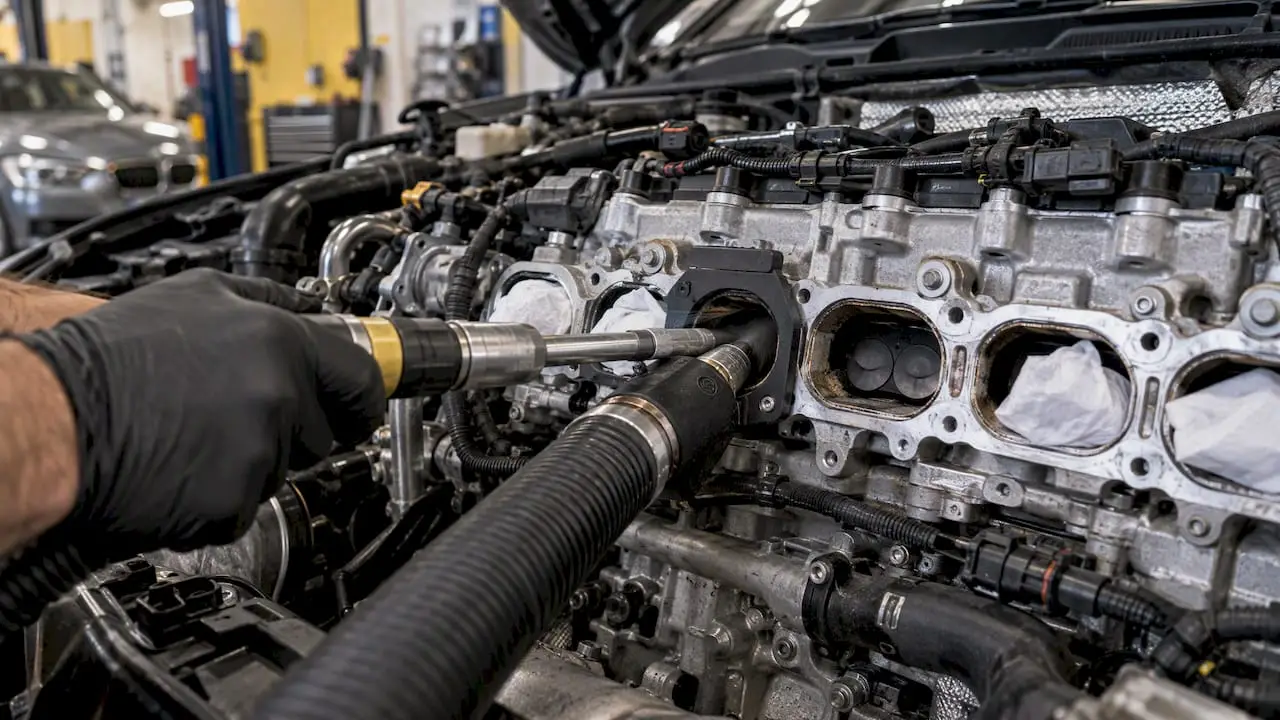
The intake manifold comes off, the valves are sealed from the cylinder, and crushed walnut shell is blown against the deposits and vacuumed out. Walnut shell is hard enough to remove carbon but softer than the metal. Automotive Tech Info states that it produces the best end results for removing carbon without removing the cylinder head.
Chemical intake cleaning
Some shops use a spray or induction service that works through the intake. It involves less labor and generally costs less, but it works on softer deposits and cannot be inspected the way an open port can.
What it costs
Expect cost to track labor. Consumer Reports found that walnut-shell cleaning can run about $1,000 at one shop it contacted, because the intake manifold must be removed, and noted that chemical cleaning may cost less. Prices vary by engine, shop and what else is found.
Factors that move the quote:
- Engine layout and how much must be removed to reach the intake
- Whether the car needs new gaskets, seals or bolts when the manifold comes off
- Whether spark plugs, coils or the PCV system are due at the same time
- Borescope diagnosis time before any cleaning is approved
A good shop gives you the diagnosis findings and the estimate in writing before work starts. Our list of questions to ask a mechanic helps you hold that conversation. Worth asking: will the technician show you the before condition of the valves?
Slowing buildup: what is supported
No maintenance habit stops carbon on a direct-injection engine entirely, because the design causes it. Some habits support a cleaner engine overall.
- Use quality gasoline. Audi’s 2023 bulletin recommends changing the gasoline source if contamination is suspected, and using only TOP TIER detergent gasoline if low deposit-control additives are suspected. Its cited additive addresses injector and combustion-chamber deposits, and intake-valve deposits only in port-injected engines, so it is not a cure for valve carbon in a direct-injection engine.
- Keep oil service on schedule. Clean oil and a healthy crankcase ventilation system reduce what reaches the intake.
- Watch oil consumption. Rising use is a clue worth testing early.
- Avoid constant very short trips. Engines that never reach full temperature stay in the conditions where cold-start symptoms appear.
- Address misfires promptly. Early diagnosis keeps a small issue from becoming a catalytic converter or plug problem.
A customized maintenance plan that tracks mileage, fuel habits and symptoms is the practical way to stay ahead of it.
Carbon service from Alternative European & Domestic
Alternative European & Domestic is a Dallas-area shop that works on European, domestic and high-performance vehicles, with ASE-certified technicians and dealer-level diagnostics. For an Audi with cold-start roughness or an unexplained misfire, we start with the diagnosis, not the cleaning: fault memory, freeze-frame data, ignition checks and, where it applies, a look at the intake ports. You get the findings and a clear recommendation, and you decide.

Repairs that qualify may be covered by our 24-month/24,000-mile warranty, subject to applicable terms. See our full list of services for engine, electrical and maintenance work, or read how we approach intake valve cleaning on European direct-injection cars.
If you drive in Oak Lawn, Uptown or elsewhere in Dallas and your Audi has started running rough on cold mornings, contact Alternative European & Domestic to schedule a diagnostic evaluation.
FAQ
What are the first signs of carbon buildup in an Audi?
The earliest sign is usually a rough or shaky idle after a cold start that smooths out as the engine warms. Occasional misfires at idle, mild hesitation and a gradual drop in fuel economy often follow. Because other faults share these signs, have them diagnosed before assuming carbon.
Can I keep driving with carbon buildup?
Mild symptoms allow careful driving to an appointment, but deposits do not clear on their own. A flashing check engine light, strong shaking, stalling or a loss of power calls for stopping, reducing load and having the car inspected or towed.
How much does Audi carbon cleaning cost?
Walnut-shell cleaning can cost about $1,000 at some shops, according to Consumer Reports, since the intake manifold must be removed. Chemical cleaning may cost less. Your quote depends on the engine, shop and any gaskets or parts needed.
Can a misfire in my Audi be something other than carbon?
Yes. Ignition coils, spark plugs, injectors, air leaks and poor fuel can all cause the same misfire. A technician checks fault memory and freeze-frame data and may swap coils to see if the misfire follows, before examining the intake ports.
How often should an Audi have carbon cleaning?
There is no single interval that fits every engine. Cleaning makes sense when diagnosis shows deposits are affecting performance. A maintenance plan based on your engine, mileage and symptoms is more reliable than a fixed number.
Sources
- Dealing With Audi Carbon Buildup, Automotive Tech Info
- Dealing With Audi Carbon Buildup (PDF), Automotive Tech Info
- Diagnosing Carbon Build Up in GDI Engines, Vehicle Service Pros
- Dealing with GDI, Vehicle Service Pros
- Audi secondary air system carbon accumulation bulletin
- Audi of America emissions warranty extension, NHTSA
- Audi misfire technical service bulletin, NHTSA
- Audi fuel quality technical service bulletin, NHTSA
- What Is Walnut Blasting for Cars?, Consumer Reports