
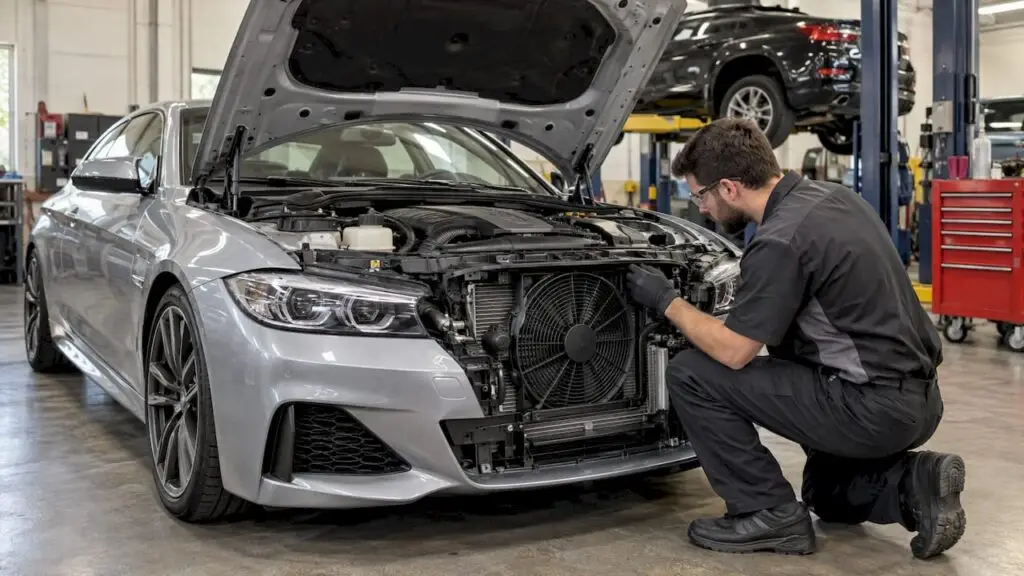
If your car’s AC blows cold, turns warm, then cools again, something is cycling the system off before it should. The usual suspects are a low refrigerant charge tripping the low-pressure switch, moisture freezing inside the system, an iced-over evaporator, a compressor clutch that drops out when hot, or a condenser that isn’t getting enough airflow. Each has a different fix, and intermittent faults often vanish when the car is on the lift. That is why a proper diagnosis matters more than a quick recharge.
At Alternative European & Domestic, we see this complaint on European, domestic and high-performance vehicles from Oak Lawn to Uptown, especially once Dallas heat settles in. This guide explains what is happening behind the vents, what you can safely observe, and how a technician pins the fault down.
TL;DR
- Intermittent cooling means the compressor, refrigerant flow or condenser airflow is being interrupted, then restored. It is not random.
- The most common cause is low refrigerant from a leak. Moisture freezing at the expansion valve, an iced evaporator, a failing clutch and a weak condenser fan are the others.
- Note when it happens (idling, driving, hot day, after a long run). That detail speeds up diagnosis.
- Refrigerant service in the U.S. requires approved equipment and certified technicians, so a can from the parts store is not the answer.
- Book a diagnostic evaluation rather than guessing at parts. We can test the system under the conditions you describe.
Table of Contents
- What intermittent AC cooling actually means
- Common causes, by symptom pattern
- What you can safely check yourself
- How a technician diagnoses an intermittent AC fault
- When to stop driving and when to tow
- Refrigerant types and why certified service matters
- What affects the repair cost
- Prevent intermittent cooling before it starts
- Having your AC diagnosed at Alternative European & Domestic
- FAQ
- Sources
What intermittent AC cooling actually means
A car AC is a sealed loop. The compressor pressurizes refrigerant, the condenser at the front of the car sheds heat, a metering device (an expansion valve or orifice tube) drops the pressure, and the evaporator behind the dash absorbs heat from cabin air. Switches and sensors watch pressure and temperature and can shut the compressor off to protect it.
When cooling comes and goes, one of three things is usually true:
- The compressor is cutting in and out. A pressure switch, a clutch problem or an electrical fault interrupts it.
- Refrigerant flow is blocked temporarily. Ice forms at the metering device or on the evaporator, then melts.
- Heat isn’t leaving the system. The condenser can’t dump heat at idle or in traffic, pressure climbs and the system protects itself.
Professional guidance backs up how broad the list is. The MACS service procedures published by AA1Car list many possible causes of poor cooling, including compressor operation problems, contaminated refrigerant, air in the system, a defective expansion valve, a restricted orifice tube, faulty clutch cycling switches, a clogged evaporator core, a plugged cabin air filter and insufficient condenser airflow. Narrowing that list down is the job of diagnostics.
Common causes, by symptom pattern
The pattern you notice is the best clue. Use this table as a starting point for the conversation with your technician, not as a substitute for testing.
| What you notice | Likely cause | Why it happens |
|---|---|---|
| Cold at first, warm after 10 to 30 minutes, cold again after the AC sits off | Moisture or evaporator icing | Ice restricts refrigerant flow or airflow, then melts when the system is off |
| Cold while driving, warm at stoplights | Weak condenser fan or blocked condenser | Not enough airflow across the condenser at idle |
| Compressor clicks on and off rapidly | Low refrigerant charge | Low-side pressure drops and the switch shuts the compressor off |
| Cold when the engine is cool, warm when hot | Compressor clutch or wiring fault | Clutch air gap or coil resistance changes with heat |
| Cooling fades slowly over weeks, worst on hot afternoons | Slow leak or degrading condenser | Gradual loss of capacity that drivers get used to |
| Cold on one side, warm on the other, or temperature shifts with no pattern | Blend door or actuator fault | Air is mixed incorrectly, not a refrigerant problem |
Low refrigerant from a leak
This is the most frequent cause. The AC is a sealed system, so low refrigerant means there is a leak, at a hose, seal, condenser, evaporator or compressor shaft seal. As the system runs, low-side pressure falls until the low-pressure switch shuts the compressor off. Pressure equalizes, the switch closes, and cooling returns briefly. Our guide on signs and causes of low AC refrigerant covers this in more detail.
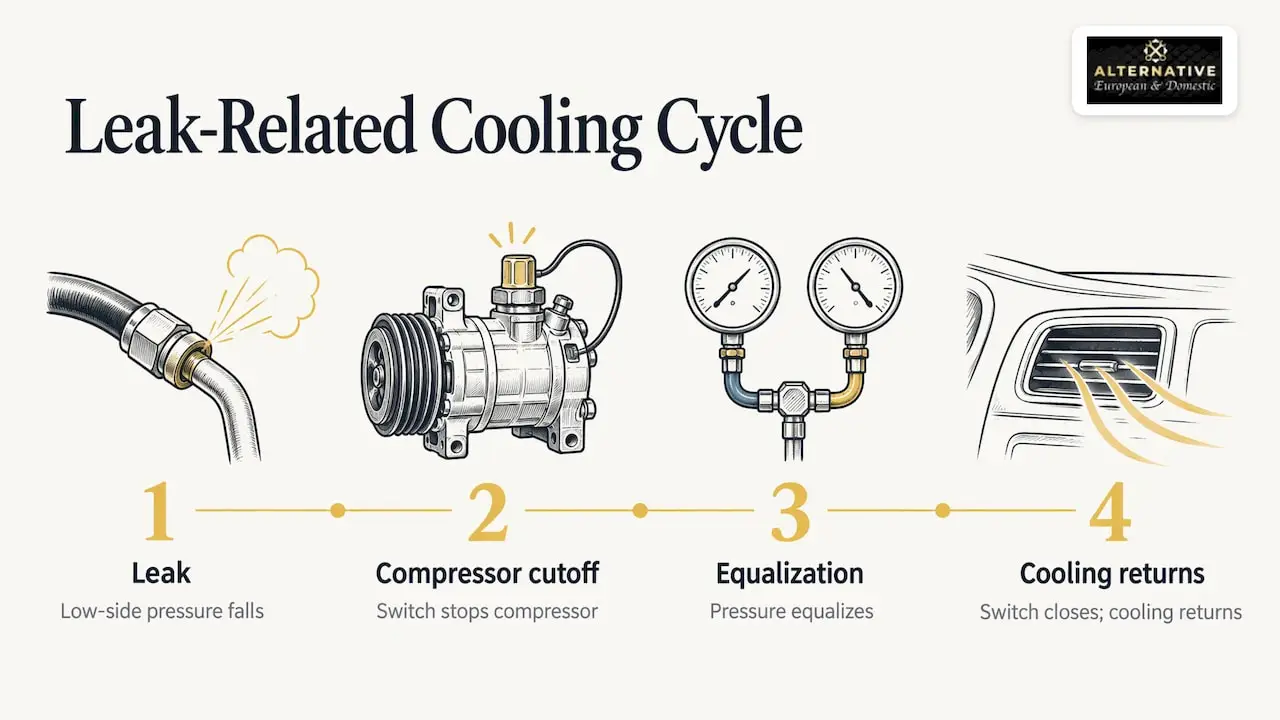
Adding refrigerant without finding the leak only resets the clock. A proper repair locates the leak, replaces the failed part, evacuates the system and recharges to the manufacturer’s specification.
Moisture freezing at the expansion valve
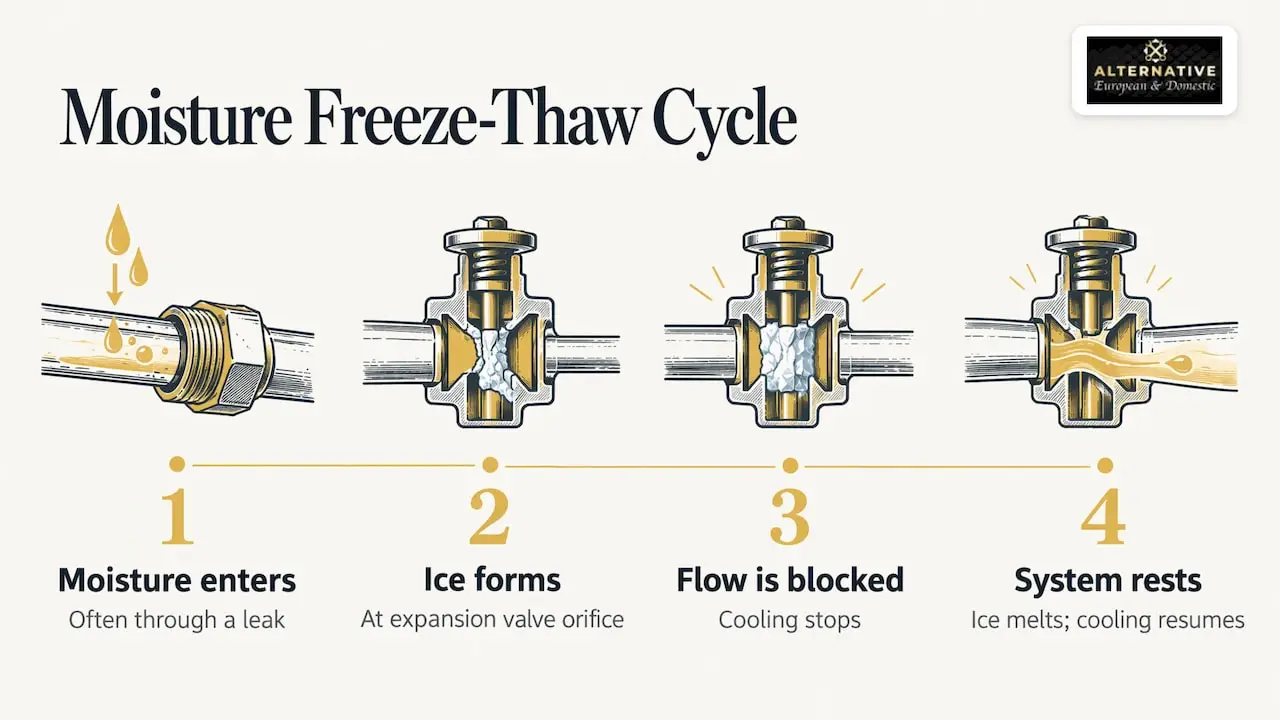
Moisture that gets into the system, usually through a leak, a neglected service or an old receiver-drier, can freeze where the refrigerant pressure drops. The ice plugs the flow, cooling stops, and the plug melts after the system rests. A Toyota service manual entry describes this exact behavior: the system alternates between normal and improper function as moisture freezes at the expansion valve orifice and later thaws. The corrective actions listed are replacing the cooler drier and removing moisture by repeatedly evacuating the system. The principle applies broadly, although the specific parts differ by make.
Evaporator freeze-up
If the evaporator itself ices over, airflow drops and cooling fades, then returns when the ice melts. A dirty cabin air filter, restricted airflow or a refrigerant or control fault can contribute. Cabin filters are inexpensive and are one of the few things worth checking early. On many European models they sit behind the glove box or under the cowl, and replacing them is part of routine maintenance service.
Compressor clutch and electrical faults
The clutch has to engage every time the system calls for cooling. A worn clutch, a widened air gap, a weak coil, a corroded connector or a bad relay can let it work cold and drop out as parts heat up. Vehicle Service Pros describes using a current probe and lab scope on a clutch circuit, where a late “pintle bump” in the current ramp points to an air gap issue that stops the clutch from engaging even when current flow looks normal. A basic multimeter would miss that, which is why we pair AC work with advanced electrical diagnostics. Our article on AC compressor symptoms lists what else to watch for.
Weak condenser fan or blocked condenser
The condenser needs airflow. At highway speed the car supplies it. At idle, the electric fan has to. When the fan, its relay or its wiring fails, pressure climbs at idle and the system can cut out. AutoZone explains that modern systems use high-pressure cutoff switches that shut the compressor down when pressure rises too far, and a blocked condenser can drive that pressure up so the AC stops and then returns minutes later.
If your AC is mainly warm when stopped, see our shop guide to AC that runs warm at idle.
Airflow direction matters too. ALLDATA notes that repairs have been made with electric fans wired backward or incorrect fans fitted, and the opposing airflow cancels out when the car moves. That is one more reason to have fan and wiring repairs done by a shop that verifies the result.
Not a refrigerant problem at all
Sometimes the temperature wobbles because a blend door actuator is moving the door unpredictably, not because the cooling circuit is failing. If the compressor runs steadily and the air temperature changes between sides or with no pattern, see how to test a blend door actuator before replacing anything.
What you can safely check yourself
You do not need tools for the most useful observations. Write these down before your visit:
- When it happens: at idle, at speed, after 20 minutes, only on hot days, only after the car has been parked in the sun.
- How long it lasts: does shutting the AC off for 20 to 30 minutes bring the cold back? That points toward icing.
- Sound and sight: does the compressor clutch click on and off repeatedly under the hood? Does the radiator or condenser fan spin when the AC is on?
- Airflow: is the blower strong but the air warm, or has airflow itself dropped? Weak airflow suggests a filter or evaporator problem.
- Smells and moisture: a musty smell, or water pooling inside the cabin, suggests a different issue than refrigerant loss.
- Recent work: any previous AC service, collision repair or front-end work.
That is where DIY stops. Do not open the system, add stop-leak products or probe wiring. Federal rules say that no person servicing a motor vehicle air conditioner for consideration may perform refrigerant service without approved equipment and proper training and certification. Refrigerant is also pressurized and can cause injury, and venting it is not allowed.

How a technician diagnoses an intermittent AC fault
Intermittent problems are harder than constant ones. Vehicle Service Pros states that the technician has to confirm the fault under the conditions the customer experiences, because the system can work in some conditions and fail with small changes in ambient temperature or driving conditions. That is why your notes help so much.
A typical diagnostic path looks like this:
- Interview and duplicate the complaint. We ask when it happens and try to reproduce it, sometimes with a longer run time or specific engine speed.
- Visual inspection. Condenser fins and debris, fan operation, belt and clutch condition, oily residue at fittings that suggests a leak, and the cabin air filter.
- Static pressure check. ALLDATA notes that with the system off at normal room temperature, both sides should read about 70 to 80 PSI on a properly charged system. A very low reading points to lost refrigerant.
- Running pressures and temperatures. Vehicle Service Pros says outlet vent temperature on most vehicles is about 30 degrees F or more below ambient on a healthy system, and the condenser should show a 20 to 50 degree F drop from inlet to outlet. Above 50 can suggest low charge, below 20 can suggest insufficient airflow.
- Touch and thermal checks. ALLDATA explains the low-pressure side should be cold and the high-pressure side hot. Cold spots on the high side suggest a restriction, while warm low-side hoses can mean a charge problem, a stuck expansion valve or a control fault.
- Electrical testing. Clutch current, relay and switch operation, and wiring checked while the fault is happening. A lab scope shows how a circuit behaves over time, which a basic meter cannot show.
- Leak detection. Dye, electronic detection or pressure testing to find where refrigerant is escaping.
One caution: intermittent faults can disappear during inspection, so sometimes the answer comes from monitoring pressures and compressor cycling over a longer drive. Expect your technician to ask to keep the car for a while, or to ask you to bring it in when the problem is active.
When to stop driving and when to tow
Most AC faults are a comfort issue, not a safety one, and you can drive the car while you arrange service. Some situations are different:
- Stop driving if the engine temperature gauge climbs, a warning light comes on, or you smell burning or hot electrical odors. A seized compressor or a slipping belt can affect the cooling system and charging system.
- Stop driving if the serpentine belt squeals loudly, shreds or comes off. That belt may also drive the water pump and alternator.
- Consider towing if the compressor makes grinding or loud knocking noises, or if you see smoke from under the hood. Continuing to run a failing compressor can spread debris through the system and turn a single-part repair into a larger one.
- Turn the AC off and have the car checked if the clutch repeatedly cycles rapidly. It protects the compressor while you wait for an appointment.
- Stay safe in the heat. If the AC fails on a Dallas summer afternoon, never leave children, pets or vulnerable adults in a parked car, even briefly.
Refrigerant types and why certified service matters
Most vehicles from model year 1994 through 2020 use R-134a, and newer ones increasingly use a different refrigerant. The Washington State Department of Ecology notes that starting in 2026, new passenger vehicles in the U.S. no longer use R-134a, and owners of vehicles with R-134a systems will need to see EPA Section 609 certified mechanics for service. Using the wrong refrigerant, mixing types or overcharging can damage components and create its own cooling problems.
This matters for European and high-performance cars, where systems can be tightly packaged and charge capacities are small and specific. A few ounces over or under can change how the system behaves, and an exact charge by weight is part of doing the job correctly.
What affects the repair cost
We do not publish AC repair prices because the bill depends on what the diagnosis finds. The main factors are:
- The failed component. A relay or cabin filter is a small repair. A condenser, evaporator or compressor is not, and an evaporator often means removing the dash.
- Labor time. Access varies widely between vehicles. Some condensers are behind bumper covers, and some evaporators take hours to reach.
- Refrigerant type and quantity. Newer refrigerants and larger charge capacities cost more.
- Related parts. When a compressor fails, the receiver-drier or accumulator and metering device are typically replaced and the system flushed as needed.
- Parts quality. We use quality parts, and the choice affects how long the repair lasts.
The diagnostic step is where money is saved. Replacing a compressor when the real fault was a $20 relay, or recharging a leaking system three summers in a row, costs more than finding the cause once. Our guide to questions to ask a mechanic can help you get findings and estimates in writing.
Prevent intermittent cooling before it starts
A few habits keep systems healthy, especially in a hot climate:
- Run the AC briefly year-round so seals stay lubricated.
- Replace the cabin air filter on the schedule in your owner’s manual, sooner if you drive in dusty or heavy-traffic conditions.
- Keep the condenser area clear of leaves, road debris and bugs, and have it inspected after front-end impacts.
- Address a slow loss of cooling early. AutoZone points out that a failing condenser usually degrades gradually, so drivers adjust expectations for months before noticing. If the car takes longer to cool than it used to, that is the time to have it looked at.
- Include the AC system in your regular inspections. We build customized maintenance plans around how you drive and what you own.
Having your AC diagnosed at Alternative European & Domestic
If your cooling comes and goes, we start with your description, then test the system under the conditions that cause the fault. Our ASE-certified technicians work on European, domestic and high-performance vehicles, and our Auto A/C Repair & Service covers leak finding, electrical and mechanical diagnosis and repair. Qualifying repairs may be covered by our 24-month/24,000-mile warranty, subject to applicable terms.

If you are not sure whether the problem is refrigerant, airflow or electrical, our guide on why your car AC isn’t cold is a good next read. When you are ready, schedule an appointment and tell us when the cooling drops out. Drivers in Oak Lawn, Uptown and the surrounding Dallas neighborhoods can bring the car in for a diagnostic evaluation before the next heat wave.
FAQ
Why is my car AC only cold sometimes?
The system is being interrupted, then restored. Low refrigerant tripping the low-pressure switch, ice forming at the expansion valve or evaporator, a clutch that drops out when hot, and poor condenser airflow are the usual causes. The timing of the symptom tells a technician where to look first.
Why does my car AC work and then stop, and come back after I turn it off?
That pattern often points to icing. Moisture or a freezing evaporator restricts flow or airflow, and the ice melts while the AC is off. It can also be a pressure switch protecting the system. Either way, it needs diagnosis, because moisture in the system usually means a leak or aged parts.
Is it safe to drive with intermittent AC?
Usually yes, if the engine temperature stays normal and there are no grinding noises, burning smells or belt problems. If any of those appear, stop driving and consider a tow. Turn the AC off if the compressor is cycling rapidly.
Can I just add refrigerant when it stops cooling?
We don’t recommend it. A low charge means there is a leak, and the charge amount matters. Federal rules require approved equipment and certified training for refrigerant service on vehicles, so a certified shop should handle it.
How long does an AC diagnosis take?
It depends on whether the fault shows up on demand. A constant fault can be found quickly, while an intermittent one may require running the car under specific conditions or monitoring pressures over time. Your notes on when it happens help shorten that.
Sources
- MACS Recommended Service Procedures (AA1Car)
- Toyota RAV4 air conditioning service information
- Diagnosing an A/C issue on a 2003 Honda Civic (Vehicle Service Pros)
- Signs of a Bad or Failing A/C Condenser (AutoZone)
- No sweat: AC troubleshooting (ALLDATA)
- 40 CFR Part 82 Subpart B, Servicing of Motor Vehicle Air Conditioners (eCFR)
- Addressing an intermittent A/C issue (Vehicle Service Pros)
- Small cans of refrigerant (Washington State Department of Ecology)