
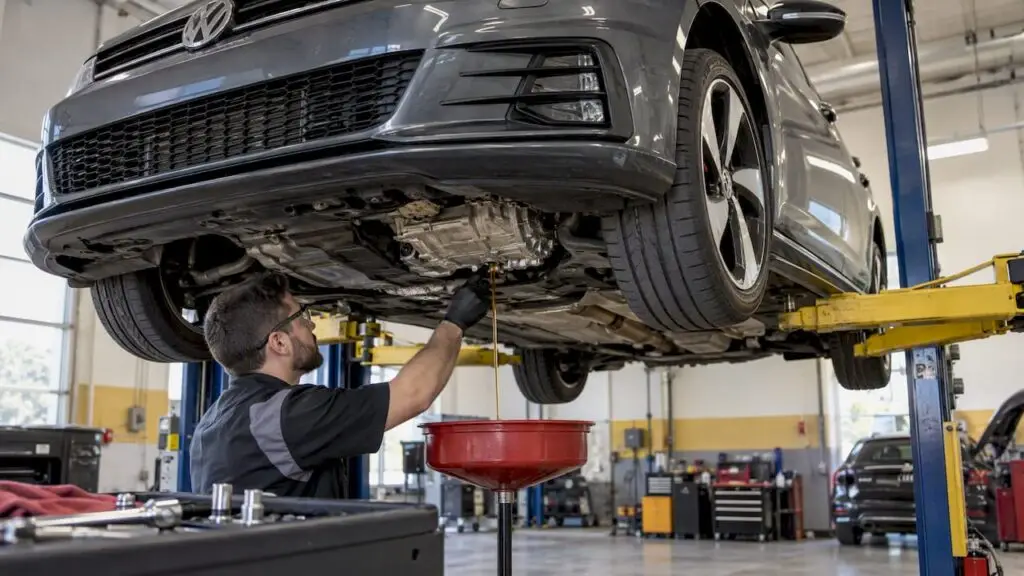
There is no single dual-clutch service interval. Official U.S. schedules range from a fluid and filter service at 20,000 miles on some Ford models to 60,000 miles on a 2019 Infiniti QX30, and many Volkswagen DSG units fall at 40,000 miles. The right number depends on your vehicle’s year, model and transmission code, so start with the owner’s manual or the manufacturer’s maintenance schedule, then adjust for how you drive. At Alternative European & Domestic, we confirm the interval against your exact transmission before we quote any service.
TL;DR
- Dual-clutch intervals vary by manufacturer and by transmission code. Published U.S. figures run from 20,000 to 80,000 miles.
- Many wet-clutch Volkswagen DSG units list a 40,000-mile fluid and filter service. Some newer units list 80,000 miles, and at least one dry-clutch unit lists none.
- Haldex all-wheel-drive clutch fluid is on its own schedule. Volkswagen’s U.S. schedule lists every 3 years for applicable vehicles.
- Heat, towing, track days and stop-and-go traffic age transmission oil faster, so shorten the interval if that describes your driving.
- Shifting that is clunky, slipping or a dashboard warning calls for diagnosis, not just a fluid change.
Table of Contents
- Why dual-clutch fluid service matters
- What manufacturers actually publish
- DSG service interval by transmission code
- Haldex all-wheel-drive fluid and filter
- ZF 8HP fluid change interval
- Shorten the interval if your driving is hard on fluid
- Signs the transmission is asking for attention
- What affects the cost of a DCT service
- DCT service at Alternative European & Domestic
- FAQ
- Sources
Why dual-clutch fluid service matters
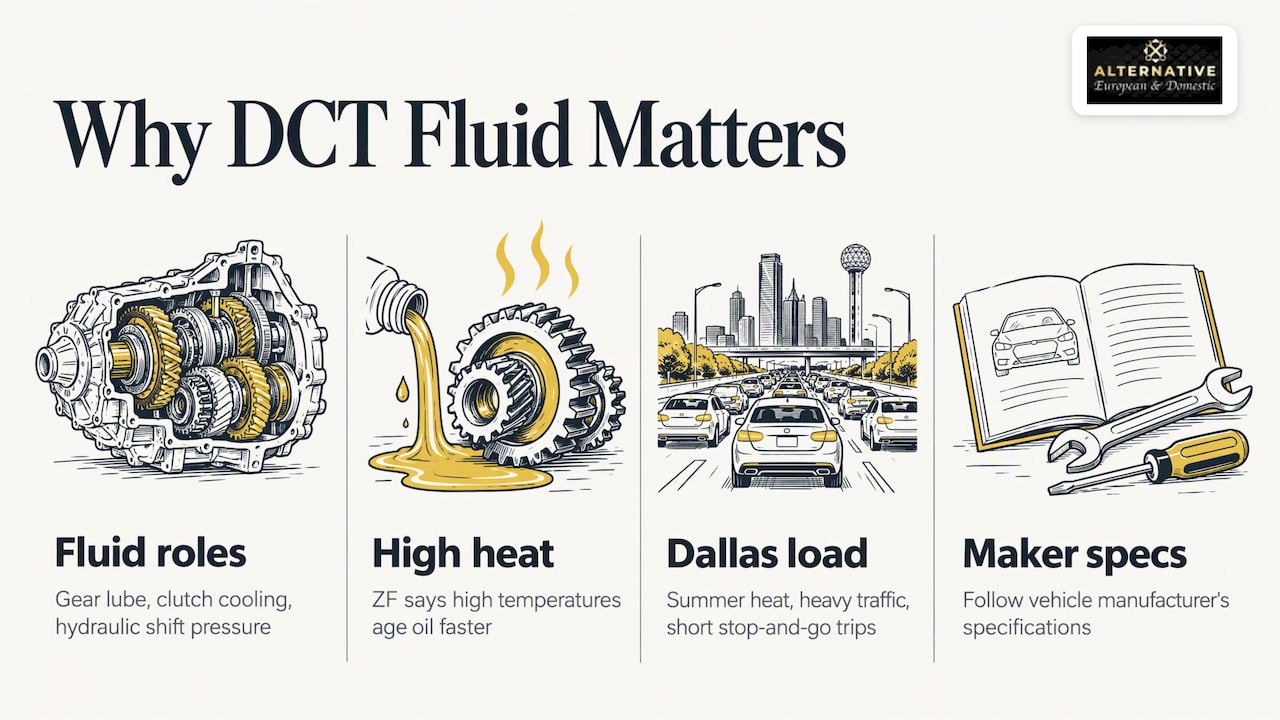
A dual-clutch transmission (DCT, called DSG on Volkswagen and Audi vehicles) uses two clutches and an automated gearbox. In a wet-clutch design, the fluid does several jobs at once: it lubricates gears, cools the clutches and carries the hydraulic pressure that the control unit uses to shift. Heat is the enemy of all of that.
ZF, which builds the 8HP automatic used by many European brands, states that transmission oil ages faster at very high operating temperatures and recommends following the vehicle manufacturer’s specifications. Dallas adds its own load: long summer heat, heavy traffic on the North Central Expressway and Dallas North Tollway, and plenty of short stop-and-go trips around Uptown and Oak Lawn. Those conditions hold temperatures high and shifts frequent.
What manufacturers actually publish
The numbers below come from manufacturer schedules and are listed for the specific model and year named. Do not apply one row to a different car.
| Vehicle or transmission | Published interval | Source type |
|---|---|---|
| 2024 Nissan GT-R | Replace DCT oil every 36,000 miles; inspect every 12,000 miles or 12 months, standard and severe | Nissan U.S. schedule |
| 2019 Infiniti QX30 | Replace DCT oil and filter every 60,000 miles or 60 months, standard conditions | Infiniti U.S. schedule |
| Ford (owner-manual schedule, 2021) | Side-filter replacement and fluid top-off at 20,000 miles; fluid and side-filter replacement at 40,000 miles | Ford owner manual |
| Volkswagen DSG 02E, 0D9, 0DD | Fluid and filter service every 40,000 miles, if applicable | VW U.S. schedule (2013) |
| Volkswagen DSG 0GC | Service at 80,000 miles | VW U.S. schedule (2013) |
Sources: Nissan’s 2024 GT-R schedule, Infiniti’s 2019 QX30 schedule, Ford’s scheduled maintenance page and Volkswagen’s U.S. service schedule.
Three things stand out.
- Inspection and replacement are different steps. Nissan separates a 12,000-mile inspection from the 36,000-mile replacement. An inspection checks fluid level and condition. It does not refresh the fluid.
- Intervals differ inside one brand. Ford’s schedule shows partial service steps at 20,000 miles and a fuller service at 40,000. Ford also says the original owner manual for your vehicle is the primary source.
- Severe conditions do not always change the number. Nissan lists the same figures for standard and severe use, which is a reminder to read your own schedule rather than assume.
For the track-capable owner, the GT-R figure is a useful anchor. If you drive a performance car and want a wider view of keeping a high-value vehicle in shape between services, a luxury car maintenance checklist covers the routine items worth tracking alongside the transmission.
DSG service interval by transmission code
Volkswagen Group dual-clutch units are the ones Dallas European-car owners ask about most. The interval follows the transmission code, not the model name. The code is on the transmission and in your service records.
- DQ250 (02E) and DQ500 (0BH): TPS lists 40,000-mile services for these wet-clutch units. Volkswagen’s U.S. schedule matches this for 02E.
- DQ381 (0GC): Volkswagen’s U.S. schedule lists 80,000 miles, and TPS describes it as a fluid-only service. FCP Euro notes that some newer front-wheel-drive Volkswagen models with this unit specify the longer 80,000-mile interval.
- DQ200 (0CW): TPS lists no service interval for this dry-clutch unit. It has no wet-clutch fluid change in the same sense, but that does not mean it needs no attention. Shift quality and fault codes still matter.
The 2013 schedule is old, and Volkswagen has updated fluid specifications and intervals on newer models. Treat it as a guide to how codes map to intervals, and confirm against the current schedule for your model year.
What a proper DSG service includes
A wet-clutch service is more than draining and refilling. Expect these steps:
- Scan for stored faults and check adaptation values before touching anything.
- Drain the fluid and replace the filter where the unit has a serviceable one.
- Refill with the fluid specification for that transmission code, at the correct fluid temperature and level.
- Road test and confirm shift quality, then clear and recheck for faults.
The level procedure is temperature-sensitive on these units, which is one reason we do not suggest driveway fluid changes. Overfilling or underfilling can damage clutches. This is work for a shop with the right scan tools and fluids.
Haldex all-wheel-drive fluid and filter
Many Audi, Volkswagen and some Volvo and Land Rover models with transverse engines use a Haldex coupling to send power to the rear axle. It is a separate fluid system from the transmission, and owners often miss it because it is not part of the dual-clutch service.
- Fluid: Volkswagen’s U.S. schedule lists an AWD clutch fluid change every 3 years for applicable vehicles. It is time-based, so a low-mileage car still comes due.
- Filter: Ravenol recommends changing Haldex fluid every 60,000 km (about 37,000 miles), replacing the Haldex oil filter and cleaning or replacing the oil-pump pre-filter at the same visit.
Those two figures come from different sources with different bases, so use the shorter one that applies to your car unless the manufacturer’s schedule for your exact vehicle says otherwise. Our team often suggests doing the Haldex service at the same visit as the DSG service when both come due, because it saves a second trip and a second set of fluid-handling charges.
Related drivetrain fluids have their own schedules too. Our shop guide to differential fluid intervals and the article on BMW transfer case service cover those.
ZF 8HP fluid change interval
The ZF 8HP is a conventional torque-converter automatic, not a dual-clutch, but the questions are similar and it shows up in BMW, Audi, Jaguar Land Rover, Dodge, Jeep and other vehicles we see in Dallas.
What ZF publishes is guidance, not one mileage figure:
- ZF says to observe the vehicle manufacturer’s specifications and notes that oil ages faster during high-speed trips, towing or sporty driving.
- ZF supplies oil-change kits for the 8HP, and its 2026 release says regular oil changes reduce wear and breakdown risk.
Some manufacturers label this fluid as lifetime fill. That label describes the factory’s assumed service life, not a promise that the fluid will never degrade. If you tow, drive hard or keep a car well past 100,000 miles, ask a technician to check fluid condition and review the transmission data before deciding. We follow the specification for your vehicle and the fluid ZF lists for the unit.
Shorten the interval if your driving is hard on fluid
Manufacturers publish a normal schedule and sometimes a severe one. Consider the shorter path when you:
- Drive mostly short trips or heavy stop-and-go traffic.
- Tow a trailer or carry heavy loads.
- Run track days, autocross or spirited canyon-style driving.
- Have tuned the engine or transmission software, which raises torque and heat.
- Bought the car used with no service records.
On that last point, FCP Euro suggests servicing a newly acquired DSG within its service-mileage window when the history is unknown, calling it inexpensive insurance. We agree with the logic: a known fluid age is better than a guess.
Signs the transmission is asking for attention
FCP Euro describes DSG problems that can include clunky or hard shifting, flywheel-related noise, dashboard faults from Mechatronic failures and slipping. In practice, watch for:
- Harsh or delayed engagement when pulling away from a stop.
- Shudder or judder at low speed.
- Flares in engine speed between shifts.
- Whining, grinding or rattling at idle or in particular gears.
- A transmission warning light, or the car dropping into limp mode.
These symptoms can come from old fluid, but also from worn clutches, a failing Mechatronic unit or a sensor fault. Changing fluid will not fix a mechanical failure, which is why a scan and test drive come first. Our guides on Mechatronic unit failure and limp mode causes explain what we look for.
When not to drive the car
Stop driving and call for a tow if the transmission will not engage a gear, slips badly under load, makes grinding noises, leaks fluid in quantity, or the car goes into limp mode on a highway where you cannot keep pace with traffic. Continued driving can turn a repairable fault into a transmission replacement and puts you at risk in traffic. If the warning light is on but the car drives normally, book a diagnostic soon and avoid hard acceleration until it is checked.
What affects the cost of a DCT service
We do not publish a flat price for transmission service, because the work depends on the car. These factors drive the quote:
- Fluid capacity and type: Some dual-clutch units hold several quarts of a specific fluid, and the specification matters.
- Filter and gasket or seal needs: Some services include a filter, a pan or a side filter, and some do not.
- Service scope: A fluid-only service, a fluid and filter service and an inspection are different jobs.
- Vehicle accessibility: Some units need lifting or underbody panels removed.
- Condition findings: A scan may reveal a fault that needs separate repair.
We give a written estimate after identifying your transmission code. For questions worth asking any shop before you approve work, see our guide to questions to ask a mechanic.
DCT service at Alternative European & Domestic
Alternative European & Domestic services European, domestic and high-performance vehicles for Dallas drivers, including those in Oak Lawn, Uptown and nearby neighborhoods. Our ASE-certified technicians start with dealer-level diagnostics, confirm your transmission code and the manufacturer’s interval, and explain what we find before any work begins. Qualifying repairs carry our 24-month/24,000-mile warranty, subject to applicable terms.
See our transmission repair and service page or our maintenance service page, or schedule an appointment for a diagnostic evaluation or fluid service.
FAQ
How often should a DCT be serviced?
It depends on the vehicle. Published U.S. schedules include 36,000 miles for a 2024 Nissan GT-R, 60,000 miles for a 2019 Infiniti QX30, and 40,000 miles for several Volkswagen DSG codes. Check your owner’s manual or the manufacturer’s schedule for your model year and transmission, and shorten the interval for heat, towing or track use.
Is 100,000 miles too late to change transmission fluid?
Not automatically, but do not assume it is harmless either. We have no published figure that sets a cutoff, so the sensible step is an inspection first: a technician checks fluid condition, scans for faults and evaluates shift quality. If the transmission is already slipping or shuddering, fluid alone may not solve it, and the findings decide whether service or repair is the right next step.
Do Haldex and DSG services happen at the same time?
Not necessarily. They are separate fluid systems on separate schedules. Volkswagen’s U.S. schedule lists the AWD clutch fluid change every 3 years for applicable vehicles, while many DSG units list 40,000 miles. We often combine them when both are due to save you a second visit.
Can I change dual-clutch fluid myself?
We do not recommend it. Fluid level on many units is set at a specific temperature with a scan tool, and the wrong fluid or fill level can damage the clutches. The transmission should also be scanned before and after service, which a basic home setup cannot do.
Sources
- 2024 Nissan GT-R dual-clutch transmission oil schedule
- 2019 Infiniti QX30 dual-clutch transmission oil and filter schedule
- Ford scheduled maintenance, owner manual
- Volkswagen U.S. service schedule
- DSG servicing, TPS
- DSG transmissions explained, FCP Euro
- Haldex fluid, Ravenol AWD-H
- ZF service information
- ZF oil change kits in brief
- ZF transmission oil change kit range
- Luxury car maintenance checklist