
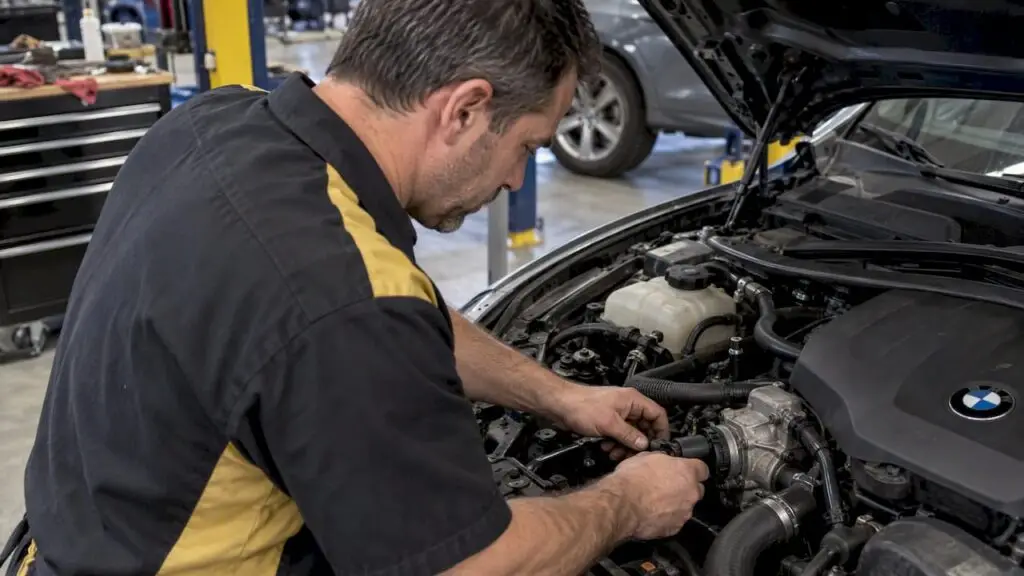
If your BMW shows a temperature warning, coolant puddles, a whining noise near the engine, or any combination of these at once, a water pump failure is a likely cause and you should stop driving if you see active overheating, steam, or smoke. Check coolant level when the engine is cold, note exactly when symptoms appear, and schedule diagnostics right away.
TL;DR:
- A failed pump can stop coolant circulation entirely, risking head gasket failure or warped cylinder heads; isolated leaks without temperature changes warrant inspection within days.
- Electric pumps can stop circulating coolant without a whine or visible leak, so an apparently normal gauge does not rule out sudden overheating.
- Codes 2E82, 2E84, and 2E85 may reflect fuse, connector, or ground faults, so shops should test power and pump activation before replacing parts.
- Check coolant only after the engine cools, inspect for residue or puddles, and record when symptoms occur; never open a warm coolant cap.
- Check your VIN against BMW USA’s open water pump connector recalls; eligible vehicles may receive a remedy at no cost.
Table of Contents
- Common symptoms owners see with BMW water pump problems
- What causes BMW water pump failure and the risk factors
- How serious is a water pump failure and when should you stop driving
- Owner-level checks you can do safely before calling a shop
- Shop-level diagnostics: OBD codes, electrical checks, and bleeding procedures
- Repair options and what a correct repair includes
- Maintenance and prevention: reducing risk and extending pump life
- What our shop sees with BMW water pump failures
- Schedule a BMW water pump diagnostic appointment
- FAQ
- Sources
Common symptoms owners see with BMW water pump problems
Water pump failure in BMW vehicles rarely announces itself with one obvious sign. Most owners notice a cluster of symptoms that build over days or weeks, though some electric pumps fail abruptly with little warning. Recognizing the pattern early can mean the difference between a straightforward pump replacement and a damaged engine.
- Coolant puddles under the front of the vehicle or a coolant level that keeps dropping between fill-ups
- Dried coolant residue or a crusty buildup near the pump housing or front timing cover
- A high-pitched whine or grinding sound from the engine bay, often louder when cold and changing as the engine warms
- Sudden or intermittent temperature gauge spikes paired with erratic cooling fan behavior
- A coolant warning light or a stored fault message in the instrument cluster, sometimes with no obvious external symptom at all
- Steam, a burning smell, or visible smoke from under the hood, which calls for an immediate stop
That last pattern deserves special attention on BMW models equipped with an electric water pump. Because the pump runs on its own control circuit rather than a belt, it can stop circulating coolant with almost no warning, producing what technicians sometimes call a silent overheat. The temperature gauge can look normal one moment and climb rapidly the next, since there is no mechanical squeal or belt slip to tip you off beforehand. This is part of why BMW’s own technical training documentation treats the electric pump’s integrated electronics as a distinct failure category from the shaft seal and bearing wear that affect older mechanical pumps.
If you have already noticed unusual coolant consumption, our guide on BMW coolant leaks and dealer diagnostics covers how a leak at the pump can be distinguished from leaks at hoses, the expansion tank, or the heater core.
What causes BMW water pump failure and the risk factors
BMW water pump failure traces back to a handful of well-documented mechanical and electrical weak points, and the cause often shapes how urgent the repair is.
- Electric pump electronics can fail internally or develop a connector issue that creates a short hazard, which is the basis for a known BMW recall on certain models
- Shaft seals and bearings in mechanical pumps wear gradually, allowing a slow coolant seep that starts well before any visible leak
- A built-in leakage retention chamber on many mechanical pump designs holds escaped coolant until it evaporates, which means a pump can be leaking internally for some time before you ever see a drop on the ground
- Heat-soak cycles, frequent stop-and-go driving, old or contaminated coolant, and simple mileage and age all shorten pump life
- Improper bleeding after a coolant service, or the use of a poor-quality replacement part, can introduce air pockets or premature wear that brings on a repeat failure
A thermostat that sticks can produce overlapping symptoms, and our page on diagnosing a thermostat stuck open walks through how to tell the two problems apart before assuming the pump is at fault.
How serious is a water pump failure and when should you stop driving
A failed water pump is one of the more serious cooling system problems a BMW can develop, because it removes the engine’s ability to circulate coolant at all rather than just reducing efficiency. Once circulation stops, heat builds quickly in the cylinder head and block, and continued driving risks head gasket failure or warped cylinder heads, repairs that cost far more than the pump itself.
If you see the temperature gauge climbing rapidly, steam or smoke from under the hood, or a coolant warning paired with an active overheat, pull over as soon as it is safe and arrange a tow rather than trying to drive to a shop. A slow leak, an intermittent whine, or a warning light that appears without any temperature change is less urgent. These can usually be scheduled for inspection within a few days, as long as you keep an eye on coolant level in the meantime and avoid long highway runs.
Owner-level checks you can do safely before calling a shop
A few basic checks, done safely, give a shop useful information before you even arrive and can confirm whether a water pump is the likely culprit.
- Let the engine cool completely, then check the coolant reservoir against the marked level rather than opening the radiator or expansion tank cap.
- Note the coolant color. Fresh coolant should look consistent; a milky or rust-colored tint suggests contamination worth mentioning to your technician.
- Look under the car for fresh puddles and visually inspect the hoses, clamps, and the area around the pump housing for residue or crust.
- Listen for a bearing whine during a cold start and again as the engine warms, and compare it to accessory noises like a belt tensioner or alternator bearing.
- Record exactly when symptoms occur (cold start, highway speed, idle) along with current mileage, since this timing helps a technician narrow down the cause faster.
Never remove a coolant cap while the engine is warm or hot, since pressurized coolant can cause serious burns. If you see active steam or smoke, do not continue driving even a short distance.
Pro Tip: Take a short video of the noise and the gauge reading with your phone. It gives your shop a reference point that is far more useful than a verbal description.
Shop-level diagnostics: OBD codes, electrical checks, and bleeding procedures
A proper BMW water pump diagnosis goes well beyond pulling a fault code and ordering a part. Codes such as 2E82, 2E84, or 2E85 are commonly associated with pump faults, but according to one BMW electric water pump diagnostic guide, these same codes can also be triggered by a blown fuse, a corroded connector, or a bad ground strap, meaning the pump itself may be perfectly functional but simply not receiving power.
A thorough diagnostic sequence typically includes:
- Pulling and interpreting stored fault codes, cross-referenced against live data rather than treated as a standalone verdict
- Checking fuses and the rear power distribution block for continuity and signs of corrosion
- Inspecting the pump’s electrical connector and nearby ground straps for damage, consistent with the connector issue addressed in BMW recall 24V-608
- Running an activation test to confirm the pump responds to a command and measuring current draw to catch an electrically alive but mechanically weak pump
- Following BMW’s prescribed engine-off accelerator sequence to bleed air from the system after any repair that opens the cooling circuit, a step detailed in BMW’s own engine cooling and heating system training material
Shops that skip power delivery checks risk replacing a good pump, since diagnostic guidance on BMW pump faults notes that fault codes alone are ambiguous between a true pump failure and an upstream electrical fault.
A complete diagnostic report should document which codes were present, what live data readings were taken, what electrical components were tested, and the result of any activation test, so you know exactly what was verified before a repair is recommended. For a broader look at how technicians separate real faults from electrical noise, see our check engine light diagnosis workflow, or read Artec Automotive’s explanation of BMW check engine diagnostics for another technician’s perspective on stepwise fault isolation.
Repair options and what a correct repair includes
Once a water pump failure is confirmed, the repair itself should cover more than just the pump housing.
- Replacement of the pump along with its connector or cover assembly, which is the remedy path described for the recall-affected connector design
- Inspection of the thermostat and surrounding hoses, since a pump failure sometimes coincides with or accelerates wear on these related parts
- A full coolant change rather than a partial top-off, paired with the proper bleed sequence to purge trapped air
- A decision between genuine BMW parts and OEM-equivalent aftermarket parts, weighing reliability history against availability and cost
- Verification steps after the repair: a pressure test of the cooling system, clearing and re-checking stored codes, and a road test to confirm stable temperatures
Pro Tip: Ask your shop whether the bleed procedure follows BMW’s engine-off accelerator sequence rather than a generic bleed. Skipping this step is one of the most common reasons a freshly repaired cooling system still shows air pockets.
Timeline and cost depend on parts availability and whether related components like hoses or the thermostat also need attention, so ask your shop what could extend the job before you commit. Worthwhile questions to ask include what diagnostic steps were performed, which parts will be used, what labor coverage applies, and whether a follow-up check is included after the repair.
Maintenance and prevention: reducing risk and extending pump life
Following BMW’s own maintenance guidance is the most reliable way to catch a weakening pump before it fails outright. BMW’s maintenance documentation classifies the cooling system as a long-term rated component and recommends checking coolant level on a cold engine, topping off only to the marked maximum rather than overfilling.
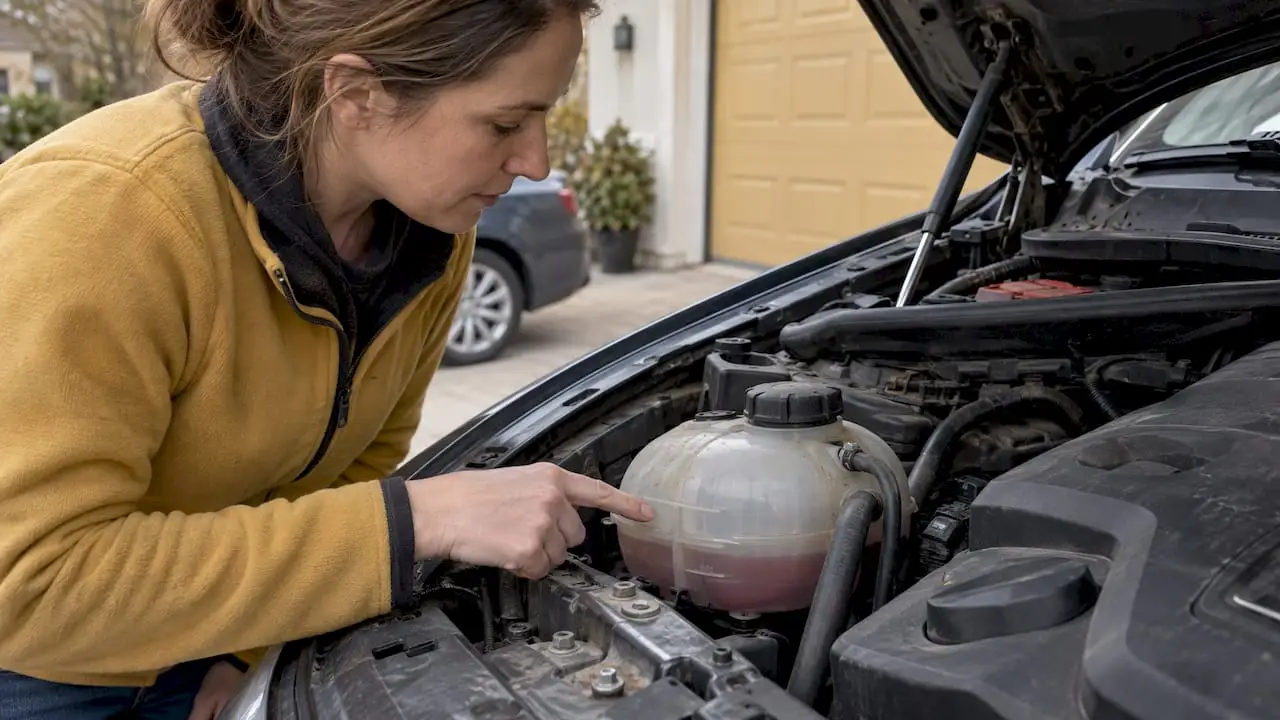
Build a cooling system check into routine service visits, including a look at connectors, hoses, and the area around the pump rather than waiting for a dashboard warning. Any shop performing work that opens the cooling circuit, whether a pump job, thermostat replacement, or coolant flush, should follow BMW’s specified fill and bleed steps afterward to avoid trapped air recreating the same symptoms.
Before scheduling repairs, check your VIN for open recalls through BMW USA’s recall portal, since the connector issue covered under recall 24V-608 may apply to your vehicle at no cost for the remedy. You can also run a broader VIN check using resources like this guide to checking for open recalls before booking any appointment. Pumps tend to show increased failure risk as mileage and age climb, so it is worth scheduling a cooling system inspection proactively rather than waiting for symptoms.
What our shop sees with BMW water pump failures
Across the BMW models we service, electric pump failures tend to cluster around a familiar pattern: a stored fault code paired with no obvious external leak, which is exactly the scenario where skipping the electrical checks leads to an unnecessary parts swap. We build our diagnostic workflow around confirming power delivery and current draw before condemning a pump, because a connector or fuse issue can look identical to a dead pump on a basic code scan.
Transparent estimates matter here because a cooling system repair can expand once a thermostat or hose is found to be compromised alongside the pump, and we would rather explain that upfront than surprise a customer mid-repair. Quality parts matter just as much: a pump that fails again in a year costs you more in the long run than the price difference up front.
— Alternative European & Domestic
Schedule a BMW water pump diagnostic appointment
We provide diagnostics for BMW cooling system concerns, including electrical checks and specified bleeding procedures, along with recall-related remedies when applicable.

At your visit, you can expect a thorough diagnostic process and a clear estimate explaining the findings and recommended repairs, along with a realistic timeline based on parts availability and any related cooling system components that need attention.
Check your VIN for open recalls before your visit, then explore our engine repair services or head straight to our appointment scheduling page to get your cooling system looked at.
FAQ
How much does it cost to fix a water pump in a BMW?
Cost depends on the pump design, whether related parts like the thermostat or hoses need replacement, and parts availability, so we are not able to quote a fixed price here. Your shop should provide a transparent estimate after completing the diagnostic steps described above, including the electrical checks that confirm the pump itself is at fault.
What causes BMW water pump failure?
BMW water pump failure stems from either electrical issues in the electric pump’s integrated electronics or mechanical wear at the shaft seal and bearings in older pump designs. Heat cycling, stop-and-go driving, aging coolant, and mileage all add to the risk, as outlined in BMW’s technical training documentation.
How serious is a water pump failure?
A failed water pump stops coolant circulation entirely, which can cause rapid overheating and lead to head gasket or cylinder head damage if you keep driving. Active overheating, steam, or smoke means you should stop and arrange a tow rather than continuing to the shop.
How long should a BMW water pump last?
There is no single published mileage figure that applies to every BMW model and pump design, so the safest approach is following BMW’s own maintenance guidance rather than assuming a fixed interval. BMW’s maintenance documentation recommends regular cold-engine coolant checks and scheduled service as the reliable way to catch a weakening pump early.
Is there a BMW recall related to water pump failure?
Yes, BMW recall 24V-608 addresses a water pump electrical connector issue on certain model-year vehicles, with a remedy that can include inspection, pump replacement, and a shield to divert fluid away from the connector. Check your VIN through BMW USA’s recall portal to see if your vehicle is affected.
Sources
- BMW USA — Recall 24V-608: Water Pump Electrical Connector (sample recall page)
- BMW technical training — engine cooling/heating system (technical training PDF)
- BMW electric water pump failure diagnosis guide — Race or Ly