
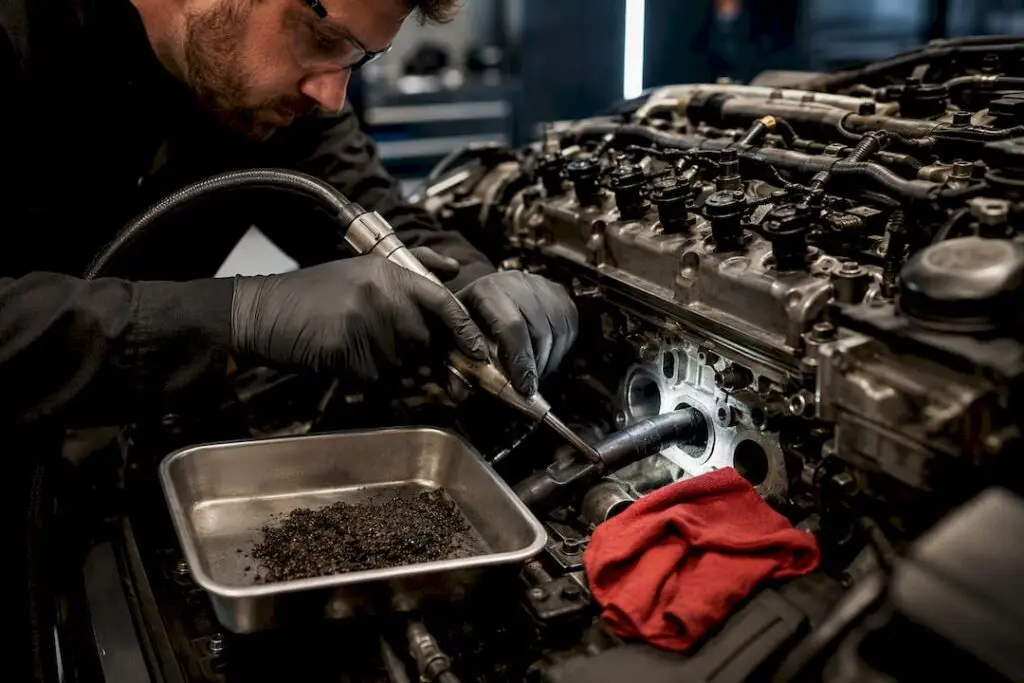
Walnut-shell blasting is the reliable fix for heavy, rock-hard carbon on direct-injection intake valves, and chemical induction works fine for light deposits or routine prevention. If your engine already shows a rough idle, misfires, or a check engine light, the deposits are likely past the point where a spray-in cleaner will help. Book a professional inspection before choosing a method.
TL;DR:
- Walnut-shell blasting is necessary for heavily carboned intake valves, especially in engines with severe buildup confirmed by borescope inspection.
- Chemical induction works only on light, soft deposits and is ineffective against hardened carbon crusts that have baked onto the valves.
- Using fuel additives alone does not clean intake valves in GDI engines because fuel never contacts the back of the valves, limiting their effectiveness.
- Regular oil and PCV maintenance, along with preventive chemical induction, slows the recurrence of carbon deposits but cannot prevent heavy buildup entirely.
- Professional walnut blasting involves precise valve closing and vacuum extraction, making it the safest and most effective method for restoring airflow in heavily fouled engines.
Table of Contents
- What Are the Signs of Dirty Intake Valves?
- What Do the Different Cleaning Methods Actually Do?
- How Do You Safely Clean Intake Valves at Home?
- What Happens During Professional Walnut-Shell Blasting?
- How Do You Prevent Carbon From Coming Back?
- When Does Alternative European & Domestic Recommend Walnut Blasting?
- Book an Intake Valve Inspection in Dallas
- Sources
- FAQ
What Are the Signs of Dirty Intake Valves?
A cold start that stumbles, hunts for idle, or shakes for a few seconds before smoothing out is often the first tell. Direct-injection engines get there because fuel injectors spray straight into the combustion chamber and never wash the backs of the intake valves, so oil vapor from the PCV system, exhaust soot recirculated through the EGR valve, and unburned fuel residue bake onto the valve surface over time. SAE’s research on GDI deposit formation confirms this is a structural byproduct of the fuel delivery design, not a sign of neglect.
Watch for these symptoms:
- Rough or unstable idle, especially on a cold start
- Random or cylinder-specific misfires and a lit check engine light
- Noticeable loss of power or hesitation on throttle input
- Falling fuel economy with no other obvious cause
- Fuel trim numbers drifting outside normal range on a scan tool
A technician can confirm the diagnosis without pulling the head apart. A borescope fed through the intake port, or even a look through the spark plug hole with the valve open, shows the deposit thickness directly. Pairing that visual with a live scan of fuel trims, misfire counts, and a compression test rules out other causes before committing to a cleaning method.
What Do the Different Cleaning Methods Actually Do?
Not every product marketed for “carbon cleaning” touches the intake valves at all. In-tank fuel additives travel through the fuel system and can help keep injectors and the combustion chamber cleaner, but on a GDI engine, that fuel never contacts the back of the intake valve, so pouring in a bottle of injector cleaner does nothing for valve carbon. That single fact trips up more owners than any other part of intake valve maintenance.
Here’s how the real options stack up:
- Chemical induction cleaning feeds a solvent through the throttle body or a vacuum line so it contacts the valves directly. It works well on soft, fresh deposits but struggles once carbon hardens into a shell-like crust.
- Walnut-shell blasting uses a media blaster and crushed walnut shells to physically fracture carbon off the valve face. It’s considered the industry standard for restoring heavily coked GDI valves because the shells are hard enough to shatter carbon but soft enough not to scar aluminum heads or steel valve faces.
- Manual disassembly or ultrasonic cleaning comes into play only when deposits have gone unaddressed for years and blasting alone can’t fully restore flow.
Walnut media works precisely because it splits the difference: abrasive enough to remove carbon, gentle enough to leave the underlying metal untouched.
How Do You Safely Clean Intake Valves at Home?
Light, fresh deposits respond well to a careful chemical induction job, but this is not a five-minute spray-and-go task. Rushing it is how owners end up with a hydro-locked cylinder or a fouled sensor.
Before you touch anything, run a scan for stored codes and note them. Warm the engine to normal operating temperature so the cleaner can penetrate residue, then follow your product’s guidance on whether to disconnect the battery. If you’re removing intake components, cover any exposed spark plug holes and disconnect sensitive sensors so overspray doesn’t reach them.
- Choose your feed point. Most kits work through the throttle body; some route through a PCV or vacuum hose closer to the valves themselves.
- Introduce the cleaner in short bursts while holding a steady idle or a mildly elevated RPM, per the product’s instructions.
- Let it soak for the recommended window, then use a soft brush or a zip-tie with a notched end to loosen crusted spots you can reach.
- Vacuum out loosened residue rather than letting the engine simply burn it off, and turn the engine over slowly by hand where the OEM procedure calls for it to avoid pushing liquid into a closed cylinder.
Pro Tip: If a deposit feels like dried cement rather than soft grime when you probe it with a plastic pick, stop. That’s a sign you’re dealing with hardened carbon that no amount of soaking will lift, and continuing risks pushing chunks somewhere they don’t belong.
Stop immediately and call a shop if you see hard, glassy crusts that won’t soften, new codes appearing mid-process, liquid pooling anywhere near a cylinder, or unusual smoke and knocking after a test start.
What Happens During Professional Walnut-Shell Blasting?
A shop visit for walnut blasting follows a tighter, more controlled sequence than any home method. Technicians start with a diagnostic scan and a borescope inspection to confirm the deposit severity, then gain access to the intake ports, either by removing the intake manifold or working through dedicated access points depending on the engine layout.
The critical safety step comes next: the technician manually rotates the engine so the target cylinder’s valves sit fully closed at top dead center. This valve-closed positioning keeps blast media from dropping into the combustion chamber, where it could score a cylinder wall or cause a hydro-lock on startup. A vacuum line runs simultaneously to capture spent media and loosened carbon as the blasting happens.
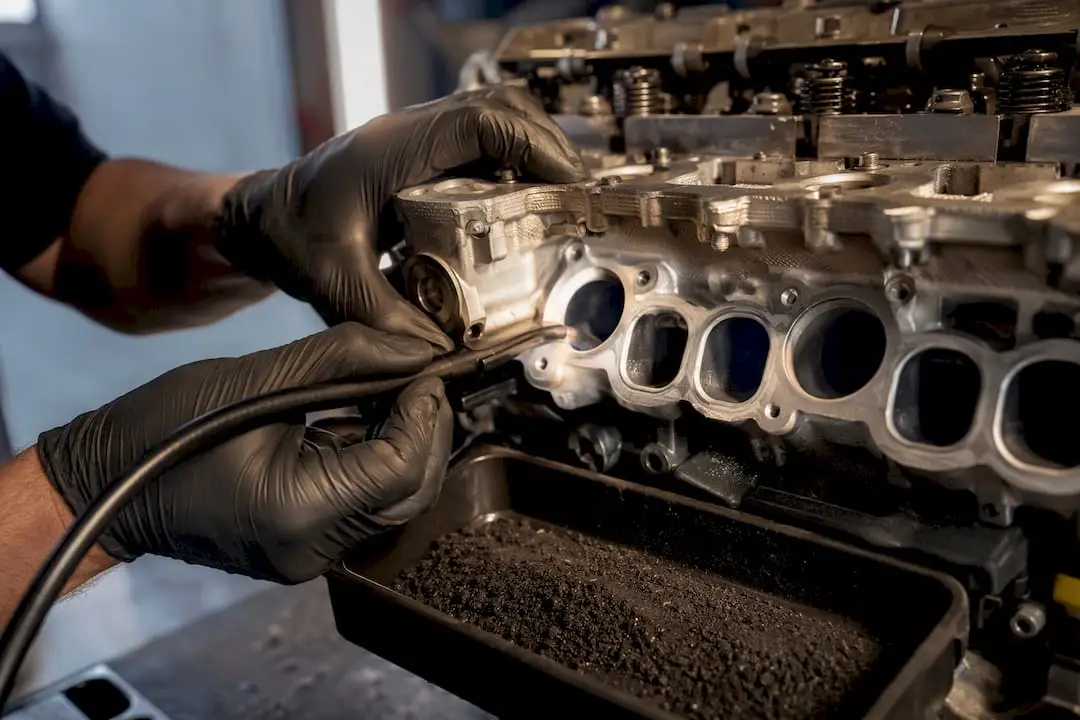
Pro Tip: Ask any shop quoting a walnut blast job how they confirm valve closure before blasting starts. A vague answer, or no mention of vacuum extraction at all, is a red flag worth walking away from.
What to expect:
- Media that’s soft enough to avoid damaging aluminum heads or steel valves, unlike hard abrasive blasting
- A visible return to near-original valve flow once carbon is cleared
- A process that typically restores drivability symptoms tied to poor airflow
- Shop intervals commonly cited around 60,000 to 80,000 miles for engines prone to heavy buildup, with cost varying by engine layout and labor time
How Do You Prevent Carbon From Coming Back?
Cleaning the valves once doesn’t make an engine immune to carbon; it resets the clock. What determines how fast that clock runs again is oil quality, PCV health, and how the vehicle gets driven.
- Stick to a full synthetic oil that meets current API SP or GF-6 specifications, and shorten your interval if most of your driving is short city trips that never let the engine fully warm up.
- Have your PCV valve inspected on a regular schedule. A worn PCV pushes more oil vapor into the intake tract than a healthy one.
- Consider a baffled oil catch can, which intercepts oil vapor before it reaches the intake valves and is one of the more cost-effective ways to slow recurrence.
- Keep injectors, spark plugs, and any manufacturer software updates current, and pair a cleaning service with routine oil service rather than treating them as separate errands.
A light chemical induction every so often keeps soft deposits from accumulating into something a shop has to blast off later.
When Does Alternative European & Domestic Recommend Walnut Blasting?
We lean toward walnut blasting whenever a borescope shows hard, layered carbon rather than soft buildup. Chemical induction earns its place as a preventive step on engines still showing light deposits. Dealer-level diagnostics matter most on European and high-performance engines, where variable valve timing and turbo boost make airflow restriction show up as drivability complaints faster than on a typical commuter engine. After a cleaning service, we build a follow-up maintenance plan around oil intervals and PCV checks so the work actually holds.
— Alternative European & Domestic
Book an Intake Valve Inspection in Dallas
Alternative European & Domestic gives Dallas drivers something a bottle of throttle-body cleaner can’t: a real diagnosis before you spend a dime on the wrong fix. We run a full scan and borescope inspection first, then recommend chemical induction or walnut-shell blasting based on what the valves actually need, not a one-size-fits-all service.

During your visit, expect a diagnostic scan, a borescope look at valve condition, a straightforward recommendation, and an estimated time for the work involved. If your car is due for related maintenance, we’ll flag it. Many customers pair intake service with oil change and engine lubrication service since fresh oil reduces vapor recontamination right after cleaning. If the inspection turns up something more serious, like valve damage from long-neglected deposits, our engine repair team handles it under the same roof.
Schedule a diagnostic visit through our maintenance service page or call our Dallas shop directly to get on the schedule. Bring your service history if you have it. It helps us judge how quickly deposits have progressed and whether a catch can or PCV service should go on the ticket alongside the cleaning.
Sources
- Formation of intake valve deposits in gasoline direct injection engines — SAE
- Direct Injection (GDI) Carbon Buildup: Walnut Shell Blasting guide — TheAutoReviewer
- Tech Q&A – How To Clean Intake Valves Stationary In Situ — Porsche Club of America (PCA)
For general safe practices when working near engine components, Diamondbrite’s engine bay cleaning guide is a useful companion reference.
FAQ
How Much Does Intake Valve Cleaning Cost?
Cost depends on the method and how the intake is accessed on your specific engine, since some layouts require more labor to reach the valves than others. Alternative European & Domestic’s current service pricing is available on the maintenance service page rather than a flat quote, since every diagnosis starts with an inspection.
What Are the Signs of Dirty Intake Valves?
Rough cold-start idle, misfires, a lit check engine light, throttle hesitation, and declining fuel economy are the most common signs. A borescope inspection or a scan of fuel trim data confirms the diagnosis without disassembling the engine.
Can I Clean My Intake Valves at Home?
Light deposits respond to a careful chemical induction process done through the throttle body or a vacuum line, following the safety steps outlined in the DIY section above. Hard, crusted carbon does not respond to home methods and needs professional walnut-shell blasting instead.
How Often Should I Clean My Intake Valves?
Light preventive chemical induction can be done periodically as part of routine upkeep, while full walnut-shell blasting is commonly needed around 60,000 to 80,000 miles on engines prone to heavy carbon buildup. Driving habits, oil quality, and PCV condition all shift that timeline earlier or later.
Does Alternative European & Domestic Offer Intake Valve Cleaning?
Yes. Our shop performs diagnostic inspections and recommends either chemical induction or professional walnut-shell blasting based on what a borescope inspection actually shows, paired with follow-up maintenance planning through our maintenance service program.