
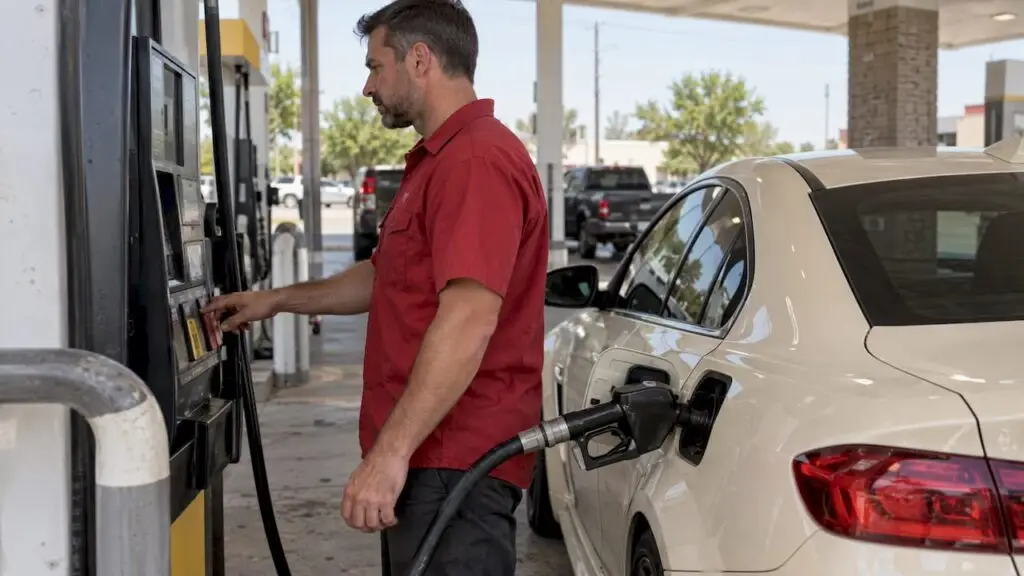
Octane rating measures how well a gasoline resists auto-ignition, or knock, inside your engine. It has nothing to do with how much energy the fuel contains. The number on the U.S. pump, called the Anti-Knock Index, is calculated as the average of two lab tests. The practical rule is simple: use the octane grade your manufacturer requires, since premium only helps an engine built or tuned to use it.
TL;DR:
- Most drivers do not benefit from premium fuel unless their engine is designed or tuned specifically for higher octane ratings.
- Using a lower grade than required can cause knocking, reduced power, and efficiency losses until the engine adapts or repairs are made.
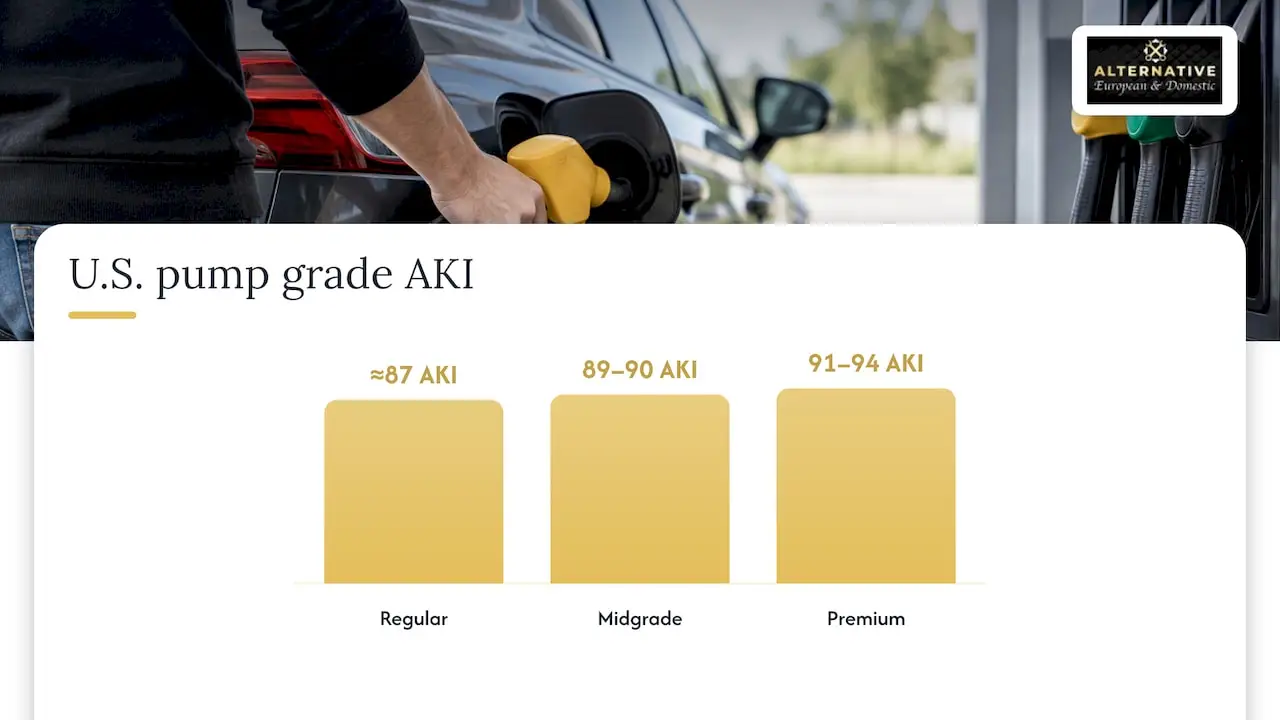
- The posted pump number (Anti-Knock Index) must match the manufacturer’s recommendation, typically 87 for regular, 89-90 for midgrade, and 91-94 for premium fuels.
- Persistent knocking, loss of power, or check-engine lights after refueling indicate potential mechanical or sensor problems, not just fuel grade issues.
- Most vehicles will not see notable gains in performance or fuel economy from premium fuel unless they are high-compression or turbocharged engines calibrated for it.
Table of Contents
- What octane measures and how it relates to engine knock
- How octane is measured: RON, MON, and the pump number (AKI)
- Why octane matters for engine performance, efficiency, and durability
- Does premium fuel make my car faster or more efficient?
- How to choose the right octane at the pump and what to do if you used the wrong grade
- Troubleshooting octane problems: symptoms, tests a shop performs, and urgency
- How Alternative European & Domestic approaches suspected octane and knock problems
- The editorial take: octane is a compatibility question, not a quality ranking
- FAQ
- Sources
What octane measures and how it relates to engine knock
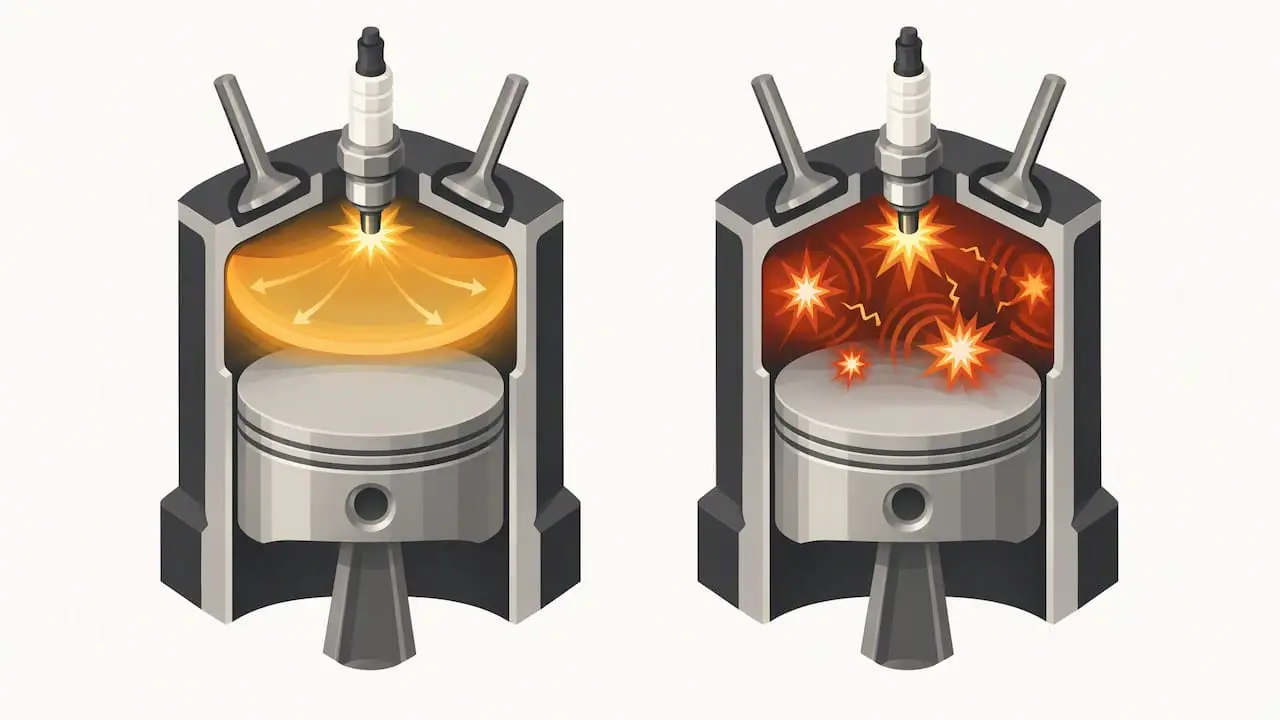
When your engine runs normally, the spark plug ignites the air-fuel mixture at a precise moment and the flame front spreads evenly through the cylinder. Knock, sometimes called pinging, happens when pockets of that mixture ignite on their own from heat and pressure before the spark fires. Instead of one controlled burn, you get multiple uncoordinated explosions colliding inside the cylinder. Drivers often hear it as a light rattling or pinging sound under acceleration or load.
Energy Information Administration. It is not a measure of power, cleanliness, or energy content. A higher octane number simply means the fuel can withstand more heat and compression before it ignites on its own. That distinction matters because a lot of drivers assume premium fuel is simply “better” gasoline, when it is really just more resistant to a specific failure mode.
Whether knock becomes a problem depends heavily on engine design. A low-compression commuter engine built to run on 87 AKI fuel generates relatively mild in-cylinder pressures, so it rarely approaches the point where auto-ignition occurs. A high-compression or turbocharged performance engine operates much closer to that edge by design, since higher compression and boost pressure are what generate extra power. Those engines need fuel that can handle the heat without lighting off early.
Several everyday conditions make knock more likely to occur, regardless of engine type:
- Hot weather or a hot engine bay, which raises intake and cylinder temperatures
- Heavy acceleration, towing, or climbing steep grades under sustained load
- Carbon buildup on pistons and valves, which raises effective compression
- Using a fuel grade below what the engine was designed to run
- Aggressive driving that pushes ignition timing and boost toward their limits
A single knock event is not dangerous on its own. Persistent knock over time can damage pistons, head gaskets, and bearings, which is why your engine’s computer is designed to react to it immediately rather than let it continue.
How octane is measured: RON, MON, and the pump number (AKI)
Three different numbers show up when people talk about octane, and they measure the same resistance to knock under different conditions. Research Octane Number, or RON, is measured under mild, low-speed test conditions that approximate light city driving. Motor Octane Number, or MON, is measured under harsher conditions with higher engine speed and temperature, closer to what happens under load or at highway speed. MON numbers always come in lower than RON for the same fuel because the test conditions are tougher on the fuel’s resistance to knock.
The number posted on U.S. fuel pumps is neither RON nor MON by itself. It is the Anti-Knock Index, calculated as (RON + MON) divided by two, and federal rules require every pump to display it. The FTC Fuel Rating Rule requires that fuel retailers disclose this minimum octane rating on the dispenser, and the underlying testing follows ASTM D4814 standards for gasoline quality. That is why the yellow sticker on the pump reads something like “87 Octane” rather than citing RON or MON separately.
The gap between RON and MON for a given fuel is called octane sensitivity, and it affects how that fuel performs in different engines, according to U.S. Department of Energy research on fuel and engine modeling. A fuel with high sensitivity (a large RON minus MON gap) behaves differently under light-load city driving versus hard acceleration, since the two tests represent those two extremes. This matters most for engines running high compression ratios or aggressive turbocharging, where engineers may specifically calibrate around RON rather than AKI. It is a detail most drivers never need to think about, but it explains why some performance-oriented manufacturers reference RON ratings in their literature, particularly for vehicles sold or tuned with international specifications in mind.
Typical U.S. pump grades break down this way:
- Regular: around 87 AKI, the standard grade for most daily-driver vehicles
- Midgrade: around 89 to 90 AKI, a middle option some vehicles are tuned for
- Premium: around 91 to 94 AKI, required or recommended for higher-compression and turbocharged engines
These ranges come directly from the EIA’s breakdown of common pump labels, and they hold true across most U.S. stations, though exact premium numbers can vary slightly by region and altitude.
Why octane matters for engine performance, efficiency, and durability
Octane only becomes a performance factor when an engine is specifically designed to use it. Higher-octane fuel resists auto-ignition at higher pressures and temperatures, which lets engineers push compression ratios higher, add more turbocharger boost, or advance ignition timing further before knock becomes a risk. Each of those changes increases torque and power, and can improve thermal efficiency, but only in an engine built and calibrated to take advantage of the extra octane headroom.
The Department of Energy’s analysis of higher-octane fuels found that these performance and efficiency gains depend entirely on matching fuel to engine design. Pouring premium into an engine designed around 87 octane does not unlock hidden compression or boost, because the factory calibration was never written to use that extra margin.
Here is what actually happens inside a modern engine when the fuel in the tank does not meet what the engine needs. Nearly every gasoline engine built in the last two decades has a knock sensor, a small device that detects the vibration signature of abnormal combustion. When it senses knock, the engine control unit responds by retarding ignition timing, reducing boost, or both, which lowers cylinder pressure and stops the knock. That protective response works, but it comes at a cost: retarded timing and reduced boost mean less power and worse efficiency than the engine would otherwise deliver. The DOE’s technical notes describe this knock-control intervention as a protective measure, not a substitute for running the correct fuel grade.
A few real-world conditions increase an engine’s octane needs beyond what it might require during easy, flat-road commuting:
- Turbocharged or supercharged engines running near their boost limits
- Heavy towing or hauling, which raises load and combustion temperatures
- Climbing steep or sustained grades at highway speed
- Hot ambient temperatures, especially combined with hard acceleration
- Aggressive driving styles that call for more ignition advance and throttle
Pro Tip: If your vehicle calls for premium and you notice a loss of power or a rough idle after switching to a lower grade, don’t assume it’s just the fuel: have the knock sensor and ignition timing checked, since repeated knock-control events can point to a developing mechanical issue.
None of this means every driver needs premium. It means the relationship between octane and performance is a design question, not a universal rule. An engine tuned from the factory for 87 octane is not leaving power on the table by using 87 octane; it was calibrated around that number from the start. An engine tuned for 93 octane, by contrast, is actively relying on that fuel’s extra knock resistance to deliver its rated power and efficiency, and feeding it a lower grade will trigger the same timing-retard response described above, quietly costing you both performance and fuel economy.
Does premium fuel make my car faster or more efficient?
For most vehicles, no. Pouring premium into an engine designed for regular rarely produces a noticeable gain in power or fuel economy, because the engine was never calibrated to exploit the extra octane margin in the first place.
The owner’s manual and the fuel-door label are the two places that settle this question for any specific vehicle, and they generally use one of two words that mean very different things:
- Required means the engine’s compression ratio, turbocharging, or ignition mapping depends on that minimum octane to avoid knock and protect the engine; using a lower grade risks triggering persistent knock-control intervention or, over time, mechanical wear.
- Recommended means the manufacturer has found a measurable benefit at the higher grade, often in power or towing capability, but the engine will still run safely on regular, typically with some loss of output under hard use.
Premium fuel genuinely helps in a narrow set of situations: engines factory-tuned for high octane, vehicles doing sustained towing or high-load driving where knock risk rises, and some performance vehicles with driving modes that adjust timing and boost based on the fuel quality detected. Outside those cases, extra octane is extra cost with no measurable return.
A couple of persistent myths are worth clearing up directly. Premium fuel is not inherently better at cleaning your engine. Fuel additive packages, not octane rating, are what control deposit buildup, and many regular-grade fuels meet the same detergent standards as premium. Premium also does not improve fuel economy across the board. Octane rating and energy density are two separate properties of gasoline: a higher octane number tells you about knock resistance, not how much energy is released when the fuel burns. In an engine not designed to use the extra octane, there is no efficiency gain to unlock, and you are simply paying more per gallon for a property your engine doesn’t need. Following the manufacturer-recommended fluids and fuel specifications for your specific vehicle, rather than assuming “more expensive means better,” is the more reliable way to protect performance and efficiency over time.
How to choose the right octane at the pump and what to do if you used the wrong grade
Choosing the correct grade takes less time than it takes to read this sentence, once you know where to look. Here is the short checklist:
- Check the fuel-door sticker first; nearly every vehicle has the required or recommended octane printed right there
- Confirm it against the owner’s manual if the fuel-door label is worn or unclear
- Match that number to the posted AKI on the pump, not to RON or MON figures you might see referenced elsewhere
- Consider stepping up to midgrade or premium temporarily if you are towing, hauling a heavy load, or driving in sustained high heat, even if your manual only recommends it rather than requires it
Misfueling with a lower-than-required octane grade is more common than drivers expect, especially at unfamiliar stations or rental vehicles. If you realize partway through a fill-up or shortly after that you used the wrong grade, a few simple steps limit any risk. Drive gently for the rest of that tank, avoiding hard acceleration, towing, or sustained high speed. Avoid heavy loads until the tank runs low enough to refill. Top off with the correct grade as soon as it’s practical, since blending in the right fuel dilutes the lower-octane gas already in the tank.
Pro Tip: Note the station location, pump number, and time of fill-up if you suspect a misfueling or notice symptoms afterward: that detail helps a technician quickly rule fuel quality in or out during diagnostics.
Most single misfueling incidents resolve themselves once the tank is topped off with the correct grade and a few gallons of it mix in. What should prompt a service visit instead of just waiting it out is persistence: knock or pinging that continues after refueling with the correct octane, a check-engine light that stays on, or a noticeable, ongoing loss of power under normal driving. Those symptoms suggest something beyond a one-time fuel mismatch, whether that’s a knock sensor issue, a carbon buildup problem, or an unrelated mechanical fault that happens to produce similar symptoms.
That overlap is worth taking seriously. Fuel-quality problems and genuine mechanical faults, like a failing ignition coil, a vacuum leak, or worn spark plugs, can produce nearly identical symptoms: rough running, pinging, reduced power, and an illuminated check-engine light. Guessing which one you’re dealing with from the driver’s seat wastes time and sometimes money on the wrong fix. Bringing specific details to the shop (the fuel grade you used, roughly when and where you filled up, and exactly what symptoms you noticed) gives a technician a real starting point instead of a vague complaint.
Troubleshooting octane problems: symptoms, tests a shop performs, and urgency
Not every rattle or hesitation is an octane problem, and distinguishing fuel-grade issues from mechanical ones is exactly the kind of diagnostic work a shop visit resolves quickly. Symptoms that lean toward a fuel or octane issue include pinging or knocking that appears shortly after a fill-up, a drop in power that correlates with a specific tank of gas, and symptoms that improve once that tank is used up. Symptoms that lean mechanical include knock that persists across multiple fill-ups regardless of grade, knock paired with rough idle or stalling, or a check-engine light that flashes rather than stays steady.
A shop-level diagnosis generally follows a consistent sequence:
- Read stored fault codes to see whether the engine control unit has logged knock events, misfire counts, or other relevant data
- Check knock sensor function and wiring, since a failing sensor can either miss real knock or trigger false timing retard
- Inspect for carbon buildup on intake valves and pistons, which raises effective compression and can cause knock even on the correct fuel grade
- Run compression or leak-down tests when mechanical wear is suspected, to rule out worn rings or valve issues
- Check the fuel system itself, including fuel pressure and injector performance, since a lean or inconsistent fuel delivery can mimic octane-related knock
Telling the shop the fuel grade you used, the approximate station and date, your typical driving load, and exactly what symptoms appeared and when speeds up this process considerably. It narrows which of these five steps need the most attention instead of running every test from scratch.
Some symptoms call for prompt attention rather than monitoring: a flashing check-engine light, which usually signals an active misfire that can damage a catalytic converter if ignored, or a sudden, significant loss of power under load. Both warrant scheduling diagnostic service rather than waiting to see if the next tank of gas fixes it.
How Alternative European & Domestic approaches suspected octane and knock problems
When a vehicle comes in with a complaint that sounds like a fuel or knock issue, we start with verification rather than assumptions by reviewing fault codes, sensor outputs, and symptom patterns before proceeding with repairs.
From there, we move to fuel quality and ignition system checks, inspecting components and running tests to differentiate between temporary fuel issues and mechanical problems.
Providing details such as fuel grade used, fill-up time and location, driving load, and symptoms helps narrow the diagnostic process during service appointments.
Repeated knock events, a flashing check-engine light, or a sudden loss of power under load are signs we recommend bringing the vehicle in promptly rather than waiting. A single symptom after one unusual fill-up, with no recurrence, is something we’re comfortable having you monitor. If you’re due for a checkup or want a professional read on a persistent symptom, our maintenance and diagnostic service is the practical next step.
The editorial take: octane is a compatibility question, not a quality ranking
The biggest misunderstanding about octane is treating it like a scale of fuel quality, where higher is always better. It isn’t. Octane rating is a single engineering spec that either matches your engine’s design or doesn’t, the same way a bolt either fits a thread or it doesn’t. Spending extra on premium for an engine calibrated around regular doesn’t buy you a “better” tank of gas; it buys you nothing measurable.
The conventional advice to “just use premium to be safe” gets the logic backward. Safety and performance here come from matching the fuel to what the manufacturer specified, not from defaulting to the most expensive option on the pump. If you want one habit worth prioritizing, it’s this: read the fuel-door sticker once, follow it consistently, and treat any knock or power loss that shows up despite doing that as a signal to get the car looked at rather than to switch grades and hope.
— Alternative European & Domestic
FAQ
What does octane rating actually measure?
Octane rating measures how resistant a gasoline is to auto-ignition, or knock, inside the engine. It does not measure the fuel’s energy content, power potential, or cleanliness, according to the EIA’s explanation of octane.
What is the difference between octane rating and cetane rating?
Octane rating applies to gasoline and measures resistance to knock in spark-ignition engines, while cetane rating applies to diesel fuel and measures how quickly the fuel ignites under compression. The two ratings describe opposite qualities because gasoline and diesel engines ignite fuel in fundamentally different ways.
Will using premium gas improve my fuel economy?
Only if your engine is specifically designed and calibrated for premium fuel; otherwise, there’s typically no measurable improvement. Octane and energy density are separate properties of gasoline, so a higher octane number by itself does not mean more energy per gallon.
What happens if I accidentally use a lower octane grade than required?
You may notice knock, pinging, or reduced power, since the engine’s knock sensor will retard ignition timing to protect itself. Drive gently, avoid heavy loads, and refill with the correct grade as soon as practical; if symptoms persist after that, schedule a diagnostic check.
How do I know what octane rating my car needs?
Check the fuel-door sticker or the owner’s manual, both of which specify whether a fuel grade is required or merely recommended. Match that number to the Anti-Knock Index posted on the pump, which is calculated as (RON + MON) divided by two under the FTC’s fuel rating rule.