
A car that starts normally cold but struggles after a short stop is usually showing one of four faults: a heat-sensitive crankshaft position sensor, fuel pressure bleeding off after shutdown, a leaking injector, or a starter and cable circuit that loses performance with heat. How the engine behaves while cranking tells you which one. Slow cranking points to the electrical side. Normal cranking that takes too long to fire points to fuel or ignition signals. At Alternative European & Domestic, we sort this out with a structured diagnostic rather than by swapping parts.
TL;DR
- Normal-speed crank, slow to fire: suspect fuel pressure loss, a leaking injector, or a sensor signal problem.
- Slow, heavy crank only when hot: suspect the starter, battery, or a high-resistance cable or connection.
- Cranks but never fires after a short stop: a heat-failing crankshaft position sensor is the classic cause, and it needs a scan tool and live data to confirm.
- Stalling, flashing check-engine light, or a no-start in traffic: do not keep driving it. Have it diagnosed before it strands you.
- Parts guessing is expensive. A diagnostic that separates spark, fuel, and compression comes first.
Table of Contents
- Why heat changes how an engine starts
- First clue: how does the engine crank?
- The most common causes of a hard warm start
- What a proper diagnosis looks like
- When not to drive the car
- What affects the repair cost
- Preventing hot-start problems
- Getting it diagnosed in Dallas
- FAQ
- Sources
Why heat changes how an engine starts
Heat does three things under the hood. It raises electrical resistance in wiring, starter windings, and relays. It makes electronic parts with internal cracks or worn windings open up intermittently. And it makes fuel evaporate sooner, which matters in a fuel system that cannot hold pressure.
After you shut the engine off, airflow stops and heat from the exhaust and block soaks into everything around it. Fuel rails, injectors, sensors and connectors sit in that heat for 10 to 30 minutes. A part that is marginal when cold can pass every cold start and fail on the restart.
Blueprint Engines’ technical knowledge base lists fuel-system heat soak, ignition timing, starter performance and electrical issues as the usual causes of a hard hot start, rather than an internal engine problem. Its example is a carbureted engine, but the same four areas apply to modern fuel-injected European and domestic cars.
First clue: how does the engine crank?
Before anyone touches a part, the useful question is what the engine does when you turn the key. ALLDATA, a repair-information provider for professional technicians, advises watching cranking RPM against specification. In its guidance, no RPM signal points to the crankshaft position (CKP) sensor, slow cranking points to the battery, cables, starter or mechanical drag, and normal cranking points to fuel or spark.
That gives you a simple sorting table you can use to describe the problem accurately to a technician:
| What you notice | What it usually points to |
|---|---|
| Slow, labored crank only when hot | Starter, battery, cables, or ground connections |
| Rapid clicking or dim dash lights | Weak battery or poor connection |
| Normal crank, long delay before it fires | Fuel pressure loss, leaking injector, sensor input |
| Normal crank, never fires until it cools | Heat-failing crankshaft position sensor, ignition module or coil |
| Fuel smell and a puff of black smoke when it finally starts | Too much fuel, often from a leaking injector or a faulty coolant temperature reading |
| Starts easier with the gas pedal slightly pressed | Flooded or over-rich condition |
The patterns in the last three rows are described in published troubleshooting guides such as this fuel and sensor breakdown of hot-start faults. Treat them as clues, not a verdict. Several faults overlap, which is why a diagnosis has to confirm the cause.
The most common causes of a hard warm start
Heat-sensitive crankshaft position sensor
The crankshaft position sensor tells the engine computer how fast the engine is turning and where the pistons are. With no signal, the computer commands neither spark nor fuel, so the engine cranks normally and never fires. The sensor sits low on a hot engine, and internal windings or electronics that work cold can fail once heat-soaked. After the engine cools, it fires right up again.
This is why the problem feels random. The car starts in the morning, runs fine, then refuses to restart after a fuel stop. Ten minutes later it starts as if nothing happened.
Wiring, connector and reluctor-wheel faults can cause the same symptom, and mechanics report these are often more common than the sensor itself failing. That is a good reason to test the circuit before replacing the sensor. On many vehicles the new sensor also needs a relearn procedure with a scan tool afterward.
Fuel pressure that does not hold after shutdown
Modern fuel-injected engines keep the fuel rail pressurized after the engine stops. Pressure keeps the fuel liquid even in a hot engine bay. Three components normally hold it: the fuel pump check valve, the fuel pressure regulator, and the injectors. If any of them leaks, pressure bleeds off while the car sits. On the restart, the pump has to rebuild pressure first, so the crank is normal but the start is long.
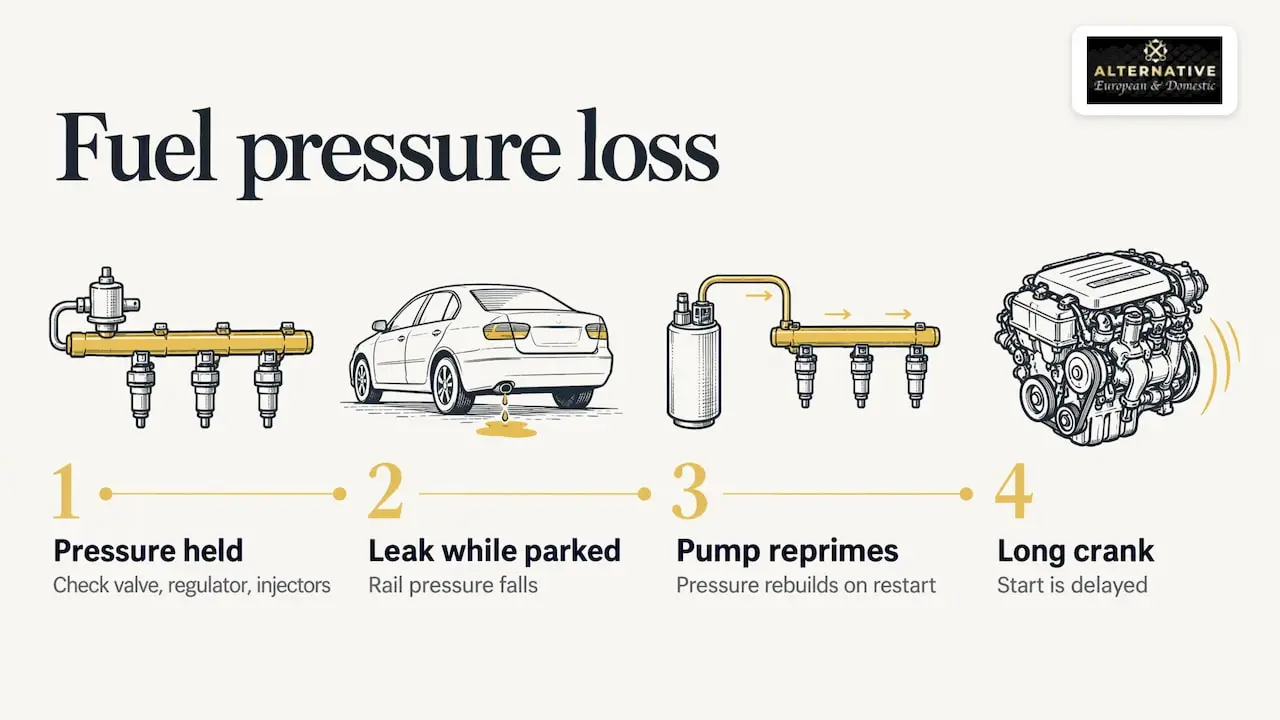
A published rule of thumb from a shop-oriented diagnostic write-up is that rail pressure should hold steadily for at least 10 to 20 minutes after shutoff. A rapid drop suggests a leak or a failing check valve. Fuel in the regulator’s vacuum hose points to a ruptured diaphragm. These are measurements taken with a gauge, not something to improvise at the roadside.
A related tell: cycling the key to on and off a few times before cranking lets the pump prime the rail. If the car then starts noticeably better, pressure was not being held. Mention that to your technician if you have noticed it. If your car also shows other low-pressure symptoms, our guide to low pressure fuel pump symptoms, signs, causes and tests explains what the pump side of the system looks like.
Leaking injectors
An injector that does not seal can drip fuel into a hot cylinder after shutdown. The next start is then over-rich or partly flooded. The signs are a long crank, a fuel smell, a black puff from the exhaust when it finally catches, and easier starting with the throttle held open. Leaking injectors and rail leaks can also set misfire or fuel trim codes. Our misfire diagnosis guide covers how those codes are chased down on European and performance cars.
Coolant temperature sensor reading wrong
The engine computer decides how much fuel to add at startup partly from the coolant temperature signal. If the sensor reads colder than the engine really is, the computer adds extra fuel to a warm engine and the start becomes rich and rough. HP Tuners’ diagnostic manual suggests comparing coolant temperature with ambient air on a cold start. A difference of more than 10 degrees indicates high resistance in the sensor circuit. This is a scan-tool check, and a quick one for a shop that has the equipment.
Ignition coils and modules that fail hot
Coils and ignition modules can have tiny insulation cracks that open as they heat up. Cold, they spark. Hot, they short. Separating spark from fuel delivery is the core of the diagnosis: if there is no spark while cranking, the cause is not vapor lock but possibly an overheating electronic control unit or igniter. Coil trouble also often shows up as a misfire under load, which our article on BMW misfire under load walks through.
Starter, battery, cables and grounds
A hot starter and heat-soaked cables have more resistance than cold ones, so cranking slows. The signature is a heavy, dragging crank that gets worse after a hot stop. Low battery voltage makes this worse, and it can also confuse other modules. A corroded ground or loose cable end can cause the same symptom.
One published test is measuring voltage at the starter terminal during a hot crank. A drop of more than about one volt across the cables points to a cable or connection fault. Mechanics call this a voltage drop test. It finds a bad connection that a battery load test alone will miss. For the wider approach, see how ASE-certified shops test advanced electrical faults.
Vapor and EVAP issues
A stuck-open EVAP purge valve can feed fuel vapor into the intake when the engine is hot, which makes the mixture too rich at restart. A leaking system can set related EVAP codes such as P0441, P0442 or P0455. Our EVAP leak diagnosis workflow explains how technicians trace these on European performance cars.
Diesels
Diesels have a different set of weak points. Modern common-rail diesels can fail hot restarts from a weak high-pressure fuel pump, injector return leakage, or low rail pressure. Control-system inputs matter too, including parts such as the glow plug control unit and ignition-side checks, so a scan tool reading comes before any parts decision.
What a proper diagnosis looks like
A no-start that only happens hot is difficult because the fault disappears when the engine cools. The goal of a diagnosis is to catch the car in the failed state or to reproduce the heat. A sound sequence looks like this:
- Interview and codes. The technician asks when it happens, how long the car sat, and how it cranked, then scans for stored and pending codes. Related codes include P0087 for low fuel rail pressure, P0116 to P0119 for coolant temperature sensor performance, and P0300 to P0302 for misfires.
- Check engine light and power. ALLDATA’s first step is confirming the check-engine light illuminates in the run position. If it does not, the computer may lack power or have a bad ground.
- Live data while cranking. Engine speed (RPM) should register during cranking. A scan tool reading 0 RPM while the starter turns the engine is a strong sign of a sensor or signal fault.
- Spark and injector command. If the RPM signal is present, the next question is whether the coil and injector are being commanded. Missing command points to input, power or ground circuit problems.
- Fuel pressure and volume. A gauge on the rail shows pressure at key-on, during cranking, and how it decays after shutdown. ALLDATA gives a benchmark for volume: about 7 ounces in 10 seconds is generally enough for an engine to start and run.
- Heat testing. A technician may wiggle the harness, check connectors, and warm the suspect sensor while watching live data to reproduce the failure.
- Mechanical checks last. If signals and fuel are fine, compression, valve timing and airflow come next. A hot compression figure well below the cold figure points to valve seating or ring wear.
This order matters because it protects you from paying for parts you did not need. A professional scan tool reads active and historical codes and live sensor data. Without that capability, diagnosis is working blind.
Pro Tip: Before you drive in, write down what happened. Note how long the car sat, whether the crank was fast or slow, whether you smelled fuel, and whether pumping the pedal or cycling the key helped. That information can cut diagnostic time significantly. If you want a broader checklist of what to ask, our guide to questions to ask a mechanic helps you get findings in writing.
When not to drive the car
An intermittent hot-start fault can leave you without power at the worst moment. Treat these as stop signs:
- The engine stalls while driving. A failing crank sensor or ignition component can cut the engine in traffic, taking power steering and brake assist with it. Pull over safely and do not keep driving it.
- The check-engine light is flashing. A flashing light signals an active misfire that can overheat the catalytic converter. Reduce load and get the car inspected promptly.
- You smell raw fuel. Fuel leaking onto a hot engine is a fire risk. Shut the engine off and have the car towed.
- The starter is grinding, smoking or clicking repeatedly. Repeated cranking can overheat the starter and drain the battery.
- The car will not restart on a highway shoulder or in a live traffic lane. Do not keep cranking. Call for roadside assistance and a tow.
If the car starts after a wait and runs normally, it is still not fixed. The failure will usually come back, and often when you are far from home. Towing to a shop is reasonable whenever the car will not start, loses power while moving, or leaks fuel. It is a lot cheaper than a second breakdown.
We do not recommend roadside improvisation like spraying starting fluid, clamping fuel lines or poking at wiring. Fuel and electrical systems on late-model European cars are sensitive, and mistakes cause damage or fire.
What affects the repair cost
The cost depends on what failed and where it sits. Here are the main factors:
- Which component failed. A sensor, a coil, an injector, a pump check valve and a starter are very different jobs.
- Access. Published estimates for crank sensor replacement run from roughly $120 to $250 fitted for easy access, up to $250 to $500 for awkward access and above $700 where the transmission or bellhousing has to be disturbed. Your vehicle may fall outside those ranges.
- Programming. Many cars need a scan-tool relearn after a sensor swap.
- Diagnostic time. Intermittent faults take longer to catch than a car that fails every time.
- Related damage. Repeated flooding or misfires can foul plugs or stress the catalytic converter.
Costs at Alternative European & Domestic depend on the vehicle and the findings. Ask for the diagnosis and the repair recommendation in writing, so you know what is needed now and what can wait.
Preventing hot-start problems
Not every failure is preventable, but you can reduce the odds:
- Keep the battery, terminals and ground straps tested and clean, especially before Dallas summers.
- Replace fuel filters, spark plugs and ignition parts at the intervals set for your vehicle.
- Fix check-engine lights early, since stored codes often point to the failing part before it strands you.
- Use the fuel grade your manufacturer specifies.
- Have heat-exposed wiring and connectors inspected when you see cracked insulation or oil contamination.
A customized maintenance plan built around your car’s mileage and driving pattern covers most of these items in one visit.
Getting it diagnosed in Dallas
If your car is hard to start when warm, whether you drive a European sedan from Uptown, a performance car in Oak Lawn, or a domestic truck across town, the useful step is a diagnostic that reproduces the failure and measures the circuit. Alternative European & Domestic provides dealer-level diagnostics on European, domestic and high-performance vehicles, performed by ASE-certified technicians, with clear communication about what we find and what we recommend.
When the cause turns out to be a mechanical or fuel-system repair, our engine repair services cover it. Electrical items such as starters, alternators and batteries are listed on our services page. Qualifying repairs are backed by our 24-month/24,000-mile warranty, subject to applicable terms.

To schedule a diagnostic evaluation, contact Alternative European & Domestic through alternativecarcare.com. If the car will not start at all, our guide to diagnosing a no-crank, no-start explains what we check first.
FAQ
Why does my car start fine cold but struggle when warm?
Heat exposes marginal parts. Sensors and coils with internal cracks, a starter with higher resistance, or a fuel system that loses pressure can all work cold and fail after a hot stop. Whether it cranks slowly or cranks normally and does not fire tells a technician which group to test first.
Is it safe to keep driving a car that is hard to start when hot?
Not for long. If the cause is a failing crankshaft sensor or ignition part, the engine can stall while moving. A flashing check-engine light, a fuel smell or a car that will not restart on a roadside are reasons to stop and arrange a tow. Have it diagnosed soon.
Can a bad battery cause hard starting only when the engine is hot?
Yes. Heat raises resistance in the starter and cables, so a weak battery that copes cold may fall short hot. A weak battery typically causes slow cranking, dim lights or repeated clicking, while strong, even cranking points toward fuel pressure, vapor or sensor signals.
Does a hard warm start always mean a bad crankshaft position sensor?
No. It is a classic suspect when the engine cranks but never fires, but wiring, connector and reluctor-wheel faults produce the same symptom. Fuel pressure loss, leaking injectors and ignition modules can look similar. A scan tool showing RPM during cranking helps separate them.
How long does a diagnosis take?
It depends on whether the fault shows up when the car arrives. A fault that is present is faster to confirm. An intermittent one may require heat testing or a longer observation. Ask the shop for a written finding and recommendation before approving repairs.
Sources
- Blueprint Engines: What Causes Hard Hot Starts
- ALLDATA: A quick-start guide to no-start diagnostics
- Corbay Global: Engine hard to restart when hot
- HP Tuners: Hard Start Diagnostics
- Star Tribune: No restart in warm weather
- The Motor Guy: Symptoms of a bad crankshaft position sensor
- RapidRepair.blog: Engine that will not start when hot
- obdllm.com: Car hard to start when hot
- A1: Diesel engines basic troubleshooting