
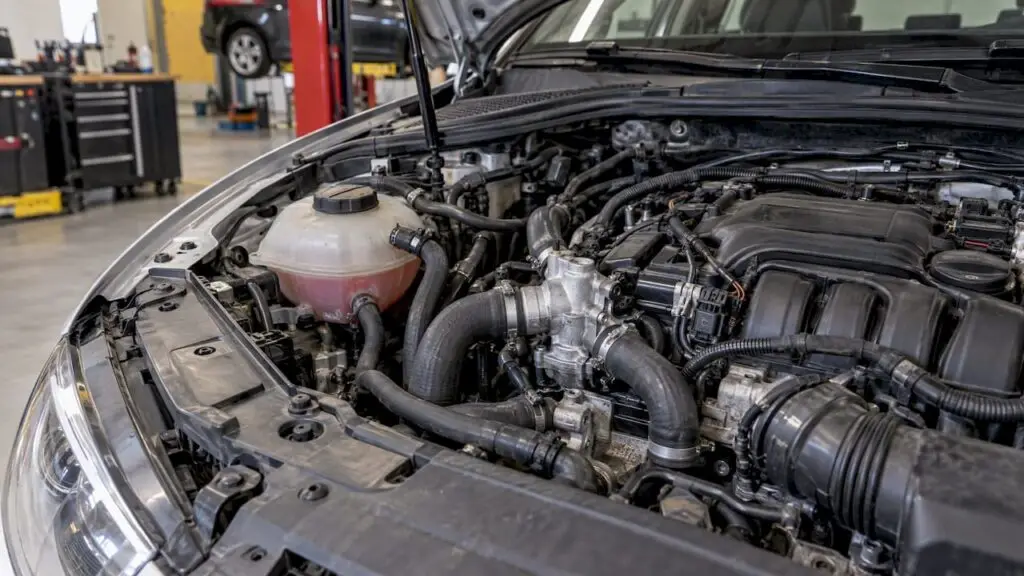
A failing Audi thermostat usually shows up as a coolant warning with the fans running, a check engine light, a temperature gauge that swings or sits low, or overheating. Audi’s own service bulletins tie some thermostat faults to the fault codes P218100 and P1BB400. If the gauge climbs or a red coolant warning appears, stop driving and have the car diagnosed. A thermostat is only one of several parts that cause these symptoms, so the cooling system should be tested before parts are replaced.
Below, we cover the symptoms, what else can look like a thermostat problem, how a technician confirms the diagnosis, when the car should not be driven, and what shapes the repair bill. Drivers across Dallas, from Oak Lawn and Uptown to the surrounding neighborhoods, bring us cars with exactly these complaints, especially during Texas summers when the cooling system works hardest.
TL;DR
- Typical signs: a red coolant warning, fans running at the wrong time, the check engine light, a gauge that stays low or spikes, and weak cabin heat.
- Audi bulletins link thermostat faults on certain models to codes P218100 and P1BB400. A code points to the circuit, not automatically to a bad part.
- Water pumps, leaking housings, hoses, fans and temperature sensors can mimic a bad thermostat. Pressure and temperature testing separates them.
- If the car overheats or the coolant is low, pull over and shut the engine off. Do not keep driving, and arrange a tow if the warning stays on.
- Cost depends on the engine, whether the thermostat is part of a housing or pump assembly, and the labor to reach it. We do not quote a figure without diagnosing the car.
Table of Contents
- What the thermostat does in an Audi
- Symptoms of Audi thermostat failure
- What else looks like a bad thermostat
- How a technician confirms a thermostat failure
- Can you drive with a failing thermostat?
- Why the repair is not a casual DIY job
- What affects Audi thermostat replacement cost
- Preventing thermostat and cooling problems
- Audi cooling system service in Dallas
- FAQ
- Sources
What the thermostat does in an Audi
The thermostat is a temperature-controlled valve in the coolant circuit. It stays closed while the engine warms up so the coolant heats quickly, then opens to send coolant through the radiator once the engine reaches operating temperature. On many modern Audis the engine control module also manages it electrically, so it can adjust the operating temperature for load and efficiency.
That means it can fail in two ways:
- Stuck closed: coolant never reaches the radiator properly, and the engine overheats, often on the highway or under load.
- Stuck open (or partly open): the engine runs too cool, takes a long time to warm up, and cabin heat is weak.
A third failure type is common on Audis: the housing around the thermostat leaks. On many engines the thermostat sits inside a plastic housing, and a crack or a failed seal causes a coolant loss without the valve itself being at fault.
Symptoms of Audi thermostat failure
Not every car shows every sign. Here is what to watch for, and what each usually means.
Warning lights and fault codes
Audi service bulletins for several V6 TFSI models describe a thermostat fault that shows up as the malfunction indicator lamp (MIL), a cooling fan that may run permanently, and stored codes including P218100. The same bulletin notes that replacing the coolant temperature sender does not fix that condition. For other listed Audi models, a thermostat fault may produce a red coolant warning with the fans running, or the MIL with P218100 and/or P1BB400.
Those bulletins cover specific models and years. Your own car may differ, so a scan of every control module is the starting point rather than a guess from a code list.
Temperature gauge behavior
- Gauge climbs above its normal range, then the car overheats: consistent with a thermostat stuck closed, but also with low coolant, a weak pump or a fan problem.
- Gauge takes a very long time to reach the middle, or never gets there: consistent with a thermostat stuck open. We cover this in detail in our guide to diagnosing a thermostat stuck open on European cars.
- Gauge moves up and down without a pattern: the valve may be sticking, or the sensor signal may be unreliable.
Heat, fuel economy and drivability
An engine that runs too cool often gives weak heat at the vents, especially on winter mornings, and may use more fuel because the control module enriches the mixture until the engine warms up. These signs are easy to ignore, but an engine that never reaches temperature wears faster and can store codes that trigger the check engine light.
Coolant loss, smell and residue
A sweet smell, low coolant level, or dried coolant residue around the thermostat housing suggests a leak. Audi coolant is typically tinted pink or purple, so crusty residue in that color near the engine’s coolant fittings is a clue. Leaks do not always drip on the ground, since coolant can evaporate off hot parts.
What else looks like a bad thermostat
This is where many repairs go wrong. Overheating and temperature swings have several common causes. An Audi A6 C5 guide lists low coolant or leaking hoses, faulty fan wiring or module, a stuck-closed thermostat, a faulty water pump, or radiator problems as the usual suspects. The principle applies broadly to European cars.
| Symptom | Thermostat | Other likely causes |
|---|---|---|
| Overheating under load | Stuck closed | Low coolant, failing pump, blocked radiator, fan fault |
| Slow warm-up, weak heat | Stuck open | Faulty temperature sensor, low coolant, heater core airflow issues |
| Coolant loss, no visible puddle | Leaking housing or seal | Hose, pump, radiator, intake-area leak, internal engine leak |
| Fans running constantly | Fault code or valve failure | Fan module, temperature sensor, low coolant |
| Check engine light | Thermostat plausibility codes | Sensor circuit, wiring, other engine faults |
Water pump and thermostat share a neighborhood
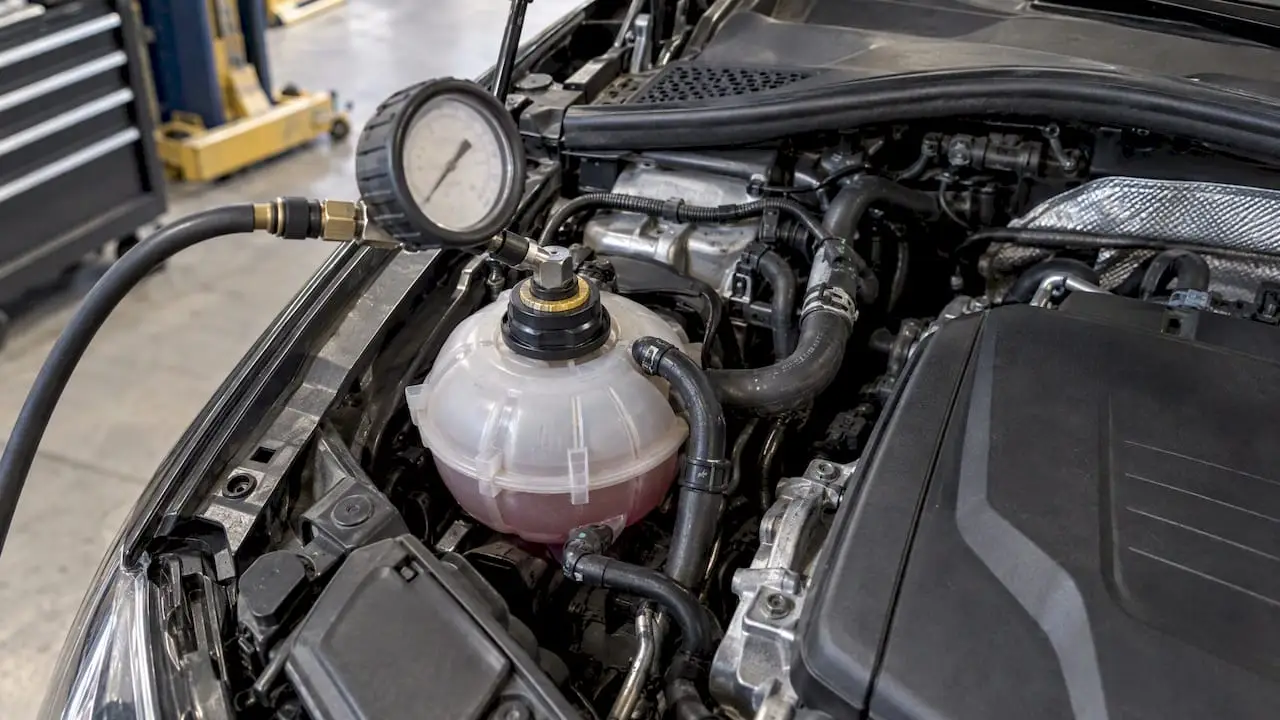
On many Audi engines the pump and thermostat housing sit close together or are built as one assembly. Audi bulletins say cooling system leaks often occur around the thermostat housing or water pump, and technicians are directed to perform a pressure check to confirm which component is leaking rather than replacing both. Another Audi bulletin adds that some pumps need a small amount of leakage to lubricate the slip ring seal, so a trace of coolant on a pump housing does not always mean the pump is failing.
The same logic applies to other brands we see. Our article on why shops test a VW water pump leak before replacing nearby parts walks through the process, and it carries over to Audi’s shared VW Group cooling designs.
A design issue, not just wear
Audi has also acknowledged thermostat problems that come from the part itself. One circular describes a modified thermostat housing for specified S5, RS5 and A8 models because thermostat opening-spring tolerances caused the condition. That is a reason to identify your exact engine and check for updated parts before ordering anything. If you want a broader view of how Audi problems cluster by system, this overview of common Audi problems by system is a reasonable companion read.
How a technician confirms a thermostat failure
A proper diagnosis follows a sequence. It avoids swapping parts hoping the symptom goes away, which is the pattern behind many repeat overheating complaints on forums.
- Scan all modules and read live data. We look at stored and pending codes, then at coolant temperature data as the engine warms. On Audis with electrically controlled thermostats, we also check the commanded versus actual temperature.
- Check the basics. Coolant level and condition, contamination, antifreeze strength, visible leaks and belt condition. Standard cooling system checks also include comparing temperatures before and after the thermostat, inspecting it in a water bath, checking pump operation and radiator flow, and testing the coolant temperature sensor.
- Pressure test the system. A cold pressure test finds slow leaks at the housing, hoses, pump and radiator. The test shows which part is leaking instead of assuming.
- Verify fans and flow. Fans should command on at the right temperature, and the radiator should heat evenly. A cold lower hose with a hot engine points toward a stuck-closed valve or flow problem.
- Confirm, then repair. Only after the test results line up do we recommend replacing the thermostat, the housing, or the pump assembly.
This is why professional diagnostics matter. A scan code tells you where the control module saw something implausible, not which part caused it. Dealer-level diagnostic tools and the experience to read the data separate a one-visit fix from a series of replacements.
Can you drive with a failing thermostat?
If the temperature gauge is climbing, a red coolant warning is showing, or the coolant level is low, do not keep driving. Guidance for an Audi A6 says not to drive with low coolant, and to pull over and turn the engine off if it begins to overheat. Drivers are also cautioned to stop immediately when an Audi overheats to avoid catastrophic engine damage.
Here is a practical way to think about it:
- Stop now and call for a tow: red coolant warning, gauge in the hot zone, steam, a strong sweet smell, coolant visibly pouring out, or the warning returning after you add coolant.
- Get it inspected soon, driving short and gently: check engine light with normal gauge readings, slow warm-up, weak heat, or fans running more than usual. Keep trips short and monitor the gauge.
- Never open a hot cooling system. Pressurized coolant can cause serious burns. Let the engine cool fully first.
In Dallas traffic on I-35E, the Tollway or Central Expressway, there is rarely a safe place to keep going on a hot engine. Pull to a shoulder or exit as soon as it is safe. Aluminum cylinder heads can warp from overheating, and head gasket damage turns a modest repair into an engine-level one. Towing is almost always cheaper than that.

Why the repair is not a casual DIY job
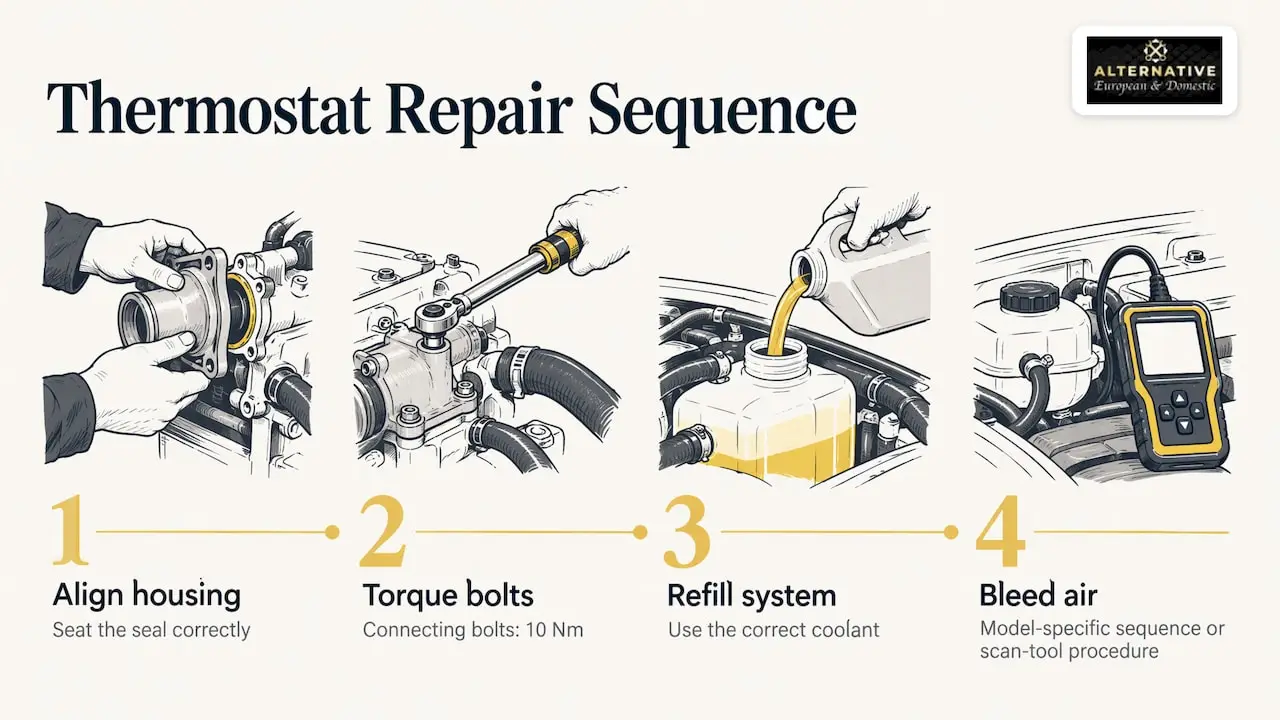
People ask whether an Audi thermostat can be replaced at home. On some models it is reachable, but the job rewards precision. On certain 2.0L TFSI engines, replacing the thermostat housing or pump requires precise alignment and specific torque values, often 10 Nm on the connecting bolts, to prevent leaks. Plastic housings crack when overtightened, and a new seal that sits slightly off will leak.
After the part is installed, the system also has to be refilled with the correct coolant and bled of air. Trapped air creates false overheating and hot spots. Many Audi cooling systems need a scan tool-assisted bleed procedure or a specific fill sequence. Because a wrong repair can end with an overheated engine, we recommend leaving this to a technician with the right tools and service information.
What affects Audi thermostat replacement cost
No single price fits every Audi, and we do not publish a flat figure because the cost depends on what the diagnosis finds. These are the factors that move the estimate:
- Engine and model: access differs sharply between a transverse 2.0T in an A3 and a V6 or V8 in an A6, A7, A8 or Q7.
- Part design: on some engines the thermostat is serviced as part of a housing or a water pump assembly, so the part is more than a simple valve.
- Labor time: intake components, covers and other parts sometimes have to come off to reach the housing.
- Related parts: seals, bolts, coolant, and sometimes the pump, if it is worn or leaking, should be addressed in the same visit when the testing supports it.
- Diagnostic time: pressure testing and data analysis come before any repair and prevent paying twice.
- Collateral damage: if the car was driven hot, the bill can also include head gasket or other engine work.
Ask any shop for an estimate that separates parts, labor, coolant and diagnostics. We explain what we found, show you what the testing supports, and let you decide, which is how we handle all of our work at Alternative European & Domestic.
Preventing thermostat and cooling problems
Thermostats are wear items, and plastic housings degrade with heat cycles. You cannot stop that, but you can catch problems early:
- Check coolant level periodically when the engine is cold, and investigate any drop instead of topping off repeatedly.
- Use the coolant specification Audi calls for. Mixing incompatible coolants can create deposits.
- Replace aging hoses, and look at the housing area during oil services.
- Do not ignore a check engine light or a slow warm-up.
- Follow a maintenance plan that includes cooling system inspections, especially if the car sees heavy stop-and-go traffic or summer heat.
The same preventive approach we recommend for other European makes applies here. Our article on BMW coolant leaks and the 60,000 to 80,000 mile refresh shows how plastic cooling parts age, and our look at Audi oil consumption causes and testing is worth a read if your car also has other engine concerns.
Audi cooling system service in Dallas
Alternative European & Domestic is a Texas-based shop for European, domestic and high-performance vehicles. Our ASE-certified technicians use dealer-level diagnostics to test the cooling system, find the actual failed part, and explain the result before any repair begins. Qualifying repairs may be covered by our 24-month/24,000-mile warranty, subject to applicable terms.

If your Audi is running hot, warming up slowly, or showing a coolant warning, you can schedule an appointment for a diagnostic evaluation, or look over our full list of services, including engine repair, heating and cooling, and the Texas state inspection.
FAQ
How do I know if my Audi thermostat is bad?
Look for a red coolant warning, fans running at odd times, a check engine light, a gauge that stays low or spikes, and weak heat. On some models, Audi bulletins associate thermostat faults with codes P218100 and P1BB400. Because a pump, leak or sensor can cause the same signs, the car needs testing to confirm.
Why is my Audi overheating after the thermostat was replaced?
The thermostat may not have been the original problem. Low coolant, trapped air after refilling, a leaking housing or pump, a fan fault or a blocked radiator can all cause overheating. A pressure test and a check of the bleed procedure usually find the cause.
Can I drive my Audi with low coolant?
No. Low coolant lets the engine overheat quickly, and overheating can cause costly damage. If the gauge climbs or a warning appears, pull over, shut the engine off, let it cool, and arrange a tow if the coolant level stays low or the warning returns.
Can I replace an Audi thermostat myself?
It is not a job we recommend for home repair. Housings are plastic and sensitive to torque and alignment, and the system must be refilled and bled correctly afterward. An incorrect repair can leave a leak or air pocket that leads to overheating.
How much does Audi thermostat replacement cost?
It depends on the engine, whether the thermostat comes with a housing or pump assembly, the labor to reach it, and any related parts the testing shows are needed. We diagnose the car first and give an itemized estimate so you know what you are paying for.
Sources
- Audi technical bulletin on V6 TFSI thermostat faults and code P218100 (NHTSA, 2020)
- Audi technical bulletin on thermostat warnings and codes P218100 and P1BB400 (NHTSA, 2023)
- Audi circular on modified thermostat housing for S5, RS5 and A8 (NHTSA, 2017)
- Audi technical bulletin on coolant leaks, pressure checks and torque specifications (NHTSA, 2021)
- Audi circular on coolant pump slip ring seal leakage (NHTSA, 2017)
- Audi A6 C5: Why is My Car Overheating? (Audiworld)
- Cooling system check, troubleshooting and diagnostics (HELLA)
- Coolant system problems: overheating diagnosis and fixes (WW Spares)
- Common Audi problems by system