
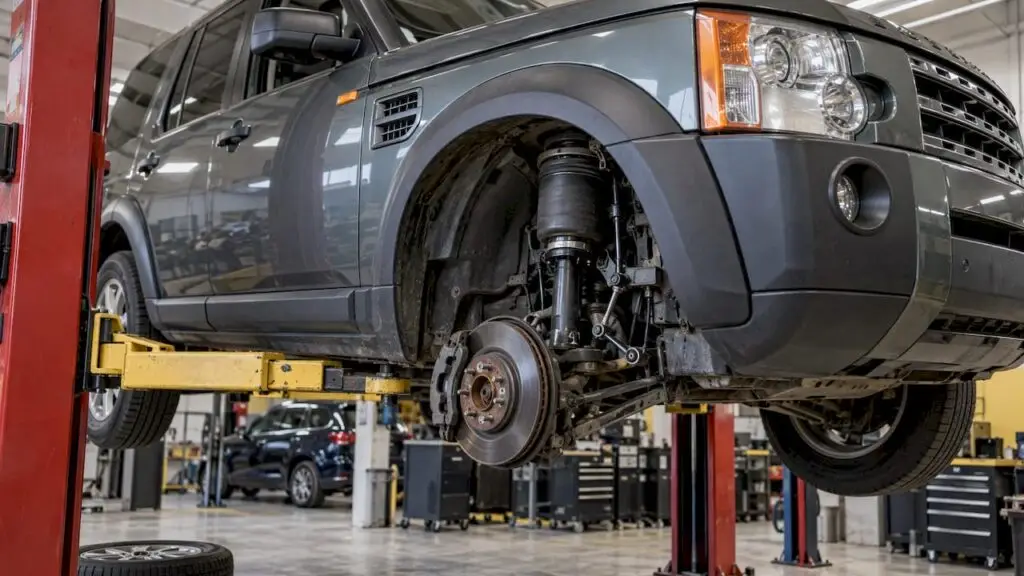
A Land Rover or Range Rover air suspension fault message means the air-suspension control module has detected a problem and has stored a fault code. What you do next depends on the color of the lamp and the wording on the dash. An amber warning means the vehicle can still be driven normally. A flashing red warning means a serious fault, so drive carefully. “Stop safely, stop engine” means pull over immediately. In every case the fix starts with reading the codes, not replacing parts. Drivers in Oak Lawn, Uptown and across Dallas often ask us about this, so here is how we approach it at Alternative European & Domestic.
TL;DR
- Amber “Suspension Fault” means a fault is stored but normal driving is still possible. Get it scanned soon.
- A flashing red lamp, a reduced speed limit or a “stop safely” message means limit driving or stop. Call for a tow if the vehicle sits visibly low, tilted or will not hold height.
- “Air suspension inactive” usually means the module cannot confirm ride height or cannot lower the vehicle, and it limits speed as a precaution.
- Common causes are air leaks, worn air springs, a failing compressor or valve, ride-height sensor faults, poor electrical connections and software issues. Codes point to the circuit, not always the part.
- Resetting or clearing the message without finding the cause usually brings it back. Diagnose first.
Table of Contents
- What the warning messages mean
- Is it safe to keep driving?
- What commonly causes an air suspension fault
- How a proper diagnosis works
- Can you reset the fault yourself?
- Warning signs before the message appears
- What affects the repair cost
- Preventive habits that protect the system
- Air suspension diagnostics at Alternative European & Domestic
- FAQ
- Sources
What the warning messages mean
Air suspension on these vehicles is controlled by a module that reads ride-height sensors, commands a compressor and a valve block, and inflates or vents each air spring. When any of those signals fall outside what the module expects, it logs a diagnostic trouble code (DTC), lights a warning and often restricts the system.
The wording matters. Based on Land Rover’s own service documentation, the common messages break down like this:
| Message or lamp | What it means | What to do |
|---|---|---|
| Amber warning lamp | A fault is present, but the vehicle can still be driven normally | Book a diagnostic visit soon |
| Flashing red warning lamp | A serious fault | Drive carefully, with a speed limit if one is shown, until you can get qualified help |
| “Suspension fault, normal height only” | A fault was detected and only normal height is available | Seek qualified assistance immediately |
| “Suspension fault, stop safely, stop engine” | A major component failure | Stop immediately and arrange help |
| “Air suspension inactive” (often with a speed limit) | The system is shut down and restricted | Limit speed, avoid highways, get it scanned |
The first four rows reflect Land Rover’s 2017 air suspension service documentation, which describes an amber lamp as a fault where the vehicle can still be driven normally, a flashing red lamp as a serious fault, and the “stop safely” message as a reason to stop at once. A separate Jaguar Land Rover technical bulletin from 2017 adds that an amber warning may leave performance unchanged while preventing the vehicle from lowering, while a red warning can mean the vehicle is above nominal height and cannot lower, with a “do not exceed 30 MPH” instruction.
Messages vary by model and year. A Discovery 3, an LR4, a Range Rover L322 and a current L460 do not all word things identically, so treat the table as a guide to severity, not a dictionary.
What “air suspension inactive” tells you
This message usually appears when the module can no longer trust or control ride height. Typical triggers are a sensor reading that makes no sense, a vehicle that has settled low overnight and cannot raise itself, or a compressor that is not delivering. The speed limit that comes with it exists because a vehicle at the wrong height, or one that cannot adjust, handles differently and can scrape or bottom out.
The inactive message is a symptom, not a diagnosis. It tells you the system has given up, not which of a dozen parts caused it.
Is it safe to keep driving?
Use this as a decision guide:
- Amber lamp, vehicle sits level and drives normally. You can usually drive to a shop. Avoid long trips, heavy loads and off-road use until it is scanned.
- Amber lamp, but the vehicle is stuck in one height. It may ride harsher or sit higher than usual. Drive gently and have it checked within days, not weeks.
- Flashing red lamp or a speed limit message. Slow down, stay off highways where you can and head straight to a shop if the vehicle is level enough to drive safely.
- “Stop safely” message, or the vehicle is visibly low at one corner, tilted, or sitting on its bump stops. Do not keep driving. Pull off the road and arrange a tow.
Towing is the right call when the body is resting low on a corner, tires rub the fenders, the steering feels vague or the vehicle will not stay at a safe height. Driving on a collapsed air spring can damage the tire, the spring itself and surrounding components, which turns a modest repair into a larger one. If you are unsure, a tow is cheaper than a wheel-well repair.
If the message appears alongside other warnings, such as charging or stability control lamps, the fault may be electrical. Our guide to what different service lights mean and when to stop or tow covers how to read the pattern, and our page on battery warning lights explains why low voltage can trigger several messages at once.
One safety item deserves a mention for owners of older models. NHTSA lists a recall covering certain 2014 to 2017 Range Rover and Range Rover Sport vehicles for a cracked front suspension upper knuckle that can detach the arm and cause loss of handling and control, with dealers installing a retaining bracket or replacing the knuckle at no charge. It is a different issue from air suspension, but if you own one of those vehicles, check your VIN for open recalls whenever a suspension warning appears.
What commonly causes an air suspension fault
Air suspension is a closed network of air springs, lines, a valve block, a compressor, height sensors and a control module. Faults tend to fall into five groups.
Air leaks
Air springs are rubber bellows that flex thousands of times and age with heat, road salt and moisture. A small pinhole or a cracked fold makes the compressor run more often to compensate, which eventually triggers a fault or wears the compressor out. Leaks also occur at airline fittings, at the valve block and along the lines where they run from the engine bay to the chassis. The typical symptom is a corner that sags overnight or after sitting for a few hours.
Compressor and valve problems
The compressor builds pressure, and a valve vents it. When either is weak or sticking, the system cannot reach or hold target height. Land Rover has documented specific cases: a 2015 technical bulletin linked codes C1A13-64, C1A36-01 and C1A24-67 to an exhaust valve that could stick inside the compressor because of a manufacturing issue. Note that a compressor working overtime because of a leak looks a lot like a failing compressor, which is why a leak check comes before a compressor replacement.
Ride-height sensors
Each corner has a sensor that reports how far the body sits from the axle. According to Monroe’s air suspension diagnostic guidance, a failed sensor can change the ride height, set height-related error codes and reduce the system’s ability to adjust. Symptoms such as a vehicle that sits oddly yet shows no leak often lead to the sensor circuit.
Electrical connections and modules
This group surprises owners. A 2022 bulletin covering 2018 to 2023 model year Range Rover vehicles says an amber suspension warning can come from a poor connection when code C105A-01 or C105B-01 is stored in the Chassis Control Module, and it tells technicians not to replace parts before following the published diagnostic steps. Corrosion at a connector, a weak ground or low battery voltage can all produce a suspension message without any failed air component.
Software and calibration
Some faults are not hardware at all. A 2017 bulletin describes intermittent “Suspension fault, drive with care” or “Adaptive dynamics fault” messages with code U3000-04 as a software calibration issue, fixed by reconfiguring the module, with further diagnosis needed if the code returns. For certain 2014 models, a 2015 bulletin says a fault that appeared only at elevations of 9,000 feet or higher could be software related. On newer L460 and L461 vehicles, a 2023 bulletin ties a “stop safely and switch off, suspension fault detected” message to codes U3000-49 and B1646-01, with a test and possible software update as the path.
These are manufacturer service documents for specific model years. They show the range of causes, and they are not a list of what is wrong with your vehicle until it has been scanned.
How a proper diagnosis works
Guessing is expensive on air suspension. A compressor can cost several times what a sensor does, and replacing it when a leak is the real cause just burns out the new one. The order below avoids that.
- Interview and visual check. When does the message appear? Is it intermittent, after sitting overnight or after a cold start? We look at ride height at all four corners, air lines, connections, the air springs and any component damage. Monroe’s guidance suggests the same checks, plus noting rough or bouncy ride quality and unusual clicking, hissing or grinding.
- Power supply and battery test. A weak battery distorts module behavior. Manufacturer procedures for module work call for a stable external power supply during diagnosis and programming, and the 2015 compressor bulletin above specifically calls for an approved battery power supply during SDD diagnosis or module programming.
- Read and record the codes. A scan tool pulls DTCs from the air suspension and chassis modules. Codes reveal things like sensor signals out of range, valve block problems or communication loss between the module and its components. We record them before clearing anything, so the history is not lost.
- Plausibility and live data. The module checks whether signals behave sensibly, for example whether average height changes as commanded and whether it changes fast enough. Watching live data shows which corner is slow to respond and whether the compressor is running too long.
- Leak test. With the system pressurized, we check lines, fittings, the valve block and each spring. A soapy water solution on a connection shows bubbles where air escapes. Finding the source first is the same principle behind tracing a car odour back to its origin instead of masking it.
- Electrical checks. Voltage drop at connectors, ground integrity and wiring continuity. Our article on how ASE shops test advanced electrical faults shows what this involves.
- Repair, then verify. After the repair we clear codes, cycle the system through its height range, and road test to confirm the fault does not return.
A warning for the DIY-minded: air springs and lines hold pressure, and lifting a vehicle with a faulty system can drop it unexpectedly. Leave the work to a trained technician with the right equipment, and do not crawl under a vehicle that has lost air.
As a reference for the same diagnostic logic on another European platform, we explain the leak-first order in our piece on Mercedes AIRMATIC problems. The principle carries across brands: find the leak or electrical cause before you buy a compressor.
Can you reset the fault yourself?
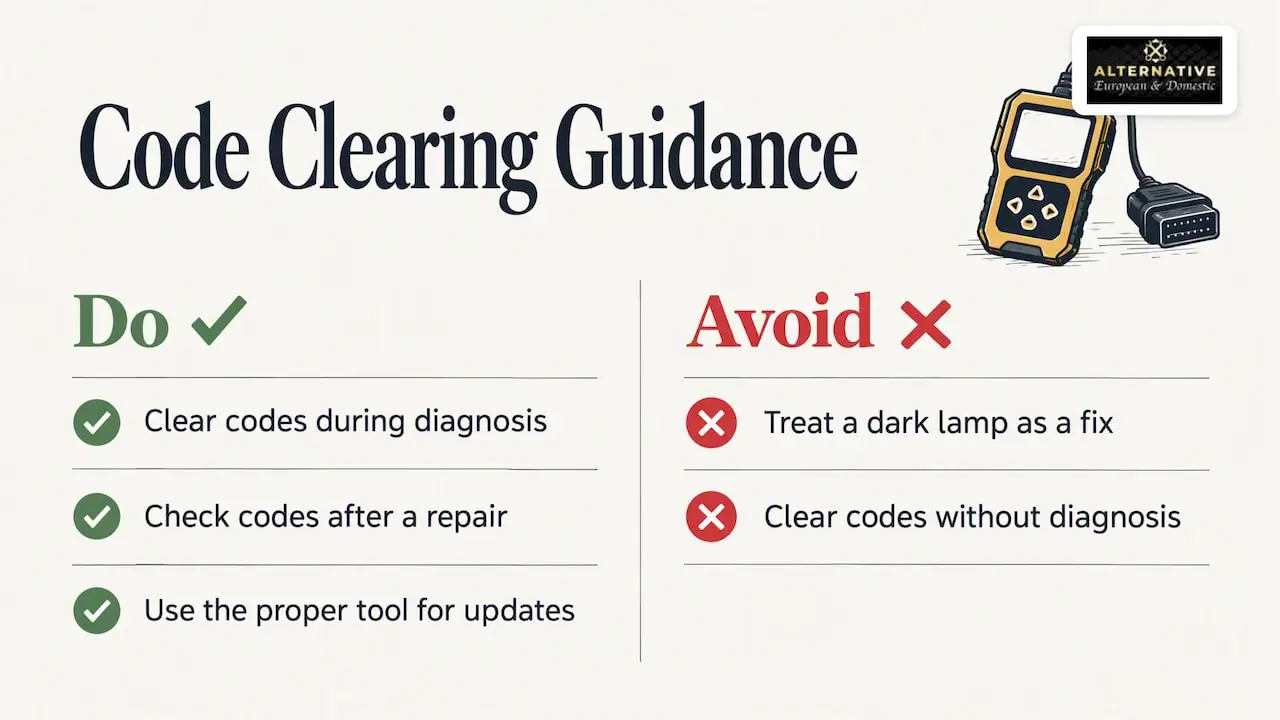
You can sometimes make the message disappear. A key cycle, a battery disconnect or a scan tool clear may turn off the lamp for a while. That does not mean the problem is gone. If a leak, a sensor or a connection is behind the fault, the module will re-detect it, often within a drive cycle or after the vehicle sits overnight.
Clearing codes is useful at two points: during diagnosis, to see which codes come back immediately, and after a repair, to confirm it held. Clearing without diagnosing erases information a technician needs, such as freeze-frame data. It can also hide a developing leak until the vehicle sits on its bump stops at a gas station.
There is one case where a software step is the actual fix: the calibration issues in the bulletins above. Even there, the procedure is a module reconfiguration or update with the proper tool, followed by a check that the code does not return, which is a shop task and not a reset.
Warning signs before the message appears
Air suspension often tells you something is wrong before the dash does. Watch for:
- One corner lower than the others after the vehicle sits
- The compressor running longer or more often than before, or running after the vehicle is off
- A slow rise when you start the vehicle, or a delay changing height modes
- Harsh, floaty or bouncy ride quality
- Clicking, hissing or grinding noises from the suspension area
- Intermittent amber messages that clear on their own
Intermittent faults are the ones owners tend to ignore, and they are often the cheapest to fix when caught early. A small leak caught now spares the compressor.
What affects the repair cost
We do not publish fixed prices for this work, because the range is wide and depends on what the diagnosis finds. The main cost factors:
- What failed. A connector or ground repair is a different job from an air spring, a valve block or a compressor.
- How many parts. Springs age at similar rates, so a second one may follow the first. A technician can tell you which parts show wear and which are fine.
- Vehicle and model year. Access, parts and module programming differ between a Discovery, a Range Rover Sport and a newer L460.
- How long it was driven with the fault. A compressor run to failure by an unaddressed leak adds cost.
- Diagnostic time. Intermittent faults take longer to chase than a fault that is present on arrival.
Ask for a written estimate that separates diagnosis, parts and labor. Our list of questions to ask a mechanic shows what to request before you approve work, and our comparison of dealer diagnostics versus an independent shop can help you decide where to start.
Preventive habits that protect the system
- Have the suspension inspected during routine service, including springs, lines and ride-height behavior.
- Keep the battery healthy. Low voltage causes odd messages across several modules.
- Do not ignore an amber message because the vehicle still drives fine.
- Rinse salt and grime from the underside after winter travel, and avoid pressure-washing directly at air fittings.
- When changing tires or lifting the vehicle, tell the technician it has air suspension so the system is put in the correct mode.
- Address small leaks early, before they overwork the compressor.
For Dallas drivers, summer heat is hard on rubber, and stop-and-go traffic on routes like the Dallas North Tollway keeps the system cycling. Regular inspection is cheaper than a roadside tow.
Air suspension diagnostics at Alternative European & Domestic
If your Land Rover or Range Rover is showing a suspension message, we start with a scan and a hands-on inspection, then explain what we found before any repair begins. Our ASE-certified technicians work on European, domestic and high-performance vehicles, and we aim to give you clear communication at each step. Qualifying repairs may be covered by our 24-month/24,000-mile warranty, subject to applicable terms.

You can see everything we handle on our services page, including electrical system work, check engine diagnosis, shocks and struts and battery replacement. If the vehicle is low, tilted or showing a “stop safely” message, do not drive it in. Arrange a tow and call us from the roadside.
Drivers in Oak Lawn, Uptown and nearby Dallas neighborhoods can contact Alternative European & Domestic to schedule a diagnostic evaluation before a small fault becomes a large repair.
FAQ
What does it mean when the air suspension light comes on?
It means the control module has detected a fault and stored a code. An amber lamp indicates a fault where the vehicle can still be driven normally, while a flashing red lamp indicates a serious fault. Either way, the cause could be a leak, a sensor, a compressor, a connection or software, so it needs a scan.
How do I know if my Land Rover’s air suspension is bad?
Look for a corner that sags after parking, a compressor that runs often, a rough or bouncy ride, unusual hissing or clicking and recurring dash messages. A visual check of air lines, connections and springs, followed by a code scan and a leak test, confirms which part is at fault.
How do I reset a Range Rover suspension fault?
A key cycle or scan tool clear may turn off the message, but it will return if the cause remains. The correct approach is to read and record the codes, repair the cause, then clear the codes and verify with a road test. Some software-related faults need a module reconfiguration with the right tool.
What are the symptoms of a bad ride-height sensor?
A failing sensor can change the ride height, set height-related codes and reduce the system’s ability to adjust height. The vehicle may sit unevenly with no sign of a leak. A technician confirms it with live data and circuit checks, not by swapping parts.
Can I drive with an air suspension fault?
With an amber lamp and a level vehicle, usually yes, for a short trip to a shop. With a flashing red lamp, a speed limit or a “stop safely” message, limit speed or stop. If the vehicle sits low or tilted, have it towed.
Sources
- Land Rover air suspension service documentation (2017)
- Jaguar Land Rover technical bulletin on amber and red suspension warnings (2017)
- NHTSA recall notice for 2014 to 2017 Range Rover front suspension knuckle
- Jaguar Land Rover bulletin on compressor exhaust valve codes (2015)
- Monroe guide to diagnosing common air suspension problems
- Jaguar Land Rover bulletin on C105A-01 and C105B-01 (2022)
- Jaguar Land Rover bulletin on software calibration and U3000-04 (2017)
- Jaguar Land Rover bulletin on high-elevation suspension faults (2015)
- Jaguar Land Rover bulletin on L460 and L461 suspension fault (2023)
- Diagnosing the source of car odour