

Audi’s own guidance treats oil use of up to about 1 quart per 1,000 miles as normal, though many independent mechanics consider anything beyond 1 quart per 500 miles a problem. The usual causes are stuck or worn piston rings, a failing PCV (crankcase ventilation) valve, worn valve seals, turbocharger seals, or external leaks. The only way to know which one you have is a measured consumption test and a proper diagnosis, not a guess.
At Alternative European & Domestic, we see this question from Audi owners across Dallas, from Oak Lawn and Uptown to the neighborhoods around them. This guide explains what is normal, what is not, and what a sensible repair path looks like.
TL;DR
- Up to 1 quart per 1,000 miles is what Audi’s specification is commonly reported to allow. Needing a quart every 500 miles or less deserves a diagnosis.
- Common causes: piston rings, PCV valve, valve seals, turbo seals, and leaks. A leak is not the same as burning oil, and the fix differs.
- Measure first. Track the dipstick or the oil level readout over a set distance before paying for any repair.
- Never let the level run low. Low oil can destroy an engine. If the oil pressure warning appears, stop driving.
- Repairs range from replacing a PCV valve to rebuilding piston rings. A diagnosis tells you which one applies.
Table of Contents
- What counts as normal oil consumption in an Audi
- Why Audi engines burn oil
- Symptoms that point to a problem
- When not to drive, and when to tow
- How a shop tests oil consumption properly
- Repair options and what they involve
- Warranty, dealer position, and what to document
- Preventing excess oil use
- How Alternative European & Domestic handles it
- FAQ
- Sources
What counts as normal oil consumption in an Audi
Every engine uses some oil. A thin film stays on the cylinder walls, and a small amount burns off with each combustion cycle. Turbocharged, direct-injected engines such as Audi’s TFSI and TDI-era designs run hotter and at higher pressure than a naturally aspirated engine, so they tend to use more.
The figure most owners hear from dealers is the one above: up to 1 quart per 1,000 miles. A published guide on Audi oil consumption reports that same allowance, along with the view among many technicians that it is generous. We would put it this way:
| Consumption rate | What it usually means | What we suggest |
|---|---|---|
| Less than 1 quart per 3,000 miles | Typical for most healthy engines | Check the level at every fuel stop for the first few weeks, then monthly |
| About 1 quart per 1,000 to 3,000 miles | Elevated, often early ring or PCV wear | Diagnose at your next service |
| 1 quart per 500 to 1,000 miles | Within the loosest factory allowance but costly and risky over time | Schedule a diagnostic evaluation |
| More than 1 quart per 500 miles | Likely a mechanical fault | Book soon and keep oil topped up until then |
These bands are our shop guidance for deciding when to look deeper. They are not an Audi specification, and your owner’s manual and warranty terms govern anything involving a claim.
Why Audi engines burn oil
Piston rings and carbon
Piston rings seal the combustion chamber and scrape excess oil off the cylinder wall. When ring grooves collect carbon and baked-on oil deposits, the rings can stick and stop sealing properly. Oil then passes into the combustion chamber and burns. Turbocharged direct-injection engines are prone to this because of high cylinder temperatures and short trips that never fully heat the oil.
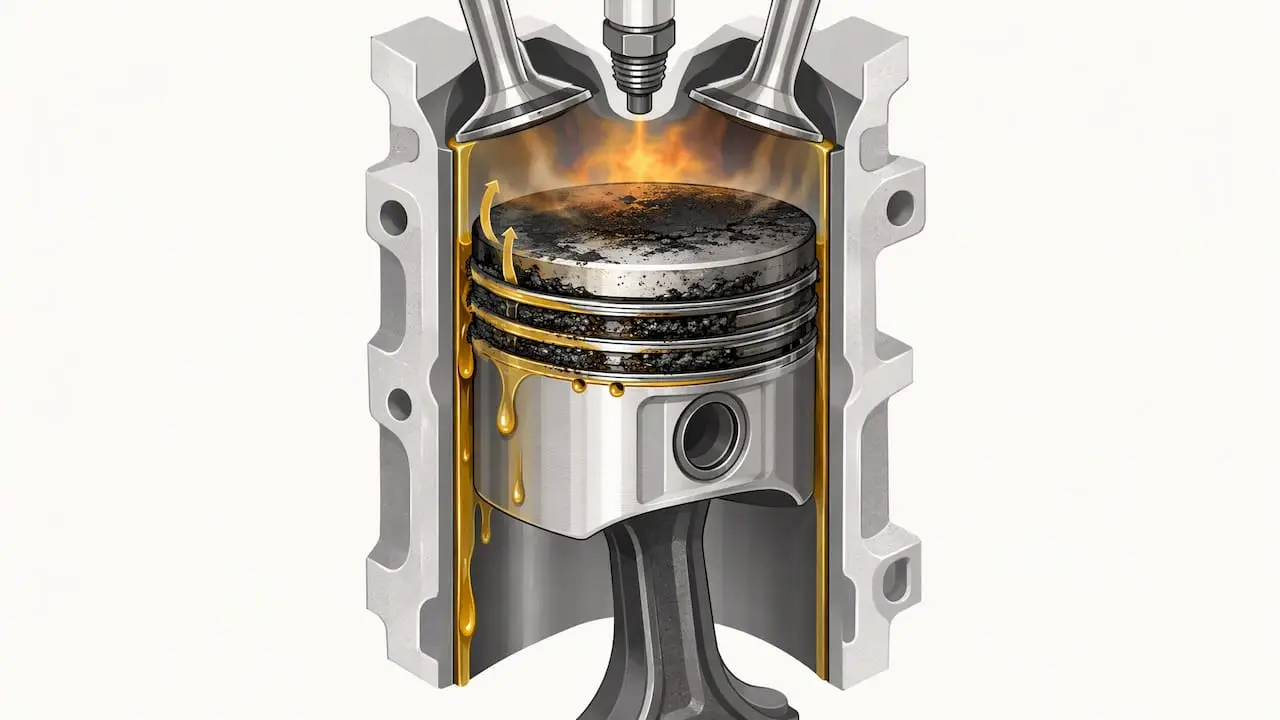
This is the most discussed cause on the 2.0T. A March 2026 report on a class action alleges that EA888 2.0-liter engines in several Audi and Volkswagen models consume too much oil because of defective piston rings. These are allegations in a lawsuit, not findings. If your Audi is in the affected years, check the case details and your warranty status before choosing a repair.
PCV and crankcase ventilation
The PCV system routes crankcase vapor back into the intake so pressure does not build inside the engine. A failed diaphragm or a clogged passage can pull oil vapor into the intake, or push oil past seals. Of all the causes, this is often the cheapest to fix, which is why we check it early.
Valve stem seals
Worn valve seals let oil seep down the valve stems. The classic sign is a puff of blue-gray smoke on startup after the car has sat overnight, or after long deceleration.
Turbocharger seals
A worn turbo can leak oil into the intake or exhaust. Signs include smoke under boost, oil in the intercooler piping, and a drop in performance. Turbo work is a specialty repair, and we would never replace one without confirming the cause.
Fuel dilution and the “missing” oil that is not missing
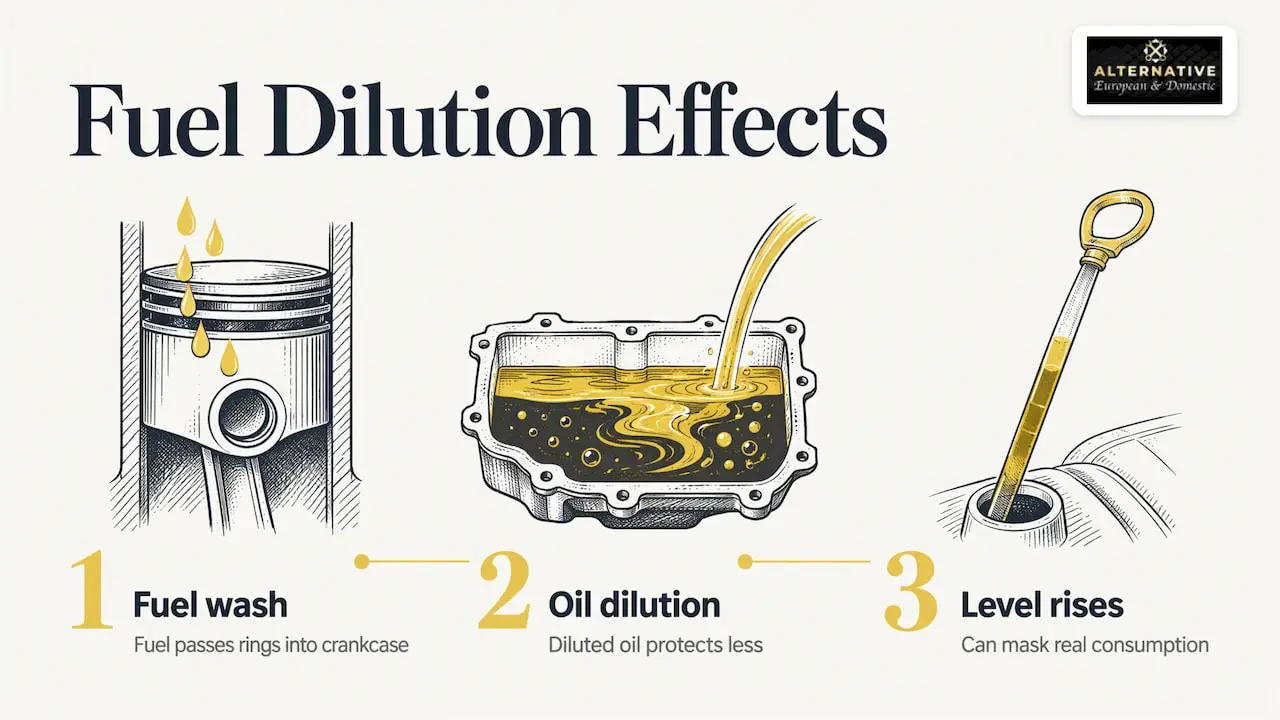
On direct-injection engines, fuel can wash past the rings into the crankcase. An SAE study of turbocharged gasoline direct-injection engines examined how fuel injection affects dilution of crankcase oil. The practical lesson: a dipstick that reads fine does not always mean the oil is healthy. Diluted oil protects less and can raise the level, masking real consumption.
External leaks
Valve cover gaskets, oil filter housings, oil cooler seals, and the rear main seal all leak on aging Audis. A leak leaves spots on the driveway or oil residue on the engine and undertray. A car that burns oil leaves no puddles, but may show smoke, fouled spark plugs, or a failing catalyst over time. Both problems can exist at once.
Symptoms that point to a problem
- You add oil between scheduled changes more than once.
- The oil level warning or low oil message appears before the next service.
- Blue-gray smoke from the tailpipe, especially at startup or under hard acceleration.
- A burning smell after a drive, which may be oil on a hot exhaust.
- Misfire codes or rough running from oil-fouled spark plugs or coils.
- Oil residue around the filler cap, intake piping, or intercooler hoses.
If a Check Engine light also appears, our guide to service and warning light meanings explains which lights mean you can keep driving and which mean you should stop or tow.
When not to drive, and when to tow
Oil is the one fluid you cannot ignore. Park the car and do not restart it if:
- the red oil pressure warning illuminates while driving,
- the dipstick or level readout shows empty or below the minimum mark,
- you hear knocking or ticking that was not there before,
- oil is visibly pouring from under the car or smoke is coming from the engine bay.
In these cases, towing is the right call. A tow costs far less than a replacement engine. If the level is merely low and no warning is on, add the correct oil grade for your engine from your owner’s manual and bring the car in promptly. Do not keep adding oil and driving indefinitely.

How a shop tests oil consumption properly
Guessing from “I top off every month” does not tell you much. A real test is measured. This is the sequence we follow for an Audi that appears to be using oil:
- Confirm the baseline. Check the oil type and service history. The wrong viscosity or a missed change can change consumption.
- Inspect for external leaks. Look at the valve cover, oil filter housing, oil cooler, turbo lines, and rear main seal, ideally with the car on a lift.
- Scan for codes and live data. Advanced diagnostics can reveal misfires, fuel trims, and ventilation faults tied to oil use.
- Check the PCV system. Test the valve and the hoses and passages for restriction or failure.
- Set a measured oil level. Fill to the full mark on a level surface, record the odometer, and track the level over an agreed distance.
- Inspect spark plugs and look for fouling. Oil on one or more plugs helps narrow the cylinder or cause.
- Evaluate compression or leak-down when warranted. This tests whether rings and valves are sealing.
- Inspect the turbo and intake tract for oil carryover if boost-related symptoms exist.
This is why professional diagnostics matter: the same symptom, a low dipstick, can come from a $50 part or a rebuild. Paying for a test first keeps you from paying for the wrong repair.
Repair options and what they involve
| Cause | Typical repair | What to expect |
|---|---|---|
| PCV valve or hoses | Replace the valve or breather components | Often the least invasive fix, and sometimes it resolves consumption entirely |
| Oil leak | Replace the failed gasket, seal, or housing | Cost depends on access, and some seals take a lot of labor |
| Valve seals | Replace valve stem seals | Labor-intensive, usually done with the cylinder head partly or fully accessed |
| Stuck rings, mild | Oil system service and a chemical or soak treatment | Sometimes helps, but results vary, and it is not a guaranteed cure |
| Worn or defective rings | Engine disassembly and replacement of pistons or rings | The most involved repair, and where updated parts matter |
| Turbo seals | Rebuild or replace the turbo | Confirm the cause first, and check the intake for contamination |
We do not publish prices for these jobs because they vary by engine, model year, and findings. After a diagnosis, you get a written estimate that separates what is urgent from what can wait. Our guide on questions to ask a mechanic explains how to review that estimate with any shop.
The 2.0T and other turbo engines also depend on healthy ignition. Misfires from worn plugs add stress and can mimic consumption symptoms, so see our notes on the spark plug interval for performance cars.
Warranty, dealer position, and what to document
Before you pay for a major repair, find out whether your car is still covered. Audi and dealers commonly require a documented consumption test, and results often decide whether a repair is approved. One independent shop’s article on how warranty coverage depends on oil consumption testing walks through that process in more detail.
To protect yourself:
- Keep every oil change receipt, with the date, mileage, and oil specification.
- Record each time you add oil, with the odometer reading.
- Follow the interval in your owner’s manual. Audi publishes owner’s manuals and maintenance literature for U.S. models.
- Ask for any consumption test result in writing.
If the engine you drive is in a class action, stay informed. A lawsuit does not change what your engine needs today, and low oil never waits for a court.
Preventing excess oil use
You cannot make a ring design flaw disappear, but you can reduce the factors you control:
- Use the oil your engine calls for. Audi specifies oil approvals by engine, and the correct grade matters for rings and turbo bearings. Your manual lists it.
- Do not stretch change intervals. A long interval can leave oil that is degraded or fuel-diluted. Texas heat and stop-and-go Dallas traffic count as severe use, so we lean toward shorter intervals on turbocharged engines.
- Avoid constant short trips. Oil that never reaches full temperature collects fuel and moisture.
- Let a turbo cool. After a hard run, a short easy drive before shutdown helps the turbo bearings.
- Check the level regularly, especially before long highway trips. Do not rely only on the dash display.
- Replace PCV components on schedule or when symptoms start.
For a broader view of what Audi ownership costs year to year, read our Audi annual maintenance cost breakdown.
How Alternative European & Domestic handles it
We work on European, domestic, and high-performance vehicles, including Audi, and our technicians are ASE-certified. For a car that uses oil, we start with the measured diagnosis above, explain what we find in plain language, and give you an estimate before work begins. You decide what goes ahead.
Two service pages cover the most relevant work: oil change and engine lubrication services for correct-spec oil and level monitoring, and engine repair services for ventilation, seal, and internal repairs. Our maintenance service covers custom plans for keeping a turbocharged engine reliable.
Repairs that qualify can carry our 24-month/24,000-mile warranty, subject to the applicable terms. Ask us how it applies to your specific job.
If your Audi is losing oil, schedule an appointment with Alternative European & Domestic for a diagnostic evaluation. Dallas drivers from Oak Lawn, Uptown, and beyond can bring the car in before a small problem becomes an engine replacement.
FAQ
Why does my Audi burn so much oil?
The most common reasons are stuck or worn piston rings, a failing PCV valve, worn valve seals, and turbo seal wear. Turbocharged direct-injection engines run hot, which encourages carbon buildup around the rings. A diagnostic test tells you which cause applies to your car.
How much oil consumption is normal for an Audi?
Audi’s specification is commonly reported as up to 1 quart per 1,000 miles. Many technicians treat a quart every 500 miles or sooner as a clear sign of a fault. Check your owner’s manual and warranty documents for the terms that apply to your car.
Can I fix Audi oil consumption without rebuilding the engine?
Sometimes. If the cause is a PCV valve, an external leak, or worn valve seals, a targeted repair can solve it. Stuck rings may respond to treatment in mild cases, but worn or defective rings generally need internal work. Diagnosis comes first so you do not pay for a repair that will not help.
Is it safe to keep driving if my Audi uses oil?
Only if you check the level often and keep it between the marks. If the oil pressure warning comes on, the level reads empty, or you hear new engine noise, stop driving and have the car towed. Running low on oil can cause severe engine damage.
Is there a lawsuit over Audi oil consumption?
A class action filed in 2026 alleges that 2.0-liter TSI engines in certain Audi and Volkswagen models consume oil because of defective piston rings. The claims are allegations. Keep your service records and ask a qualified attorney about your rights.
Sources
- Impact of Fuel Injection on Dilution of Engine Crankcase Oil for Turbocharged Gasoline Direct-Injection Engines (SAE)
- VW 2.0-Liter TSI Engine Problems Cause Class Action Lawsuit (CarComplaints.com)
- Audi Excessive Oil Consumption Guide (AudiVolt)
- Audi owner’s manuals and literature (Audi of America)