
Most Porsche owners in the United States should budget a moderate to high amount annually for maintenance, typically increasing significantly in years that include a major service or brake job. Where you land in that range depends on your model, whether you’re still under warranty or on a Porsche Scheduled Maintenance Plan, and how hard you drive the car. The sections below break down exactly why the range is so wide and how to plan around it.
TL;DR:
- Most Porsche owners in the U.S. should expect to spend between $1,000 and $2,500 annually on routine maintenance, with significant increases in years requiring major services.
- Costs vary depending on the model, age, warranty status, driving style, and parts sourcing, with older out-of-warranty cars facing higher unplanned repair risks.
- Major service items like the 40,000-mile checkup and brake replacements can cost $1,000 to $2,000 or more each, often surpassing regular yearly budgets.
- Factory maintenance plans offer predictable costs but may be less economical for owners with high annual mileage or long-term ownership.
- Choosing independent specialists over dealer service can significantly reduce labor and parts costs, especially for out-of-warranty vehicles or older models.
Table of Contents
- How Much Does Porsche Maintenance Cost Per Year?
- What Drives Porsche Ownership Costs Up or Down?
- What Do Individual Porsche Services Actually Cost?
- Are Porsche Scheduled Maintenance Plans Worth It?
- Dealer vs. Independent Specialist: Which Costs Less?
- How Can You Avoid Surprise Porsche Repair Bills?
- What Owners Get Wrong About Porsche Costs
- Get a Clear Maintenance Plan From Alternativecarcare
- Sources
- FAQ
How Much Does Porsche Maintenance Cost Per Year?
RepairPal puts the average annual repair and maintenance cost for a Porsche at $1,192, based on data across the model lineup. That figure lines up with what owner-focused guides report for routine care, though it tells only part of the story.
By the numbers: Owner-reported data from Ilusso shows routine upkeep typically runs $1,000 to $2,000 a year, with years that include a bigger service pushing totals to $2,000 to $3,500 or more.
Here’s how that breaks down in practice:
- Low year ($500–$1,000): A newer Cayenne or Macan still under factory coverage, needing only an oil and filter change.
- Typical year ($1,000–$2,500): A 911 or Cayman out of warranty getting an oil service plus brake pads or a coolant flush.
- High year ($2,500 and up): Any model due for a 40,000-mile major service, new tires, or a PDK fluid change in the same visit.
Labor rates vary by region, too. A shop in a major metro area with high overhead will charge more per hour than a suburban independent, and that gap alone can shift your annual total by several hundred dollars.
What Drives Porsche Ownership Costs Up or Down?
Not every Porsche costs the same to keep on the road. A Macan or Cayenne built on shared Volkswagen Group platforms tends to run cheaper than a 911 GT3 or a vintage air-cooled 911, where parts are scarcer and labor demands specialized know-how. Four factors decide where your car falls on that spectrum:
- Model type. SUVs share more common parts across the Volkswagen Group family, which keeps prices down. Flagship performance models and classic air-cooled cars often need specialist sourcing and command higher labor times.
- Age and warranty status. Cars in their first three to five years usually see only routine items. Once the factory warranty and any PSMP coverage expire, owners absorb the full cost of brakes, suspension bushings, and electronics repairs.
- Driving style. Daily commuting is gentle on a Porsche compared to spirited weekend driving or track days, which chew through brake pads, tires, and fluids at a much faster clip.
- Labor and parts sourcing. Dealer labor and OEM parts markups run higher than what most independent specialists charge, and that gap widens on bigger jobs.
Pro Tip: If you track your car even occasionally, budget for brake pads and tires as consumables, not surprises. A single track day can use up months of street-driving brake life.
Older, out-of-warranty cars carry the most risk of an unplanned repair. Once a Porsche passes the five-year mark, deferred maintenance items like control arm bushings, water pumps, and ignition coils start showing up on invoices that used to be covered.
What Do Individual Porsche Services Actually Cost?
Porsche’s dealer network generally recommends service every 10,000 miles or annually, whichever comes first, with intermediate inspections around 20,000 miles and major service items at roughly 40,000-mile intervals. Here’s what that Porsche 911 service schedule and comparable models typically translate to in dollars:
- Annual/10k oil service: Oil, filter, and multi-point inspection. Expect roughly $200–$400 at an independent shop, more at a dealer.
- 20k intermediate service: Adds brake fluid flush and additional inspections. Often $400–$700 depending on findings.
- 40k major service: Spark plugs, belts, and deeper inspections. This is where costs jump, frequently $1,000–$2,000 or more.
- PDK transmission fluid service: Recommended periodically on PDK-equipped cars. Parts and labor commonly run $400–$800.
- Brake service (pads and rotors): Front and rear combined can run $800–$1,800 depending on whether rotors need replacement.
- Tires: A full set of performance tires for a 911 or Cayman can run $1,200–$2,000, and sportier models chew through them faster.
The 40,000-mile major service and a full brake job are the two line items most likely to blow past a typical annual budget in a single visit.
Are Porsche Scheduled Maintenance Plans Worth It?
Porsche’s factory-backed program, the Porsche Scheduled Maintenance Plans, covers items like engine oil, filters, brake fluid, and scheduled inspections under a locked-in price. First service typically falls at 1 year or 10,000 miles, and Plus plans extend coverage across 2 to 5 years.
The appeal is predictability. You pay one negotiated amount upfront and never see a service invoice for covered items, performed by factory-trained technicians using Porsche Genuine Parts.
- PSMP tends to pay off if you plan to keep the car within the plan’s term and want zero billing surprises.
- It’s less attractive if you drive high annual mileage, since you’re prepaying for service intervals you’ll hit faster than average.
- If you expect to keep the car well past the plan term, a self-funded reserve paired with an independent specialist often costs less over the long run.
Dealer vs. Independent Specialist: Which Costs Less?
The gap here is real and it compounds. Dealer labor rates commonly run $225–$350 an hour, while independent Porsche specialists often charge $140–$200 an hour, and dealer parts markups add further distance on major services.
That doesn’t mean the dealer is always the wrong call. Here’s how to think about it:
- Choose the dealer when the car is still under factory warranty, enrolled in a PSMP, or when a repair involves a manufacturer recall or technical service bulletin.
- Choose an independent specialist once the car is out of warranty, especially for older or air-cooled models where a shop’s institutional knowledge of that specific generation often beats a dealer’s focus on current production.
Before booking with any shop, ask these questions:
- Do you have Porsche’s PIWIS diagnostic system, not just a generic OBD scanner?
- Are your technicians factory-trained or Porsche-certified?
- Can you provide a written quote before starting work?
- Do you have references from other Porsche owners in the area?
Pro Tip: Ask for OEM parts pricing versus aftermarket options on the same quote. On items like brake pads and filters, a quality aftermarket part can save real money without sacrificing fit or performance.
How Can You Avoid Surprise Porsche Repair Bills?
Deferred maintenance is the single biggest reason a predictable service turns into an expensive repair. RepairPal’s own reliability data backs what most specialists will tell you directly: staying on schedule prevents small issues from becoming large ones. Here’s how to stay ahead of it:
- Build a reserve fund. Set aside $1,500–$3,000 a year depending on your model and age, more for older or high-performance cars.
- Decide on PSMP versus self-funding early. Compare the plan’s total cost against your expected ownership length before you commit.
- Keep a documented service history. This protects resale value and helps any shop diagnose issues faster.
- Use independent specialists for non-warranty work. Reserve dealer visits for warranty-covered repairs and recalls.
- Manage tires seasonally. Rotating between summer and winter sets, if you drive in a cold-weather state, extends tread life significantly.
Pro Tip: Schedule your 20k and 40k services in the off-season. Shops are less booked in late fall and winter, and you may get faster turnaround on parts.
What Owners Get Wrong About Porsche Costs
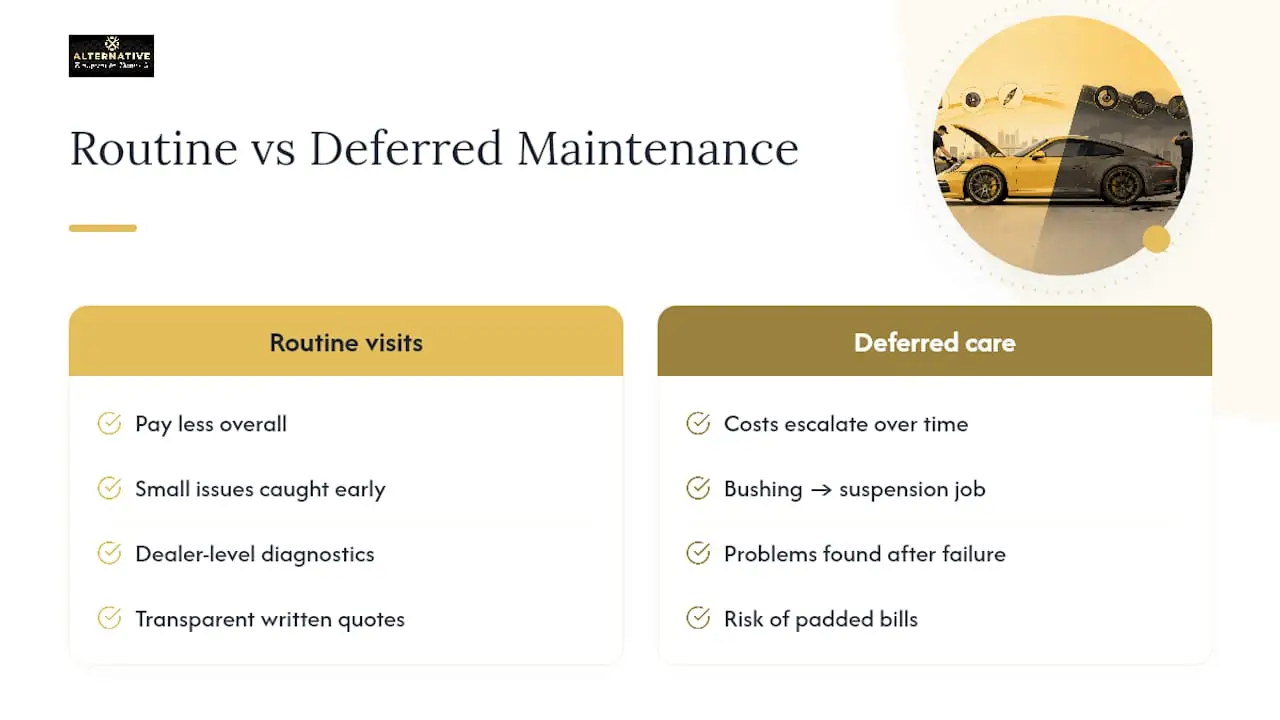
Most owners underestimate one thing: it’s not the oil changes that wreck a maintenance budget, it’s the deferred stuff. A worn control arm bushing left alone for a year turns into a suspension job. A skipped brake fluid flush turns into caliper work. I’ve seen the same pattern across shops that work on European performance cars: the owners who show up for routine visits pay less overall than the owners who wait until something fails.
Alternativecarcare’s approach with customized maintenance plans exists for exactly this reason, catching the small stuff with dealer-level diagnostics before it becomes the expensive stuff. Transparent, written quotes before work starts are what separate a trustworthy shop from one that pads the bill.
— Hassan
Get a Clear Maintenance Plan From Alternativecarcare
You’ve got three paths for keeping a Porsche running right: pay dealer rates for factory-backed certainty, prepay through a PSMP, or find an independent shop that actually knows these cars. Alternativecarcare gives Texas-based Porsche owners a fourth option that beats going it alone: dealer-level diagnostics and factory-trained-caliber service at independent labor rates, with a written quote before any work begins.

The shop handles the full range of what a Porsche actually needs, from routine oil and brake service to deeper engine and electrical diagnostics, and builds each customer a maintenance plan matched to how they actually drive the car rather than a generic factory interval. That’s the difference between guessing at your annual budget and knowing it. If you’re due for a service or want a second opinion on a dealer quote, book an inspection with Alternativecarcare and get a straight answer on what your car needs and what it costs.
Sources
- Porsche Repair: Service and Maintenance Cost | RepairPal
- Porsche Scheduled Maintenance Plans | Porsche USA
- Porsche Maintenance Costs: What You Pay Annually | Ilusso
- Independent vs Porsche Dealer Service: Which is Better? | Repasi Motorwerks
FAQ
Are Porsches Really Expensive to Maintain?
Porsches cost more than mainstream brands to maintain, but the gap is smaller than reputation suggests. RepairPal puts the average annual repair cost at $1,192, which sits closer to other luxury European brands than to the horror stories often repeated online.
What Is Called the “Poor Man’s Porsche”?
The Boxster/Cayman have both carried the “poor man’s Porsche” nickname over the years, referring to their lower purchase price relative to the 911 lineup. They still carry genuine Porsche engineering, just at a more accessible entry cost.
How Expensive Is an Oil Change on a Porsche?
A standard oil and filter service typically runs $200 to $400 at an independent specialist, with dealer pricing often running higher due to labor rates and parts markups.
Is Owning a Porsche Worth It?
For most owners, yes, provided you budget realistically. Setting aside $1,500 to $3,000 a year for maintenance, choosing between a PSMP and self-funded reserve early, and using a specialist who understands the platform keeps ownership costs predictable rather than surprising.