
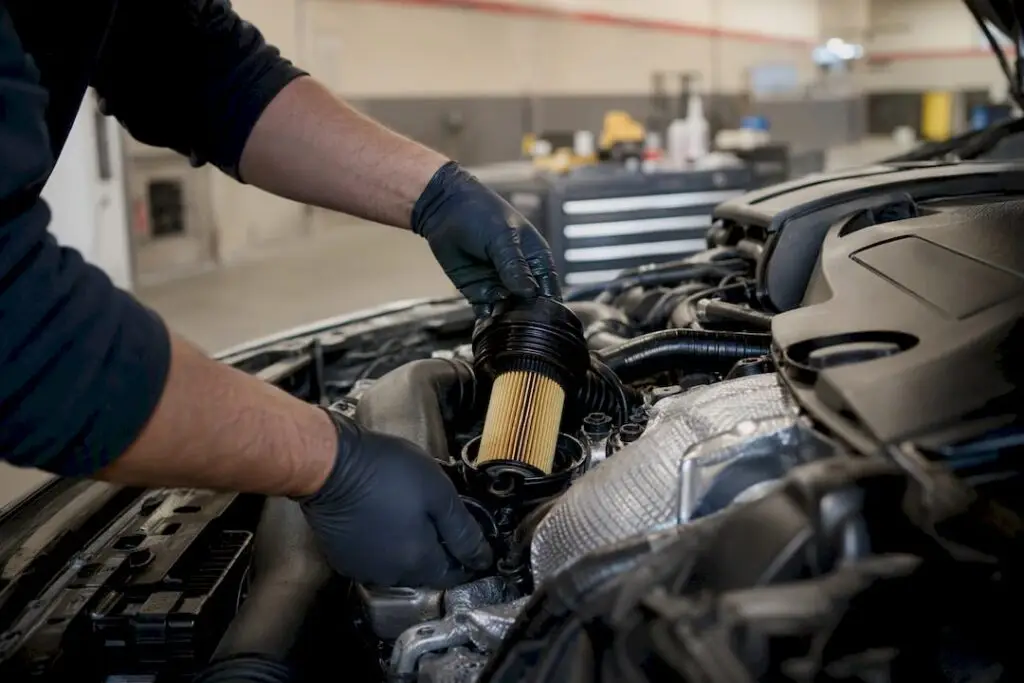
Mercedes Service A typically runs $180 to $450 at an independent shop and $350 to $600 at a dealership, according to U.S. price-guide data. The spread comes down to three things: your model’s oil capacity and access difficulty, whether the shop uses conventional or MB-approved synthetic oil, and the local labor rate.
Before you approve anything, do this:
- Get a written, line-item estimate, not a verbal quote
- Compare at least two shops, one dealer and one independent
- Confirm the oil spec matches your model’s Flexible Service System requirement
Key Takeaways
Mercedes Service A costs less at independent shops than at dealerships mainly because of labor rates and bundled extras, not because the underlying checklist changes.
| Point | Details |
|---|---|
| Typical price range | Independent shops run $180–$450; dealers run $350–$600 depending on model and oil type. |
| Get it in writing | An itemized estimate listing oil spec, labor hours, and fees is the single best defense against surprise charges. |
| Know the real checklist | Service A covers oil, filter, fluid checks, and inspections; anything else is an add-on, not a requirement. |
| Watch the interval pattern | Service A and B alternate roughly every 10,000 to 20,000 miles; check your dashboard’s Flexible Service System, not a generic chart. |
| Compare before you commit | Alternativecarcare provides dealer-level diagnostics with written, itemized Service A pricing for European and high-performance vehicles. |
Table of Contents
- How Much Does Mercedes Service A Cost, Line By Line?
- What Does Mercedes-Benz Actually Include in Service A?
- Why Do Two Service A Quotes Differ So Much?
- What Does Service A Cost by Mercedes Model Class?
- How Do I Get an Accurate Mercedes Service A Quote?
- How Alternative European & Domestic Handles Service A
- How Often Does Mercedes Recommend Service A?
- Is Service A or Service B Cheaper, and Why?
- What Extra Charges Show Up During a Service A Visit?
- How Can I Save Money on Service A Without Cutting Corners?
- What Independent Shops Get Right (and Where to Push Back)
- Book a Transparent Service A Appointment
- Sources
- FAQ
How Much Does Mercedes Service A Cost, Line By Line?
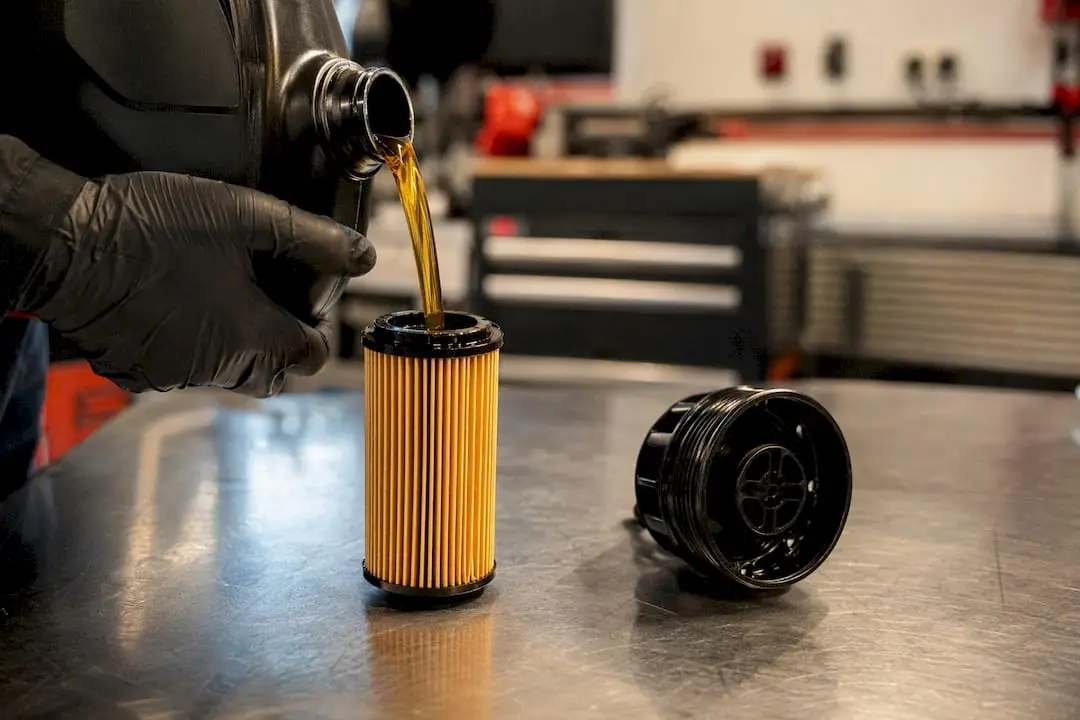
An A-Service invoice usually breaks into four buckets: parts, labor, diagnostics, and fees. Oil and filter materials alone commonly run $30 to $120 depending on whether the shop uses conventional or full synthetic oil that meets Mercedes-Benz’s 229.5 or 229.51 specification. Labor adds another chunk, and this is where dealer and independent pricing really split.
- Oil and filter: $30–$120 (parts only)
- Cabin filter (if included this visit): $20–$60
- Labor time for the service typically ranges from about one to two and a half hours, with hourly rates varying widely by shop and region.
- Diagnostics and multi-point inspection: often bundled, sometimes itemized separately
- Shop fees, disposal, and sales tax: varies by state and shop
A U.S.-focused price guide puts the full Service A total in the $180 to $520 range, with independents clustering around $190 to $450 and dealers around $350 to $600. Some owners on enthusiast forums report dealership quotes well above that ceiling, often because the visit included extras beyond the base checklist. That’s exactly why line-item pricing matters more than a flat number quoted over the phone.
Dealers tend to price higher partly because they bundle software updates and OE-branded parts into the visit by default, a trade-off worth understanding before you assume the independent quote is simply “cheaper for less.”
What Does Mercedes-Benz Actually Include in Service A?
Mercedes-Benz USA defines Service A as a specific, factory-set checklist, not a vague “oil change plus extras.” According to Mercedes-Benz USA, the base service covers:
- Engine oil and oil filter replacement
- Visual inspection of brake components, front and rear
- Fluid level checks (brake, coolant, washer fluid, and others)
- Tire inflation check and tread inspection
- Reset of the vehicle’s service interval indicator
- General visual inspection under the hood and undercarriage
Most models hit their first A-Service around 10,000 miles or one year, whichever comes first, then roughly every 20,000 miles or two years after that, alternating with Service B. Your exact interval depends on the model and what the Flexible Service System on your dashboard reports, since Mercedes adjusts intervals based on driving conditions detected by the car itself. Anything beyond that list, brake fluid flushes, cabin air filters, wiper blades, spark plugs, is an add-on your advisor should flag separately, not fold into the “Service A” line without explanation.
Why Do Two Service A Quotes Differ So Much?
The same service on the same model can price out $150 apart depending on four variables. Engine size and access time top the list: a compact four-cylinder with an easy-to-reach filter housing takes less labor than a V8 or AMG variant with a tighter engine bay.
- Oil type: conventional oil costs less than MB-approved full synthetic; the delta alone can be $40–$80
- Labor rate: independents in suburban markets often run $90–$130/hour, while dealers in major metro areas can hit $150–$180/hour
- Model and engine size: larger engines need more oil and sometimes more labor hours to access the filter
- Recommended extras: brake fluid, air filter, or wiper replacements pushed during the visit
Regional cost of living plays a real role too. A Service A quote in a high-cost urban market will typically run higher than the same job in a smaller suburban market, independent of who’s doing the work.
Pro Tip: Ask your advisor to separate “required for Service A” from “recommended while we have it open.” That single question exposes most of the padding in a dealer quote.
What Does Service A Cost by Mercedes Model Class?
Here’s how the math typically plays out across three common vehicle classes, based on typical labor hours and parts pricing:
Compact class (A-Class, CLA, C-Class): Lower oil capacity and easy filter access keep this the cheapest tier. Expect roughly $180–$250 at an independent shop and $350–$420 at a dealer, assuming no add-ons.
Mid-size class (E-Class, GLC, GLE): Slightly larger engines and more inspection points push labor up a bit. Typical range: $220–$320 independent, $400–$480 dealer.
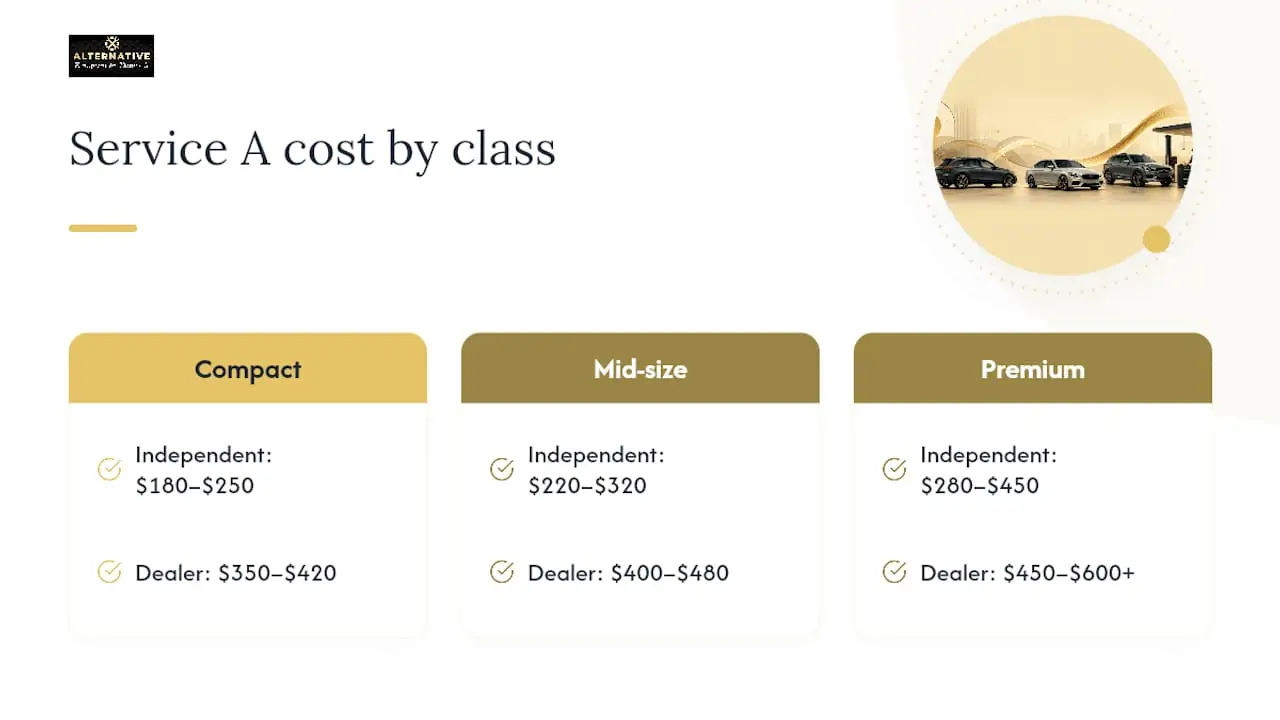
Premium and performance class (S-Class, AMG variants): Higher oil volume, tighter engine bay access, and additional inspection points on AMG models often add extra labor hours beyond the standard estimate, since access panels and performance-specific components take longer to service. Expect $280–$450 independent, $450–$600+ at a dealer.
These are sanity-check ranges, not quotes. Your dashboard’s Flexible Service System and your specific trim will move the number, so treat these as the band your estimate should fall within, not a guarantee.
How Do I Get an Accurate Mercedes Service A Quote?
Walking in with the right questions turns a vague number into a comparable estimate. Do this before you authorize any work:
- Ask for a written, itemized estimate listing oil brand and spec, parts, labor hours, labor rate, diagnostics, and taxes
- Confirm whether MB STAR diagnostics or software updates are included in the quoted price
- Ask whether OE parts or aftermarket equivalents are being used, and get the difference in writing
- Confirm warranty coverage on both parts and labor
- Set an authorization cap so the shop calls you before performing anything beyond the agreed scope
- Get at least two quotes, ideally one dealer and one independent, and compare them side by side
A shop that hesitates to itemize any of this is telling you something. Practical owner guidance consistently points back to the same fix: compare written estimates, never verbal ones.
How Alternative European & Domestic Handles Service A
Alternativecarcare approaches Service A the way a dealer would on diagnostics, without the dealer markup on transparency. The shop uses dealer-level diagnostic equipment to catch issues during the same visit, which cuts down on the follow-up trip that a surface-level inspection can miss.
- Written, itemized estimates before any work begins
- Dealer-level diagnostic capability on European and high-performance models
- Clear communication if anything beyond the base checklist needs attention
- Quality parts selected to match manufacturer specifications
That combination matters more than it sounds. A shop that can diagnose at the same level as a dealer but explains every line item before charging for it removes most of the guesswork owners complain about.
How Often Does Mercedes Recommend Service A?
Mercedes-Benz sets the first Service A around 10,000 miles or one year, whichever arrives first. After that, most models alternate between Service A and Service B roughly every 20,000 miles or two years, though your dashboard’s Flexible Service System is the actual authority here since it adjusts based on how the car is actually driven.
That alternating pattern trips up a lot of owners. You don’t get Service A every single interval forever, the car alternates A and B, so a vehicle at 30,000 miles is due for B, not another A. Skipping this distinction is the single most common mistake owners make when scheduling their own maintenance.
Your owner’s manual and the maintenance booklet that came with the car are the definitive word on your specific model year, since Mercedes has adjusted these intervals over different generations. If your dashboard shows a service reminder that doesn’t match what you expected, that’s the FSS talking, not a scheduling error, and it should take priority over any printed chart you find online. Newer models with turbocharged four-cylinders sometimes see slightly shorter intervals under harder driving conditions, while larger naturally aspirated engines can sometimes stretch a bit longer. The dashboard message is always more current than a generic interval chart, because it factors in your actual driving pattern, climate, and idle time.
Is Service A or Service B Cheaper, and Why?
Service A is almost always the less expensive of the two. It covers oil, oil filter, and a set of inspections. Service B adds to that list: typically a cabin filter replacement, brake fluid exchange, and additional inspection points beyond what A covers.
That extra scope means Service B commonly costs $80 to $150 more than Service A at the same shop, mostly driven by the added parts (cabin filter, brake fluid) and the extra labor time those tasks require. If you’re budgeting a year of ownership, plan for the A-Service years to be the cheaper ones and the B-Service years to carry a modest premium.
Where this gets confusing is the brake fluid itself. Mercedes specifies DOT 4 brake fluid for most models, and the difference between DOT 4 vs DOT 5 matters here: DOT 5 is silicone-based and incompatible with the rest of the system, so it should never be substituted. The more relevant comparison for most owners is DOT 4 vs DOT 5.1, since DOT 5.1 is a glycol-based fluid with a higher boiling point that’s sometimes used as an upgrade in performance applications. If a shop suggests swapping to DOT 5.1 during a B-Service brake fluid exchange, ask why, since it’s not the factory-specified fluid on most trims and the added cost isn’t always justified for daily driving.
What Extra Charges Show Up During a Service A Visit?
The base checklist is fixed, but what your car actually needs isn’t always predictable until a technician has eyes on it. The most common additions that show up on a Service A invoice:
- Cabin air filter replacement if it wasn’t done at the prior interval and is visibly clogged
- Wiper blade replacement when they’re worn beyond a safe range
- Battery testing or replacement on vehicles more than three years old, since a marginal battery often gets flagged during the multi-point inspection
- Tire rotation or alignment check if uneven wear is spotted
- Brake pad or rotor replacement if wear is beyond the safe threshold during the visual brake inspection
None of these are supposed to be silently rolled into a base Service A price. A shop that finds a worn brake pad during inspection should stop and call you, not add it to the final bill as a surprise. That’s the entire point of setting an authorization cap before the work starts: it forces the conversation to happen before the charge does, not after. If a shop won’t commit to that kind of communication upfront, that’s worth weighing as much as the price itself.
How Can I Save Money on Service A Without Cutting Corners?
The cheapest Service A isn’t always the one with the lowest sticker price. It’s the one where you know exactly what you’re paying for and none of it is padding.
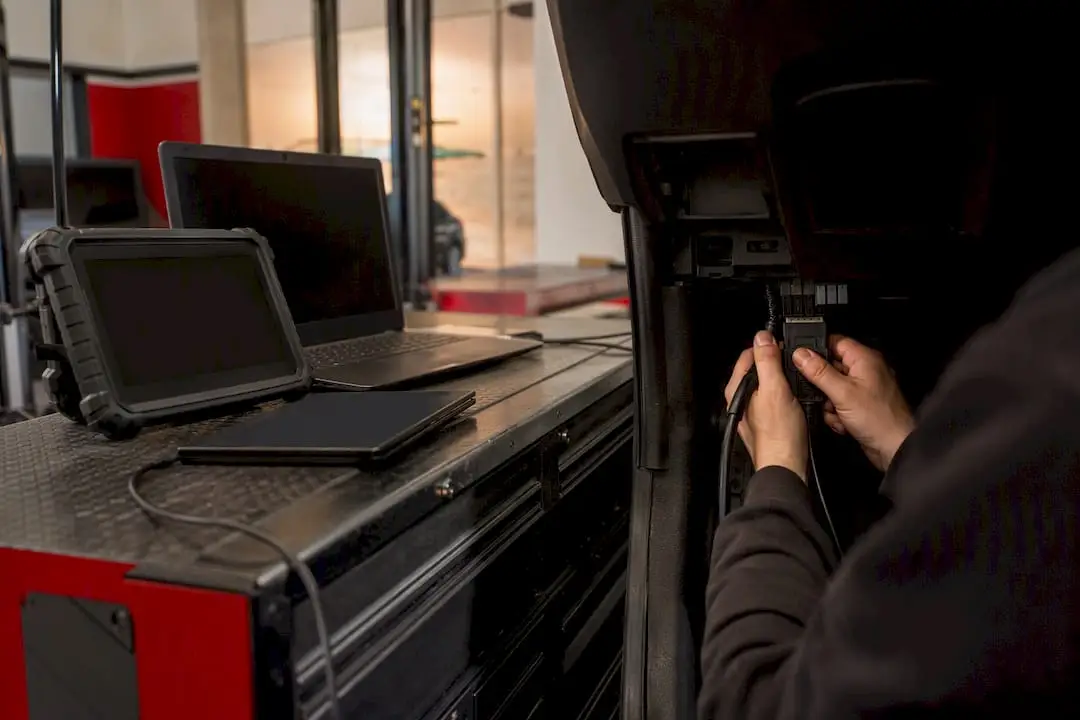
Start by comparing an independent European specialist against your dealer for the same written scope. Independent shops with dealer-level diagnostic equipment can often match the technical accuracy of a dealer visit at a lower labor rate, particularly once you’re outside the factory warranty window.
Ask specifically whether MB-approved synthetic oil is required for your model or whether a comparable synthetic meeting the same 229.5/229.51 spec is acceptable. That single question can shift the parts cost by $40 or more without touching quality.
Decline optional add-ons pitched during the visit unless the technician shows you the worn part or the failed reading. A visual brake inspection finding “60% pad life remaining” is not a reason to replace pads today.
Finally, track your service history in one place, receipts, dates, mileage. A documented history lets any shop, dealer or independent, quickly confirm what’s already been done instead of re-inspecting or re-recommending something you paid for eighteen months ago.
What Independent Shops Get Right (and Where to Push Back)
Trust dealer add-ons when they’re tied to an open recall, a software update affecting safety systems, or a part still under factory warranty. Question anything framed as “recommended” without a specific failure reading attached to it.
Keeping your own service records, dates, mileage, what was done, saves you from paying twice for work a shop can’t verify happened.
Book a Transparent Service A Appointment
Alternativecarcare gives you dealer-level diagnostics without the dealer markup on communication. Every Service A visit at Alternativecarcare starts with a written, itemized estimate: oil spec, parts, labor hours, and any inspection findings, before a single tool touches your car.
Appointments include the full factory checklist, oil and filter service, brake and fluid inspection, tire check, and service interval reset, plus a straight answer if the technician finds something beyond that scope. Nothing gets added to your invoice without a call first. If you’re comparing quotes between a dealer and an independent shop, request the same written breakdown from Alternativecarcare and set it side by side with what you already have. You can schedule your Service A appointment directly through the shop’s booking page and get a real, line-item estimate before any work begins.
Sources
Mercedes-Benz USA’s service pages cover official intervals; Cost Insider’s price guide covers U.S. pricing ranges.
- Mercedes Service & Maintenance | Mercedes-Benz USA
- Mercedes a Service Cost: Price Guide for US Owners – Cost Insider
- Cost of Mercedes A Service: What You’re Paying For | Auto Web Expo
FAQ
Is Mercedes Service A or Service B cheaper?
Service A is cheaper. It covers oil, filter, and inspections only, while Service B adds a cabin filter and brake fluid exchange, which typically adds $80 to $150 to the total.
Does my Mercedes need Service A or Service B?
Check your dashboard’s Flexible Service System message or your maintenance booklet. Most models alternate: A first around 10,000 miles or one year, then B, then back to A roughly every 20,000 miles or two years.
How long does a Mercedes Service A appointment take?
Labor time for the service itself typically runs 1.0 to 2.5 hours, though total appointment time, including check-in and inspection, often runs longer at a busy dealer.
Can I skip Mercedes Service B?
Skipping it isn’t recommended since it includes brake fluid replacement and inspections tied to safety systems. Delaying past the FSS reminder can also affect warranty coverage on covered components.
What’s the difference between DOT 4 and DOT 5.1 brake fluid?
Both are glycol-based and compatible with each other, but DOT 5.1 has a higher boiling point. Most Mercedes models specify DOT 4 as standard, so a shop should explain why before upgrading you to DOT 5.1.