

A failing BMW guibo (also called a flex disc or giubo) usually shows up as a clunk or thud when you shift into gear or get on and off the throttle, a vibration that builds with speed or acceleration, and a loose, delayed feel when power is applied. The guibo is a mechanical rubber part with no sensors, so it will not announce itself with a dash light. If you hear or feel these symptoms, have the driveline inspected before a small repair becomes a larger one.
This guide explains what the flex disc does, how its symptoms differ from look-alike faults, how a technician confirms the diagnosis, and when a BMW should not be driven. It is written for BMW owners in Dallas, from Oak Lawn and Uptown to the surrounding neighborhoods, who want a clear picture before booking service.
TL;DR
- Typical guibo symptoms: a clunk or thud on takeoff or when shifting, vibration that grows with speed or acceleration, and jerky or delayed power delivery.
- A worn guibo normally sets no warning light, so a clean dash does not rule it out.
- Motor mounts, the center support bearing, U-joints and differential mounts can cause similar noises. A hands-on inspection separates them.
- A visibly torn or cracked guibo should be replaced promptly. A disc that separates can leave the car without drive and damage nearby parts.
- If the car vibrates badly, loses drive or you see a torn disc, stop driving and consider a tow.
Table of Contents
- What a BMW guibo does
- Common BMW guibo symptoms
- Symptom quick reference
- Does a bad guibo trigger a warning light?
- Similar problems that get mistaken for a guibo
- How a technician confirms a bad guibo
- Is it safe to keep driving?
- When a guibo needs replacing
- What affects the cost of a guibo replacement
- Preventing premature guibo wear
- Book a driveline inspection in Dallas
- FAQ
- Sources
What a BMW guibo does
The guibo is a flexible coupling in the driveline. On rear-wheel-drive and xDrive BMWs, it sits between the transmission (or transfer case) output and the front of the driveshaft. It absorbs vibration and reduces shock loads in the drivetrain, and it tolerates the small movement between the engine-transmission unit and the rest of the car.
On most BMW applications it is a rubber disc with metal bolt sleeves. Later applications use an aluminum carrier with round bushings, according to the same source. Either way, the part flexes every time you apply or release power, so it ages with heat, mileage and any fluid that reaches it.
That constant flexing is why the guibo is a wear item. Rubber hardens, cracks start near the bolt holes, and the cords inside the disc can separate.
Common BMW guibo symptoms
Symptoms rarely appear all at once. They tend to show up in a sequence, and the order helps a technician judge how far along the wear is.
Clunk or thud on takeoff and shifting
The classic sign is a knock from under the center of the car when you move the selector from Park to Drive or Reverse, release the clutch, or get back on the throttle after coasting. A failing disc can cause a clunk or thud when shifting from Park to Drive or when getting on and off the accelerator. Some owners describe a double knock as the driveline takes up slack in one direction, then the other.
Vibration that follows speed or throttle
A worn disc lets the driveshaft run slightly off center. The result is a vibration through the floor or seat that is felt under load. One published diagnostic account describes a vibration under acceleration at certain speeds that got worse as speed increased, first noticeable in 2nd and 3rd gear.
The pattern to note: the vibration tends to ease when you lift off the throttle and return when you press it again. A tire or wheel balance problem usually does not care much about throttle load, so this detail is useful when you describe the problem to a shop.
Harsh feel at low speed and from a stop
Parts retailers who sell flex discs note that a worn disc produces a harsh vibration, especially at low speeds and when starting from a standstill. Owners often say the car feels rough pulling away from a light, then smooths out once rolling.
Loose or delayed drivetrain response
As the disc loses its ability to flex evenly, acceleration can feel uneven or jerky. You may notice a slight delay between pressing the pedal and the car taking up drive, a sense of slop in the driveline.
Visible damage
From underneath, a healthy guibo has intact rubber with clean edges. Worn ones show cracks radiating from the bolt holes, torn or missing rubber, separated cords, or bolt holes that have stretched out of round. Visual inspection is the only reliable way to catch early wear, which is why we look at it during driveline checks and routine service.
Symptom quick reference
| What you notice | When it happens | What it can point to |
|---|---|---|
| Single or double clunk | Park to Drive, takeoff, off and on throttle | Guibo, engine or transmission mount, center support bearing |
| Vibration that grows with speed | Under acceleration, eases when you lift | Guibo, driveshaft balance, center support bearing |
| Rough launch | Pulling away from a stop | Guibo, mounts |
| Clunk over bumps | Not tied to throttle | Suspension or control arm bushings |
| Noise only when turning | Steering input | CV axle on xDrive or front-drive models |
Does a bad guibo trigger a warning light?
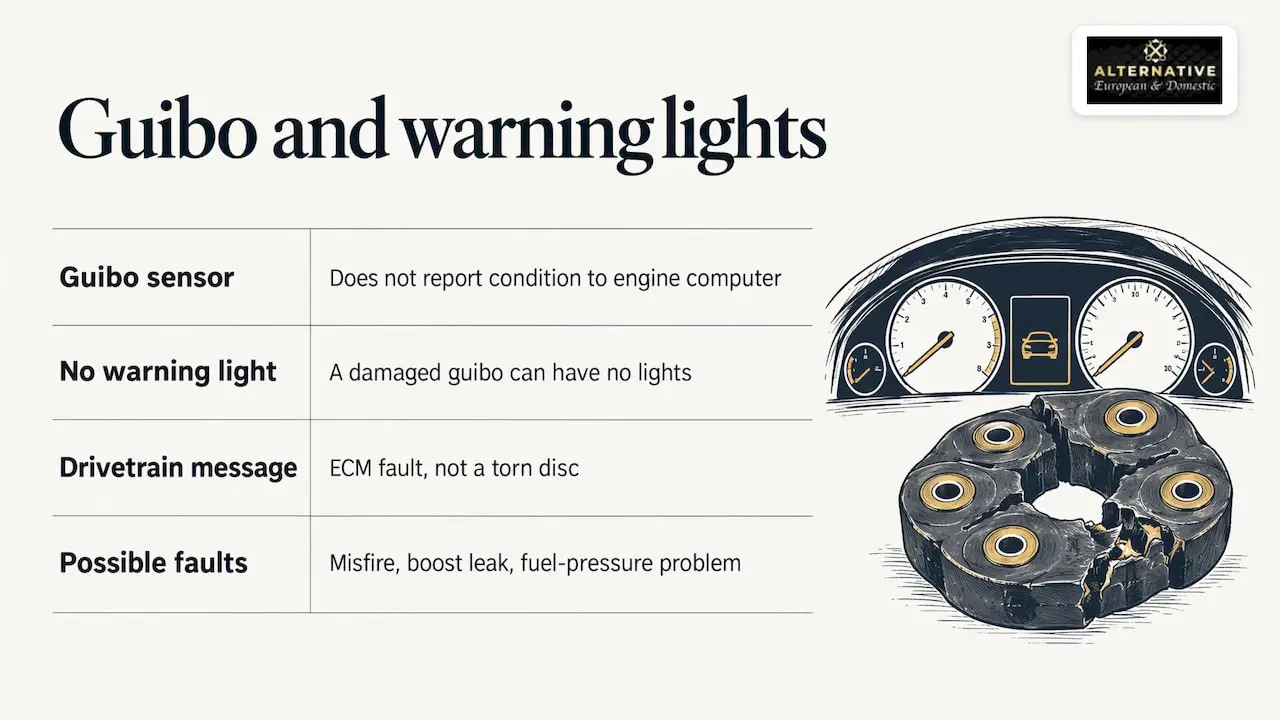
Usually not. A guibo has no sensor that reports its condition to the engine computer. One parts-industry source explains that a Drivetrain Malfunction message appears when the engine control module detects a fault such as a misfire, boost leak or fuel-pressure problem, not because a rubber disc is torn.
This cuts both ways. A car with no lights can still have a damaged guibo, and a car with a Drivetrain Malfunction message may have nothing to do with the flex disc. If that message is what brought you here, read our guide on what to ask about BMW drivetrain malfunction codes and ISTA freeze frame data.
Similar problems that get mistaken for a guibo
A clunk under power has several possible sources. Replacing the guibo when the real culprit is elsewhere wastes money and leaves the noise in place, so the diagnosis matters.
- Driveshaft center support bearing. Its rubber carrier can tear or sag, causing vibration and clunks. Because the guibo and center bearing sit on the same shaft, they are often inspected together. See our article on center support bearing repair and why reindexing matters.
- Engine and transmission mounts. A collapsed mount lets the powertrain shift under load and knock on takeoff. Our guide to engine mount failure on European, domestic and performance cars covers the symptoms.
- U-joints and the slip joint. Play or binding in these joints creates clicks and vibrations similar to a worn guibo.
- Differential mounts and rear suspension bushings. These typically wear gradually, while a guibo that cracks through can announce itself suddenly after a pothole or hard launch, according to one diagnostic guide for clunks on acceleration.
- Suspension and control arm bushings. If the knock happens over bumps or under braking as well as acceleration, the suspension becomes the suspect. See shop tests for suspension clunks and control arm bushing symptoms.
- Transfer case on xDrive models. Flex disc trouble can overlap with transfer case issues, which is why we pay attention to BMW transfer case service intervals.
How a technician confirms a bad guibo
Good diagnosis starts with reproducing the symptom, not with taking parts off the car. A typical sequence looks like this:
- Interview. When does it happen: only on acceleration, also on braking, also over bumps? Did it start suddenly or gradually? Sudden onset after an impact points toward something that has cracked through. Gradual onset points toward wear.
- Road test. In a safe, level area, accelerate gently, lift off completely, then reapply throttle. Abnormal play produces a distinct knock. The technician also notes the character of the noise.
- Lift inspection. Both sides of the disc are checked for deep cracks, exposed cords, missing material, deformation and oil contamination.
- Neighboring components. The center support bearing carrier, U-joints, slip joint, transmission and engine mounts, and differential mounts are checked by hand for play, tearing or sagging.
- Source of contamination. Oil leaking from the rear of the transmission significantly shortens guibo life. If the disc is oily, fixing the leak belongs on the repair order, or the new disc will fail early.
- Written findings. You should get a clear explanation of what was found and what is urgent versus what can wait. Our list of questions to ask a mechanic shows what a good estimate should contain.
This is the reason professional diagnosis matters here. The same clunk can come from a $-small rubber disc or from a mount or bearing, and the visual and hands-on checks above are how that is settled without guessing.

Is it safe to keep driving?
It depends on what the inspection shows and how the car behaves.
Short-term driving may be reasonable when: the clunk is mild, the car steers and accelerates normally, and there is no heavy vibration. Even then, schedule an inspection soon rather than waiting for the next oil change.
Stop driving when:
- The vibration is severe or has worsened quickly.
- The car hesitates, loses drive or feels like it is slipping out of gear.
- You see a torn disc, loose rubber or hanging driveshaft components from underneath.
- You hear scraping or slapping under the car.
Consider a tow when any of the above applies, particularly on a freeway or if the car will not move normally. A disc that is cracked most of the way through can fail and cause an abrupt loss of torque or let the driveshaft drop. One parts-industry write-up says a broken disc can slap the tunnel and damage the transmission output flange and center bearing, and that it can happen without a warning light.
There is also a regulatory history worth knowing. NHTSA recall 20V-185 covers 2013-2016 BMW 3 Series diesel models with xDrive, where friction rust can form on the transfer case output flange behind the aluminum flex disc. The potential result is a loss of power to the rear wheels and a vehicle that may not stay in Park. If you own a BMW, you can check your VIN for open recalls on NHTSA’s site or ask us to look when you bring the car in.
When a guibo needs replacing
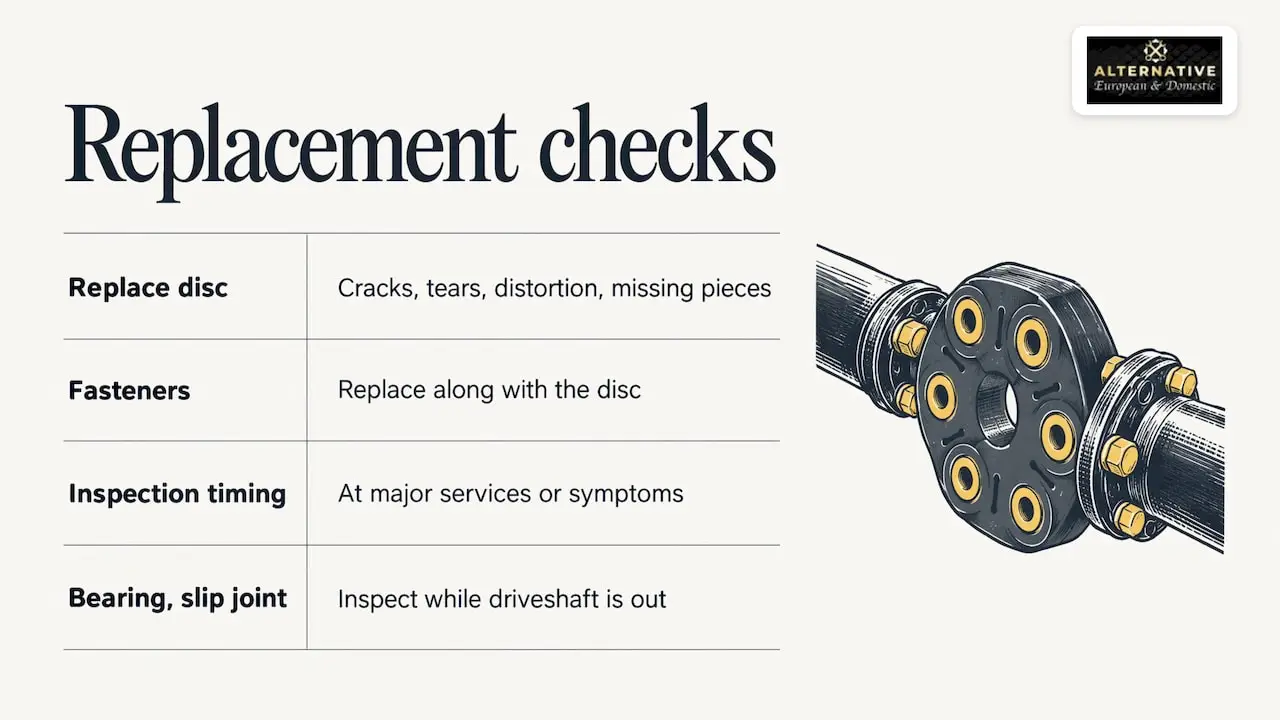
Replace it when the disc shows cracks, tears, distortion, missing pieces or separated cords. Published repair procedures say the flex disc should be free of distortion, cracks, tears and missing pieces, and that fasteners should be replaced along with it. The disc is rubber, so it wears with time as well as mileage.
There is no single mileage that fits every BMW. Driving style, heat, launches, towing and fluid leaks all change the lifespan. The practical approach is to have it looked at during major services and any time you notice a symptom above.
When the driveshaft is out for a disc replacement, the center support bearing and slip joint are worth inspecting while access is easy. That avoids paying for the same labor twice if a neighboring part is also worn.
What affects the cost of a guibo replacement
We do not publish a flat price because the job varies by chassis and by what the inspection finds. These are the main factors:
- Model and drivetrain. Access, driveshaft design and whether the car is rear-wheel drive or xDrive change labor time.
- Part choice. The disc itself is a modest part, but quality varies. We use quality parts, and we discuss options with you before the work starts.
- Related components. A worn center support bearing, oily disc from a transmission leak, or damaged flange adds to the repair.
- Delay. Driving on a torn disc risks damaging the flange and bearing, which turns a simple repair into a bigger one.
After an inspection, we explain what we found and give you the estimate before work begins.
Preventing premature guibo wear
- Fix transmission and transfer case leaks early so oil does not soak the rubber.
- Keep engine and transmission mounts in good condition, since a collapsed mount puts extra strain on the disc.
- Avoid repeated hard launches, especially on high-torque and tuned cars, as heavy shock loads work the rubber hardest.
- Have the driveline inspected during scheduled maintenance. Our maintenance service can be set up around your car’s mileage and how you drive it.
- Do not ignore small vibrations or clunks. Early attention is usually the cheaper kind.
A word on repairs: guibo replacement requires lifting the car, supporting the driveshaft and torquing fasteners correctly. It is not a repair we encourage at home, because a mistake affects driveline balance and safety.
Book a driveline inspection in Dallas
At Alternative European & Domestic, our ASE-certified technicians diagnose BMW driveline noises with road testing, a lift inspection and a check of the surrounding components, so you know whether the guibo, a mount or a bearing is the cause. We work on European, domestic and high-performance vehicles for drivers across Dallas.

If your BMW clunks on takeoff or vibrates under acceleration, start with our transmission repair and service team or contact us through Alternative European & Domestic to schedule a diagnostic evaluation. Qualifying repairs are backed by our 24-month/24,000-mile warranty, subject to applicable terms.
FAQ
What are the symptoms of a bad guibo on a BMW?
The most common are a clunk or thud when shifting into gear or getting on and off the throttle, vibration that increases with speed or acceleration, and uneven or jerky power delivery. You may also feel a loose driveline. A torn or cracked disc is visible from underneath.
Are BMW flex disc symptoms the same as guibo symptoms?
Yes. Guibo, giubo and flex disc are different names for the same part. Whatever name your mechanic uses, the symptoms and inspection steps are the same.
Will a failing guibo turn on the check engine light?
Normally no. The guibo is a mechanical rubber part with no sensor reporting to the engine computer. A Drivetrain Malfunction message usually points to an engine or fuel-system fault, so it needs its own diagnosis.
Can I drive with a bad guibo?
A mild clunk with normal handling may be tolerable for a short time until you can get an inspection. Severe vibration, loss of drive, scraping noises or a visibly torn disc mean you should stop driving and consider a tow, since a failed disc can damage the flange and center bearing.
How is a guibo problem diagnosed?
A technician reproduces the noise on a road test, then inspects both sides of the disc for cracks, separated cords and oil contamination. The mounts, center support bearing, U-joints and slip joint are checked at the same time, because they can cause similar symptoms.
Sources
- BMW Driveshaft Q&A, Tomorrow’s Technician
- BMW Driveshaft Flex Disc (Guibo) Failure, Go-Parts
- How to Diagnose a Faulty Flex Disc/Guibo, CarThrottle
- Guibos and Flex Discs for BMW 5 Series F10, Turner Motorsport
- Clunk when Accelerating BMW, Causes and Diagnosis, BimmerTalk
- BMW Guibo Replacement Costs, BMW Guidebook
- NHTSA recall 20V-185
- BMW E90 Flex Disc Replacement, Pelican Parts