
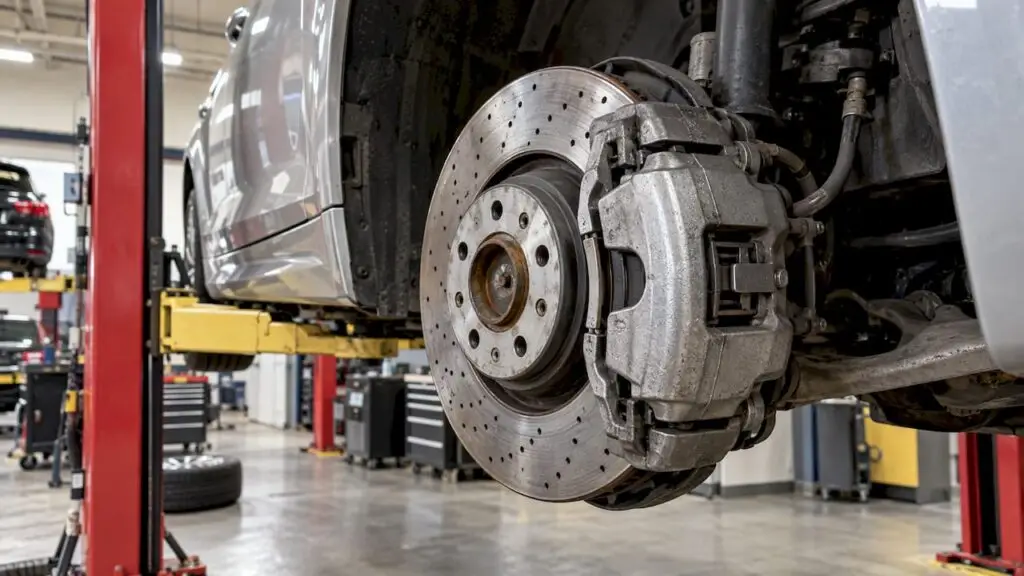
A stuck brake caliper is a caliper that clamps the pads onto the rotor and then fails to let go. The wheel keeps dragging, so you get a pull to one side, a burning smell, heat at one wheel and pads that wear unevenly. It is a safety problem, not a comfort problem: a dragging brake builds heat, damages the rotor and bearing, and reduces your stopping power. If you suspect one, book a diagnostic at Alternative European & Domestic and avoid long drives until the car has been checked.
TL;DR
- Main symptoms: the car pulls to one side, a burning or acrid smell after driving, one wheel much hotter than the others, and one pad worn much faster than its partner.
- Typical causes: corroded or dry slide pins and bushings, a corroded piston, old brake fluid, a collapsed brake hose or, at the rear, a hung-up parking brake mechanism.
- Do not keep driving on it. Heat can warp rotors, damage the wheel bearing and, in severe cases, cause total brake loss or a wheel fire.
- A caliper that is freed but still corroded tends to stick again, so the repair has to address the cause, not just the symptom.
- Dallas drivers can have the whole brake system diagnosed and repaired by ASE-certified technicians at Alternative European & Domestic.
Table of Contents
- What a brake caliper does and why it sticks
- Stuck brake caliper symptoms
- What causes a brake caliper to stick
- Is it safe to drive with a stuck caliper?
- Can you free a stuck caliper yourself?
- How a shop diagnoses a sticking caliper
- Repair or replace: what the options are
- Stuck caliper or something else?
- How to keep calipers from sticking again
- Brake service at Alternative European & Domestic
- FAQ
- Sources
What a brake caliper does and why it sticks
The caliper is the clamp around the brake rotor. When you press the pedal, hydraulic pressure pushes a piston (or pistons) outward, and the pads squeeze the rotor. When you release the pedal, the piston and the caliper body should back off a hair, leaving the pads just clear of the rotor.
Most passenger cars, including many European sedans and SUVs, use a floating (sliding) caliper. It rides on two guide pins that let the body slide so both pads press evenly. Per the Louisiana Department of Environmental Quality’s disc brake guide, dirt, corrosion or loss of lubrication on the guide pins, sleeves or ways are the most likely cause of drag on a single-piston floating caliper, because the caliper cannot fully retract. The same guide lists excessive wear on one pad, vehicle pull and tapered pad wear as signs.
Two things usually fail:
- Slide pins and bushings. Road salt, moisture and heat strip the grease. The pin seizes in its bore and the caliper stops floating.
- The piston. Moisture and dirt corrode the piston surface or the bore, and the piston no longer retracts smoothly after the pedal is released.
High-performance and European cars put extra demand on both. Heavier vehicles, stronger brakes and repeated heat cycles from spirited driving are hard on grease and seals. That is one reason brake service on these cars rewards a technician who knows the specific hardware.
Stuck brake caliper symptoms
A sticking caliper does not always announce itself loudly. Here is what to watch for, roughly in the order drivers notice it.
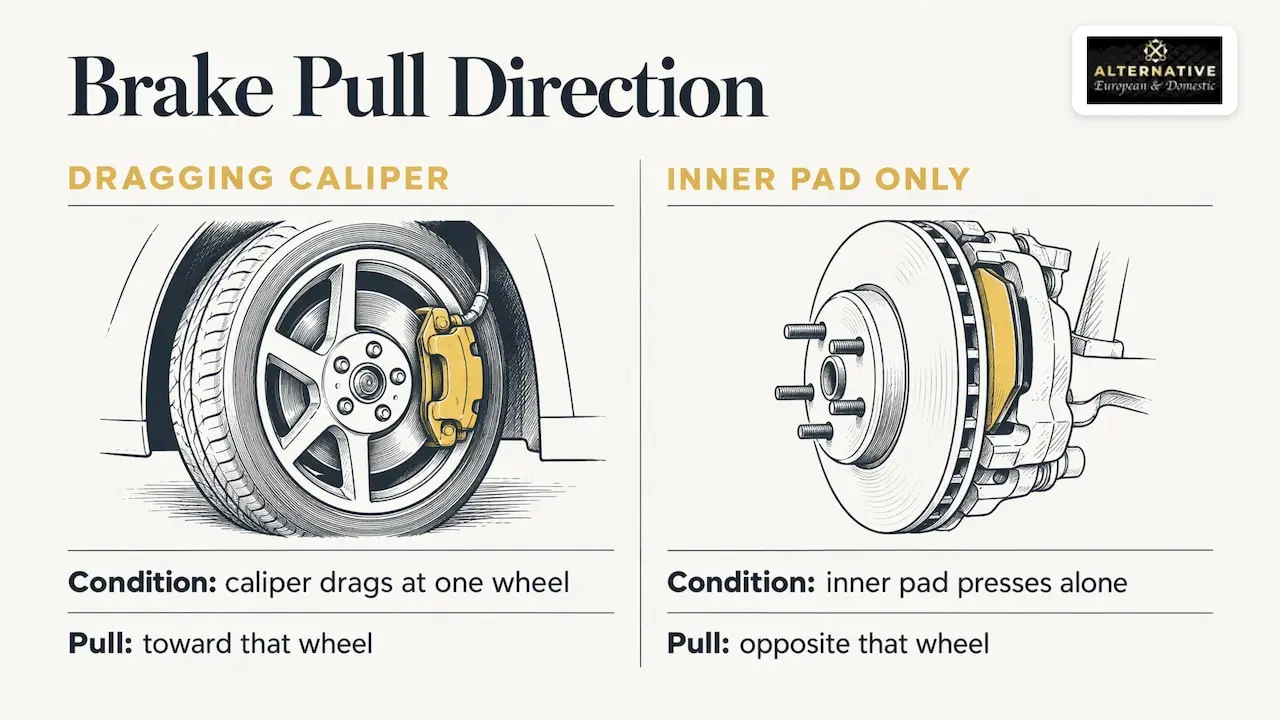
The car pulls to one side
A caliper that drags at one wheel pulls the car toward that side while driving and braking. A caliper that hangs up and lets only the inner pad press against the rotor does the opposite under braking. Brake & Frontend explains that corroded or unlubricated slides, bushings or pins can leave the inner pad as the only one pushing, which greatly reduces braking friction and makes the vehicle veer sharply to the opposite side. So the direction of the pull alone does not tell you which wheel is the problem. A technician confirms it at the wheel.
A burning smell
Constant friction heats the pad and rotor. After a drive you may notice an acrid, burning odor near one wheel. Smoke from a wheel well is an emergency: pull over safely and do not continue.
One wheel is hotter than the rest
A wheel that is noticeably hotter than the others after a normal drive, with no hard braking, suggests drag. Do not touch rotors or wheels by hand. They can burn you.
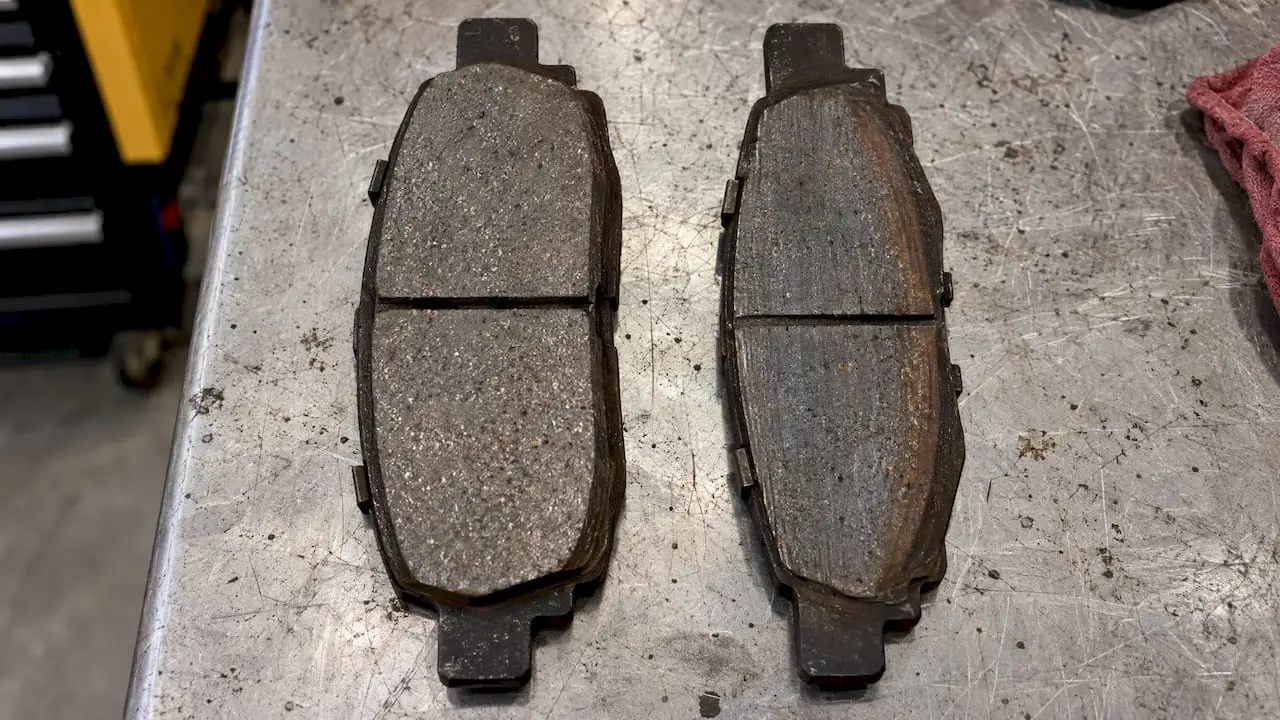
Uneven or tapered pad wear
One pad worn far thinner than the other on the same caliper, or a tapered wear pattern, points to slide pin or piston trouble. Brake & Frontend notes that a dragging outer pad can wear quickly. This is often discovered during a pad replacement, which is why a proper inspection looks at the hardware and not just the pad thickness. Our guide to timing brake pad replacement on European luxury and performance cars covers how wear patterns factor into the interval.
Noise, weaker braking and worse fuel economy
Grinding or squealing from one corner can come from a dragging pad. The drag also works against the engine, so mileage can drop. The same source says a dragging pad can overheat the rotor unevenly and warp it, causing pedal pulsation when you brake. If that is what you feel, see why a brake pedal pulsates.
Symptoms by location
| What you notice | Likely meaning | Urgency |
|---|---|---|
| Pull to one side while driving, with a burning smell | Dragging caliper at the front or rear | High: stop driving soon |
| Pull only when braking | Caliper hanging up, or uneven friction | High |
| One wheel very hot, no hard braking | Brake not releasing | High |
| Inner pad worn much more than outer | Seized slide pins or piston | Moderate: schedule promptly |
| Smoke or strong burning smell from a wheel | Severe overheating | Emergency: pull over |
| Soft or spongy pedal | Often a hydraulic issue, not a stuck caliper | See our soft brake pedal tests |
What causes a brake caliper to stick
A shop looks at several possibilities, because the visible symptom at the wheel can come from further up the system.
- Corroded or dry slide pins. The most common cause on floating calipers, per the Louisiana DEQ guide above.
- A corroded piston or bore. Moisture gets past the dust boot, the piston roughens, and it stops retracting.
- Old or contaminated brake fluid. Brake fluid absorbs moisture over time, and water promotes internal corrosion. Replacing fluid on a schedule is a standard preventive measure, and many European manufacturers specify an interval of about two years.
- A deteriorated brake hose. A hose can swell internally and act like a one-way valve, trapping pressure at one caliper after you release the pedal. A kinked line or restriction does the same.
- A parking brake that hangs up. On rear brakes, a sticking parking brake cable or mechanism can keep the pads applied even when the caliper itself is fine. Many European cars use an electronic parking brake motor on the rear caliper, which adds another thing to check.
- Long periods of sitting. A car parked for months, especially outdoors, can corrode at the pads and rotors and seize the brakes.
- Over-lubrication. More grease is not better. A technical service bulletin filed with NHTSA advises using the manufacturer-recommended lubricant sparingly, because too much can create an “air spring” that makes the caliper drag.
This is why professional diagnosis matters. Replacing a caliper when the real problem is a collapsed hose, or a parking brake cable, wastes money and leaves the drag in place.
Is it safe to drive with a stuck caliper?
No. A dragging brake produces extreme heat. Reporting on caliper maintenance lists the risks as warped discs, damaged wheel bearings, and possibly total loss of braking or a wheel fire. A caliper that sticks also reduces braking at that wheel, and braking balance affects stopping distance and stability in an emergency stop.
Here is a plain rule set:
- Do not drive the car if you see smoke, smell strong burning, the brake pedal goes soft or sinks, the car pulls hard, or a wheel is too hot to be near.
- Short, gentle trip to the shop can be reasonable only when symptoms are mild: a faint pull, slight smell, no smoke, normal pedal. Drive slowly, avoid highways and heavy braking, and go straight there.
- Tow it if any of the severe signs above show up, if the wheel will not turn freely, or if you are unsure. A tow costs far less than a bearing, rotor and caliper replacement or a fire.
- Do not keep driving to see if it clears up. A stuck caliper does not fix itself.
On a hot Texas day in stop-and-go traffic on Central Expressway or the Dallas North Tollway, a dragging brake heats up faster than you might expect. If the car feels like it is working harder than usual or smells hot, take it seriously.
Can you free a stuck caliper yourself?
We do not recommend it. Brakes are the one system on the car where a partial fix can fail at speed. Forum threads and videos describe jacking the car, forcing the piston back with clamps or spraying penetrant, but each of those steps carries risk: pushing a corroded piston back can push debris into the hydraulic system and damage the ABS unit, and releasing a caliper that is the symptom of a failing hose hides the real fault.
A common question is whether you can spray WD-40 on a caliper. WD-40 is not a brake component lubricant, and no lubricant or penetrant should reach pads or rotors, because contamination reduces friction. Brake hardware calls for the correct high-temperature brake grease, applied to the right surfaces only, as part of a proper service where the pins, boots and bushings are inspected.
A freed caliper is also likely to stick again if the cause was a corroded piston or pins, because the corrosion remains. That is the reason a shop inspects and measures instead of just loosening what is stuck.
How a shop diagnoses a sticking caliper
Professional diagnosis separates the caliper from everything that imitates it. A thorough inspection follows a logical order:
- Road test and symptom review. Where does the pull show up, under braking or while coasting? Is there a smell or noise? Has the car sat recently?
- Wheel-off inspection. Technicians check whether the wheel spins freely, compare pad thickness inside and outside, and check the rotor for heat discoloration, scoring or a hot spot.
- Slide pin and hardware check. The pins should move freely and the boots should be intact. Seized or dry pins, torn boots and rust on the abutment clips are all findings.
- Piston check. Does the piston retract and move evenly, or is it corroded and slow?
- Hose and hydraulic check. A swollen hose, restricted line or sticking master cylinder can imitate a stuck caliper. On the rear, the parking brake cable or motor is checked too.
- Fluid condition. Old fluid is a red flag for internal corrosion and shortens the life of any new component.
- Rotors and bearing. A shop measures rotor thickness and runout and checks the wheel bearing for heat damage.
On newer European cars, electronic parking brakes and stability systems add scan-tool steps, such as putting the rear caliper motor into service mode before work. Dealer-level diagnostics matter here, because the wrong procedure can damage the actuator.
Repair or replace: what the options are
Once the cause is clear, there are three realistic outcomes.
| Option | When it fits | What to know |
|---|---|---|
| Clean and re-lubricate slide pins, new hardware | Mild sticking, pins corroded but bores and piston healthy | Lowest cost, and the usual fix when the pins are the only problem |
| Rebuild the caliper | Light internal corrosion, piston and bore still serviceable | Seals and boots replaced. Depends on the condition of the piston |
| Replace the caliper | Pitted piston or bore, seized piston, seized bleeder | The simplest long-term fix. Often installed as a loaded assembly with new hardware |
A few points shape the decision:
- Pairs on an axle. Calipers are generally replaced in pairs on the same axle, because uneven braking force can damage suspension and tires. Pads and rotors are replaced as an axle set too.
- Rotors and pads. A dragging caliper usually ruins the pads and often the rotor on that wheel, so expect them to be part of the estimate.
- Fluid service. After a hydraulic repair the system is bled, and fresh fluid is a sensible part of the job.
- Brake bedding. New pads and rotors perform best when bedded correctly. See our guide to brake bedding for European and performance cars.
What drives the cost
We do not quote a caliper price in an article, because it varies too much by car. These are the factors that move the estimate:
- Make, model and brake package (a performance brake package with multi-piston calipers costs more than a single-piston unit)
- Whether the caliper is rebuilt or replaced, and whether the part is a loaded assembly
- Front or rear, and whether the rear has an electronic parking brake motor
- Rotors, pads, hoses and fluid that need replacing at the same time
- Condition of the wheel bearing if the car was driven while dragging
For a sense of how brake work is priced on one European brand, see our look at Audi brake job costs in Texas. A written estimate that lists each part and each labor line lets you see exactly what is being recommended and why.
Stuck caliper or something else?
Several brake problems feel alike, so it helps to separate them:
- Pedal pulsation usually points to rotor thickness variation or warping. A dragging caliper can cause it, but so can other things. See what pulsation means.
- Squeal at low speed is commonly pad material, hardware or a missing shim, not drag. Our stop test for brake squeal explains what to tell the shop.
- A soft or sinking pedal is a hydraulic or air-in-the-system symptom. Try the three tests for a soft pedal.
- Pull with no heat or smell can be tire pressure, alignment or a tire problem. If your European car has AWD, uneven tire wear also matters. See AWD tire rotation intervals.
- Binding at the rear can be the parking brake cable or mechanism rather than the caliper.
- ABS faults or master cylinder problems can also cause brakes to bind or lock, which a scan tool and a pressure check will show.
How to keep calipers from sticking again
Most caliper failures are slow corrosion problems, and routine maintenance is what stops them.
- Replace brake fluid about every two years, or as your manufacturer specifies. Fresh fluid carries less moisture and protects the internal surfaces of calipers and the ABS unit.
- Service slide pins at every pad change. The pins are cleaned, inspected and lubricated with the right high-temperature grease, and torn boots or worn bushings are replaced. Reporting on caliper care recommends silicone or ceramic brake grease for this.
- Use grease sparingly. Over-lubrication can cause drag, as the NHTSA bulletin above notes.
- Replace hardware, not just pads. New clips and shims at each pad change keep the pad moving freely.
- Drive a parked car. If a car sits for weeks or months, a short drive now and then keeps the surfaces from rusting in place.
- Inspect hoses. Cracks, bulges or soft spots show up during a brake inspection.
- Have brakes inspected yearly, more often if you drive hard, track the car or tow.
A customized maintenance plan can fold these into the intervals your car already needs, so the brake system is checked on a schedule instead of when something goes wrong.
Brake service at Alternative European & Domestic
If your car pulls, smells hot after a drive or shows uneven pad wear, Alternative European & Domestic can diagnose it. Our Dallas shop works on European, domestic and high-performance vehicles, and our ASE-certified technicians use dealer-level diagnostics to find the actual cause, whether that is a slide pin, a piston, a hose or the parking brake mechanism. We explain what we find and what each repair involves before work starts, and qualifying repairs are covered by our 24-month/24,000-mile warranty, subject to applicable terms.
Drivers in Oak Lawn, Uptown and the surrounding Dallas neighborhoods can read about our brake pad replacement and brake service or schedule an appointment for a brake inspection.
FAQ
How do I know if my brake caliper is stuck?
The usual signs are a pull to one side, a burning smell after driving, one wheel hotter than the others, and uneven pad wear. You may also notice reduced fuel economy or noise from one corner. Because other faults feel similar, a technician should confirm it at the wheel.
Can I drive with a seized caliper?
Not safely. Constant drag creates heat that can warp rotors, damage the wheel bearing and reduce braking. If there is smoke, a strong burning smell, a soft pedal or a hard pull, stop and tow the car instead of driving it.
Can a stuck caliper fix itself?
No. A caliper stuck from corrosion or lost lubrication keeps dragging, and the heat adds damage to the pads, rotor and bearing. Sometimes it seems to release after a drive and then sticks again, which still calls for an inspection.
Do I need to replace both calipers on an axle?
Usually, yes. Calipers are normally replaced in pairs on the same axle, because uneven braking force can damage suspension and tires. A technician can tell you whether a rebuild or a single caliper is reasonable for your specific car.
How often should brake fluid be changed to prevent sticking?
A common interval is every two years, though your owner’s manual sets the exact schedule for your vehicle. Fresh fluid helps protect calipers and the ABS unit from moisture-related corrosion. Pair it with slide pin service at each pad change.
Sources
- Car, Van, and Light Truck Disc Brakes and Fuel Economy, Louisiana Department of Environmental Quality
- Brake Caliper Service, Brake & Frontend
- Technical Service Bulletin, NHTSA
- Brake caliper maintenance and how to prevent sticking and seizure, Your Thurrock
- Brake Caliper Replacement Cost 2026, Empire Auto Protect