
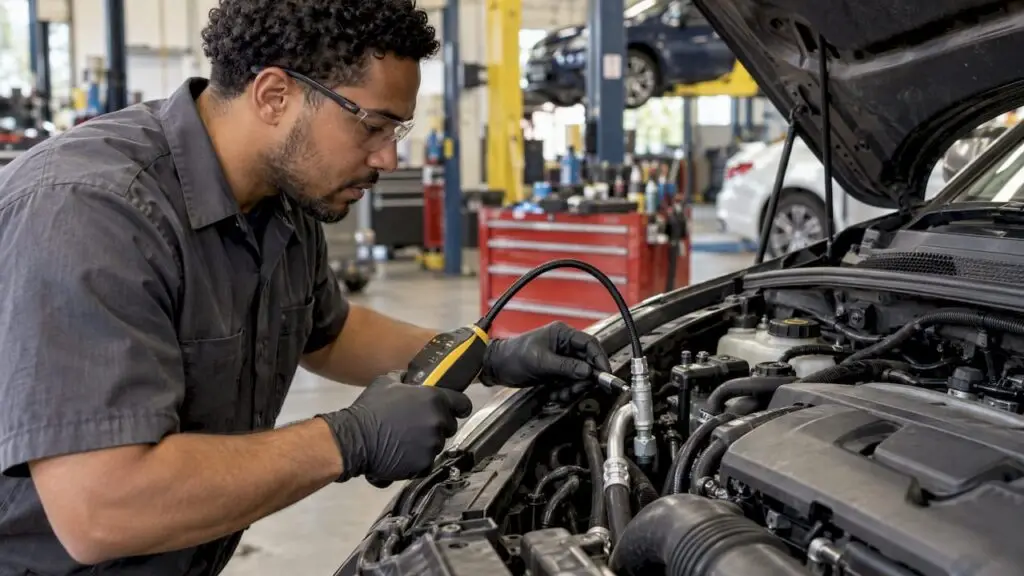
Professional AC leak detection finds where refrigerant is escaping from your car’s air-conditioning system, using a combination of pressure checks, UV dye, an electronic detector and, for stubborn leaks, nitrogen or trace-gas testing. A technician usually finds the leak, but not always on the first pass: the US EPA notes that very small leaks can be hard to locate even with sophisticated equipment. For Dallas drivers, a system that slowly loses cooling before summer heat arrives is the classic sign to book a diagnostic.
TL;DR
- A car A/C is a sealed system. If it loses cooling over weeks or months, refrigerant is leaking, and recharging without finding the leak only delays the problem.
- Shops use four main methods: electronic detector, UV dye, pressure or trace-gas testing, and soap solution on suspect fittings.
- The system needs enough pressure for most tests to work, but the EPA says only a few ounces, about 10 percent of a normal charge, are needed for a leak check.
- Warm air does not always mean a leak. Compressor, electrical, fan and blend-door faults can look the same, which is why diagnosis comes before repair.
- Sealant cans and DIY recharge kits can complicate the next professional repair. Book a diagnostic instead.
Table of Contents
- What an A/C leak looks like from the driver’s seat
- Where car A/C systems usually leak
- How technicians find the leak: the four main methods
- Why the system needs some refrigerant to test
- Why recharging alone is the wrong first move
- What a thorough A/C leak diagnostic includes
- Do leak detectors really work?
- What affects the cost of A/C leak diagnosis
- When to stop driving and when to get towing
- Preventive habits that protect your A/C
- A/C leak diagnosis and repair at Alternative European & Domestic
- FAQ
- Sources
What an A/C leak looks like from the driver’s seat
Refrigerant usually escapes as a vapor, so you rarely see a puddle. What you notice is a change in performance. Kelley Blue Book lists these warning signs of low refrigerant:
- Greasy-feeling drippings
- Ice or frost on refrigerant lines or the evaporator
- Longer time to cool the cabin
- Warm air that persists after a couple of minutes
- Reduced airflow
- Clicking that may point to compressor short-cycling
- A warning light on vehicles that have one
The most telling pattern is a system that blows cold after a recharge and then slowly drifts back to warm. That is the signature of a slow leak: the charge you added is leaving again. The same symptom list appears on our own page about when A/C refrigerant is low, including the causes behind it.
Symptoms that look like a leak but are not
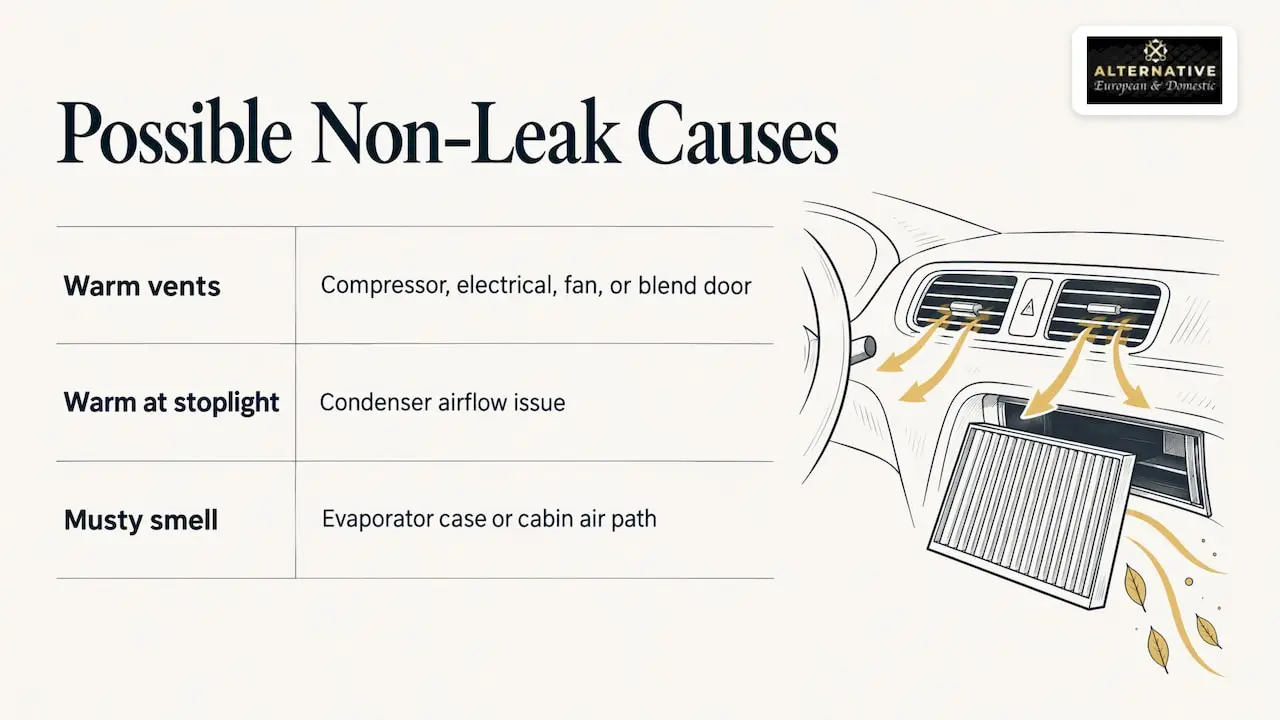
Warm air from the vents does not automatically mean low refrigerant. A failing compressor, an electrical fault, a cooling-fan problem or a stuck blend door can all produce the same complaint. If the air is only warm at a stoplight and cools down once you are moving, the cause may be airflow across the condenser rather than a leak, which we cover in our guide to A/C running warm at idle. If the compressor clicks on and off rapidly or makes noise, read our list of A/C compressor symptoms.
A musty smell is a different diagnosis again. That points to the evaporator case or cabin air path, not refrigerant. Our page on A/C that smells like mildew explains it, and the principle of tracing car odors to their source applies: find the cause first, then treat it.
Where car A/C systems usually leak
A/C systems have many joints and rubber parts, and heat, vibration and age work on all of them. Common leak points include O-ring connections, the compressor shaft seal, the condenser (which sits at the front of the car and takes road debris) and the evaporator behind the dash, according to R & Y A/C Compressors. Hoses, service ports and Schrader valves are also usual suspects.
The evaporator is the hard one. It is buried inside the dash, so a leak there is rarely visible, and detection often relies on an electronic probe at the drain tube or a dye check at the evaporator housing. That is one reason a methodical process matters more than a quick look.

How technicians find the leak: the four main methods
HSM University’s A/C service course describes four main ways a technician locates a leak. Most diagnostics combine two or more.
| Method | How it works | Best for |
|---|---|---|
| Visual inspection | Refrigerant oil leaves a greasy, dirt-collecting film at the leak | Fittings, condenser, compressor |
| Electronic detector | A probe senses refrigerant escaping and signals with a tone or light | Pinpointing leaks on a charged system |
| UV dye | Fluorescent dye travels with the oil and glows yellow-green under a UV lamp | Slow leaks that hide in hard-to-reach areas |
| Nitrogen or trace gas | An empty system is pressurized with dry nitrogen, or a mix of 95 percent nitrogen and 5 percent hydrogen | Leaks that only show under pressure |
| Soap solution | Brushed onto a suspect fitting, it bubbles at a leak | Confirming a specific joint |
Visual inspection
The refrigerant carries oil to lubricate the compressor. When the refrigerant escapes, the oil stays behind as a greasy residue, and dust sticks to it. A technician looks for that film on the condenser, compressor, hose crimps and fittings. It is the simplest first step and it narrows the search before any tool comes out.
Electronic leak detector
An electronic detector senses refrigerant escaping from a joint. Technique matters. Refrigerant is heavier than air and sinks, so the probe goes below each fitting and moves slowly, about 1 to 2 inches per second according to HSM University. Industry practice documented by Vehicle Service Pros for SAE J1628 calls for testing with the system off, a static pressure of at least 50 psi, an ambient temperature of at least 59°F, and keeping the probe about 3/8 inch from the surface. Rushing, drafts and contamination from other under-hood fluids can all cause missed or false readings, which is why an experienced hand matters.
UV dye
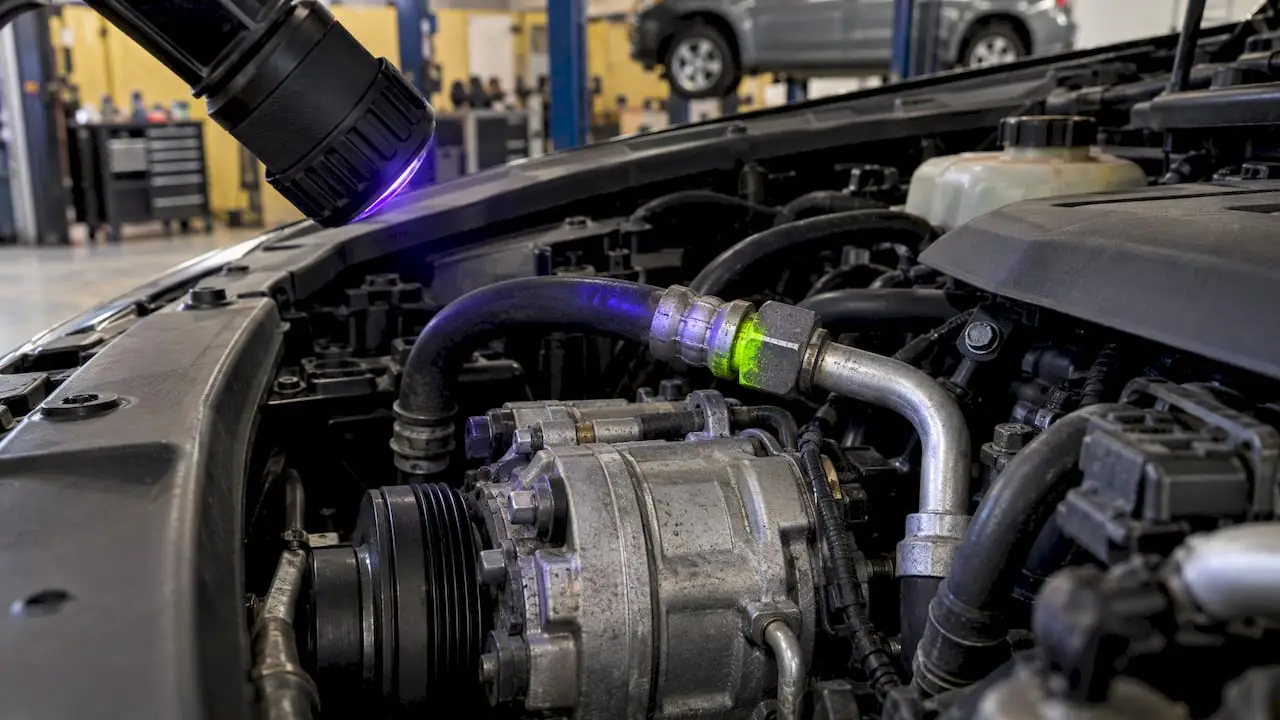
A small measured amount of fluorescent dye is added to the system. It circulates with the oil and collects at the leak. After the A/C has run, the technician scans with a UV lamp and looks for the glow. Honda’s service bulletin on A/C leak detection says large leaks show immediately, while smaller leaks may need at least 90 minutes of operation before the dye becomes visible, and a return visit 24 to 48 hours later may be needed so the dye can circulate. That is normal for a slow leak and is not a sign that the shop missed something.
Nitrogen and trace-gas pressure testing
When the system has already lost its charge, there is nothing for a detector to find. In that case the technician recovers whatever remains, then pressurizes the empty system with dry nitrogen, or a nitrogen and hydrogen trace gas, and watches for a pressure drop or sniffs for the escaping gas. Soap solution on a suspect joint then confirms the exact spot. This method finds leaks that only open under pressure.
The vacuum decay test
During a service, the machine pulls the system into a vacuum and then isolates the pump. If the vacuum rises quickly and keeps rising, air is leaking in. If it rises slightly and levels off, moisture is still boiling out and the system needs more evacuation. HSM University points out this test cannot catch small leaks that only open under refrigerant pressure, which is why a pressure-side check follows the recharge.
Why the system needs some refrigerant to test
Technicians usually cannot find a leak in a system that is completely empty of refrigerant unless they use nitrogen. Manufacturer data shows why. Mitsubishi’s technical information on leak testing states that refrigerant pressure must be 345 kPa (50 psi) or more at 61°F or above, and leaks may go undetected below that. It also directs technicians to check from the high-pressure side to the low-pressure side.
The good news from the EPA: a vehicle does not need a full charge for the check. A few ounces, roughly 10 percent of a normal charge, is enough, and in some cases the technician will add refrigerant specifically to find the leak.
Why recharging alone is the wrong first move
Adding refrigerant to a leaking system restores cooling for a while and then the problem returns. Refrigerant also carries the oil that lubricates the compressor, so running low is hard on the most expensive part of the system. Some states regulate this directly. Wisconsin, for example, prohibits topping off a leaking system without inspecting and repairing it first. Texas rules differ, but the logic holds everywhere: find the leak, fix it, then charge the system.
Sealant products deserve a second thought for the same reason. The same Wisconsin agency notes that sealants vary widely in composition, have little data on effectiveness, are not recommended for large leaks, and can impair the recovery equipment used by the next technician. A shop then has to deal with contamination before it can even start the repair.
Refrigerant handling is also regulated. Under the EPA’s Section 608 program, only certified technicians may service equipment with non-exempt refrigerants, and recovered refrigerant has resale limits. That is part of why this work belongs in a shop with the right recovery equipment, not a driveway.
What a thorough A/C leak diagnostic includes
A proper diagnostic is a sequence, not a single tool. At a shop with dealer-level diagnostics, expect steps like these:
- Symptom review. When did cooling fade, how quickly, and has the system been recharged before?
- Visual inspection. Check the condenser, compressor, lines, fittings and service ports for oily residue.
- Pressure readings. Gauges show low-side and high-side pressures and help separate a leak from a compressor or airflow fault.
- Electronic detection. A calibrated probe is moved slowly along lines, joints and the compressor, then at the evaporator drain.
- Dye, if needed. If the leak is slow, dye goes in and the car is rechecked after it has circulated.
- Nitrogen or trace-gas test. Used when the system is empty or the leak hides under pressure.
- Written findings. The repair is explained before work begins, with the failed part identified.
This matters more on European and performance cars. Tight engine bays, compact packaging and long hose runs make leaks harder to reach, and some parts, such as condensers and evaporators, can take real labor to replace. Knowing the exact leak point before quoting keeps the repair honest. If you want to know what to ask a shop before approving work, our guide to questions to ask a mechanic is a useful checklist.
Do leak detectors really work?
Yes, with limits. The EPA says technicians can identify refrigerant leaks most of the time, especially with an electronic detector certified to SAE J1627. Standards for these tools are specific. SAE J2791 requires detectors for R-134a systems to offer at least three sensitivity scales (4, 7 and 14 grams per year), as Vehicle Service Pros reports, and a similar standard exists for newer R-1234yf systems.
That is why professional tools outperform the budget sniffers sold online. Sensitivity, false-trigger resistance and technique all affect results. Even the best tool in the wrong hands, or on a drafty day, can miss a small leak, which is where a second method like dye earns its keep.
What affects the cost of A/C leak diagnosis
There is no single national price, and we do not publish a flat rate for diagnostics. What shapes the bill is easier to describe:
- Vehicle and system. Dual-zone or rear-climate systems, hybrid electric compressors and tight packaging add time.
- Leak location. A loose fitting is a quick fix. An evaporator behind the dash is a major job.
- Refrigerant type. Newer R-1234yf systems differ from R-134a in material cost.
- Parts and labor. The failed part, plus the evacuation and recharge that follows any repair.
- How long the leak has been present. Moisture or contamination in the system may need extra service.
The EPA notes that many shops charge a flat fee for top-off or evacuation and recharge, and that such fees usually include a performance check and may include a leak test. Ask what your estimate covers, and ask for the leak location in writing.
When to stop driving and when to get towing
A weak A/C is not a roadside emergency, so you can usually drive to a shop. Some situations call for more caution:
- Loud grinding, screeching or a seized compressor. The compressor drives off the serpentine belt. A seized one can shred the belt, and the belt may also run the water pump and alternator. Stop driving and call for a tow.
- Burning smell or smoke from the engine bay. Pull over safely and shut the engine off.
- Fogged windshield that will not clear. Defog performance can be affected, which is a visibility issue. Get it checked promptly, and do not drive in poor visibility.
- A/C warning light or check engine light. Have codes read and diagnosed before the next long trip.
If any of these show up, do not keep running the A/C hoping it improves. Dallas summers push a stressed system hard, and delay can turn a seal repair into a compressor replacement.
Preventive habits that protect your A/C
A/C systems lose refrigerant slowly even when healthy, and seals dry out when not used. A few habits help:
- Run the A/C briefly year-round, including in winter with the defrost setting, so seals stay lubricated.
- Have the condenser area checked for debris and damage during routine service. Stones and road grime wear on it.
- Address small cooling losses early, before low refrigerant starves the compressor of oil.
- Include an A/C performance check in your regular maintenance service, ideally before the Texas heat peaks.
Our technicians are ASE-certified and build customized maintenance plans around how you drive, whether that is a daily commute along the Dallas North Tollway or weekend performance use. If A/C is not cold at all, our page on why your car A/C isn’t cold outlines what to expect next.
A/C leak diagnosis and repair at Alternative European & Domestic
At Alternative European & Domestic, we diagnose A/C systems on European, domestic and high-performance vehicles using dealer-level diagnostics, then explain what we found before any repair is approved. Our Auto A/C repair and service covers leak detection, component replacement and recharge. Qualifying repairs may be covered by our 24-month/24,000-mile warranty, subject to applicable terms.

If you live or work in Oak Lawn, Uptown or elsewhere around Dallas and your A/C is fading, contact Alternative European & Domestic to schedule a diagnostic evaluation. You can also see everything we handle on our full services page.
FAQ
How do I test if my car’s AC has a leak?
The reliable tests are pressure checks, an electronic detector, UV dye and nitrogen pressure testing, all of which need professional equipment. At home, you can only look for greasy residue around the A/C lines and compressor and notice whether cooling fades after a recharge. Either sign is a reason to book a diagnostic, not to add more refrigerant.
How much does it cost to check for an AC leak?
It depends on the vehicle, the system and how hard the leak is to reach. The EPA notes that many shops bundle a performance check, and sometimes a leak test, into a flat evacuation and recharge fee. Ask the shop what is included and request the leak location in writing before approving repairs.
Do AC leak detectors really work?
Professional electronic detectors do, when used correctly. The EPA says technicians can find leaks most of the time, though very small ones can be difficult. Technicians often pair a detector with UV dye to confirm a slow leak.
Can I keep driving with an AC refrigerant leak?
Usually yes, but the system works harder and the compressor can lose lubrication as refrigerant escapes. Stop driving if you hear grinding or screeching from the compressor, smell burning, or see smoke. Otherwise, schedule diagnosis soon, particularly before summer heat.
Is adding refrigerant a fix for a leak?
No. It restores cooling temporarily, and the refrigerant leaks out again. Finding and repairing the leak first, then recharging the system, is the sound sequence, and some states require it by law.
Sources
- US EPA: Options for Recharging Your Air Conditioner
- Kelley Blue Book: Freon, Signs Your Car Needs It
- R & Y A/C Compressors: How to Find and Fix an AC Refrigerant Leak
- HSM University: A/C service, recovery, evacuation and recharge
- Vehicle Service Pros: Find those leaks
- Honda NHTSA Technical Service Bulletin A07-030 v15
- Mitsubishi technical information: Leak Test
- Wisconsin DATCP: MVAC Leak Testing and Repair Q&A
- US EPA: Section 608, What Technicians Need to Know
- Diamondbrite: Diagnose the source of car odors