
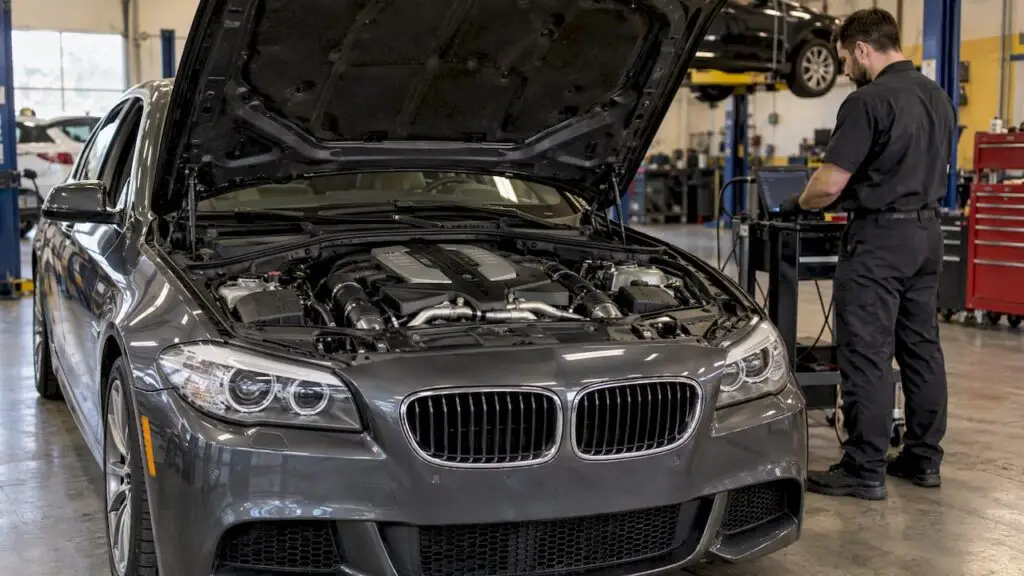
BMW’s own specification allows the N63, N63TU and N74 engines to use up to 1 liter of oil per 750 miles. Anything beyond that calls for a structured oil-consumption test, not guesswork. The most common mechanical causes are heat-aged valve stem seals, turbocharger seal migration and the crankcase ventilation path. At Alternative European & Domestic, we diagnose the cause first, then recommend a repair.
TL;DR
- BMW’s published limit for the N63, N63TU and N74 is 1 liter per 750 miles. Many owners notice the problem well before that, because low-oil warnings arrive between services.
- The hot-vee layout puts the turbochargers and exhaust manifold in the valley between the cylinder banks. The heat hardens and wears the valve seals over time.
- Blue-gray smoke at start-up or after hard deceleration, along with oil-fouled spark plugs, points toward valve seals. Confirm that with a test before replacing anything.
- Rule out external leaks first. A leaking valve cover gasket or hose can look like consumption.
- Shorter oil intervals and the correct viscosity help protect the engine after any repair.
Table of Contents
- What counts as excessive oil consumption on an N63
- Which N63 engines are affected
- What causes the oil loss
- How a technician tells burning from leaking
- Repair options
- When not to drive the car
- Preventing a repeat
- Oil consumption diagnosis at Alternative European & Domestic
- FAQ
- Sources
What counts as excessive oil consumption on an N63
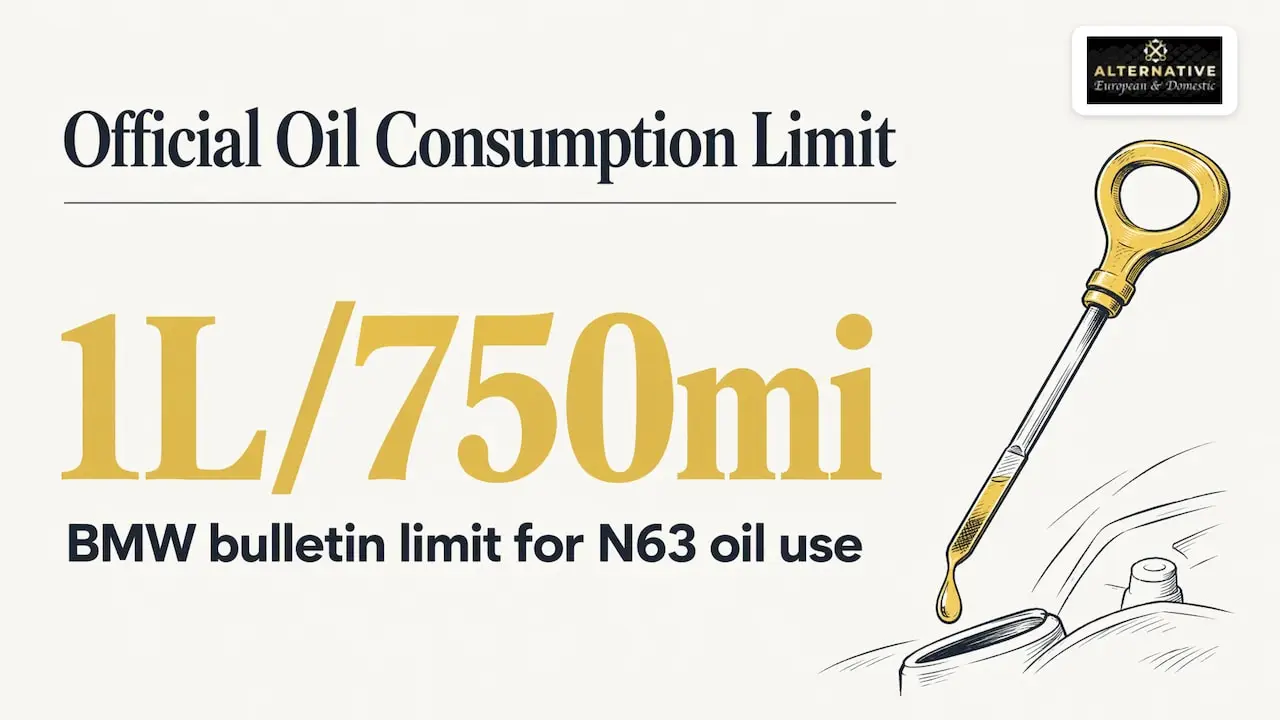
BMW’s service bulletin SI B11 03 13 sets the figure at 1 liter per 750 miles for the N63, N63TU and N74. The same bulletin says a turbocharged engine uses somewhat more oil than a naturally aspirated one, because some oil passes the turbine bearing seals and some travels through the crankcase ventilation system. So some consumption is expected. A rate near or above the limit is what deserves a closer look.
Owners tend to describe the problem in practical terms. One common report is needing to add a quart or more every 1,000 miles or so, along with oil level warnings that appear between scheduled services. Consumption that climbs over time usually suggests wear rather than a one-time event.
How to monitor it at home
The way you check the level depends on the engine generation:
- N63 and N63TU: There is no traditional dipstick. The level is read electronically through iDrive’s oil level check, with the engine at operating temperature and the car on level ground.
- N63TU3 (2018 onward): BMW returned to a physical dipstick.
Keep a simple log. Write down the odometer reading and the amount added each time. Two or three entries give a technician a far better starting point than a general impression.
Which N63 engines are affected
The original N63 had the worst reputation. The N63TU, introduced around 2012, received a revised oil catch can and a new valve seal design, which helped without fully solving the problem. The N63TU3, arriving in 2018 with better thermal shielding, improved the situation considerably.
The legal record helps date the problem:
- The first settlement (Bang v. BMW, announced July 2018) covered specified 2009-2014 5 Series, 6 Series, 7 Series, X5 and X6 vehicles sold or leased in the United States and Puerto Rico, roughly 73,700 vehicles.
- A later case (Isley v. BMW, filed 2019) focused on N63TU cars such as the 2013-2019 650i, 2013-2015 750i, 2013-2017 550i, and 2014-2018 X5, and excluded the N63TU2 and N63TU3.
Settlement terms have deadlines and eligibility rules, so do not assume your car qualifies. Check the current status with BMW of North America or the settlement administrator.
What causes the oil loss
Heat and valve stem seals
In the N63’s hot-vee design, the turbos and exhaust manifold sit inside the V. That puts heat next to the cylinder heads, and the rubber valve seals harden and lose their grip on the valve stems. Oil then seeps down the guides and burns in the cylinder. Heat is the enemy here, and that is why the seals fail earlier than on many other engines.
Typical symptoms of failing valve seals:
- Puffs of blue-gray smoke on a cold start or after coasting downhill, then closing the throttle.
- Oil-fouled spark plugs.
- Steady, rising consumption without any visible leak.
BMW’s procedure treats these as grounds for valve seal replacement. When consumption is the only symptom, it calls for a complete oil-consumption test first.
Turbocharger and crankcase ventilation
Oil can migrate past turbo bearing seals into the intake. The crankcase ventilation system is another path. Per BMW’s earlier bulletin SI B11 03 08, the N63 system has no regulating valve. Pressure is set by an orifice in the ventilation tubes, so it cannot be measured consistently. Checking it comes down to looking for loose connections or cracked hoses, and a smoke machine helps locate leaks. That is one reason a diagnosis cannot stop at the first suspect.
External leaks
Valve cover gaskets, oil filter housing seals and similar parts leak on many European engines. BMW states the engine should be leak-free before an oil-consumption analysis. A drip on your Uptown driveway or a burning smell after a drive is a different repair from oil burned in the combustion chamber.

How a technician tells burning from leaking
A sound process follows a set order. BMW’s settlement-era procedure begins with a smoke check:
- Warm the engine to operating temperature, about 15 minutes.
- Quickly raise engine speed from idle to 2,000-3,000 RPM.
- Watch the tailpipes for smoke.
- If there is no smoke, start an oil-consumption test.
For the N63TU, the electronic measurement works through BMW’s diagnostic system. After topping up, you drive 1,000 miles or until the next low-oil message, then measure again. The result is a documented number, not an opinion.
A complete evaluation also includes:
- Checking for external leaks, with the car on a lift.
- Inspecting the crankcase ventilation hoses and connections.
- Reading stored fault codes and fuel trim data for signs of oil-affected combustion.
- Looking at the spark plugs for oil fouling.
This is why dealer-level diagnostic equipment matters. Our engine repair work starts with this kind of testing, carried out by ASE-certified technicians.
Repair options
| Finding | Typical direction |
|---|---|
| External leak only | Replace the leaking gasket or seal, then re-measure |
| Smoke on start-up and deceleration, fouled plugs | Valve stem seal replacement |
| Consumption only, no leak, no smoke | Full consumption test, then address ventilation or turbo causes |
| Severe wear confirmed | Major engine work, including long block replacement |
Valve stem seal replacement
BMW’s bulletin calls for special tool P/N 83 30 2 408 268 and says not to remove the engine. The oil and filter should be replaced afterward. The AERA Technical Committee notes this job is very difficult in the car, and valve keepers were often lost, which led many shops to pull the engine or heads. BMW’s tool kit was developed to address that. The labor allowance is 85 flat rate units, which tells you this is a substantial job. It is not a quick service, and it should be done with the right tooling.
We do not publish a price for this repair. Cost depends on the engine version, the confirmed cause and whether related parts need attention. We give a written estimate after diagnosis.
What the settlement programs offered
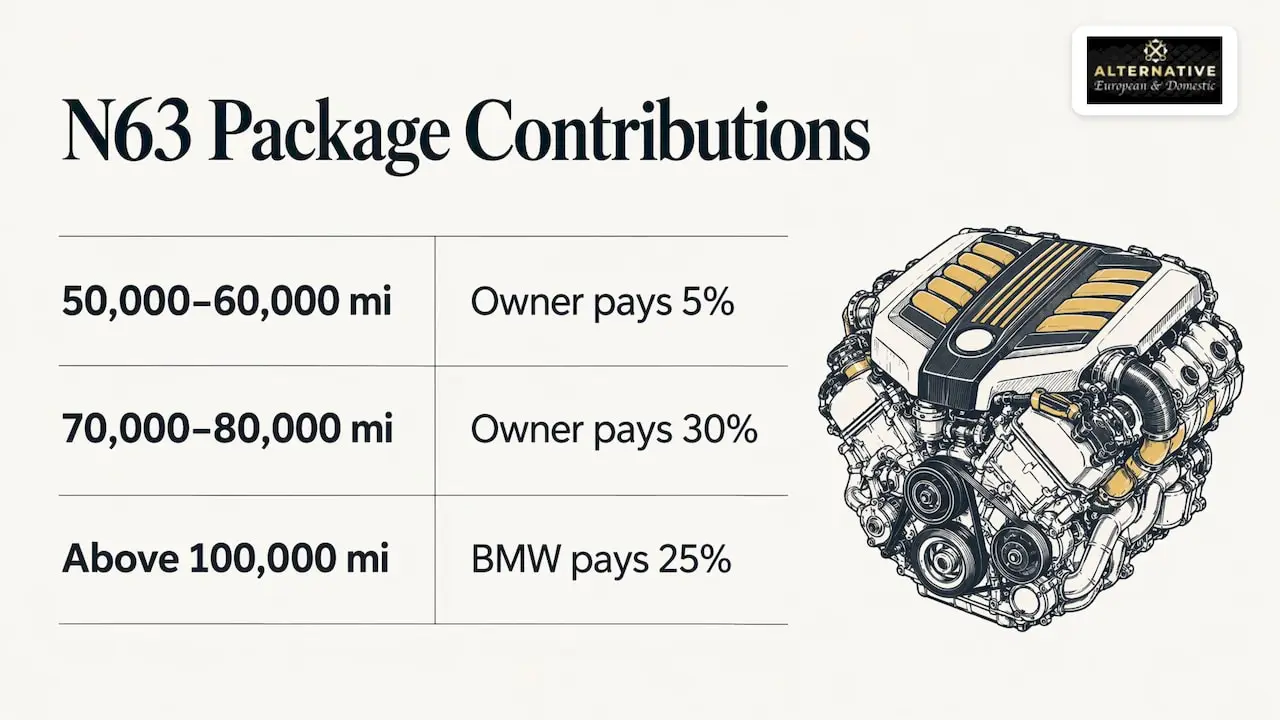
Under the N63 Customer Care Package, a new long block could be provided after two oil-consumption tests and failed repairs. The owner’s share depended on mileage: 5% at 50,000-60,000 miles, 30% at 70,000-80,000, and BMW paying only 25% above 100,000 miles. Those terms belong to a past program. Confirm with BMW whether anything applies to your vehicle today.
When not to drive the car
Oil level is a safety matter. Stop driving and consider a tow if:
- The oil pressure warning or red oil light comes on.
- The level reads at or below the minimum and you cannot add oil right away.
- You see heavy white or blue smoke at idle, or smell oil burning strongly.
- The engine runs rough with a flashing check engine light.
A turbocharged V8 running low on oil can suffer turbo and bearing damage quickly. Keep at least a quart or two of the correct oil in the car on longer trips, and top up as soon as a warning appears. Do not attempt valve seal work yourself: the cylinder head components are precise and a mistake can destroy the engine.
Preventing a repeat
BMW notes that city driving, high loads, poor fuel and extreme temperatures, combined with long oil intervals, accelerate oil degradation and wear. Using the correct viscosity for operating conditions can help avoid high consumption. Dallas heat and stop-and-go traffic on routes like Central Expressway fit that description.
Practical habits:
- Use the oil specification BMW lists for your engine, and shorten the interval from the maximum shown on the dash.
- Check the level regularly, and log what you add.
- Fix small leaks and ventilation hose cracks early.
- Have the cooling system checked, since heat drives seal wear. Our guides on BMW coolant leaks and water pump failure explain what we look at.
If you are still weighing whether the problem is just your engine, our article on Audi oil consumption shows how similar testing applies to another brand’s turbo engines.
Oil consumption diagnosis at Alternative European & Domestic
We work on European, domestic and high-performance vehicles, including BMW V8s, for drivers across Dallas, including Oak Lawn and Uptown. Our ASE-certified technicians use dealer-level diagnostics, explain what they find and quote the repair before work begins. Qualifying repairs carry our 24-month/24,000-mile warranty, subject to applicable terms. For routine upkeep, see our oil change and engine lubrication service.

If your N63 needs oil between services, schedule an appointment for a diagnostic evaluation.
FAQ
How much oil consumption is normal for a BMW N63?
BMW’s specification allows up to 1 liter per 750 miles for the N63, N63TU and N74. Turbocharged engines use more oil than naturally aspirated ones by design. If your car approaches that rate, have it tested.
Do bad valve stem seals cause N63 oil burning?
They can. Heat from the hot-vee layout hardens the seals, letting oil run past the valve stems. Smoke on start-up or after deceleration and oil-fouled plugs are the usual signs, but a consumption test should confirm it first.
Is there a fix for N63 oil consumption?
The fix depends on the cause. It may be a leak repair, valve seal replacement, ventilation work or, in severe cases, major engine repair. Diagnosis comes before any parts are ordered.
Can I keep driving an N63 that burns oil?
Yes, if you check the level often and top up promptly. Stop driving if an oil pressure warning appears or the level is below minimum, and arrange a tow if you cannot add oil safely.
Sources
- BMW SI B11 03 13, oil consumption (NHTSA)
- BMW N63 class action settlement information (NHTSA)
- N63 settlement diagnosis and repair procedures (NHTSA)
- N63 and S63 valve seal replacement, SI B11 08 15 (NHTSA)
- N63 and S63 valve seal replacement labor allowance (NHTSA)
- BMW SI B11 03 08, crankcase ventilation
- Oil consumption on 2008-2014 BMW N63 and S63 engines (AERA)
- BMW settles N63 V8 oil consumption lawsuit (BimmerLife)
- Updated N63 V8 oil consumption settlement (BimmerLife)
- BMW N63 oil consumption, causes and solutions (BMW Tuning)