
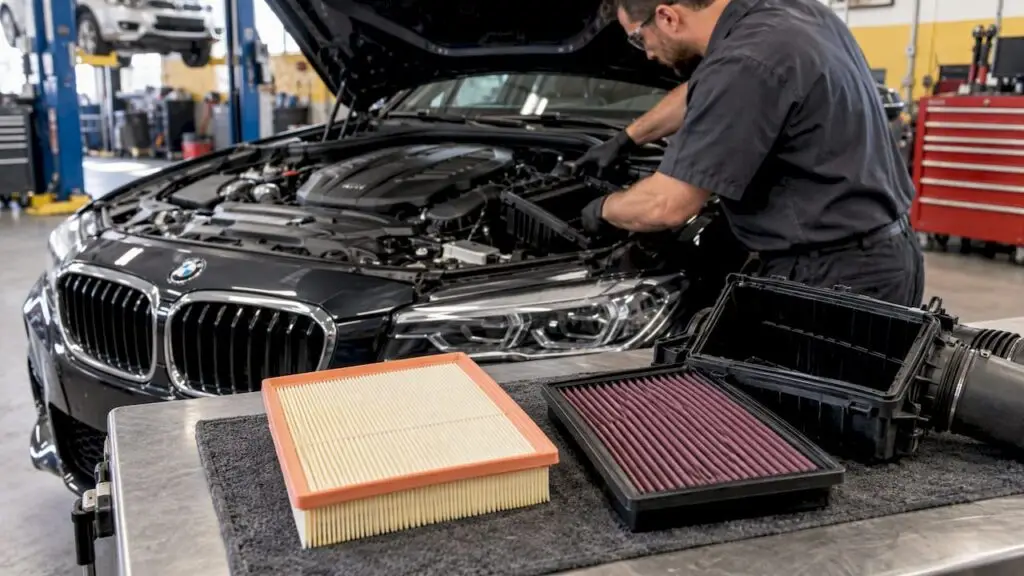
For most daily-driven European and domestic cars, a paper (disposable) engine air filter is the simpler, lower-risk choice. It filters fine dirt very well and you replace it on schedule. A reusable oiled-cotton or dry-synthetic filter flows more air and can be cleaned instead of replaced, but it gains little power on a stock engine and asks more of you in upkeep. This guide compares the two on filtration, airflow, cost, and maintenance, then explains where a cold air intake fits.
TL;DR
- Paper filters typically cost $10 to $25, and are replaced about every 12 months or 12,000 to 15,000 miles.
- Reusable filters cost more up front, flow more air, and need periodic cleaning and, for oiled types, careful re-oiling.
- Measured power gains on a stock engine are small, and a filter will not meaningfully change your fuel economy.
- A drop-in filter keeps the factory airbox. A cold air intake replaces it, which adds cost, fitment questions, and water-ingestion risk.
- Whichever you run, have the filter and airbox inspected at routine service so dirt and oil never reach sensitive sensors.
Table of Contents
- What each filter type actually is
- Filtration: how well each one protects the engine
- Airflow and power: what testing shows
- Cost over time
- Maintenance intervals
- The risk reusable filters need you to manage
- OEM filter vs. K&N: how to decide
- Drop-in filter vs. cold air intake
- When a filter change should not wait
- How we approach air filters at Alternative European & Domestic
- FAQ
- Schedule your filter inspection
- Sources
What each filter type actually is
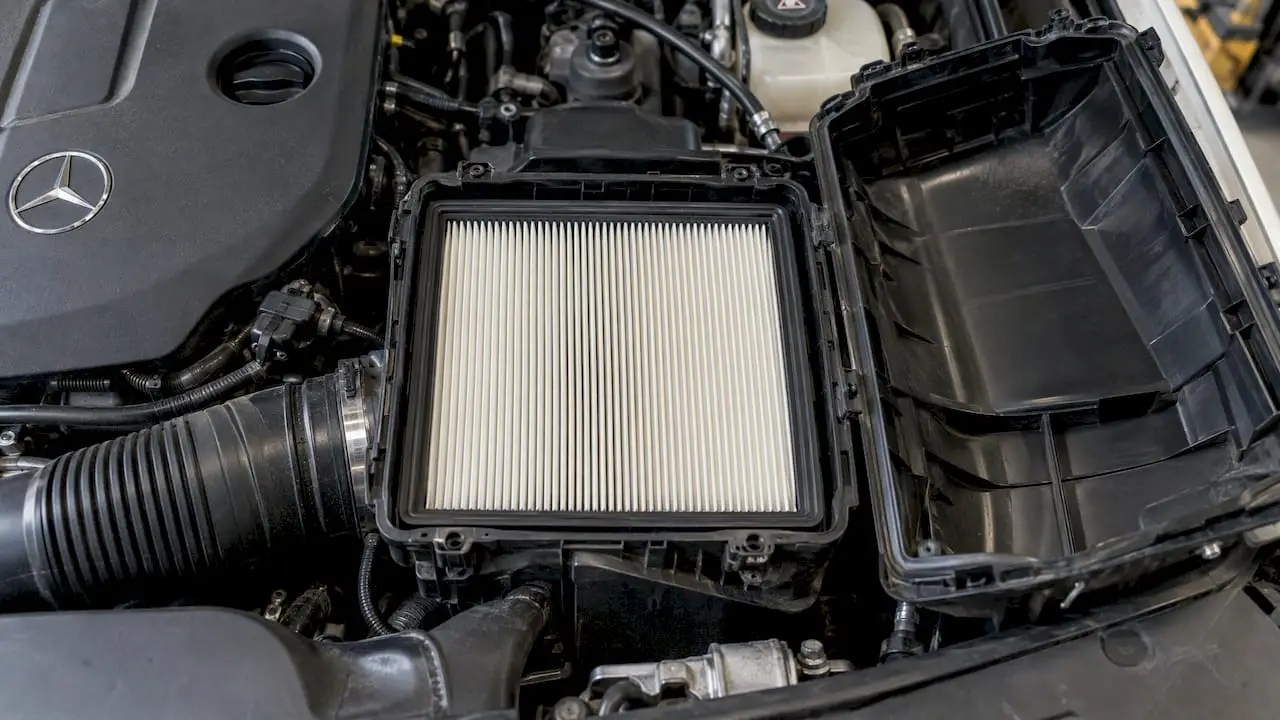
The engine air filter sits in the airbox and stops dust, sand, and debris before they reach the cylinders. Two designs dominate.
Paper (pleated cellulose) filters are what most manufacturers install at the factory. They are single use. When the element loads with dirt, you replace it.
Reusable filters come in two common forms:
- Oiled cotton gauze: layers of cotton held between wire mesh and coated with filter oil. This is the design most drivers mean when they say “K&N.”
- Dry synthetic: a washable synthetic media that does not use oil.
Both reusable types are marketed as lasting far longer than paper, with cleaning in place of replacement. That difference in upkeep is the heart of the choice.
Filtration: how well each one protects the engine
The engine’s first line of defense matters more than a few horsepower. In a flow-bench comparison of panel filters, disposable paper OEM filters were generally more efficient at capturing fine particles than many reusable performance filters, which passed noticeably more dirt in standardized testing.
That matters most on engines with tight tolerances and sensitive sensors, which describes most modern European cars. Fine particles that pass the filter can end up on the mass airflow (MAF) sensor, in the intake tract, and eventually in the oil.
Filtration is also why a clean, correctly seated element and a sealed airbox matter as much as the media. A good filter in a loose housing lets unfiltered air around the edges.
Airflow and power: what testing shows
Reusable filters are built to flow more air. Whether that shows up as power depends on the engine.
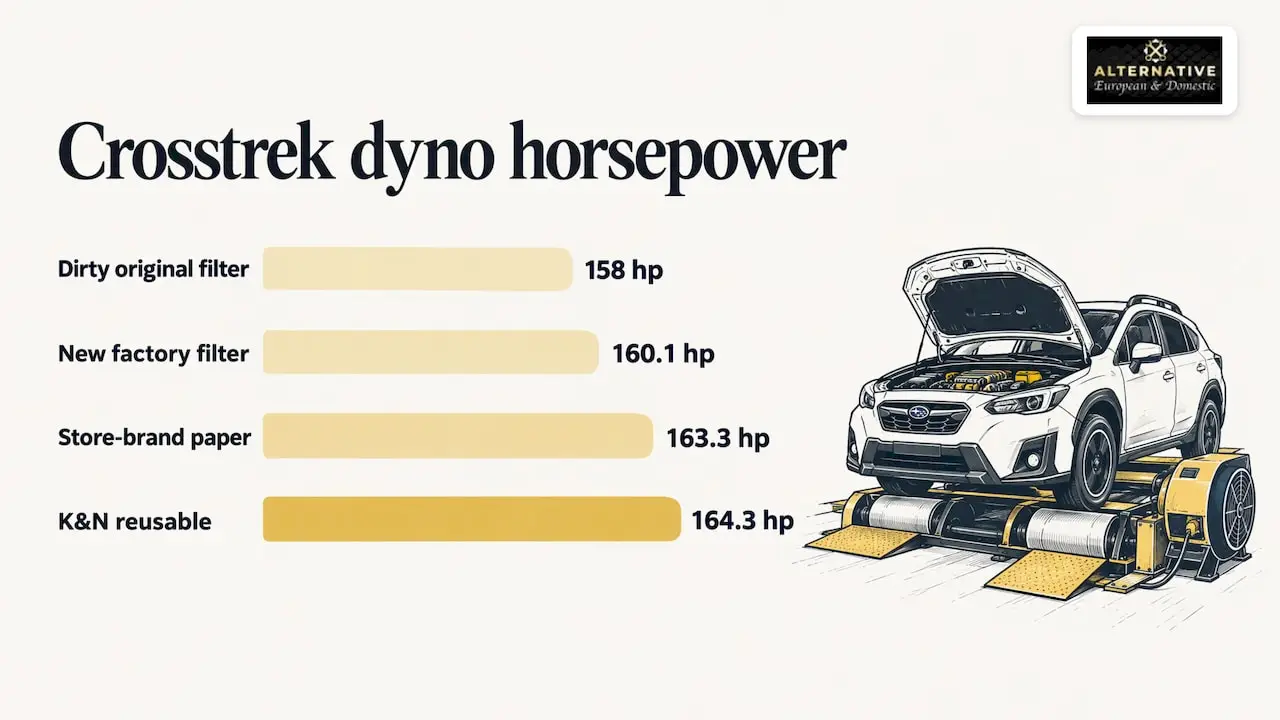
In a Subaru Crosstrek dyno test reported by Motor Authority, a dirty original filter made 158 hp. A new factory filter made 160.1 hp, a store-brand paper filter made 163.3 hp, and a K&N reusable filter made 164.3 hp. The takeaway is that the biggest gain came from simply replacing a dirty filter. The step from a fresh paper filter to a reusable one was small.
The flow-bench testing above also found that, after loading with 200 grams of dirt, OEM replacement filters were generally less restrictive than performance filters. A paper filter can hold its airflow longer as it collects dirt.
One common belief is worth correcting: better airflow does not mean better mileage. Testing documented by the U.S. Department of Energy found that in modern fuel-injected engines, intake restriction from a clogged filter does not significantly affect fuel economy. Change a filter for engine protection and performance, not for miles per gallon.
Cost over time
The up-front gap is clear. Paper filters run roughly $10 to $25, while oiled cotton filters run roughly $40 to $70. Jalopnik puts reusable performance filters at four to five times the price of a disposable one.
The long-run math depends on how long you keep the car and how you drive:
| Factor | Paper (OEM-style) | Oiled cotton | Dry synthetic |
|---|---|---|---|
| Typical purchase price | About $10 to $25 | About $40 to $70 | Varies by brand and fitment |
| Service approach | Replace | Clean and re-oil | Clean, no oil |
| Sensor contamination risk | Very low | Possible if over-oiled | Low |
| Reaction to dust | Replace sooner | Clean sooner | Clean sooner |
| Best for | Daily driving, stock cars | Enthusiasts who will maintain it | Owners who want washable without oil |
A reusable filter can pay for itself over several years, but only when it is cleaned correctly each time. The cleaning kit, filter oil, and your time or a technician’s time belong in the total.
Maintenance intervals
Intervals vary by manufacturer and by where you drive, so treat these as typical ranges and follow your owner’s manual for the factory element.
Paper filters. Jalopnik reports that disposable OEM filters are replaced every 12 months or 12,000 miles. S&B Filters recommends 12,000 to 15,000 miles or once a year.
Oiled cotton filters. S&B’s service guidance is to inspect at every oil change or 6,000 miles, and to clean and re-oil at 12,000 miles for standard use. Other sources cite longer intervals. K&N states that its filters can go up to 75,000 miles before cleaning under normal conditions. Jalopnik notes cleaning as soon as 25,000 miles in dusty or congested areas. The spread is wide, which is why inspection by condition beats going by the odometer alone.
Dry filters. S&B suggests inspecting every 5,000 miles, cleaning with compressed air, and replacing roughly every 15,000 to 30,000 miles depending on dust levels. Oiled cotton filters are the opposite: S&B says not to use compressed air on them.
Dallas driving conditions
Stop-and-go traffic around Uptown and Oak Lawn, summer dust, construction zones, and pollen season all load a filter faster than highway cruising. If your routes look like that, inspect the filter at each oil change instead of waiting for the calendar. A paper element that looks gray and packed with debris is due, whatever the mileage says.

The risk reusable filters need you to manage
Oiled filters work well when serviced correctly. The problem is excess oil. Over-oiling a cotton filter can let oil mist migrate toward nearby sensors, and JD Customs advises that excess oil can reach the sensors near the intake. A contaminated MAF sensor can cause rough running, hesitation, or a check engine light, and it can lead to a sensor replacement.
If you choose an oiled filter, these habits keep it safe:
- Use the cleaner and oil made for that filter.
- Let the filter dry fully before oiling. Humid weather can lengthen drying time.
- Apply the oil lightly and evenly, then let it wick through the cotton.
- Never use compressed air or high pressure water on cotton media.
- Check the MAF sensor and intake tube whenever the filter comes out.
If you see a check engine light after servicing a reusable filter, do not clear it and keep driving for weeks. Have the codes read and the airflow readings checked. Our advanced electrical diagnostics article explains how a shop tests sensor circuits rather than guessing.
OEM filter vs. K&N: how to decide
This is the comparison most owners are really making.
Choose a quality OEM-style paper filter if:
- You drive daily and want predictable, low-effort maintenance.
- Your car is a newer European model with sensitive airflow sensors.
- You want the filter replaced during routine service alongside oil and fluids.
- Your priority is protecting the engine and keeping the factory airbox working as designed.
Choose a reusable filter if:
- You enjoy the extra airflow and the sound it can add.
- You will inspect and service it on schedule.
- You keep cars for many years, so the higher price spreads out.
- The car is used on track or in dusty conditions where you will check the element often.
Many drivers do well with either. The mistake is not the filter type. It is running any filter past its service point.
Drop-in filter vs. cold air intake
These two are often lumped together, but they are different upgrades.
A drop-in filter replaces the paper element in the existing airbox. MAPerformance describes it as swapping the filter in place, while a cold air intake reroutes the intake to draw cooler air and can offer greater performance at a higher cost. TrackReady Products explains that a drop-in removes only the restriction of the paper element, whereas a full cold air intake replaces the airbox, resonator, and tubing and places a larger conical filter in a cooler part of the engine bay.
| Drop-in filter | Cold air intake | |
|---|---|---|
| What changes | Filter element only | Airbox, tubing, and filter |
| Airbox and water management | Factory | Replaced or relocated |
| Installation | Simple | More involved |
| Reversibility | Easy | Harder |
| Cost | Lower | Higher |
JD Customs notes that a drop-in keeps the factory airbox, ducting, and water-management design, making it the easiest change to reverse and the least likely to cause fitment or calibration problems. A cold air or enclosed intake adds installation complexity and possible water exposure.
Warranty and legal points
On warranty, S&B Filters explains that under the Magnuson-Moss Warranty Act a dealer must show the intake caused the problem to deny coverage and cannot deny a claim merely because an aftermarket intake is present. The same page says that a cold air intake must carry a CARB Executive Order for your exact year, make, model, and engine to be legal in all 50 states. That matters most if the car is registered in California or a state that follows its rules. Ask your installer about this before you buy any intake.
Check fitment first
Engines and trims vary within a single model, so match the filter to your exact year, model, and engine, then compare the new part with the old one before installing. This is especially true of imported European cars, where one model year can use two different airboxes.
When a filter change should not wait
A clogged air filter rarely strands a car on its own, but some symptoms deserve prompt attention:
- Reduced power or hesitation under load: inspect the filter and intake. If a fresh filter does not fix it, get a diagnostic evaluation.
- Check engine light with rough idle: have the codes read. A flashing light means active misfire, so reduce load and get the car to a shop soon. A severe misfire can damage the catalytic converter.
- Oil film in the intake tube or on the MAF sensor: this points to over-oiling or another source and needs inspection.
- Water in the airbox after driving through a flooded road: do not restart the engine. Water in the cylinders can cause severe engine damage, and towing is the safe option.
If the engine cranks but suddenly stalls or knocks after any water crossing, stop driving and arrange a tow.
Filter-related symptoms can also overlap with carbon buildup on direct-injected engines. Our guide to walnut blasting vs. DIY intake valve cleaning covers that separate issue on European GDI cars.
How we approach air filters at Alternative European & Domestic
At Alternative European & Domestic, filter replacement is part of our maintenance service for European, domestic, and high-performance vehicles. Our ASE-certified technicians inspect the element and airbox, check for oil or debris near the intake, and recommend replacement based on the condition we see and your driving. If a diagnostic is needed, we explain what we found and why before any work starts.
For Dallas drivers in Oak Lawn, Uptown, and nearby neighborhoods, the easiest time to handle the filter is during an oil change. See our oil change and engine lubrication services, or browse the full list of services. If you are unsure what to ask, our questions to ask a mechanic guide helps you get recommendations in writing. Qualifying repairs may be covered by our 24-month/24,000-mile warranty, subject to applicable terms.
FAQ
Is a reusable air filter better than a paper filter?
Not automatically. Reusable filters flow more air and can be cleaned, but paper filters were generally more efficient at capturing fine particles in flow-bench testing. For a daily driver, the better filter is the one that is clean, fits correctly, and is serviced on time.
Does a K&N filter add horsepower over an OEM filter?
A little. In the Crosstrek test, the K&N made 164.3 hp against 160.1 hp for a new factory filter. The larger improvement over the dirty original came from any fresh filter. Results differ by engine, so expect modest gains on a stock car.
How often should I replace or clean my engine air filter?
Paper filters are typically replaced every 12 months or 12,000 to 15,000 miles. Oiled cotton filters are inspected at each oil change and cleaned on the maker’s schedule. Follow your owner’s manual, and inspect sooner in dusty or heavy-traffic driving.
Is a drop-in filter or a cold air intake the better upgrade?
A drop-in keeps your factory airbox and is the easier change to reverse. A cold air intake replaces the airbox and tubing, costs more, and brings fitment, water-exposure, and emissions-compliance questions. Confirm legality for your state and vehicle before installing one.
Can a reusable filter damage my MAF sensor?
Over-oiling can. Excess oil can drift toward sensors near the intake and cause drivability problems. Use the manufacturer’s cleaner and oil, apply oil sparingly, and have a technician check the sensor if the check engine light comes on.
Schedule your filter inspection
If you drive in Dallas and are not sure what your air filter looks like, we can check it with your next service. Contact Alternative European & Domestic to schedule an inspection, diagnostic evaluation, maintenance, or repair.
Sources
- Air Filters Explained 2026: Drop-In vs Cold Air Intake vs Universal
- Best Engine Air Filters: OEM vs Performance (StrikeEngine)
- Effect of Intake Air Filter Condition on Vehicle Fuel Economy (fueleconomy.gov)
- Do performance air filters actually work? (Motor Authority)
- Can You Really Clean A Car Air Filter? (Jalopnik)
- Best Car Air Filter: Types, Benefits and Replacement Guide (S&B)
- How often should I service my filter? (S&B support)
- K&N Engine Air Filter 33-2185 (AutoZone)
- Cold Air Intake VS Drop-in Air Filter (MAPerformance)
- K&N Drop-In Filters vs. Full Cold Air Intake (TrackReady Products)
- Drop-In Filter vs Short-Ram vs Cold-Air Intake (JD Customs)
- Cold Air Intake Benefits: Power, Throttle, and Performance (S&B)