
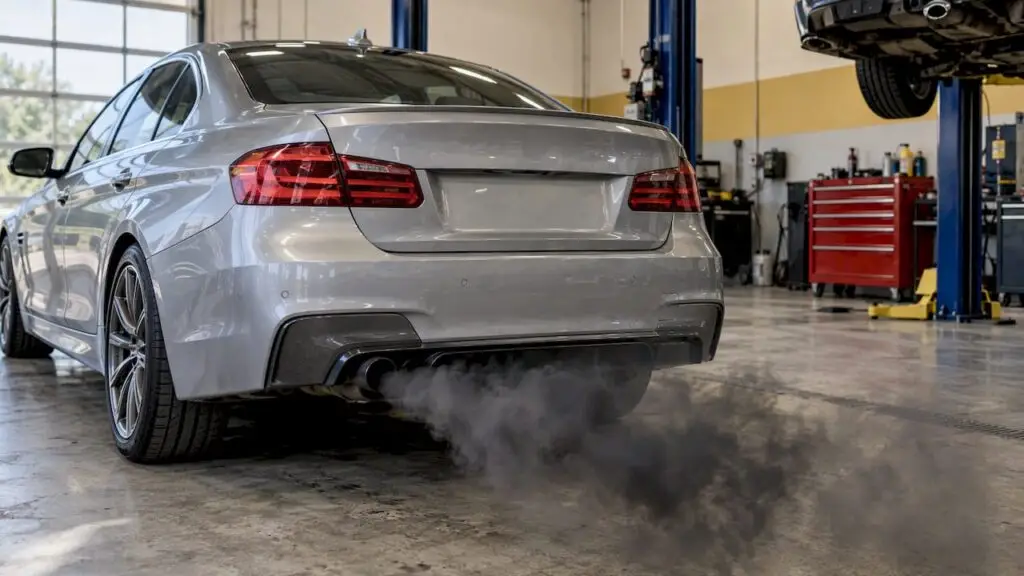
Exhaust smoke color is one of the quickest clues to what is going wrong inside an engine. Thin white vapor that fades on a cold morning is normal. Thick white smoke usually means coolant is being burned, blue smoke means oil is being burned, and black or gray smoke means the engine is getting too much fuel or not burning it completely. A warmed-up gasoline engine should not smoke visibly, and the color only narrows the search. It does not name the failed part.
TL;DR
- White: thin vapor that disappears quickly is condensation. Thick, persistent, sweet-smelling white smoke points to coolant entering the combustion chamber, often a head gasket problem.
- Blue: engine oil is burning. Worn piston rings, valve seals or guides, or in turbocharged cars a leaking turbo seal, are the usual suspects.
- Black or dark gray: the mixture is running rich or fuel is not burning fully. Injectors, fuel pressure, sensors and ignition are the first places to look.
- Stop driving if smoke comes with overheating, a low oil pressure warning, or fluid on the ground. Have the car towed rather than risk the engine.
- Scan data and pressure tests, not the color alone, identify the cause. That is what a proper diagnostic visit is for.
Table of Contents
- Why a healthy engine should not smoke
- Exhaust smoke colors at a glance
- White exhaust smoke
- Blue exhaust smoke
- Black and dark gray exhaust smoke
- Gray smoke: a gray area
- Which smoke color means a blown head gasket, a bad turbo or a rich mixture?
- What to do when your car starts smoking
- How a shop diagnoses exhaust smoke
- Repair options and what drives the cost
- Preventing smoke-related failures
- Smoke diagnosis at Alternative European & Domestic
- FAQ
- Sources
Why a healthy engine should not smoke
The Pennsylvania Department of Environmental Protection says a properly operating gasoline vehicle should not emit visible smoke after it has warmed up, and that visible smoke generally indicates an engine malfunction. The same guide ties white smoke in gasoline engines to coolant leaking into the combustion chamber, blue smoke to burning oil, and black or gray smoke to incomplete fuel combustion.
That gives you a useful first sort. It also explains why color is a starting point. Several different faults can produce the same color, and one fault can change color depending on engine load, temperature and how long the car sat.
A few details sharpen the clue:
- When it happens: cold start only, steady cruising, acceleration or deceleration.
- How long it lasts: a few seconds, or until you shut the engine off.
- Smell: sweet, acrid, like burnt oil, or like raw gasoline.
- Other symptoms: temperature gauge, warning lights, rough running, fluid levels, fuel economy.
Note these before you call a shop. They shorten diagnosis considerably.
Exhaust smoke colors at a glance
| Color | Most likely meaning | Common causes | Urgency |
|---|---|---|---|
| Thin white vapor, fades fast | Condensation | Cold or humid start, short trip | Normal if it clears as the car warms |
| Thick white, sweet smell | Coolant burning | Head gasket, cracked head or block | High: stop driving if the car overheats |
| Blue or blue-gray | Oil burning | Worn rings, valve seals or guides, turbo seal, overfilled oil | Moderate to high: oil level must be watched |
| Black | Excess fuel | Leaking injector, fuel pressure regulator, sensor or ignition fault | Moderate: drive gently, schedule diagnosis soon |
| Gray | Oil or incomplete combustion | Overlaps with blue and black; needs testing | Moderate: confirm the cause |
White exhaust smoke
Normal condensation
Exhaust gas contains water vapor, and a cold system turns it into a visible cloud. On a cool Dallas morning you may see it for a minute or two. The Iowa Department of Natural Resources notes that white smoke can simply reflect low engine temperature at startup, requiring no repair. Water dripping from the tailpipe on a short trip is part of the same process.
The test is simple. If the vapor thins out and vanishes once the engine is warm, and the coolant level stays steady, it is not a fault.
When white smoke means coolant is burning
The same Iowa DNR guide lists coolant or water leaking into the combustion chamber, from a bad head gasket or a cracked block or cylinder head, as the other cause of white smoke in gasoline engines. This smoke is denser, lingers after warm-up, and often smells sweet. CRC Industries describes the pattern as thick white smoke with a sweet odor, alongside overheating and unexplained coolant loss.
Other signs that point the same way:
- Coolant level dropping with no visible puddle
- Milky or tan residue under the oil filler cap, or oil that looks like a milkshake on the dipstick
- Bubbles in the coolant reservoir
- Overheating, especially in traffic
- Rough running or misfires on a cold start
Edmunds warns that persistent thick white smoke can deplete coolant, cause overheating, and in some cases let coolant mix with engine oil. It recommends contacting a mechanic promptly and avoiding unnecessary driving. Coolant in the oil robs the bearings of lubrication, so a repair that might have been a gasket job can become an engine replacement.
This is why a head gasket is the first suspect but not the only one. On many European engines, an intake or cooling-system fault, a failed plastic coolant component, or a cracked cylinder head can create a similar picture. Our guide to head gasket symptoms covers the full list of warning signs and what testing involves.
White smoke in diesel engines
Diesels behave differently. The Iowa DNR says diesel white smoke can reflect low engine temperature at startup or an improper air-fuel mixture caused by faulty injection or valve timing, overheating, or fuel-pump faults. A diesel that smokes white only when cold may be normal. One that keeps doing it needs injection and timing checks.
Blue exhaust smoke
Blue or bluish-gray smoke means engine oil is reaching the combustion chamber. The Iowa DNR says diesel blue smoke indicates burning oil and may result from excessive oil or worn piston rings, valves or cylinders. The same logic applies to gasoline engines.
Common causes
- Worn piston rings or cylinder walls: oil slips past the rings and burns. Smoke is usually more noticeable under acceleration.
- Worn valve seals or valve guides: oil seeps down the valve stems when the engine is off or on closing the throttle. A puff of blue smoke at startup after the car sat overnight, or when you lift off the throttle, is a classic hint. These patterns are clues, not a verdict.
- Turbocharger seal failure: the New Zealand Transport Agency lists turbo pressure-seal failure, engine wear and an excessive oil level as possible causes of blue smoke in petrol vehicles. This matters for the many turbocharged European and performance engines on the road in Dallas.
- Overfilled oil: too much oil gets whipped up by the crankshaft and can be drawn into the combustion chamber. Always have the level checked first.
- Clogged crankcase ventilation: a blocked PCV system raises crankcase pressure and pushes oil where it should not go. This is a known weak point on some European engines, and testing it is far cheaper than rebuilding an engine.
How urgent is it?
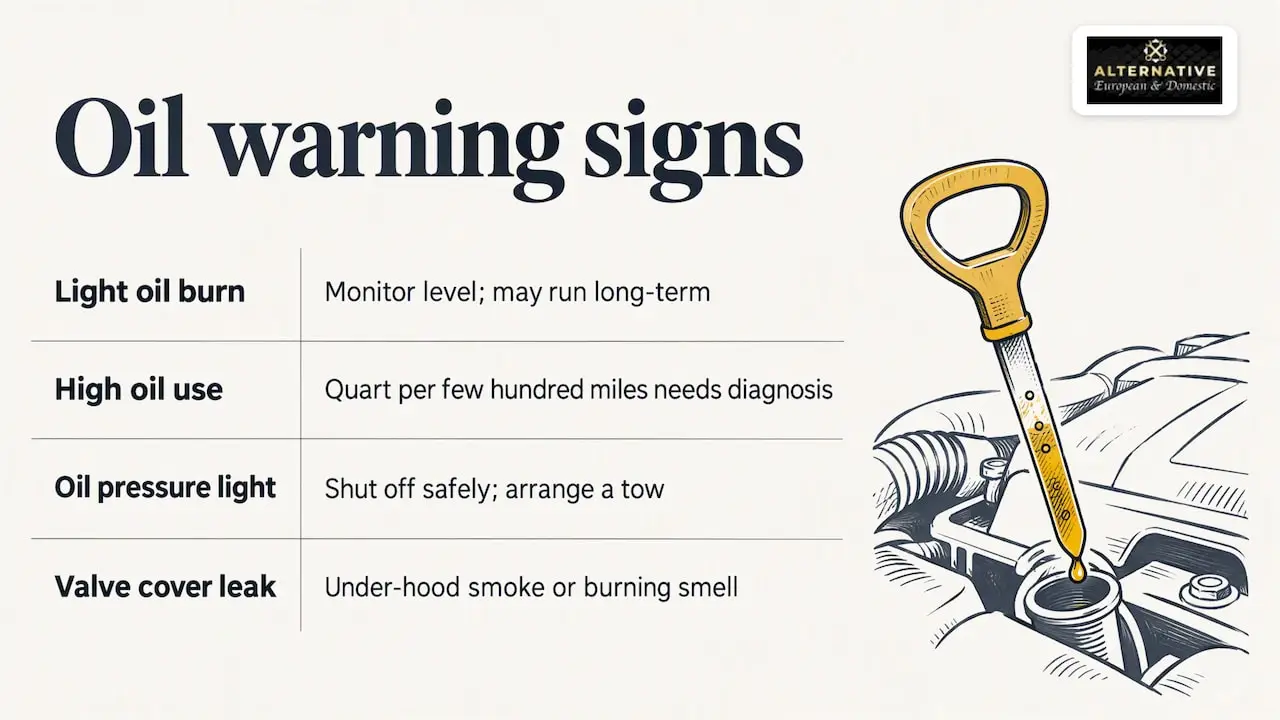
A car that burns a little oil can run for a long time if you monitor the level. A car that burns a quart every few hundred miles needs a diagnosis. Low oil starves bearings, and burning oil can foul spark plugs, oxygen sensors and eventually the catalytic converter.
Check the dipstick at every fuel stop until the cause is known. If the oil pressure light comes on, shut the engine off safely and arrange a tow. Regular oil service with the correct specification matters here too: our oil change and engine lubrication service uses the oil grade your engine is designed for, which is especially important in turbocharged engines.
Not every oil problem shows as smoke. A leaking valve cover gasket can drip onto a hot exhaust manifold and create smoke under the hood or a burning smell, which is a different problem from smoke at the tailpipe. Our valve cover gasket leak triage explains how to tell them apart.
Black and dark gray exhaust smoke
Black smoke is soot from fuel that did not burn fully. In gasoline engines it means the mixture is rich: too much fuel, too little air, or weak ignition. The Pennsylvania DEP groups black or gray smoke under incomplete combustion for both gasoline and diesel engines.
Family Handyman lists a leaking fuel injector, defective fuel-pressure regulator, failed engine sensor or ignition component as possible sources. The car may run poorly and return worse fuel economy, and if the fault is left alone the oxygen sensor and catalytic converter can be damaged.
Other things that lead to a rich mixture
- A clogged air filter or restricted intake
- A faulty mass airflow sensor reading too low
- A coolant temperature sensor that tells the computer the engine is always cold
- Worn spark plugs or failing coils that leave fuel unburned
- A stuck-open purge valve or other fuel vapor control faults
A modern engine management system tries to correct a rich condition on its own, so black smoke often arrives with a stored code and a check engine light. The code is the start of the work, not the end. A lean or rich code can come from a vacuum leak, a sensor or the fuel system. Our walkthrough of live data steps for a check engine light shows why reading fuel trims and sensor values beats swapping parts.
Diesel black smoke
Heavy black smoke under load on a diesel usually points to too much fuel for the available air: worn injectors, a failing turbo that is not delivering boost, or a restricted intake or particulate filter. Because modern diesels are tightly emissions-controlled, any visible black smoke deserves a scan and a look at boost and injector data.
Gray smoke: a gray area
Gray smoke sits between the others. It can be thin blue smoke seen in daylight, or a faint rich-running soot. Some automatic transmissions with a vacuum modulator can also draw fluid into the engine and produce it, an older design that is less common now. Because gray overlaps, do not rely on color alone. Note the smell and the timing, and have the engine tested.
Which smoke color means a blown head gasket, a bad turbo or a rich mixture?
These are the three questions drivers ask most often.
- Blown head gasket: usually thick white smoke, but not always. If the gasket fails between a cylinder and an oil passage instead, you may see oil contamination or overheating with little smoke. Look for coolant loss, bubbles, milky oil and a sweet smell.
- Failing turbo: typically blue smoke from oil getting past the seals. Other clues are an oil-soaked intake pipe, a whining or siren-like noise, lost power and slow boost. Blue smoke alone does not prove the turbo is at fault.
- Rich fuel: black smoke, a fuel smell, poor mileage and often a check engine light.
What to do when your car starts smoking
Safety comes before diagnosis.
- Pull over safely and turn the engine off if you see heavy smoke, the temperature gauge climbing, or a warning light for oil pressure or coolant.
- Do not open the radiator or coolant cap on a hot engine. Family Handyman advises checking gauges and warning lights and never touching or working on a hot engine.
- Look for fluid under the car. Family Handyman says visible dripping or puddling warrants a tow, because running out of coolant, transmission fluid or motor oil can cause severe damage.
- Do not keep driving to see if it clears. Even a short trip with low coolant or oil can warp a cylinder head or spin a bearing.
- Call a professional technician and describe the color, smell, timing and warning lights.
Our article on service lights and when to stop or tow helps you read the dashboard warnings that often accompany smoke. For tracing odors that come with smoke, see our guide on exhaust smell in your car, and for a broader read on why diagnosing the source matters, tracing the source of odors is a helpful companion.
When the car should not be driven
Do not drive the vehicle if:
- The temperature gauge is in the red or the coolant warning is on
- The oil pressure warning is lit, or the oil level is below the dipstick’s minimum mark
- Thick white or blue smoke continues after warm-up
- You can see fluid pooling under the car
- The smoke is accompanied by loud knocking, severe misfires or a flashing check engine light
A flashing check engine light signals active misfire that can quickly damage the catalytic converter. Smoke coming from under the hood instead of the tailpipe is a separate emergency: pull over, shut the engine off and move away from the vehicle.
How a shop diagnoses exhaust smoke
Guessing at smoke is expensive, which is why a structured process matters. A thorough diagnostic typically includes:
- Interview and visual check: when the smoke appears, smell, history, fluid levels and leaks.
- Scan for codes and live data: fuel trims, oxygen sensor behavior, misfire counters, coolant temperature and boost readings.
- Cooling system pressure test: to find external and internal leaks.
- Combustion leak (chemical block) test: detects exhaust gases in the coolant, which points to a head gasket or cracked head.
- Compression and leak-down tests: compare cylinders to find worn rings, valves or a failing gasket.
- Oil analysis and inspection: coolant, fuel dilution or metal in the oil changes the diagnosis.
- Boost and turbo inspection: shaft play, oil in the intercooler piping and boost leaks on turbocharged engines.
- Fuel system tests: injector balance, fuel pressure and regulator checks for rich running.
The point of this sequence is to confirm one cause before parts are replaced. If you want to know how shops charge for this, see our overview of diagnostic fees and what they cover, and our list of questions to ask a mechanic so you can get findings and estimates in writing.
Repair options and what drives the cost
Cost depends on the fault, the engine and how long the problem was ignored. Rather than quote ranges we cannot support for your car, these are the factors that move the estimate:
- Engine layout: a head gasket on a V8 or flat-six with buried components takes far more labor than on a simple inline four.
- Parts quality: gaskets, seals and sensors vary. Quality parts reduce the odds of repeat failure.
- Collateral damage: a warped head, scored cylinder or contaminated catalytic converter adds work.
- Turbo repair or replacement: rebuild versus new unit, plus oil feed and drain line replacement.
- Time: an early diagnosis often means a smaller repair. Waiting can turn a gasket into an engine.
Repairs at the top of the spectrum, like engine replacement, are among the biggest bills a vehicle can bring, which is why people ask about the most expensive parts of a car to repair. Catching smoke early is the cheapest way to stay out of that conversation.
Preventing smoke-related failures
Most smoke problems develop slowly, and routine care catches them.
- Change oil on the interval your manufacturer specifies, with the correct grade, and check the level between services.
- Keep coolant at the right level and replace it on schedule. Use the coolant type specified for your car, as European engines are often particular.
- Replace air filters and spark plugs on time.
- Do not ignore a check engine light, even if the car feels fine.
- Let turbocharged engines settle before shutting down after a hard run if the manufacturer recommends it.
- Watch for small leaks and oil loss, which tend to precede visible smoke.
A custom maintenance service plan built around your car’s age, mileage and driving pattern, such as stop-and-go traffic through Uptown or highway miles on the Dallas North Tollway, catches these issues sooner.
Smoke diagnosis at Alternative European & Domestic
Alternative European & Domestic works on European, domestic and high-performance vehicles for drivers across Dallas, including Oak Lawn and Uptown. Our ASE-certified technicians use dealer-level diagnostics to separate a harmless cold-start vapor from a cooling, oil or fuel fault, and we explain findings before any repair begins.
If smoke is already a symptom, our engine repair services cover head gaskets, valve seals, turbo-related oil leaks and fuel system repairs. Qualifying repairs may be covered by our 24-month/24,000-mile warranty, subject to applicable terms.

If your car is smoking, do not wait for it to get worse. Schedule an appointment for a diagnostic evaluation, or call to describe the symptoms and ask whether the car is safe to drive in.
FAQ
What does white smoke from the exhaust mean?
Thin white vapor that fades as the engine warms is usually condensation and is normal. Thick white smoke that persists, especially with a sweet smell, usually means coolant is entering the combustion chamber, often through a failed head gasket or a cracked head or block. Have it checked promptly and avoid driving if the engine overheats.
What color smoke means a blown head gasket?
Thick white smoke is the classic sign, but it is not proof. Confirm with a combustion leak test, a cooling system pressure test and a check for coolant loss, milky oil and overheating. Some head gasket failures produce little or no visible smoke.
What color smoke is a bad turbo?
Blue smoke is the usual sign, because worn turbo seals let oil into the intake or exhaust. Other clues include a whining noise, reduced power and oil in the intercooler piping. Blue smoke can also come from worn rings or valve seals, so the turbo should be inspected before replacement.
Is it safe to drive with smoke coming from the exhaust?
It depends on the color and what comes with it. Do not drive if the car is overheating, the oil pressure light is on, fluid is pooling under the car or the smoke is thick and constant. In those cases, have it towed to avoid turning a repair into engine replacement.
Why is black smoke coming from my exhaust?
Black smoke means the engine is burning too much fuel or not burning it completely. Typical causes are a leaking injector, a faulty fuel pressure regulator, a failed sensor or an ignition fault. A scan and live data review will usually point to the cause.
Sources
- Automobiles – Car Care, Pennsylvania Department of Environmental Protection
- Vehicle Exhaust, Iowa Department of Natural Resources
- Smoky exhausts, NZ Transport Agency Waka Kotahi
- White Smoke From Exhaust: What Does it Mean & How to Fix It, Edmunds
- Why Is My Car Smoking? What To Do If Your Car Is Smoking, Family Handyman
- Spotting Blown Head Gasket Symptoms, CRC Industries