
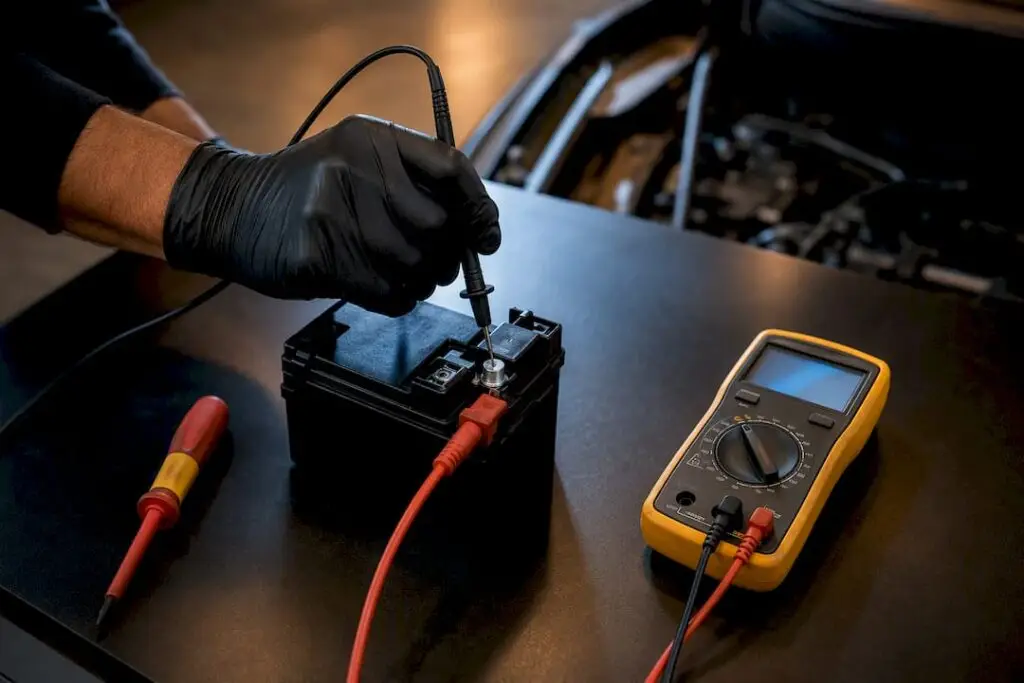
An “Auxiliary Battery Malfunction” warning usually means your Mercedes-Benz’s secondary 12V power source, or the converter module that stands in for it, isn’t holding voltage the way it should. The car often stays drivable for a short trip, but pushing your luck on a long drive risks cascading electrical faults. Common culprits are an aged auxiliary unit, a failing DC/DC converter, or a blown fuse. Get it checked soon rather than later.
TL;DR:
- The auxiliary battery in Mercedes vehicles is a small, often AGM or capacitor-based, component that supports start/stop, infotainment, and safety systems.
- Symptoms such as start/stop disabling and infotainment resets typically appear after three to five years, with the car remaining drivable but stressing the circuit if ignored.
- Replacement usually involves a 20 to 60-minute job costing between $250 and $450, depending on whether the issue stems from the battery or related wiring or converter.
- Proper diagnosis requires voltage testing, fault code reading, and checking the converter output, as faults often persist even after part replacement.
- Conducting regular voltage checks, keeping areas dry, and using AGM-specific chargers can extend the auxiliary battery’s lifespan and prevent unnecessary repairs.
Table of Contents
- What Is the Mercedes Auxiliary Battery and What Does It Do?
- Auxiliary Battery Malfunction Symptoms: What the Warnings Mean
- Mercedes Auxiliary Battery Locations by Model
- How to Test the Auxiliary Battery: Voltage Checks and Fault Codes
- Mercedes Auxiliary Battery Replacement: Steps, Time, and Cost
- Charging and Maintenance Tips to Extend Auxiliary Battery Life
- Main Battery vs. Auxiliary Battery: What’s the Real Difference
- Auxiliary Battery Types and Specs: OEM vs. Aftermarket
- How Auxiliary Battery Failure Affects Your Mercedes
- Our Take: When to DIY and When to Call a Specialist
- Book a Mercedes Auxiliary Battery Diagnostic in Dallas
- Sources
- FAQ
What Is the Mercedes Auxiliary Battery and What Does It Do?
The Mercedes auxiliary battery is a secondary 12 volt power source, separate from the main starter battery, that stabilizes electrical current for systems that don’t tolerate voltage dips well. Think of it as a buffer. When the engine cuts out at a stoplight during start/stop operation, the main battery alone can’t always keep sensitive electronics running smoothly, so the auxiliary unit picks up the slack.
It typically supports:
- The start/stop system, so the engine restart doesn’t cause a power hiccup
- Infotainment and COMAND systems, keeping displays and audio stable
- The electronic gear shifter and park lock actuator
- Comfort and safety features, including memory seats and certain alarm functions
Not every Mercedes uses a conventional battery here. Some models, including several C-Class variants, rely on a small capacitor or voltage converter module instead. That distinction matters when you’re diagnosing a fault or shopping for a part, since a capacitor-based system behaves differently than a sealed AGM cell.
Auxiliary Battery Malfunction Symptoms: What the Warnings Mean
A dashboard alert reading “Auxiliary Battery Malfunction” is the most direct signal, but it rarely travels alone. Owners typically report a cluster of related glitches that show up around the same time, and the pattern tells you a lot about how urgent the fix is.
- Start/stop system disables itself. The feature that shuts off your engine at idle stops working, which is often the first sign something’s off with auxiliary power.
- Radio, clock, or infotainment resets. These systems draw on the auxiliary supply for stable operation, so flickers or resets during stop-start cycles are a clue.
- Trunk or accessory glitches. Some owners notice the trunk release or other convenience features acting up intermittently.
- General accessory hiccups. Interior lighting, memory seat settings, or COMAND responsiveness can lag or reset unexpectedly.
These faults often surface after three to five years of service, which lines up with typical auxiliary battery lifespan. The car usually remains drivable in this state. Still, continuing to drive for weeks with an unresolved fault stresses the charging circuit and related modules, and that’s how a $300 fix turns into something more involved.
Mercedes Auxiliary Battery Locations by Model
Auxiliary battery location varies enough across the lineup that “just pop the hood” doesn’t always work. Knowing roughly where to look saves a diagnostic visit some guesswork, and it helps you describe the problem accurately if you call ahead.
- Passenger footwell, behind the kick panel or near the glovebox. This is common on the W205 C-Class and similar models, where the unit is actually a small capacitor rather than a traditional battery.
- Engine bay, near the HVAC intake or under a passenger-side cover. Several sedan and SUV platforms tuck the auxiliary unit here, sometimes under a plastic shield.
- Under the seats or in the trunk. Larger sedans and some SUVs place it in these spots, occasionally sharing space with the main battery compartment.
Access usually means removing trim clips or a few fasteners rather than major disassembly, but footwell and trunk locations carry more moisture and corrosion risk over time, especially in humid climates. That’s worth checking during any inspection, since a fault triggered by moisture damage points toward wiring or connector issues rather than a straightforward battery swap.
How to Test the Auxiliary Battery: Voltage Checks and Fault Codes
A healthy 12V system generally shows a resting voltage in the neighborhood of 12.4 to 12.8 volts, with the auxiliary circuit tracking close to the main battery. A significant gap between the two, or an auxiliary reading that sags noticeably under load, points toward a failing cell or converter. This is the kind of number a shop capturing voltage readings can spot quickly, and it’s worth having on hand before any diagnostic appointment.
A few checks you can run yourself before booking a shop visit:
- Visual inspection. Look for corrosion, swelling, or a cracked case on the battery or module, and check nearby connectors for green or white buildup.
- Voltmeter test. With the engine off, measure voltage at the battery terminals; a reading well under 12 volts suggests a weak cell.
- Fuse inspection. A blown fuse or corroded relay can mimic a dead auxiliary battery, so this step matters before you assume the worst.
- Basic parasitic draw check. Excessive current draw with the car off can drain the auxiliary supply faster than it should.
Professional diagnostics go further. Dealer-level tools read fault codes such as B21DC01, test the DC/DC converter’s actual output under load, and clear adaptation values after a repair, something a basic OBD reader often can’t do. Persistent warnings after a battery swap frequently trace back to uncleared fault memory or a struggling converter, not a defective new part.
Pro Tip: If your dashboard warning clears temporarily after you disconnect and reconnect the battery, don’t treat that as a fix. It usually means the fault is intermittent, and it will come back.
Mercedes Auxiliary Battery Replacement: Steps, Time, and Cost
Replacing the unit itself is a relatively contained job on most models, though access varies by platform as noted above. On the W205, for instance, the process involves removing the passenger footwell panel, disconnecting the old capacitor module, and checking a related trunk fuse afterward to confirm the circuit is complete.
A typical replacement sequence looks like this:
- Access the panel or cover concealing the unit
- Disconnect the negative terminal first for safety
- Remove mounting hardware and swap the old unit for the new one
- Reconnect and secure everything, then clear any stored fault codes
Many Mercedes models use a compact 12V unit rated around 1.2Ah, sometimes labeled AUX14, with OEM part numbers like N000000004039 or A0009829308 showing up across service records. The labor itself usually runs 20 to 60 minutes, and total shop cost typically lands between $250 and $450 including parts. That range climbs if the converter, a relay, or wiring turns out to be the actual root cause rather than the battery itself.
Charging and Maintenance Tips to Extend Auxiliary Battery Life
AGM-style auxiliary batteries need a charging profile that differs from a standard lead-acid charger, and getting this wrong can shorten the unit’s service life or damage nearby electronics. Low current, generally in the 2 to 5 amp range, delivered through an AGM-capable smart charger is the safer approach compared to a generic charger or jump box aimed directly at the auxiliary terminals.
A basic safe-charging checklist:
- Use a charger explicitly rated for AGM chemistry
- Keep amperage low and let the charge cycle complete slowly
- Confirm a solid ground connection before starting
- Never jump-charge the auxiliary battery directly from another vehicle
For ongoing care, check voltage periodically, especially before long trips, keep footwell and trunk areas dry to limit corrosion risk, and inspect terminals for buildup. If you notice recurring dashboard warnings despite clean terminals and solid voltage readings, that’s a signal for a professional battery health test rather than another swap attempt.
Main Battery vs. Auxiliary Battery: What’s the Real Difference
The main battery and the auxiliary battery in a Mercedes handle very different jobs, even though both run on the same 12V architecture. The main battery, usually a larger AGM unit under the hood or in the trunk, provides the heavy current needed to crank the engine and supports the primary electrical load while driving.
The auxiliary battery, or its capacitor/converter equivalent, exists to smooth things over during moments the main battery can’t handle alone, particularly the split second an engine restarts after a start/stop cycle. Without that buffer, you’d likely see flickering displays, momentary infotainment dropouts, or a rougher restart every time the engine cuts back in at a light.
Size and capacity reflect this division of labor. The main battery is rated for cranking amps and sustained output, while the auxiliary unit is a smaller, lower-capacity component built for brief, high-frequency support rather than long-duration power delivery. That’s why a 12V 1.2Ah auxiliary battery can do its job despite being a fraction of the size of the main battery.
Failure modes differ too. A dead main battery typically means the car won’t start at all. A failed auxiliary battery, by contrast, often lets the engine start just fine while quietly disabling comfort features and start/stop, which is exactly why the malfunction can go unnoticed longer than a dead main battery would. Both systems ultimately share the same electrical ground and rely on a functioning charging circuit, so a fault upstream, like a bad relay, can affect either one.
Auxiliary Battery Types and Specs: OEM vs. Aftermarket
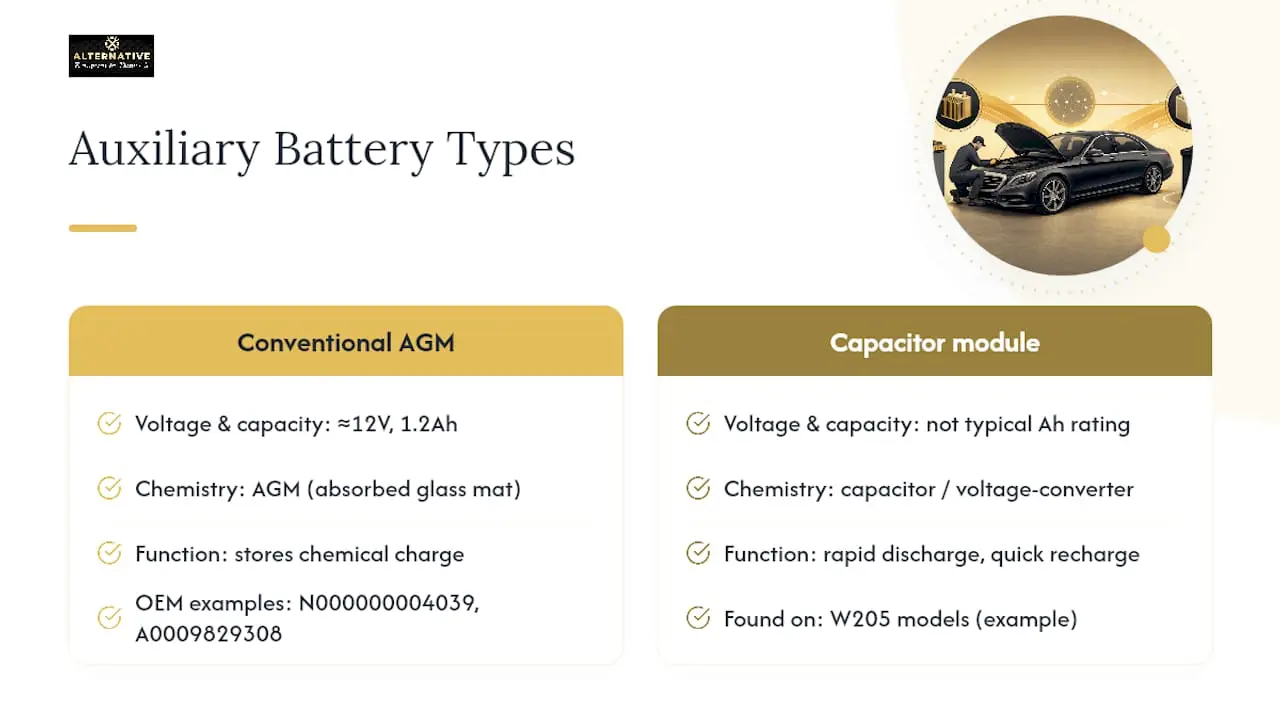
Mercedes doesn’t use one universal auxiliary battery across the lineup, which trips up a lot of owners shopping for a replacement part. The hardware falls into two broad categories: conventional small-format AGM batteries, and capacitor or voltage-converter modules that perform a similar function without storing charge the same way.
Conventional auxiliary batteries are commonly rated around 12V and 1.2Ah, with OEM references including part numbers like N000000004039 and A0009829308 appearing across various platforms. AGM chemistry is standard here because it tolerates the frequent shallow charge cycles that start/stop driving demands, something a standard flooded lead-acid cell handles poorly over time.
Capacitor-based systems, found on models like the W205, work differently. Rather than storing chemical energy, a capacitor discharges rapidly to bridge the momentary gap during engine restart, then recharges just as quickly. These modules are compact, and confusing one for a standard battery when sourcing a replacement part is a common and avoidable mistake.
On OEM versus aftermarket, matching the original part number is the safer path for auxiliary components specifically. These units are tightly integrated with the vehicle’s energy management system, and a mismatched capacity or charging profile can trigger recurring fault codes even when the part physically fits. If you’re unsure which type your vehicle uses or which specification applies, that’s a reasonable question to bring straight to a technician rather than guess from a parts catalog.
How Auxiliary Battery Failure Affects Your Mercedes
A failing auxiliary battery doesn’t usually strand you the way a dead main battery does, but it chips away at features you rely on daily. The start/stop system is typically the first casualty, since it depends on stable auxiliary voltage to manage the engine shutoff and restart cycle without a noticeable lag or stumble. Once that voltage becomes unreliable, the system often disables itself automatically as a protective measure.
Comfort electronics take the next hit. Memory seat positions, climate control responsiveness, and COMAND or infotainment displays can reset, freeze, or flicker, particularly right around the moment the engine restarts at a stop. It’s more of an annoyance than a safety issue at this stage, but it’s a clear sign the underlying fault is getting worse rather than resolving on its own.
The more serious concern involves systems tied to safety and emergency function, including certain alarm features and the electronic gear shifter and park lock actuator on some models. These don’t fail dramatically, but a marginal power supply increases the odds of an intermittent glitch at exactly the wrong moment. This is the core reason a short drive to a shop is generally fine, while extended driving on a known fault isn’t a great gamble.
Our Take: When to DIY and When to Call a Specialist
Most owners can handle the basic triage: check for a dashboard warning, glance at accessible fusing, and note whether start/stop has disabled itself. That’s useful information, and it costs nothing. Where we see owners get into trouble is assuming a fresh auxiliary battery automatically clears the fault. It often doesn’t, because a struggling DC/DC converter or uncleared adaptation data can keep the warning lit even after a correct part swap.
We use dealer-level diagnostics to isolate whether the real problem is the battery, the converter, a relay, or a wiring fault before recommending any repair. After replacement, we test converter output directly and clear the adaptation values properly, since skipping that step is the most common reason customers come back with the same warning weeks later. During a diagnostic visit, expect a full inspection, voltage and load testing, and a plain explanation of what we found before any work begins.

Book a Mercedes Auxiliary Battery Diagnostic in Dallas
If your Mercedes threw an auxiliary battery warning, guessing at parts wastes time and money. Alternative European & Domestic runs full voltage testing, reads and clears the actual fault codes behind the warning, and replaces the unit with OEM-spec parts when the diagnosis calls for it, followed by post-repair verification to confirm the fix actually held.

Mercedes electrical systems are tightly integrated, which is exactly why a battery light appearing while driving deserves more than a generic parts-store scan. Our team pulls actual voltage numbers and converter data instead of swapping parts on a guess, so you’re not paying twice for the same repair. If the dashboard warning has been sitting there for a week or a month, schedule a diagnostic appointment with our team and get a straight answer on what’s actually failing.
Sources
For deeper OEM walkthroughs and diagnostic detail beyond this guide, the W211 auxiliary battery replacement procedure from Pelican Parts covers terminal safety and relay inspection in detail. Always confirm exact part numbers and steps against your specific model’s manual or with a qualified technician.
- Auxiliary battery malfunction Mercedes: Causes & easy fixes
- Auxiliary Battery Malfunction Mercedes: Causes & Easy Fixes — YouCanic
- How To Replace A Mercedes-Benz W205 Auxiliary Battery | FCP Euro
FAQ
What Does the Auxiliary Battery Do in a Mercedes-Benz?
It’s a secondary 12V power source that stabilizes voltage for systems like start/stop, infotainment, and the electronic gear shifter during moments the main battery alone can’t keep up.
Can I Drive My Mercedes With an Auxiliary Battery Malfunction?
Short trips are usually fine, but extended driving with the fault unresolved puts added stress on the charging circuit and related electronics, so get it diagnosed promptly.
What Happens if an Auxiliary Battery Dies?
Comfort features like memory seats and infotainment may reset or glitch, start/stop typically disables itself, and in some models the electronic shifter or park lock actuator can behave unpredictably.
How Much Does It Cost to Replace a Mercedes Auxiliary Battery?
Shop cost typically runs between $250 and $450 for parts and labor, though a failing converter or relay found during diagnosis can raise that figure.