
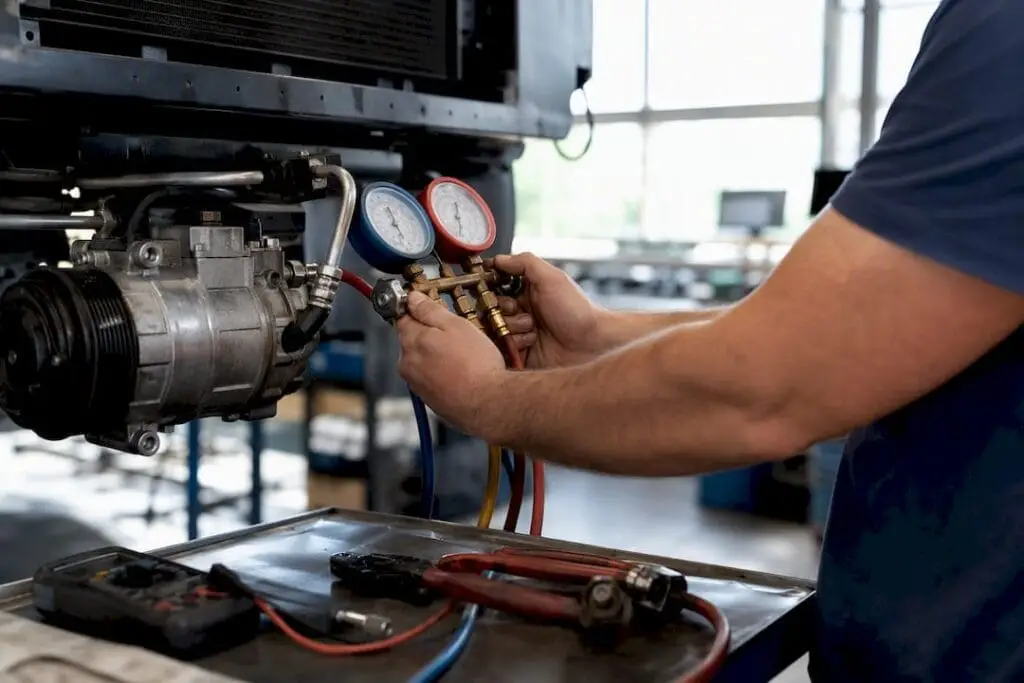
Your car’s A/C isn’t cold because of one of three things: a refrigerant leak, a heat rejection or airflow problem, or a compressor and control fault. The instinct to top off refrigerant at a parts store is the wrong first move. Adding refrigerant without finding the leak first is the most common diagnostic mistake in the business, and it usually just masks the real problem until the system fails again, often worse.
The right first step is a technician-run diagnostic that measures the system instead of guessing at it.
- If cooling drops off at idle but returns at speed, that points to airflow or condenser trouble, not necessarily a leak.
- If cooling has faded gradually over months, that’s a slow leak.
- If the compressor is making noise or cycling oddly, don’t run the system further. Book a diagnostic before you drive it much more.
Key Takeaways
Fixing an A/C that isn’t cold starts with finding the specific failed component through gauge pressure, leak detection, and airflow checks, not with adding refrigerant and hoping.
| Point | Details |
|---|---|
| Diagnose before recharging | A refrigerant top-off without leak repair almost always fails again within weeks or months. |
| Match symptom to cause | Cold at speed but warm at idle usually points to condenser airflow, not low refrigerant. |
| Leave refrigerant to certified techs | EPA Section 609 requires certification to purchase and handle refrigerant legally and safely. |
| Expect a written diagnosis | A legitimate shop gives you pressure readings, leak evidence, and a specific failure report before repairs. |
| Choose measurement-led service | Alternativecarcare diagnoses with manifold gauges and leak detection, then documents findings before recommending repairs. |
Table of Contents
- Auto AC Not Cooling at Idle: The Diagnostic Workflow
- What Usually Causes Weak or Warm AC
- Should You Check Anything Before Calling a Shop?
- What Happens Once You’re at the Shop
- How a Dealer-Level Shop Approaches AC Diagnosis
- The Recharge Trap Is the Real Problem Here
- Book a Measurement-Led AC Diagnostic With Alternativecarcare
- Frequently Asked Questions
- Sources
Auto AC Not Cooling at Idle: The Diagnostic Workflow
A shop that knows what it’s doing doesn’t start with a refrigerant can. It starts with questions and gauges. Here’s the sequence a competent technician actually runs, and what each step tells them.
- Confirm the symptom. They’ll check your fan settings, recirculation mode, actual vent temperature with a thermometer, and whether the problem shows up at idle, at speed, or both. Noises during compressor engagement get noted here too.
- Read the pressures. Manifold gauges hook into the low and high side service ports and show whether the system is undercharged, overcharged, or restricted. Low pressure on both sides usually means low refrigerant. High head pressure with weak cooling often points to a condenser or airflow issue.
- Check airflow. That means pulling the cabin air filter, testing blower output at each speed, and confirming the condenser fan spins and isn’t buried in road debris.
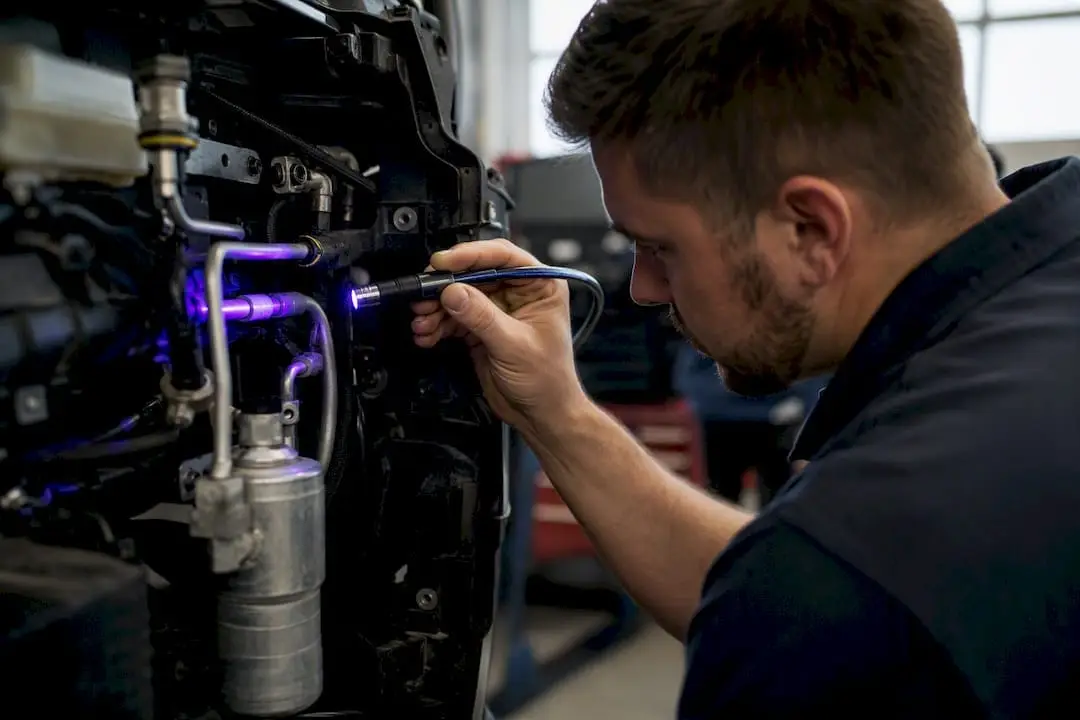
- Hunt for leaks. Techs look for visible oil residue first, then add UV dye that fluoresces under a blacklight at the leak point. An electronic refrigerant sniffer picks up vapor at fittings and seals a dye trace might miss. Stubborn or intermittent leaks sometimes need a nitrogen pressure test to isolate.
- Scan the electrical side. Fuses, relays, the low and high pressure switches, and the compressor clutch command all get checked against stored HVAC fault codes.
- If the system gets opened, it gets pulled into a vacuum for roughly 60 to 90 minutes depending on ambient temperature, which draws out moisture and reveals slow leaks before anyone adds refrigerant. A contaminated receiver/drier gets replaced, the system gets flushed if debris turns up, and it’s recharged to the exact weight and lubricant spec the manufacturer calls for, not a generic “top it off” amount.
Pro Tip: Ask whether your shop pulls a vacuum and holds it before recharging. A system that won’t hold vacuum has a leak they haven’t found yet, and charging it anyway just wastes refrigerant and your money.
What Usually Causes Weak or Warm AC
Symptoms map to causes more predictably than most drivers assume. A sound diagnosis separates the problem into four buckets: how much refrigerant is actually in the system, how well the system is rejecting heat, whether something is restricting flow, and whether the electronics are telling the compressor to run at all.
- Low refrigerant from a leak. A slow leak fades cooling over weeks or months. A sudden leak, often from a failed hose or fitting, kills cooling almost overnight. Recharging without repairing the leak just buys you a few weeks before it’s warm again.
- Compressor or clutch failure. A grinding or clicking noise on startup, a clutch that won’t engage, or metal contamination in the lines from a seized compressor turns a moderate repair into a system-wide flush.
- Condenser airflow problems. The classic “cold at speed, warm at idle” pattern usually traces back to a condenser fan that isn’t running or a condenser caked in debris, since idle speed relies entirely on the fan to move air across it.
- Expansion valve or orifice tube restriction. A clogged expansion device starves the evaporator, and you’ll often see ice forming on the evaporator or low side line, followed by warm air once it freezes over.
- Cabin-side issues. A clogged cabin filter or a weak blower motor can mimic a refrigerant problem. So can a blend door actuator stuck partway toward heat.
- Electrical faults. A blown fuse, a failed pressure switch, or a compressor that never gets the command to engage will leave a fully charged system blowing warm.
Roughly half of drivers only discover an A/C problem once summer heat exposes it, which is exactly why intermittent faults get ignored until they aren’t intermittent anymore.
Should You Check Anything Before Calling a Shop?
A few checks are safe to do yourself and can save you a diagnostic fee if the fix turns out to be simple.
- Pull the cabin air filter and look at it. If it’s packed with debris, replace it and see if airflow improves.
- Pop the hood and clear visible leaves or debris from the condenser, then confirm the condenser fan spins when the A/C is switched on at idle.
- Double-check you’re not accidentally in a fresh-air mode that’s pulling in hot outside air, and that recirculation is on.
- If none of that changes anything, or if you hear hissing, smell refrigerant, see oily residue anywhere in the engine bay, or notice compressor noise, stop troubleshooting and book a diagnostic.
Refrigerant handling itself isn’t a DIY project, and not just for convenience reasons. Under EPA Section 609, only certified technicians can legally purchase and handle refrigerant, because it’s regulated for environmental and safety reasons. Store-bought recharge cans and stop-leak additives also carry real risk: they can contaminate the system and gum up the expansion device, turning a $400 repair into a much bigger one.
What Happens Once You’re at the Shop
Expect the diagnostic itself to take somewhere between 30 and 90 minutes, depending on how straightforward the symptom is and how deep the technician needs to go to isolate it. That diagnostic fee covers real instrument time: gauges, leak detection equipment, and a scan tool, not a guess.
From there, repair paths generally fall into a few categories: sealing or replacing a leaking hose or fitting, swapping a failed compressor or condenser, flushing a contaminated system and replacing the receiver/drier, or a full evacuation and recharge once a repair is made. Typical A/C repair costs land somewhere between $384 and $445, though that range swings wider for European and high-performance vehicles, where compressors, condensers, and specialty refrigerant or lubricant specs simply cost more and take longer to source.
- Ask for the pressure readings, not just a verbal summary.
- Ask to see UV photos if a leak was found with dye.
- Ask for a written report that ties the parts and labor to a specific failure.
Pro Tip: A shop that hands you a written diagnostic with pressure numbers and photos is doing what a good report should look like: naming the failed part before it names a price.
How a Dealer-Level Shop Approaches AC Diagnosis
Alternativecarcare treats A/C work the same way it treats any electrical or engine diagnostic: with instruments, not guesswork. The shop’s toolkit includes manifold gauges, UV dye and electronic leak detection, and dealer-level scan tools that read compressor command and HVAC fault codes directly from the vehicle’s control modules.
- Every diagnostic ends in a written report naming the failed component, not a generic recharge invoice.
- Parts selection and replacement decisions get explained before any work starts, including why a receiver/drier or evacuation is or isn’t needed.
- Customized maintenance plans catch slow leaks and worn seals early, which matters most on European and high-performance vehicles where A/C components are expensive to replace after the fact.
A system that’s been recharged three times in two years hasn’t been fixed three times. It’s been patched three times. The difference between those two things is a leak someone never actually found.
The Recharge Trap Is the Real Problem Here
Most advice about a warm A/C jumps straight to “get it recharged,” and that’s exactly backward. Refrigerant is not a consumable like oil. A properly sealed system doesn’t lose charge over time, so if yours is low, something let it out, and adding more without finding that leak is just paying twice for the same problem.
The conventional wisdom treats A/C work as a commodity service: quick, cheap, done in twenty minutes at a parts counter. That framing works for topping off windshield washer fluid. It doesn’t work for a sealed, pressurized system with a compressor, an expansion device, and electronics all depending on each other to function.
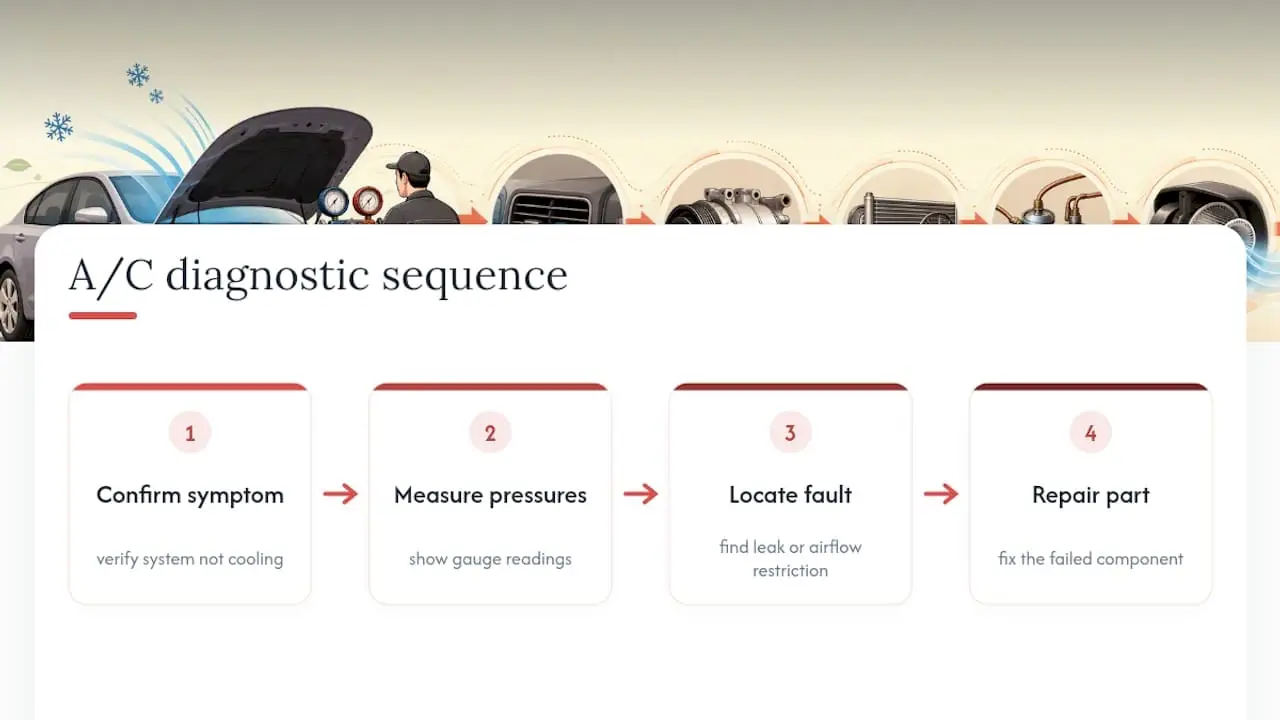
What actually matters is sequence. Confirm the symptom, measure the pressures, find the leak or the airflow restriction, then repair the specific thing that failed. Skip the sequence and you’re gambling on whether the next hot week brings the problem back. A shop willing to show you gauge readings and UV photos before quoting a repair is telling you something about how it works, not just what it charges.
Book a Measurement-Led AC Diagnostic With Alternativecarcare
If your A/C is blowing warm and you’re tired of guessing whether it’s a leak, a bad compressor, or something electrical, Alternativecarcare runs the exact diagnostic sequence this article just walked through, using manifold gauges, UV dye and electronic leak detection, and dealer-level scan tools built for European, domestic, and high-performance vehicles.

The difference shows up in the paperwork. Instead of a blanket recharge invoice, you get a written report naming the specific failed component, with pressure readings and leak evidence to back it up, before any repair gets approved. For European and performance vehicles especially, where parts and labor run higher and system complexity punishes guesswork, that upfront diagnosis is what keeps a $400 repair from turning into three repeat visits. Alternativecarcare also builds customized maintenance plans that catch slow leaks and worn seals before they leave you stranded in July traffic with no cold air.
Schedule an A/C diagnostic with Alternativecarcare and get a straight answer on what’s actually wrong before anyone touches a refrigerant can.
Frequently Asked Questions
Why is my AC blowing warm air at idle but cold while driving?
That pattern almost always points to a condenser airflow problem. At speed, air moving through the grille helps cool the condenser even if the fan is weak. At idle, the fan has to do all the work, so a failing fan motor or a debris-clogged condenser shows up specifically at idle.
Can I just recharge my car’s AC myself?
You can buy a recharge can, but it’s rarely a real fix. If your system is low, refrigerant escaped through a leak, and adding more without repairing that leak just delays the problem while risking contamination from stop-leak additives. Refrigerant purchase and handling for vehicle systems is also restricted to EPA Section 609 certified technicians.
How much does it typically cost to fix a car AC that isn’t cold?
Typical repairs run roughly $384 to $445, though the exact cost depends on which component failed and your vehicle. European and high-performance vehicles often run higher due to parts availability and system complexity.
How long does an AC diagnostic take at a shop?
Most diagnostics take 30 to 90 minutes, depending on how quickly the technician can isolate the cause. A system that needs to be opened for a leak repair, flush, or evacuation adds more time beyond the initial diagnostic.
What’s the difference between a slow leak and a sudden refrigerant leak?
A slow leak causes cooling to fade gradually over weeks or months as the charge slowly drops. A sudden leak, usually from a failed hose, fitting, or seal, can knock out cooling almost overnight because the system loses pressure fast.
Sources
- ConsumerAffairs — Cost of car AC repair
- Kelley Blue Book — Car A/C repair costs
- AutoZone — Diagnosing car AC problems
- Motronix — Automotive climate control systems (A/C logic & failures)