
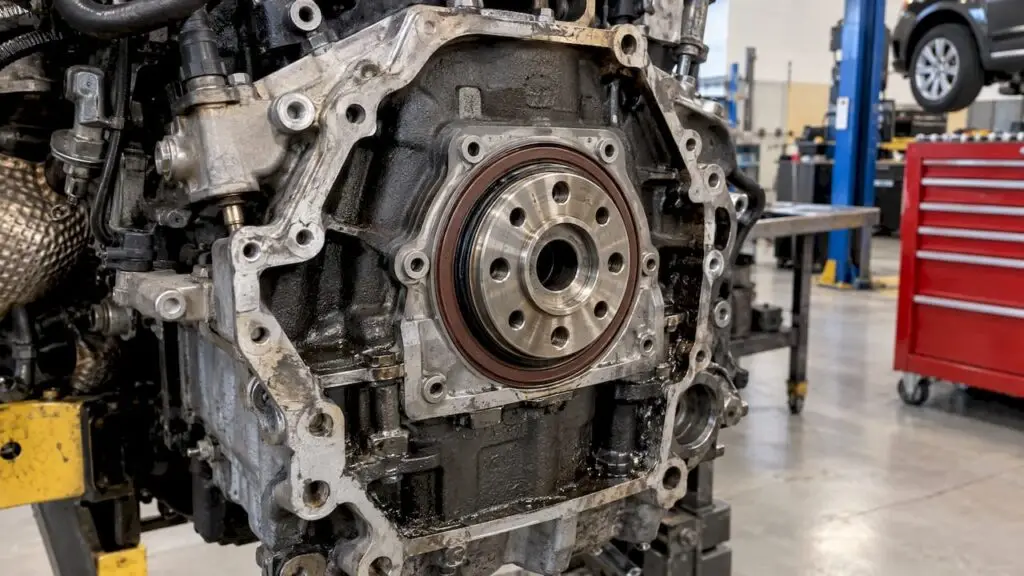
A rear main seal leak is oil seeping from the seal where the crankshaft exits the back of the engine, between the engine and the transmission. The usual signs are oil dripping from the bell housing area, a film of oil on the underside of the engine or transmission, and an oil level that keeps dropping. Many other leaks mimic it, so the seal should be confirmed by a technician before anyone removes a transmission. At Alternative European & Domestic, we confirm the source first, then repair it.
TL;DR
- The rear main seal sits at the back of the crankshaft. When it leaks, oil shows up where the engine meets the transmission, and the oil level slowly falls.
- Oil in that area does not prove the seal is the cause. Oil can run down from the oil-pan joint, rear cover or valve cover, so the source has to be traced before a repair is approved.
- A small seep with a stable oil level can wait for an inspection. A rapid leak, a significant drop in oil level or a lit oil-pressure warning means stop driving.
- The repair is mostly labor, because the transmission and flywheel come out. Cost depends on the vehicle, the shop’s labor rate and what else is done while the transmission is out.
- Dallas drivers can bring a suspected leak to Alternative European & Domestic for a diagnostic evaluation.
Table of Contents
- What the rear main seal does
- Rear main seal leak symptoms
- Oil between the engine and transmission is not always the rear main seal
- How a technician confirms a rear main seal leak
- Why a rear main seal fails or starts leaking suddenly
- Can you keep driving with a leak?
- Can a stop-leak additive fix it?
- Rear main seal replacement: what the job involves
- What affects the cost
- Is it worth fixing?
- Preventing the next leak
- Get it checked in Dallas
- FAQ
- Sources
What the rear main seal does
The crankshaft turns inside the engine block, and at its rear end it passes through the block to connect to the flywheel or flexplate. The rear main seal closes that opening. It keeps pressurized engine oil inside while the shaft spins thousands of times a minute.
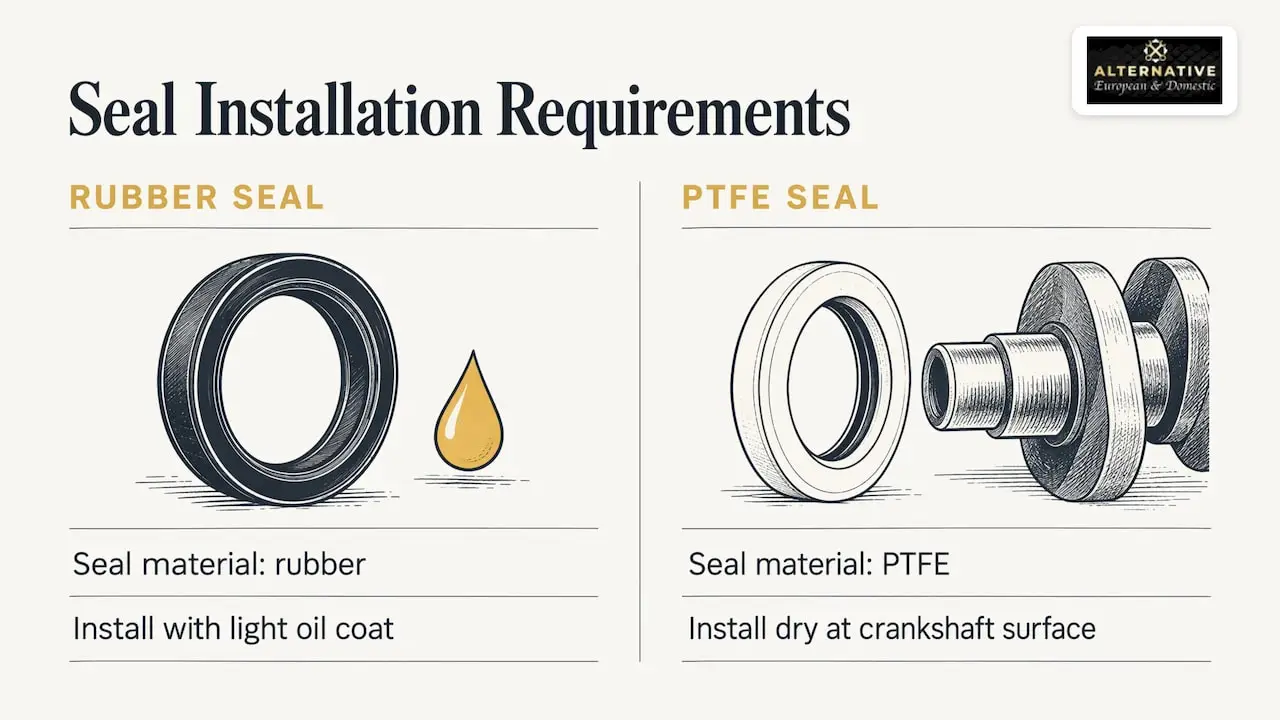
On most modern engines this is a single ring-shaped seal. One-piece rear main seals became standard on or around the 1986 model year, and the design has stayed in use on European, domestic and performance engines since. The seal is rubber or PTFE (a slick, heat-resistant polymer). The two types are installed differently: a rubber seal gets a light coat of oil, while a PTFE seal goes on dry at the crankshaft sealing surface. Details like this are why the job is worth giving to a technician who works from the correct procedure for your engine.
Rear main seal leak symptoms
The signs below are the ones owners notice first. None is conclusive alone.
- Oil spots under the rear of the engine. The drip usually lands near the middle of the car, toward the front of the transmission.
- Oil residue on the underside of the engine or transmission housing. Wet, dirty film around the bell housing is a common sign.
- A falling oil level. If you add oil between changes more often than you used to, oil is going somewhere.
- Burning-oil smell. Oil that reaches hot exhaust or driveline parts can smoke and smell. That can also come from higher leaks, so it narrows nothing down.
- Clutch slip on manual cars. Oil that reaches a manual-transmission clutch can make it slip.
On a Dallas commuter that sits in Central Expressway or Oak Lawn traffic, heat cycles and stop-and-go driving keep seals and gaskets working hard, so a slow seep can turn into a visible drip over a season. Parking on a clean driveway or garage floor and checking it once a week is a simple way to catch it early.
Oil between the engine and transmission is not always the rear main seal
This is the most common mistake in diagnosing the leak. Oil travels. A leak higher on the engine runs down the block and collects at the lowest point, which is the joint between the engine and transmission. Oil near that joint does not by itself prove a rear main seal failure. Common look-alikes include:
- Valve cover gasket. A leak at the top of the engine can run down the back of the block. See our valve cover gasket leak triage for how to tell smoke from fast oil loss.
- Oil-pan gasket or rear cover. These sit close to the seal and drip in a similar place.
- Oil filter housing or adapter, and sensors. Common on several European engines.
- Transmission fluid. Fluid from the transmission front seal or pump can also collect in the same area. Fluid color and smell help separate it from engine oil.
If your car is a BMW, our guide to BMW oil leak causes lists the usual sources before anyone looks at the rear seal. For cars that also lose oil without an external leak, Audi oil consumption and BMW N63 oil consumption cover a different problem that can be mistaken for a leak.
How a technician confirms a rear main seal leak
The goal is to prove where the oil starts, not where it ends up. A sound diagnostic process looks like this:
- Identify the fluid. Engine oil, transmission fluid, power steering fluid and coolant look different and are treated differently.
- Clean the area. A degreased engine and bell housing show new oil clearly. Old, caked oil hides the real path.
- Run the engine and look for the highest point of fresh oil. The source is at the top of the wet trail, not the bottom.
- Rule out higher leaks. Valve covers, the oil-pan joint, filter housings and the PCV system are checked first.
- Use UV dye when the trail is unclear. A dye in the oil and a UV light can trace the path through a slow seep.
- Check the engine side of the flywheel or flexplate. Oil there is the strongest evidence of a seal leak, because oil on the engine side of the flywheel points to the seal rather than a higher source.
- Recheck after a drive. A short test drive and a second inspection confirm whether the leak is fresh and where it is coming from.
The reason this matters: the repair means removing the transmission. Doing that for a leak that turns out to be a valve cover gasket is expensive and unnecessary. Our technicians are ASE-certified and the same discipline applies to our engine repair work: find the source, show you the evidence, then quote. If you want to know what to ask any shop before you approve work, see our list of questions to ask a mechanic.
Why a rear main seal fails or starts leaking suddenly
Seals wear with age and heat, and the rubber hardens. But age is not the only cause, and a seal that was fine for years can let go quickly. The usual causes are:
- Normal wear and hardening. Heat cycles harden the sealing lip until it no longer follows the shaft.
- A worn or damaged crankshaft surface. A groove where the old seal rode can let oil past a new one.
- High crankcase pressure. A blocked or frozen PCV system, or excess blow-by from worn piston rings, can raise crankcase pressure and force oil past the seal, sometimes producing a sudden leak. One published case describes a frozen PCV system pushing the seal lips rearward.
- Installation and alignment problems. A cocked seal, a damaged lip, poor alignment, flexplate runout or excessive crankshaft endplay can all shorten a seal’s life.
This is also why a replacement seal sometimes fails early. If the cause was pressure or a damaged surface and only the seal is changed, the new one faces the same problem. A proper repair checks the crankshaft surface and the ventilation system, not just the part that leaked.
Can you keep driving with a leak?
It depends on how fast the oil is leaving. Use these as a practical guide:
| What you see | What it suggests | What to do |
|---|---|---|
| A few spots on the floor, oil level steady between changes | A slow seep | Schedule an inspection soon. Check the dipstick regularly. |
| Oil level dropping between changes, fresh oil on the underside | An active leak | Book a diagnostic evaluation this week and keep the oil topped up in the meantime. |
| Oil pooling quickly, or the level falling significantly | A rapid leak | Do not drive. Arrange a tow. |
| Oil-pressure warning stays on | Low oil pressure | Stop driving at once and call for a tow. |
The reasoning is simple. A small seep with a stable oil level may allow time to arrange an inspection, but running an engine low on oil or with low oil pressure can cause severe damage, and a repair that might have been a seal becomes an engine. If you are unsure, do not drive farther: towing to the shop costs far less than a damaged engine. On a manual car, oil on the clutch can cause slipping, which adds a clutch repair to the bill.
Do not crawl under the car or try to remove components yourself to look for the leak. Lifting a vehicle and working under a hot engine carries real risk, and the repair itself needs the transmission supported and removed.
Can a stop-leak additive fix it?
No additive can identify the leak source, and an additive cannot repair a mechanical fault such as a worn seal, a damaged crankshaft surface or a pressure problem. If the oil level is dropping, the safe step is a diagnosis. Topping up oil in the meantime is reasonable; it keeps the engine protected until the cause is confirmed.
Rear main seal replacement: what the job involves
The seal itself is an inexpensive part. The work is the access. Replacement involves removing the transmission and flywheel, and in some cases the engine itself. In outline:
- Support the vehicle and drain fluids as needed.
- Remove driveline components, then the transmission (and transfer case or driveshaft where fitted).
- Remove the clutch or torque converter, then the flywheel or flexplate.
- Inspect the crankshaft sealing surface, the seal bore and the rear cover for damage.
- Install the new seal using the correct tool and method for its material, rubber or PTFE.
- Reinstall the flywheel or flexplate, clutch and transmission to specification.
- Refill, run the engine, and recheck for leaks.
On all-wheel-drive and transverse European engines, getting to the seal can mean removing subframes, axles or more, which is part of why labor varies so much between models. The one-time access is also an opportunity: parts that are hard to reach otherwise, such as a worn clutch or a leaking transmission front seal, can be addressed at the same time. Our transmission repair and service team handles that side of the job, so the engine and transmission work is planned together.
What affects the cost
There is no single price, because labor is the dominant cost and the hours differ by vehicle. One widely cited estimate puts most replacements between $650 and $1,500, with the range depending on vehicle type and shop labor rates. Performance and European cars with tight engine bays, all-wheel drive or dual-clutch gearboxes often fall toward the upper end or beyond.
The factors that move an estimate:
- Drivetrain layout. Front-, rear- and all-wheel drive need different amounts of disassembly.
- Transmission type. Manual, automatic and dual-clutch units differ in how they come out.
- Related work done while the transmission is out. A clutch replacement may be done at the same time, which adds parts but avoids paying for the same labor twice.
- Condition of the crankshaft surface and rear cover. Damage found on inspection can change the scope.
- Whether the real source is a higher leak. A valve cover or oil-pan gasket repair costs much less, which is the reason the diagnosis comes first.
We do not publish a flat price for this repair, because an honest quote depends on your car and the confirmed cause. You will get the estimate and the reasoning in writing before work starts.
Is it worth fixing?
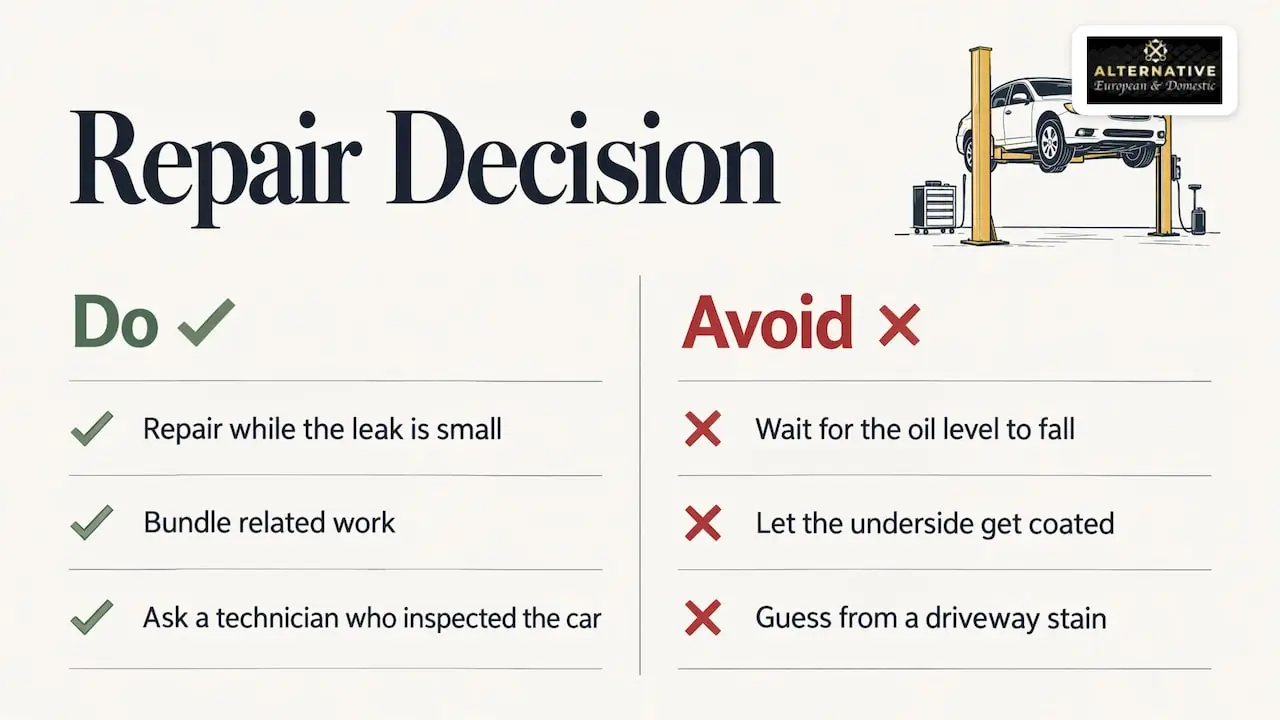
For most drivers who plan to keep the car, yes. A leak that is small today is the most predictable moment to repair it: you choose the date, bundle related work and avoid a tow. Waiting usually means the oil level falls further, the underside gets coated and the leak becomes harder to separate from others. On a European or performance car you intend to keep for years, a confirmed leak repaired on schedule protects the engine and the clutch or transmission.
If the leak is slow and the car is old, the decision is about how long you keep it and what else the transmission removal could cover. That is a conversation worth having with a technician who has looked at the car, not a guess made from a driveway stain.
Preventing the next leak
You cannot make rubber seals last forever, but you can remove the things that shorten their life:
- Keep to the oil-change schedule your manufacturer sets for your engine, using the specified oil. Our oil change and engine lubrication service follows that approach.
- Have crankcase ventilation checked when oil consumption, smoke or leaks appear together, since pressure is a documented cause of sudden leaks.
- Fix small leaks early, before oil coats other components.
- Follow a maintenance plan built around your car’s mileage and use. Our maintenance service includes customized plans aimed at longevity and reliable performance.
- Check the dipstick regularly, especially before long trips.
Get it checked in Dallas
If you see oil between the engine and transmission, Alternative European & Domestic provides dealer-level diagnostics for European, domestic and high-performance vehicles. Our ASE-certified technicians trace the leak to its source, tell you what they found and explain the repair options before work begins. Qualifying repairs are backed by our 24-month/24,000-mile warranty, subject to applicable terms.

Whether you drive in from Oak Lawn, Uptown or elsewhere in Dallas, contact Alternative European & Domestic through our website to schedule a diagnostic evaluation, or see our full list of services. If the oil-pressure light is on or oil is pouring out, do not drive in: arrange a tow.
FAQ
How do I know if I have a rear main seal leak?
Look for oil at the back of the engine where it meets the transmission, an oily film on the underside of the bell housing and an oil level that keeps dropping. Because higher leaks can run down to the same spot, a technician should confirm it by cleaning the area, tracing the highest fresh oil and checking the engine side of the flywheel or flexplate.
What is an oil leak between the engine and transmission?
It is oil showing at the joint where the two units bolt together. The rear main seal is one possible source, but the oil-pan gasket, rear cover, valve cover and transmission seals can all produce the same sign. Identifying the fluid and the highest point of the leak decides which repair is needed.
Why does a rear main seal replacement cost so much?
The seal is cheap, but reaching it requires removing the transmission and flywheel, and sometimes the engine. That is many hours of labor. The final figure depends on your vehicle, the shop’s labor rate and any related work, such as a clutch, done while the transmission is out.
Can I drive with a leaking rear main seal?
A small seep with a steady oil level can allow time to arrange an inspection, and you should check the dipstick often. If oil is leaking fast, the level drops significantly or the oil-pressure warning stays on, stop driving and have the car towed, since low oil can cause severe engine damage.
Sources
- Rear Main Seal Leak: Symptoms, Causes & Replacement Cost, MechanicBase
- Rear Main Seal Replacement, Underhood Service
- Pop Goes the Rear Mainseal, Vehicle Service Pros
- Rear Main Seal Installation Tech Tips, Fel-Pro
- Rear Main Seal Replacement: 6 to 10 Hours, HowLongFor