

The most common causes of a BMW oil leak are aging gaskets and seals: the valve cover gasket, the oil filter housing gasket, the oil pan gasket and the crankshaft seals. Heat cycles harden rubber and silicone over time, and oil then seeps out at the joint. A light film of oil is not always a leak. Wet oil, drips or a falling oil level are. At Alternative European & Domestic, we diagnose the exact source before recommending a repair, because oil spreads across an engine and the highest wet spot is rarely the true origin.
TL;DR
- Most BMW oil leaks come from the valve cover gasket, the oil filter housing gasket, the oil pan gasket or the crankshaft seals.
- BMW’s own bulletins separate light “sweating” from an active leak: pooling, dripping or spotting needs repair.
- On N52 and N54 engines, a leaking oil filter housing can damage the serpentine belt and, in the worst case, the engine.
- Do not drive with a low oil warning, oil on the belt, or oil dripping onto the exhaust. Have the car towed.
- A proper diagnosis finds the source and the underlying cause before parts are replaced.
Table of Contents
- Why BMW engines develop oil leaks
- The five most common BMW oil leak sources
- Is it a real leak or normal sweating?
- How a BMW oil leak is diagnosed
- Can you drive a BMW with an oil leak?
- What affects the cost of an oil leak repair
- Preventing BMW oil leaks
- Oil leak diagnosis and repair in Dallas
- FAQ
- Sources
Why BMW engines develop oil leaks
BMW engines run hot, and the gaskets and seals around them live in constant heat cycles. Valve cover gaskets and oil filter housing gaskets are rubber or silicone. Over thousands of heat cycles they harden, shrink and lose the compression that keeps oil inside. Technical write-ups on the valve cover gasket describe exactly this: the gasket becomes hard and can no longer seal the gap between the cover and the head. Dallas summers add to the thermal load on every under-hood component, though age and mileage matter more than climate alone.
Some leaks have a documented design or assembly cause. In March 2015 BMW issued a bulletin for N20 and N26 engines stating that loose cylinder head cover bolts cause oil leaks. The instruction was to retighten the bolts to 6 Nm and replace the gasket if the bolts were found loose. That is a useful reminder that the right fix is not always a new part. Sometimes it is a correct torque procedure.
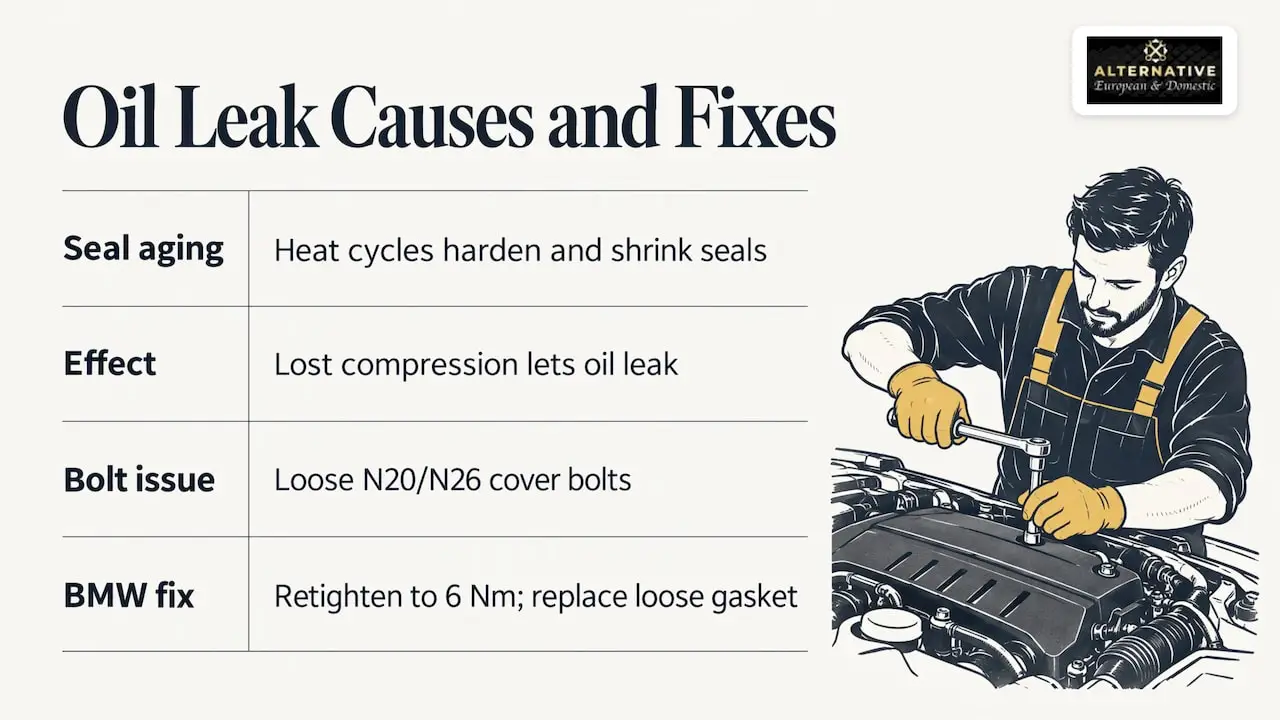
The pattern across models is simple: soft sealing materials age, and the repair is only durable when the cause behind the aging is addressed too.
The five most common BMW oil leak sources
| Source | Typical sign | Why it matters |
|---|---|---|
| Valve cover gasket | Oily film on top of the engine, burning smell | Oil can reach spark plug wells and coils |
| Oil filter housing gasket | Oil running down the side of the engine | On some engines it sits above the belt drive |
| Oil pan gasket | Drips from the bottom of the engine | Often found only on a lift |
| Crankshaft and camshaft seals | Oil near the front of the engine or bell housing | Access can be labor intensive |
| Turbo and oil feed lines | Oil residue around turbo connections | Affects turbocharged models |
Valve cover gasket
This is the leak most owners meet first. The gasket seals the cover to the cylinder head, and when it fails, oil weeps along the seam. The telltale signs are an oily film or dried residue on top of the engine, a burning oil smell when the engine is hot, and a slow drop in oil level.
On BMW inline-six engines, the leak often shows up around the spark plug wells. Pelican Parts’ E90 guide notes oil can enter the spark plug hole and contaminate the ignition coil, which is one way a gasket leak becomes a misfire.
The smell is a clue, not a diagnosis. Much of the oil burns off on the hot exhaust instead of pooling, so a leak can be well advanced before you see a drip. Our valve cover gasket leak triage guide walks through how to tell a slow seep from fast oil loss.
A gasket is not always the whole story. If the crankcase ventilation (PCV) system is clogged, cracked or has a failed diaphragm, crankcase pressure rises and pushes oil past new seals. A whistle or squeal at idle can point to a torn diaphragm in the valve cover rather than a gasket. A gasket-only repair on a car with a failing PCV system can leak again.
Oil filter housing gasket
The oil filter housing gasket is the other classic. The seal is silicone rubber that becomes brittle and compacted over time, as Tomorrow’s Technician reported. Oil then runs down the side of the engine and drips onto everything below it.
This one deserves attention because of where the housing sits. Gates Corporation’s technical bulletin explains that on 2006–2013 BMWs with N52 or N54 engines, the filter housing sits just above the belt drive. Leaking oil can cause the belt to be pulled through the crankshaft front oil seal into the engine. Shreds of belt can then reach the timing chain or oil pump, causing catastrophic damage.
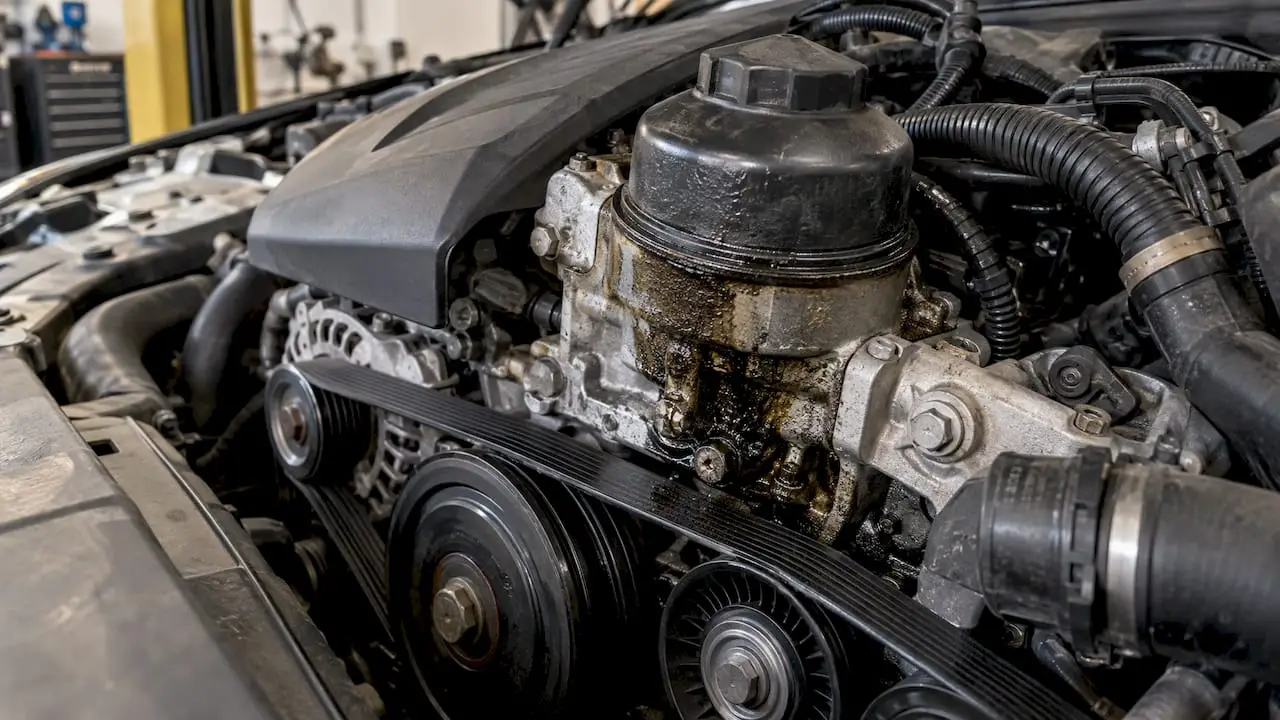
The cost contrast is striking. The Autopian reported that the gasket on N52, N54, N55 and S55 inline-six engines costs around $36, while a replacement S55 engine runs upwards of $22,000. Parts price is not labor price, so expect the repair bill to be larger than the gasket, but the point stands: this is a leak to fix early.
When the housing gasket is replaced, it makes sense to inspect the serpentine belt, tensioner and coolant flange at the same time. Tomorrow’s Technician recommends replacing the belt and tensioner with this job, since the belt may have been soaked in oil and the access is already open.
Oil pan gasket
The oil pan sits at the bottom of the engine, so leaks here show up as drips on the ground or a wet underside. Because oil from higher up also runs down to the pan, a wet pan does not prove the pan gasket is at fault. A technician cleans the area and traces the oil upward before condemning it. A loose or damaged drain plug, or a poorly seated plug washer after a previous service, can also leave oil at the pan.
Crankshaft and camshaft seals
Front and rear main seals and camshaft seals harden with age like gaskets do. A front seal leak puts oil near the belt area, while a rear seal leak shows up near the transmission bell housing and can be mistaken for a transmission leak. These repairs are labor heavy because of what has to come off to reach the seal, so confirming the source first saves money.
Turbo oil lines and other sources
Turbocharged BMWs have oil feed and return lines with their own seals and connections. Oil residue around the turbo is worth having inspected, especially if you also notice smoke or a loss of boost. Our guide to boost leak symptoms covers the pressure side of turbo problems.
Is it a real leak or normal sweating?
Not every trace of oil needs a repair. BMW’s own July 2014 service bulletin classifies light oil accumulation on the cylinder head cover gasket, oil filter housing and heat exchanger as normal sweating that does not require repair. Medium to large accumulation with pooling, dripping and spotting is an active leak and does require repair.
A practical way to sort it out:
- Light, dry residue with no drips and a steady oil level: likely sweating. Mention it at your next service and have it monitored.
- Wet, fresh oil on the seam or housing, or spots under the car: an active leak. Schedule a diagnostic.
- Oil level dropping between changes, burning smell, or smoke from the engine bay: treat as urgent.
Grime and oil left over from a previous service can make a clean engine look like it is leaking. Cleaning the area and rechecking is the fair test. If oil mist has settled on the paint or under the hood edge, a gentle two bucket wash method helps you remove it without marring the finish, and leaves a clean surface for spotting new oil.
How a BMW oil leak is diagnosed
Oil leaks are easy to see and hard to locate. Oil flows downward and gets thrown around by belts and airflow, so the wettest area is usually below the real source. Pelican Parts’ leak diagnosis article advises following the oil toward the cleaner area to find the origin, and suspecting the valve cover and crankshaft seal as sources that can fling oil around the engine.
A sound diagnostic process looks like this:
- Confirm the complaint. Oil level history, warning lights, smells, smoke and where the car is parked.
- Inspect on a lift. Check the top of the engine, the filter housing, the pan, the front and rear of the engine and the turbo area.
- Clean and re-run. Degrease the suspected area, run the engine to temperature and look for fresh oil appearing at a specific point.
- Use leak-tracing methods when needed. UV dye or a pressure check of the ventilation system helps with slow or hidden leaks.
- Check related systems. PCV condition, belt and tensioner condition, engine mounts and coolant connections that sit near the leak.
- Document it. You should leave knowing what is leaking, what caused it, what else was found, and what is urgent versus what can wait. Our list of questions to ask a mechanic is a good guide to what a clear estimate should include.
This is why professional diagnostics matter. Replacing a gasket that is not the source wastes money, and fixing a gasket without addressing crankcase pressure invites a repeat.
Can you drive a BMW with an oil leak?
It depends on how fast the oil is leaving and where it is going.
Short, careful driving to a shop may be acceptable when the leak is slow, the oil level is confirmed full, and no warning light is on. Check the dipstick or oil level display first.
Do not drive the car when any of these apply:
- The low oil pressure or oil level warning is on.
- The level is below the minimum mark and you cannot top it up safely.
- Oil is dripping onto the exhaust, producing smoke or a strong burning smell.
- Oil is visibly on the serpentine belt or around the belt drive, particularly on N52 and N54 engines where the filter housing sits above it.
- You hear belt noise, squealing, or the charging or power steering warnings appear.
In these cases, towing is the sensible choice. A tow is far cheaper than an engine. Gates recommends inspecting the belt drive at 60,000 miles and replacing worn components by 90,000 miles, or as the manufacturer recommends, on these 2006–2013 engines, so ask about belt condition if your car is in that range.
What affects the cost of an oil leak repair
We do not publish fixed prices for oil leak repair, because the estimate depends on the diagnosis. These are the main factors:
- Which component is leaking. A valve cover gasket and a rear main seal involve very different labor.
- Engine and model. Access varies widely between inline-six, turbocharged four-cylinder and V8 layouts.
- Related parts. Belts, tensioners, spark plug tube seals, ignition coils or PCV components may be recommended while the area is open.
- Collateral damage. Oil-soaked belts, hoses and mounts may need replacement. Our article on engine mount failure explains how oil can affect rubber mounts.
- How long the leak has run. Early repairs are usually simpler.
Ask for the estimate in writing, separated into the leak repair and any recommended extras, so you can decide what to do now and what can wait.
Preventing BMW oil leaks
You cannot stop rubber from aging, but you can slow the damage and catch leaks early:
- Follow a sensible oil service schedule with the correct specification oil. Our oil change and engine lubrication service uses the oil level and a visual check of the engine as part of the visit.
- Check the oil level between services. A slow drop is often the first warning.
- Have the engine looked over at every service. Early seepage at the valve cover or filter housing is far easier to manage than a leak onto the belt.
- Replace the belt and tensioner on schedule, especially on engines where the filter housing is above the belt drive.
- Keep the cooling system healthy. Overheating accelerates gasket aging. See our guide to BMW coolant leaks.
- Address model-specific issues. Owners of N20 engines should also read our N20 timing chain checklist, since oil condition and level affect the chain.
A customized maintenance plan built around your car’s mileage and use, whether that is Oak Lawn commuting or weekend driving, keeps these checks on a schedule instead of leaving them to chance.
Oil leak diagnosis and repair in Dallas
Alternative European & Domestic is a Dallas-area shop specializing in European, domestic and high-performance vehicles. Our ASE-certified technicians use dealer-level diagnostics to find where an oil leak starts, explain what caused it and tell you what is urgent. We aim to recommend only what the car needs, with clear communication at each step.
Qualifying repairs are covered by our 24-month/24,000-mile warranty, subject to applicable terms. Ask us what applies to your repair.

If your BMW has oil spots, a burning smell or a dropping oil level, our engine repair service is the place to start. Drivers in Uptown, Oak Lawn and across Dallas can schedule an appointment for a diagnostic evaluation.
FAQ
Are BMW oil leaks expensive to fix?
The cost depends on the source and how much work it takes to reach it. A valve cover or filter housing gasket is generally a smaller job than a rear main seal, which needs more disassembly. Related parts such as belts or spark plug tube seals can add to the total. A written estimate after diagnosis shows the real figure for your car.
Can I drive my BMW with an oil leak?
Only if the leak is slow, the oil level is confirmed full and no warning lights are on, and then only to get to a shop. Stop and call a tow if the oil warning appears, oil is on the belt or exhaust, or you see smoke. Driving low on oil can destroy an engine.
What is the most common BMW oil leak?
The valve cover gasket and the oil filter housing gasket are the most frequently reported sources. Both seals age from heat and become brittle or hard. On N52, N54 and N55 inline-six engines the filter housing leak in particular is widely documented.
Is a little oil residue on my BMW engine normal?
BMW’s service bulletin treats light, dry accumulation on the valve cover gasket and oil filter housing as normal sweating. Wet oil, pooling, dripping or spotting is an active leak that needs repair. If you are unsure, have a technician clean the area and check it again.
How do I find where my BMW is leaking oil?
Oil travels, so the lowest wet spot is rarely the source. A technician cleans the area, runs the engine and traces fresh oil upward on a lift, sometimes with UV dye or a ventilation pressure check. Do this professionally, since working around a hot engine and belts carries real risk.
Sources
- BMW N20 and N26 Engine: Oil Leaks from Cylinder Head Cover (NHTSA, 2015)
- BMW service bulletin on external engine oil leaks (NHTSA, 2014)
- Gates Tech Tip TT004-16: serpentine system maintenance
- The Autopian: neglecting a $36 gasket can destroy a BMW engine
- Tomorrow’s Technician: Aging Plastic Intake Components May Cause Leaks
- Pelican Parts: BMW oil leak diagnosis
- Pelican Parts: BMW E90 valve cover seal replacement
- The Track Ahead: valve cover gasket replacement, BMW E46